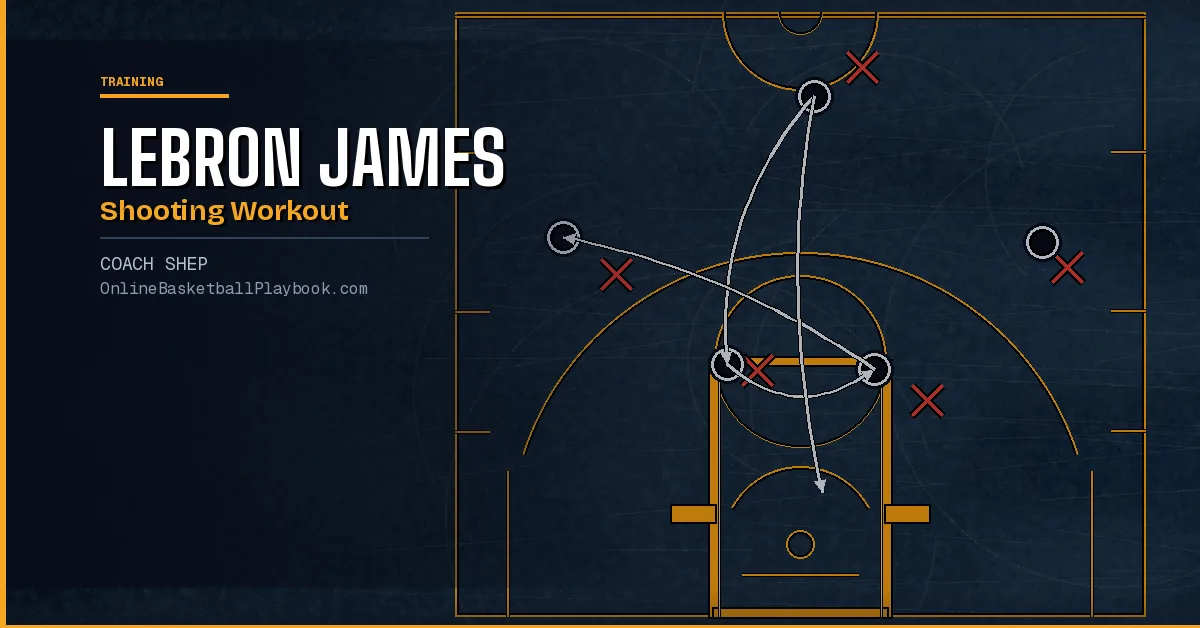
LeBron James became one of the most complete offensive players in NBA history by turning his shooting into a weapon, not through raw talent, but through purposeful, competitive reps that translated directly to games.
How LeBron Built His Shot
LeBron James entered the NBA in 2003 as a slashing, playmaking forward who averaged 5.5 three-point attempts per game in his first season and connected on just 29% of them. By 2020, he was shooting 36% or better from three on 5+ attempts per game. That transformation did not happen by accident. It happened because LeBron and his trainers committed to an off-season shooting routine grounded in the same principles that elite shooting coaches have preached for decades: form first, then volume, then competition.
The LeBron James shooting workout follows a simple philosophy. Start with one-handed form shots close to the basket. Build out to mid-range pull-ups. Expand to three-point catch-and-shoot opportunities off realistic game actions. Shoot free throws while fatigued, not fresh. Track everything. Compete against a number, not empty air.
His training sessions, documented by outlets like ESPN, Sports Illustrated, and the various trainers he has worked with over the years (Travelle Gaines, Mike Mancias, and others), reflect a consistent structure. Warm-up form work, footwork-based movement shooting, pull-up development, and high-volume three-point finishing. Every rep has a purpose. Nothing is aimless.
The Core Shooting Principles Behind the Workout
Understanding why LeBron's shooting workout works requires understanding the principles underneath it. These are not LeBron-specific ideas. They are principles that elite coaches, from Villanova's Jay Wright to Michigan's John Beilein to Rick Pitino at Louisville, have independently arrived at through decades of player development work.
Form Before Volume
LeBron's trainers consistently open sessions with close-range, one-handed form shots. The mechanics are intentional: balanced stance, elbow under the ball, wrist snap through the shot, follow-through held until the ball lands. Jay Hernandez, one of the most respected shooting trainers in the country, calls these "Quarters". Always start with one-handed form shots and progress from form work to a no-jump shot to a full jump shot before adding distance or movement. LeBron's warm-up follows the same ladder.
The reason is mechanical. A player who skips form work and goes straight to high-volume spot shooting is grooving bad habits at speed. Every rep becomes a rep of the wrong thing. Building clean mechanics at short range, where misses give instant feedback, creates a reliable foundation for everything that follows.
Train Game Shots, Game Spots, Game Speed
Kevin Eastman's framework is as clean as any in basketball: game shots, game spots, game speed. LeBron does not stand in one corner and fire thirty threes in a row. His workout cycles through the spots he actually shoots from in games, the left elbow, the right wing, the top of the key, the left corner, the right corner, and it initiates from game-real actions, not static stands. Catch off a DHO, pull-up off two dribbles to the right, step-back off a curl. The shot comes at the end of a realistic offensive sequence.
This matters because the brain trains pattern recognition along with mechanics. A player who only shoots off pure spot-up feeds will hesitate in a game when the shot comes off a ball screen. LeBron's workout builds the whole read, not just the release.
Every Rep Must Be Competitive
The most dangerous person in any gym, according to the shooting development literature, is the one who is continually improving, who competes against their own record every single day. LeBron's shooting sessions are structured around make-counts, time targets, and personal benchmarks. You are not done until you hit a number. Shaka Smart's Texas drill bank codified this with explicit records posted on the wall, 3-Minute shooting: need 100 makes, record 157. Beilein at Michigan set a timed standard: 7 makes out of 10 in 30 seconds coming off a down screen and flare. LeBron's workouts use the same competitive layer. Shooting without a scoreboard is just exercise. Shooting with a scoreboard is training.
The Workout Structure: Drill by Drill
Here is a workout template that mirrors the structure and philosophy of LeBron's documented training sessions, built on proven drill frameworks from elite shooting development programs.
Phase 1: Form Shooting (5–8 minutes)
Start three to five feet from the basket. One hand only, shooting hand under the ball, guide hand behind the back or at the side. Shoot 10 to 15 makes from the right side of the basket, then 10 to 15 from the left side. Focus entirely on the finish: full extension, wrist snapping through, fingers pointing down toward the rim at the follow-through. Progress to both hands, still close to the basket, with a simple two-foot jump. No movement yet.
Phase 2: Mid-Range Pull-Up Series (10 minutes)
The pull-up and the hesitation are what shooting development experts call "lost arts." A player who can pull up from 15 feet after two dribbles to the right, or hesitate and rise from the wing, is enormously valuable, arguably as valuable as a pure three-point shooter. LeBron has made the pull-up mid-range one of his signature weapons, particularly in the fourth quarter of playoff games.
Drill: Start at the top of the key with the ball. Two hard dribbles to the right, plant the inside foot, pull up from the right elbow. Reset. Two hard dribbles to the left, plant the inside foot, pull up from the left elbow. 10 makes from each side. Then add a hesitation: one hard dribble, stop, pump-fake, one gather step, pull up. 5 makes from each side.
Phase 3: Movement Shooting, Around the Horn (10 minutes)
Five spots: left corner, left wing, top of the key, right wing, right corner. Catch and shoot from each spot. The rule, taken directly from Shaka Smart's Texas drill bank: you cannot shoot from the same spot twice in a row, you must move. This forces players to reset their footwork and square up to the basket from a variety of angles, which mirrors what actually happens in games.
Target: 10 makes from each of the five spots before moving to Phase 4. Track how many shots it takes to get there. That number is your benchmark. Beat it next session.
Phase 4: Three-Point Competitive Shooting (10 minutes)
The Purdue Drill: a rebounder and a passer set up around the arc. The shooter sprints from the baseline to half-court and back, catches a pass on the wing, shoots a three, and sprints again. Goal: make 4 threes in one minute. Miss the target and you run. This drill, documented from the 2009 POWER Clinic, combines volume three-point shooting with the fatigue factor that makes late-game shooting so difficult. LeBron's documented sessions include high-volume three-point finishing work at the end of workouts when his legs are already taxed, exactly this principle.
Phase 5: Free Throws Under Fatigue (5 minutes)
Never shoot free throws fresh at the end of a quiet workout. LeBron, like every elite player whose shooting workouts have been documented in detail, shoots free throws when tired. Rick Pitino's method: have players shoot free throws after 1-on-1 games when they are exhausted, and track the percentages. Free throws in games happen when players are gassed. Train them that way. Shoot 10 free throws at the end of this workout. Track your percentage. That is your real free throw number, not what you shoot after standing around for five minutes.
Mechanics Breakdown: What Coaches Should Watch
When a player's shooting breaks down, the root cause is rarely what it looks like on the surface. Dr. Hal Wissel, one of the most recognized shooting mechanics experts in the world, built a diagnostic framework specifically to help coaches work backward from the error to the cause. Here are the most common breakdowns you will see when running a LeBron-style shooting workout, and what actually causes them.
The Flat Arc Problem
You see players whose shots come off flat, banging the front of the rim consistently. The instinct is to tell them to "shoot higher." The actual mechanical cause: the wrist is not fully flexed at release, and the elbow is not finishing above eye level. Wissel's correction: give players a "ceiling" target, pick a point on the gym ceiling above the front of the rim and aim the arc at that point. Players who shoot line drives immediately gain four to six inches of arc on the first attempt. This one cue is worth twenty repetitions of the generic "shoot higher" instruction.
The Guide Hand Push
The most common shooting flaw at every level from youth basketball to the professional game: the guide hand thumb pushes across the ball at release, sending the shot off-line. Watch for shots that consistently drift to the shooting hand's side. Correction: tape or consciously hold the guide hand thumb up and away from the ball. Have players shoot one-handed form shots, no guide hand at all, until the ball tracks straight consistently. Then reintroduce the guide hand in a purely passive role.
Rushing the Release
Players who shoot before their jump peaks are fighting themselves. The ball releases before the legs have contributed their power, which means the arm has to do all the work, and the timing is inconsistent rep to rep. Wissel's three-beat protocol: sight (establish the target), set (pause at the set-point with the ball above the shooting shoulder), shoot (release on the way up). Three distinct beats. Not one rushed motion. LeBron's shot is notably patient at the top. He does not rush the release even in traffic.
How to Apply This to Your Players
The LeBron James shooting workout is not just a celebrity training template. The principles underneath it apply directly to any player at any level. Here is how to translate them to your practice environment.
The Record Board
The cheapest and most powerful tool in shooting development costs nothing: a whiteboard with player names and drill records. Shaka Smart kept explicit team records at Texas. Players competed to break the marks, and when someone set a new record, they signed it. Put up a record board for your team with three or four named drills. Players will compete to own their mark. Posting records turns shooting into a team culture rather than a daily obligation.
One Scored Movement Drill Per Session
Open every skill session with form work, one-handed shots close to the basket, checking the elbow, the follow-through, the balance. Then run one scored movement drill against the clock. Around the Horn with a make-count target. The Purdue Drill with a time limit. Any drill where there is a winner and a recorded number at the end. Players will remember the number from last session and try to beat it. That is the entire mechanism of improvement.
Shoot the Pull-Up Deliberately
Do not let "shooter" mean only a catch-and-shoot three-point specialist at your program. LeBron's offensive value comes significantly from his ability to pull up from the mid-range at any point in the shot clock. Teach the pull-up and the hesitation explicitly. Build them into your workout structure. The player who can pull up from the wing after two dribbles is harder to guard than a player who only operates off the catch.
When you see consistent misses during a shooting workout, resist the urge to give generic cues like "follow through" or "bend your knees." Work backward through the diagnostic chain: check the arc angle first, then the hand position at release, then the elbow alignment at the set-point, then the balance and footwork at the catch. The root mechanical cause is almost never the first thing you see on the surface.
Building a Competitive Shooting Culture
The last and most important piece of what LeBron James's shooting workout reveals is not a drill or a mechanic. It is a culture. LeBron has maintained one of the most disciplined off-season training regimens in NBA history for more than two decades. That discipline comes from environment, from training sessions where every rep has a purpose, every session has a target, and the expectation of improvement is built into the structure itself.
Jay Wright at Villanova captured the underlying principle best: "Sloppy drills create bad habits." The opposite is also true. Drills run with full discipline and a competitive outcome at the end compound over time into players who know how to work. The shooting mechanics and the scored drills are the vehicle. The culture of purposeful competition is the destination.
Run fewer drills with complete discipline rather than more drills carelessly. Post the records. Score every rep. Shoot free throws when your players are tired, not fresh. Build the pull-up alongside the catch-and-shoot. And start every session, no matter the age or level, with form work close to the basket, because form before volume is the one principle that the best shooting minds in the game have arrived at independently, from youth coaches teaching "pizza waiter" hand position to NBA trainers opening workouts with one-handed wall shots.
LeBron James became one of the greatest offensive players in the history of the sport because he treated his shooting like a skill with a scoreboard. That is available to any player, at any level, in any gym. You just have to build the structure that makes it happen.
- Form first, every session: open with one-handed close-range shots (check elbow under ball, high follow-through, wrist snapping through) before adding distance or movement.
- Score the drill, post the record: every shooting block needs a make-count target and a time limit; put the records on a board so players compete to break their own marks.
- Train game-real actions before the shot: shots come off DHOs, curls, pull-ups, and ball screens, never let players stand and catch from a static spot without a preceding offensive action.
- Shoot free throws tired: always finish the workout with free throw reps after conditioning or competitive drills, never fresh, that is when they actually matter in games.
- Teach the pull-up deliberately: two dribbles right, plant the inside foot, rise and fire, build the hesitation and the mid-range pull-up as intentional skills, not afterthoughts.
Want more basketball coaching strategies and drills?
Join the Online Basketball Playbook newsletter →
Draw this play free in the play drawer →
Membership: the full library, playbook packs, and Pro drawing tools →
Keep Building
Related breakdowns
Guard Workout: Handles, Reads and Finishing You Can Print
A guard workout you can print: a full session with its standards, plus handle work, jab, closeout and ball-screen reads, finishing and shooting off the dribble.
Basketball Shooting Form: Step-by-Step Mechanics
Basketball shooting form step by step, from the ready stance and grip to release and follow-through, with drill progressions and where coaches disagree.
Free Throw Shooting: Routine, Form and Drills
Free throw shooting starts with a routine the player never changes. Form cues, the mental side and drills that copy the fatigue and pressure of a game.