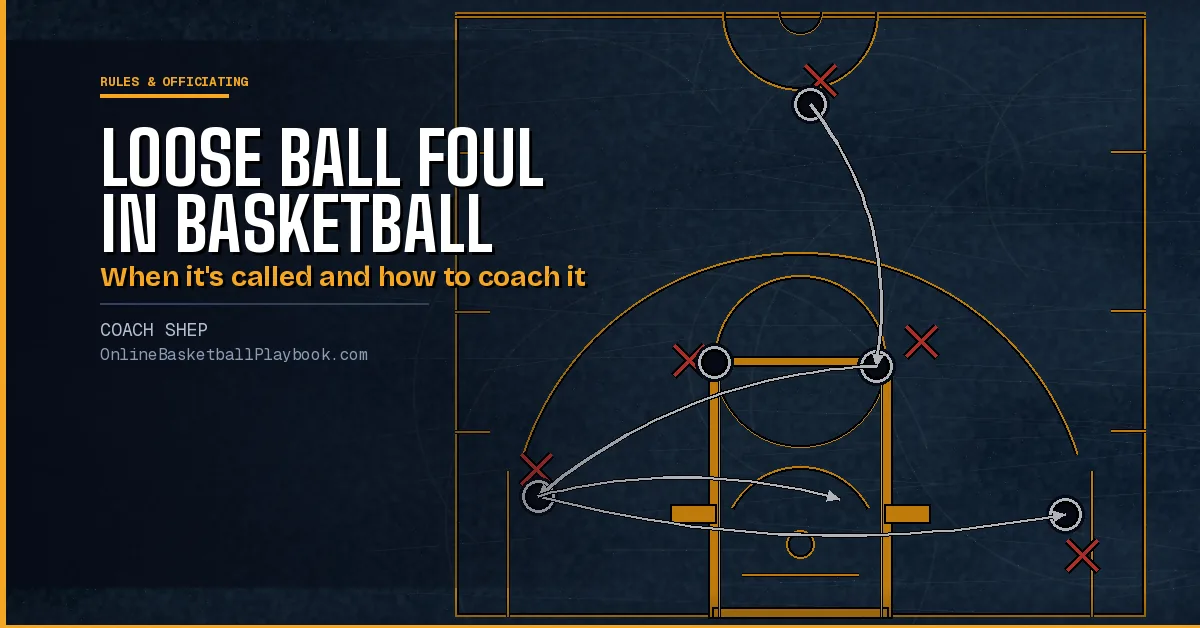
A loose ball foul is called when a player commits a foul while neither team has possession, during a scramble, a deflection, or a rebound battle where the ball is up for grabs.
What "Loose Ball" Means and When It Applies
In basketball rules, a ball is loose when no player from either team has established control of it. This happens in several situations:
- A shot is in the air and has not been caught or hit the rim yet (rare, usually only between tip and rim on an air ball)
- A missed shot is bouncing off the rim or backboard
- A deflected pass is rolling on the floor
- A tipped ball is in the air between two players
- A held-ball scramble before the whistle is blown
When a player fouls (pushes, grabs, hits) during any of these moments, the official calls a loose ball foul. The key distinction is that neither team possessed the ball when the foul occurred.
Common Situations Where a Loose Ball Foul Is Called
Offensive Rebound Scrambles
After a missed shot, multiple players are fighting for position. A defender who pushes, grabs a jersey, or body-checks an offensive rebounder during the scramble is called for a loose ball foul. The ball is neither team's until someone gains clear control, so the contact during the fight for position is a loose ball foul, not a blocking foul or a personal foul.
Deflected or Errant Passes
A pass is tipped by a defender and bounces toward the sideline. Two players dive. One grabs the other's arm to beat them to the ball. That grab is a loose ball foul. The ball was not in either player's possession at the moment of contact.
Jump Ball Situations
After an official signals a held ball and players are scrambling, any contact before the whistle stops play can be called as a loose ball foul. Less common but does occur in physical games.
Tipped Balls in the Air
A player tips the ball upward rather than securing it. If a second player pushes through to grab it, any illegal contact on the first player during that moment is a loose ball foul.
How the Penalty Works
A loose ball foul counts as a personal foul on the player who committed it and a team foul for their team. The penalty depends on which team commits it and the foul situation:
| Situation | Penalty |
|---|---|
| Defensive loose ball foul (not in the bonus) | Offensive team gets the ball out of bounds |
| Defensive loose ball foul (team in bonus) | Offensive team shoots free throws (1-and-1 in HS; 2 shots in NBA/college) |
| Offensive loose ball foul | Ball awarded to the defense out of bounds; no free throws |
| Double loose ball foul (both players foul) | Alternating possession arrow; no free throws |
The most important case to know: if your team is in the bonus (the opponent has committed 7+ fouls in a half at the high school level, or 5 in a period in the NBA), a defensive loose ball foul triggers free throws even though no one had the ball. This catches teams off guard, especially late in close games when teams are already in foul trouble.
Loose Ball Foul vs. Personal Foul: What's the Difference?
Both are personal fouls that count toward a player's total and the team foul count. The distinction is in the possession context:
- Personal foul: One player has established possession (or is in the act of shooting) when the illegal contact occurs. Examples: a defender hits the shooter's arm, or an offensive player charges into a set defender.
- Loose ball foul: Neither player has established possession when the illegal contact occurs. Both players have an equal right to the ball at that moment.
The outcome is the same from a penalty standpoint. Personal foul count and team foul count both go up. The distinction matters mostly to officials in determining which foul category to record and signal.
Coaches often ask: why call a foul when nobody had the ball? That's exactly when a loose ball foul is called. No possession is the condition for a loose ball foul, not a reason it shouldn't be called. The rules protect players scrambling for a loose ball the same way they protect players who have possession.
What It Means for How You Coach Defense and Rebounding
Loose ball fouls show up in patterns. Teams that commit them frequently usually have one or more of these habits:
Grabbing Instead of Securing
Players who dive for a loose ball and grab a jersey or arm instead of the ball. Usually because they're not quite close enough to secure it cleanly. The fix is footwork and positioning: get your body in front of the ball before going for it with your hands.
Reaching Over Backs on Rebounds
The most common loose ball foul in rebounding: a player goes over a shorter opponent's back to get the ball during a scramble. The fix is establishing position below the opponent's shoulders before the shot goes up, not after.
Physical Play in Foul Trouble
Players who already have 3–4 fouls are prone to loose ball fouls because they're aware of foul trouble and hesitate, then overreact with a grab when a clean move would have secured the ball. Keep foul-burdened players away from scramble situations or sub them out in high-scramble moments.
Coaching Tips for Avoiding Loose Ball Fouls
Loose ball fouls are almost never intentional. They're a byproduct of aggressive play without the technique to stay legal. Two things reduce them:
Positioning before the scramble. The player who gets their body in the right place first doesn't need to grab or push. Offensive rebounders should seal box-out attempts before the shot. Defenders should establish box-out position early. Whoever has body position gets the ball legally.
Two hands on every scramble. Players who go for a loose ball with one hand are more likely to grab or foul than players who go with two hands and secure the ball completely. Drill: on every loose ball drill, require two hands to "claim" the ball, no one-handed slaps or tips toward yourself.
"Take a charge, dive for the loose ball, finish the lay-up. A conditioning drill disguised as a hustle drill."
JCC Basketball Drills Packet (via coachesclipboard.net), on Hustle Drill #3
- Loose ball foul = no one had the ball. Any illegal contact during a scramble, regardless of who was closer to the ball, is a loose ball foul.
- Counts the same as a personal foul: Toward individual foul totals and team foul count.
- In the bonus, a defensive loose ball foul means free throws: Even with no possession. Track team fouls carefully late in games.
- Fix grabbing by fixing positioning. Most loose ball fouls happen because a player is slightly out of position and compensates with their hands instead of their feet.
- Box out before the shot goes up, not after, establishing legal position early removes the scramble entirely.
Get free play diagrams, drills, and coaching guides every week.
Draw this play free in the play drawer →
Membership: the full library, playbook packs, and Pro drawing tools →
Keep Building
Related breakdowns
What Is a Blocking Foul in Basketball?
A blocking foul is called on a defender who hasn't established legal guarding position before contact. Here's exactly what legal position requires, how it differs from a charge, and how to coach it out of your defense.
Basketball Positions: What Each of the 5 Positions Does
The point guard, shooting guard, small forward, power forward and center, what each one does on offense and defense, and when to ignore the numbers.
High School vs College vs NBA Rules: What Changes for a Coach
High school vs college vs NBA rules: shot clock, three-point line, bonus, fouling out, timeouts, backcourt count and defensive three seconds, and what each changes.