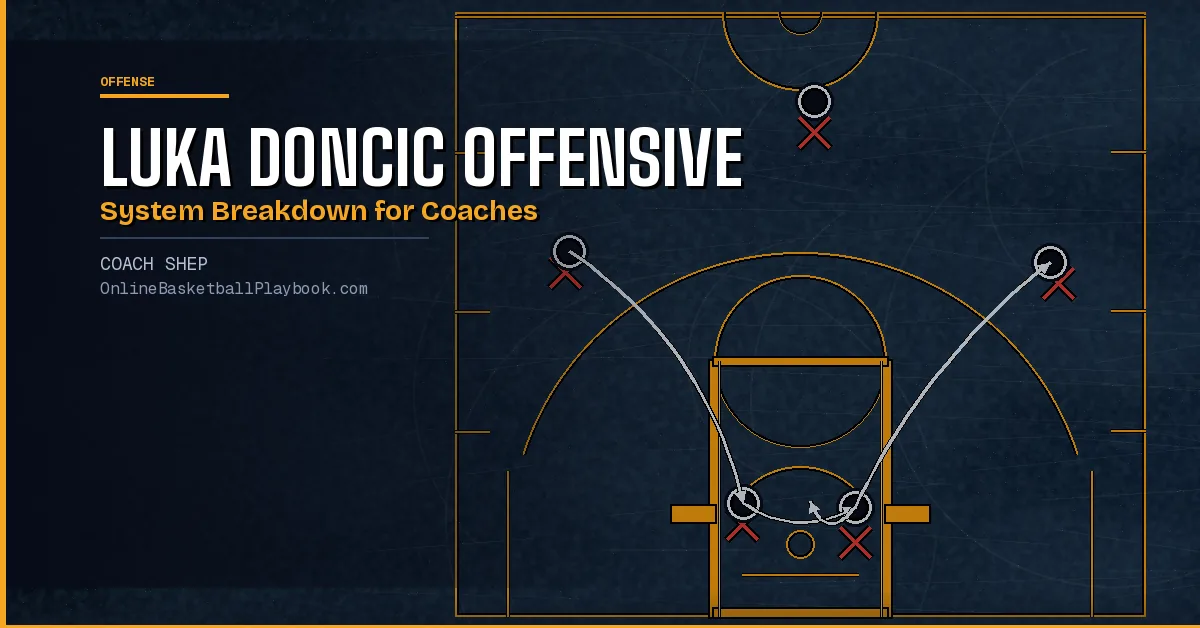
Luka Doncic runs one of the most decision-rich offensive systems in the NBA. This breakdown isolates the core reads, spacing principles, and practice methods every coach can adapt for their own team.
The Offensive Philosophy Behind Luka's System
Before you can install any piece of Luka Doncic's offensive toolkit, you need to understand the decision-making architecture underneath it. Luka does not run set plays in the traditional sense. He operates from a menu of reads, a series of if-then options triggered by how the defense is positioned. What looks improvised on television is actually a system of trained responses built on top of hundreds of practice repetitions.
The foundation is control of pace. Luka consistently initiates actions at the high post or above the break, slowing the game down to force the defense to declare its coverage. Once the defender commits (whether to shade the ball handler, drop into a zone, or trap the ball screen), Luka executes the read that the coverage gives him. This is not freelancing. It is disciplined option basketball.
Coaches at every level can borrow from this framework. The principle is not "run Luka's plays." The principle is build a system where your best ball handler reads defensive coverage and triggers the correct action. That starts in practice, long before any 5-on-5 run.
Pick-and-Roll Reads: The Engine of the Offense
The pick-and-roll is the primary action in Luka's offensive system, and the sophistication lies entirely in the reads that follow the screen, not the screen itself. When Luka catches on the move coming off a ball screen, he has already processed three variables: the defender's drop depth, the roll man's positioning, and where the weak-side help is coming from.
The Drop Coverage Read
When the defending big drops into the lane to protect the rim, Luka pulls up for the mid-range or three-pointer at the level of the screen. He does not attack the rim into a set defense. He takes the shot the coverage is offering. For your players, this is a trainable read. Run 2-on-2 pick-and-roll reps where the defense must hedge low, and require the ball handler to stop and shoot. Most players instinctively drive into traffic. They need repetitions that reinforce pulling up when the lane is not open.
The Blitz or Trap Read
When teams send two defenders at Luka on the catch, his eyes go immediately to the roll man. The blitzing team has left someone open. Luka locates the roll, makes the skip, and the offense is in advantage. This is the drive-and-kick chain at high speed. Teaching this at practice means drilling the two-on-one shooting drill: the passer attacks, the second defender closes out, and the ball handler fires the kick. Do it at game speed, score it, and repeat it until the read is automatic.
The Switch Read
When the defense switches the ball screen, Luka attacks the mismatch. If a smaller guard is now guarding him, he posts the guard on the block. If a bigger forward is now on the perimeter, he drives past the slower defender. Switching is not a stopgap against this offense. It is a different vulnerability. Your players need to recognize the switch and immediately target the new coverage rather than running the original action.
The Step-Back Three: Creating Space Without a Screen
The step-back three is Luka's signature isolation weapon, and coaches often misread what makes it work. The shot itself is only possible because of the setup that precedes it. Luka drives hard at the defender to collapse their stance, plants his lead foot, and steps back into the shot in one motion. The defender's momentum carries them forward, and the space appears.
The footwork is learnable, but it requires a specific sequence of breakdown reps. You cannot teach the step-back by having players stand at the three-point line and practice stepping backward. The drill must start with a live drive that forces the defender to react. Only then does the step-back trigger correctly, as a counter to a defender who has committed.
Teaching the Footwork Progression
Start players with the 1-on-0 version: dribble hard toward the paint at game speed, plant, and step back into the shot with a squared stance. The shooting form at the catch should match any other catch-and-shoot rep (hips loaded, feet under the body, no drift). Once the footwork is clean without a defender, add a closeout with a live defender who must react to the drive. The step-back only needs to fire when the defender takes the bait.
Add a constraint to sharpen the drill. If the player drives all the way to the rim without pulling up, that possession does not count. The rule forces the read. The step-back must come off the defense's movement, not after a full drive. This is the same constraint principle elite coaches use across all breakdown drills: rules that force the behavior rather than instructions that describe it.
Playmaking Triggers and Slot-Skip Chains
One of the most undercoached aspects of Luka's game is the chain of actions that follows any initial read. When Luka drives and the help defense collapses, he does not simply dump off to the open man. He makes a decision tree move: can the first option finish, or does the defense have a second body arriving? If the second body arrives, he skips to the corner shooter on the weak side. If the first option has a lane, he delivers the pass in stride.
This is the slot-skip chain, and it is trainable. The drill format is simple: 3-on-2 or 4-on-3 half-court, where the ball handler drives and reads how many defenders are committed. The offense scores a bonus point for a skip to the open man on a kick-out. Run it scored (make a turnover cost two points), and the players learn the read under pressure.
The Trigger Points
Luka's playmaking also relies on reading off-ball cuts triggered by his dribble penetration. When he attacks baseline, weak-side players in the corner are trained to read his path and drift to the slot for the kick. When he attacks middle, the corner players cut baseline for the dump-off. These are not spontaneous reactions. They are trained cut responses to a ball handler's lane. Your players can learn the same patterns, but only if you drill the cutting rules at practice, not just draw them on a whiteboard.
Spacing Principles and How Teammates Complement Luka
Luka's system requires a specific floor structure that his teammates must maintain with discipline. Five-out spacing is the foundation. When Luka has the ball, the other four players must occupy four spots on the arc (two corners, two wings) with no one camping inside the three-point line. Congested spacing kills his ability to drive, and any teammate standing in the paint is creating a traffic problem rather than a threat.
The corner three is Luka's most important release valve. When the paint collapses, Luka's default kick target is the strong-side corner. Teams that defend him by loading the paint must pay on the perimeter. The corner shooter is not a luxury in this system. They are a structural requirement. Your best long-range shooter belongs in that corner when your playmaker drives.
The Weak-Side Big
The roll man or weak-side big in Luka's system must read the defense after setting the screen, not just roll to the rim and wait. If the defense has two bodies in the paint, the big replaces to the short roll and becomes a secondary passer. This is the pinch post read, catching in the middle of the lane with options to the corner or to the cutting guard. Teaching this at practice requires the big to play beyond just physical setting of screens. They need to understand where the help is coming from and position themselves accordingly.
Teaching These Reads: Breakdown Drills That Work
The most effective way to install Luka-inspired reads is through part-whole breakdown drills that isolate one decision at a time. Elite programs build every offensive system from the part up, never installing 5-on-5 before the players own the individual read in a controlled setting. This approach is well established across every level of the game.
Start with 2-on-2 pick-and-roll reps where the defense is constrained: the defender must drop, must blitz, or must switch. The ball handler makes the appropriate read for that coverage. Do not let the defense play freely until the ball handler has drilled every coverage response separately. Mixing all three coverages in one drill before the player has internalized each one separately trains confusion, not decision-making.
The Drive-and-Kick Chain
Run a 3-on-2 drive-and-kick drill from the top of the key. The ball handler drives, two defenders collapse, and the ball handler must kick to the open corner shooter. Score it: award two points for the kick-out three, one point for a floater, zero for a rim drive into two defenders. The scoring itself coaches the decision. Players quickly learn that attacking two defenders is the lowest-value play in the drill, and they begin scanning for the kick automatically.
Constraint Games for Step-Back Reads
Use constraint rules from a no-paint game format: inside the paint counts as a turnover. The only scoring options are pull-up threes, step-back twos, and kick-out threes. This forces the ball handler to develop a mid-range step-back game rather than relying on rim attacks. It is the same constraint principle used in Blood series drills (mid-range equals turnover, forcing spacing) applied to a step-back context. Run it live, score it, and the behavior follows the incentive.
Installing Luka-Inspired Concepts at Any Level
You do not need an NBA roster to use Luka's decision framework. What you need is a ball handler who can read coverage and teammates trained to respond to his movements. The concepts scale down cleanly to high school and even middle school basketball when you build them from the part up.
Start with the simplest read in the system: the pull-up when the drop is offered. Put your best ball handler in 2-on-2 reps with a dropping big. Require the pull-up. Score it. When that read is owned, add the blitz read. Then add the switch read. Each layer builds on the one before it, and the player accumulates a decision tree rather than memorizing a sequence.
What to Scout and What to Practice
When you watch Luka on film, do not just catalog the plays. Catalog the defensive coverages that trigger each action. That is what your film session should identify: how does this defense cover the pick-and-roll, and what is the correct read against it? That read becomes your next practice focus. Film study and breakdown drilling are two halves of the same process. One identifies the problem the defense is creating; the other trains the solution.
Positionless Application
One of the transferable lessons from Luka's system is that playmaking is not position-dependent. Any player who can handle the ball under pressure and read defensive coverage can be a creator in this system. At practice, put all players through the same reads. Do not silo playmaking work to guards only. The forward who runs ball screen reps understands how to cut off a driving teammate's penetration. The center who practices short-roll reads becomes a better screener because they know where the pass will go. Positionless offensive development makes the entire system smarter.
When you introduce pick-and-roll reads to your team for the first time, pick one coverage (drop, blitz, or switch) and run it exclusively for two weeks before mixing coverages. Players who try to read all three simultaneously before mastering any one of them will develop hesitation habits that are very difficult to unlearn later in the season.
- Drill drop-coverage pull-ups first: constrain the defense to drop, require the ball handler to pull up at the level of the screen, and score every rep. Players who drive into a set defense count it as a turnover.
- Teach the step-back footwork in isolation at game speed (plant, step, square) before adding a live defender. Correct form must be locked in before the decision element is layered on top.
- Run 3-on-2 drive-and-kick drills with a scoring structure that awards the kick-out three over the rim attack, so the highest-value play is also the most frequently trained read.
- Keep weak-side shooters in the corner on all half-court work. Five-out spacing is a discipline that must be enforced in every drill, not just in live scrimmage situations.
- Add one new coverage response per two-week block: master the drop read, then add the blitz read, then add the switch read. Stacking reads builds a real decision tree rather than a memorized sequence.
- Use constraint games (no-paint rule, mid-range equals turnover) to force the reads your system requires rather than stopping play to describe the reads your players missed.
Want more basketball coaching strategies, drills, and tools?
Join the Online Basketball Playbook newsletter →
Draw this play free in the play drawer →
Membership: the full library, playbook packs, and Pro drawing tools →
Keep Building
Related breakdowns
Mentorship Program for Young Coaches: Match, Meet, Review
How to build a mentorship program for young coaches: set goals and a length, match on style and time, meet on a schedule, give one real job and review it.
AAU vs High School Basketball: How Coaches Work Together
A school coach's guide to AAU vs high school basketball: how the two seasons differ, how to place players and plan the summer, and how to coach an AAU team well.
Jay Wright's Villanova System: Habits Over Plays
Jay Wright's Villanova system: the habit doctrine, the daily skill block, shooting and footwork drills, 4 out 1 in spacing, Calculated Risk defense and culture.