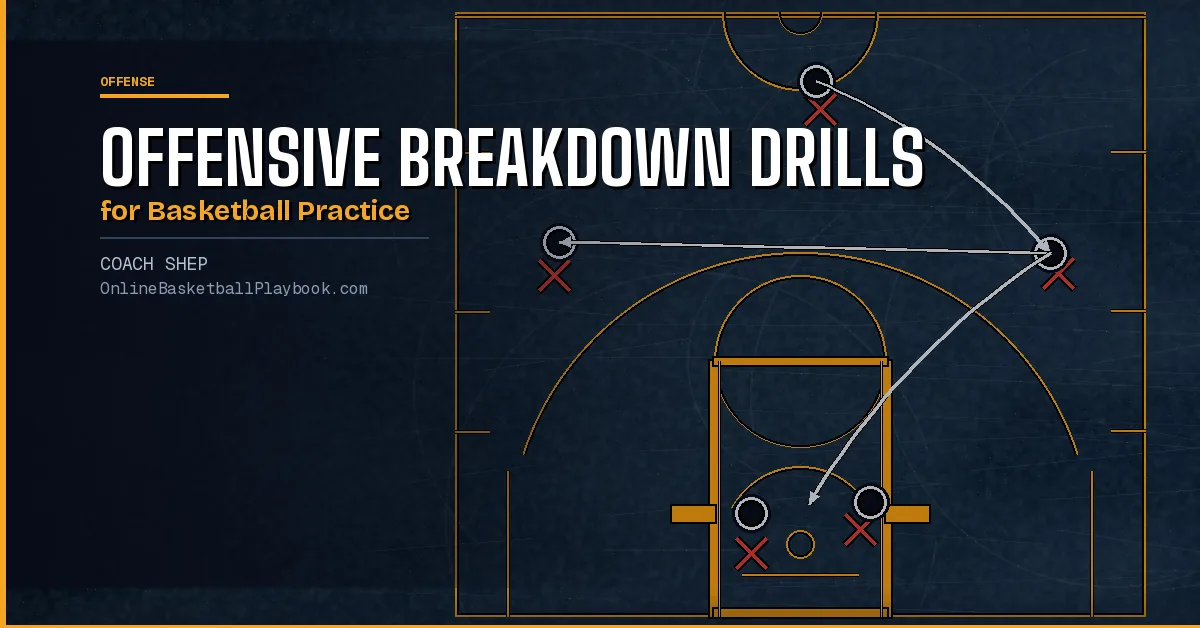
Breakdown drills install your offense one read at a time, isolating a single decision in a small-sided drill before scaling to five-on-five. Skip this step and your players run routes. Run these drills consistently and they make reads.
The One-Read-Per-Drill Principle
The defining feature of a well-designed breakdown drill is constraint. You do not run your offense in a breakdown drill. You isolate one piece of it. Each drill enforces a single decision or skill: the cut-or-hold read, the drive-and-kick decision, the screen-and-roll coverage read. Players cannot get to the next option until they have mastered the one in front of them.
This approach comes directly from the part-whole teaching method used by the most systematic offensive coaches in the game. Coaches like Nate Oats at Alabama and the late Hubie Brown built practice around the idea that players learn reads through repetition in constrained environments, not through watching film or hearing lectures. The drill is the coach.
Constraint is how you do the coaching without stopping play. Blood 4 from the Memphis breakdown series makes the mid-range jumper a turnover. Dribble caps force ball movement. "Make a free throw to validate the score" trains composure under pressure. These rules are not punishments. They are the course correction built directly into the drill design. When the rule is embedded in the drill, the coach does not have to stop possession to deliver feedback.
Another element coaches underestimate is the naming convention. Every drill in a well-run program has a name, a purpose, and a validation standard. Players who can name a drill and describe what it trains are players who understand why they are doing it. That understanding transfers to games. Drills that lack names, purposes, or standards are just organized chaos.
One final principle before we get to the specific drill categories: every breakdown drill must end with a make. Hubie Brown required this of all his two-man offensive drills. The drill does not stop on a missed shot. The player rebounds and finishes. This trains the mind to keep playing through a broken possession, and it conditions the body to work when tired. Ending on a make is not a feel-good gimmick; it is a behavioral standard that carries into games.
Finishing Footwork: The Non-Negotiable Base
Before any team reads are trained, before you run a Blood drill or a 2-on-2 live possession, players need a finishing-footwork base. This is the Walberg/Welling principle, and it is widely ignored by coaches who jump straight to system work.
The layup sequence is the foundation: both hands, both sides, straight finishes, reverse finishes, crossover finishes, and hesitation finishes, all at game speed. Add the jump-stop power layup. Your drive-and-kick offense is only as good as the finishes it creates, and if your players cannot finish at the rim under pressure, the entire read structure collapses on the last action.
The layup progression used in the Krause/Meyer/Meyer player-development framework gives you a buildable sequence: start with no ball (footwork only), then carry the ball, then one-line dribble-in, then two-line pairs, then dribble-chase pairs, and finally two-minute team layups with four passers and a clock. Each step adds complexity only after the previous one is clean.
For finishing footwork specific to shooting, the standard is the hop from the basket-side foot into a quick stop, the same pattern for catches off a pass and dribble pickups. The "game shots at game spots at game speed" framework that anchors every individual perimeter drill in this system means footwork precedes the ball. You do not hand a player the ball and tell him to shoot. You build the footwork pattern first, then add the ball, then add the pass, then add a defender.
Form shooting builds on this base. The Field-Goal Progression used at the individual-workout level (slams, TV shooting (lying on the back), form shots, Hays footwork drill (self-pass with hop footwork at the elbow), soft-touch shots, and finally shots from a pass) gives every player a daily warm-up sequence that installs proper mechanics before any competitive reps begin. Coaches who skip this step get players who develop bad habits under fatigue.
Advantage and Disadvantage Drills
The Texas series (Texas 22, Texas 33, Texas 44) and the Scramble (3-on-2) are the workhorses of advantage-based breakdown training. These drills put players in numbers situations that force decisions under pressure: the extra pass when you have the advantage, the early-clock shot when the defense is recovering, the retreat-and-skip when the first option is taken away.
The design principle here is that basketball decisions are almost never made in neutral-numbers situations. Games are played in transition, off scrambles, in the middle of rotations. If all your breakdown drills are 1-on-1 or 2-on-2 with equal numbers, your players have never practiced making reads under the pressure conditions that actually occur in games. Advantage drills close that gap.
Alex Sarama's small-sided game framework takes this further with engineered advantages and guided defense. The coach controls the start of each possession: ball on the outside hip signals a baseline drive, ball on the inside hip signals a middle drive. A defender must hi-5 to release. The distance of the hi-5 point sets the size of the advantage. This means the coach is designing a specific read into every rep without stopping play to explain it.
The guided defense concept adds another layer. Instead of live defense where the defender does whatever he wants, the guided defender rotates through three responses (trail, cut-off, and neutral), giving the offensive player a varied decision on each possession. This creates what Sarama calls "repetition without repetition": the read is the same, but the trigger changes each time. Players who have trained this way do not get surprised in games because they have seen every version of the coverage.
The Dominoes drive-and-kick chain taught in this framework (the layup, then the kick, then the drift, then the slot-skip) is the same offensive chain installed by the Blood series in the Memphis breakdown system. The names differ, the structure is identical. Drive, read the help, make the pass, the next player reads the next action. Breakdown drills train each link in that chain before players are asked to run the whole sequence in a live five-on-five possession.
Building a Competitive Shooting Battery
A shooting battery is not a warmup. A properly designed shooting battery is competitive, scored, and run at game speed. The drills from the Alabama (Oats) practice model make this explicit: every shooting drill has a score, losers run the difference, and the drill itself coaches the shot diet through its design.
The core shooting formats worth knowing:
Olympic Shooting and Five-Spot Shooting from the Memphis breakdown system train conditioning alongside volume. These are high-rep drills run with "lock and load" and squared-before-the-catch footwork. Players are moving to every spot on the floor, catching in stance, and shooting before the defense closes out. The conditioning benefit is built into the drill because the footwork requirement does not go away when players are tired.
The 3-guy-2-ball and 4-guy-3-ball drills from Alabama are catch-and-shoot drills designed to simulate game-speed spacing. The standard is "ready before the pass": feet set, hands up, behind the NBA line. Players who wait for the ball to arrive before getting ready are not training a game behavior. One-dribble pull-ups, shot-fake into a side-dribble, and two-on-one shooting with a contest on the second shot are all built into this battery.
The Celtic drill requires a player to make two in a row before rotating. This is the key difference between a drill that measures effort and a drill that measures execution. Making two in a row forces players to manage their mechanics under mild pressure. They cannot get away with sloppy footwork on one rep and a clean rep the next.
The Free-Throw Ladder, charted and posted on the locker door after every practice, builds accountability into the shooting program without requiring the coach to monitor it directly. Players know their number, they know the standard, and the chart does the coaching between practices.
The Livsey simultaneous shooting battery is designed specifically for large squads, fifteen or more players working at game speed at the same time. The Backpedal drill (sprint to half-court, back to baseline, catch and shoot), the Pepper drill (sprint to the basket looking over the inside shoulder, catch a lob, finish), and the Crack Back drill (sprint to a touch-point, crack back to the catch, passer leads to the inside shoulder) are all built so that multiple pairs are running at the same time. No lines, no standing, everyone working.
Run the Livsey battery (Backpedal, Pepper, and Crack Back) as a five-minute rotation before any five-on-five scrimmage segment. With fifteen or more players, this gets everyone game-speed shooting reps simultaneously, cuts standing time, and builds the footwork habits that transfer directly to your half-court offense.
Scored Small-Sided Games
Small-sided games are breakdown drills that include a live defense and a competitive score. The distinction from pure breakdown drills is that the defense is real: players must make reads against someone who is actually trying to stop them. The distinction from a scrimmage is that the drill still isolates one or two reads and scores specific behaviors, not just baskets.
One decision-drill library gives you the complete template. The 1-on-2 Post Double Pass-Out drill puts the offensive player in a post double-team: attack before the double arrives or retreat and make the skip pass. The winner stays on the floor. The self-scoring and the winner-stays format drive competitive intensity without the coach having to manage motivation.
The No-Paint and Paint Game constraint games from the same library illustrate how a forbidden zone or a required zone changes the shot diet without the coach having to tell players what to shoot. No Paint means no layups. Players must create and make the mid-range or perimeter shot. The Paint Game requires a score in the paint. Players must learn to drive and finish rather than settle for pull-ups. Both constraints teach decision-making through the drill structure, not through instruction.
The Karl/Stotts NBA drill encyclopedia applies this principle at the highest level with incentive scoring. The 1-on-1 Post Game awards plus-two for a field goal, plus-one for drawing a defensive foul, minus-one for committing an offensive foul, plus-one for a post pass that creates a score, minus-one for a turnover, and plus-one for an offensive rebound. The scoring system teaches all of those behaviors simultaneously. The coach does not have to say a word. The score says it for him.
Popovich's Three Ways controlled scrimmage applies the same principle to five-on-five. One point for scoring, one point for a stop. Play to ten. After going down-and-back twice, throw to the coach and restart. The coach controls the tempo and can teach after every two-possession segment. Players cannot rip-and-run out of control because the restart format eliminates the chaos of an unstructured scrimmage. This is the bridge between small-sided breakdown work and a true full-squad scrimmage.
Full-Court Transition and Conditioning Drills
Full-court transition drills build the fast break and condition players to make good decisions when they are tired. The key design principle from the championship high school coaches who contributed to the 332 full-court drill library: scoring and timing are what make these drills work. Make 50 layups in two minutes. Miss one and the clock does not stop. The score creates the pressure that makes the conditioning real.
The 11-Man Continuous 3-on-2 is the most complete single drill in this category. One team pushes 3-on-2 in transition. The rebounder from the defense outlet passes and fills a wing. The two defenders who stopped the break immediately become the new offense. The drill never stops. It trains outlet passing, lane-filling, pushing the ball ahead, and finishing a layup or reading the kick-out, all in the same continuous possession. Run it with a clock and a make total to add competitive pressure.
The Walberg transition games (Texas 1121, Duke 21, and North Carolina 32) each train a specific transition behavior. Texas 1121 limits each possession to one pass and one shot, forcing players to push the ball immediately. Duke 21 requires the scorer to sprint back and touch half-court before becoming the defender. It teaches finishing and transitioning to defense on the same possession. North Carolina 32 trains the push-ahead pass to the wing and the banana-cut outlet, the two movements that create numbers advantages before the defense can set.
The Chase drill is simple and effective: finish the layup through a defender chasing from behind, or do pushups. Players who avoid contact at the rim in games are often players who have never been trained to finish through it in practice. The Chase drill puts that pressure in every rep without requiring a full-contact drill.
The Progression to Five-on-Five
The breakdown drill library is not a collection of warmup activities. It is the curriculum for installing your offense. The 5-on-0 progression (motion principles, spacing rules, timing of cuts and screens) comes first. Then you add options one at a time in small-sided breakdowns. Then you go live. Coaches who skip straight to five-on-five are not installing an offense; they are hoping one develops on its own.
One decision drill progression makes the sequencing explicit. Start with one defender and one clean read. When players own that read, add the second defender who changes the read. Then connect two or three actions so players must keep playing after the first option is covered. This is how real offensive possessions work: the first read is covered, the second read opens, the third read is available if the second is denied. Training this progression in small-sided breakdowns means players arrive at five-on-five having already seen every link in the chain.
The Endres Princeton drill progression follows the same structure. Two-man backdoor reads and DHO reads come before three-man wheel-pin reads. Three-man reads come before ball-screen reads. Ball-screen reads come before the full Princeton set. Each step adds one decision to the last. The offense is not taught in one practice. It is installed drill by drill over a practice calendar.
For most programs, the practical application is this: build your practice plan backward from the reads you want to train in five-on-five. Pick the one or two decisions that broke down in the last game. Find the breakdown drill that isolates that read. Run it early in practice when players are fresh, score it competitively, and validate the skill with a free throw before moving on. Your five-on-five scrimmage at the end of practice should show whether the breakdown work transferred, and if it did not, that tells you what to run at the start of the next practice.
- Isolate one read per drill. Never ask players to make multiple decisions in a breakdown rep until each individual decision is already owned under low-pressure conditions.
- Use constraints to coach without stopping: mid-range equals a turnover, dribble caps force ball movement, "validate with a free throw" trains composure after a score.
- Build finishing footwork before any system work. Drill both-hand layups, straight and reverse finishes, and the hop-into-quick-stop shooting footwork before adding live defenders.
- Score every competitive drill: specify what earns points, what costs points, and who runs when the loser is determined. The scoring system does the coaching without interrupting play.
- Use the Livsey simultaneous battery (Backpedal, Pepper, Crack Back) before five-on-five scrimmage when squads are large, all players working at game speed at the same time, no standing in lines.
- End every drill on a make. The player rebounds and finishes. Train the mind to keep playing through broken possessions before that habit is needed in a game.
Want more basketball coaching strategies, drills, and tools?
Join the Online Basketball Playbook newsletter →
Draw this play free in the play drawer →
Membership: the full library, playbook packs, and Pro drawing tools →
Keep Building
Related breakdowns
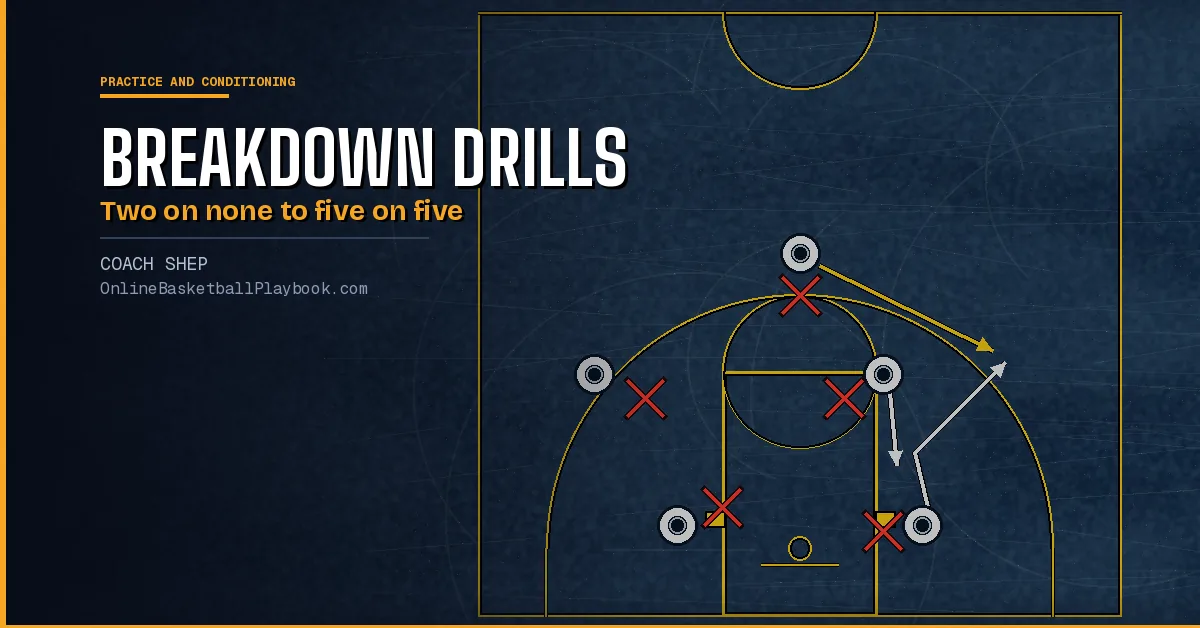
Breakdown Drills in Basketball: Part to Whole Teaching
Breakdown drills in basketball, from 2 on 0 to 5 on 5: whole first or parts first, the ladders coaches climb, dummy then live, advantage drills and drill length.
Fun Basketball Games for Practice: Scored Games for Any Team
Fun basketball games for practice at any level: shooting games, defense-only scoring, rebounding contests and passing games, with scoring rules and records.
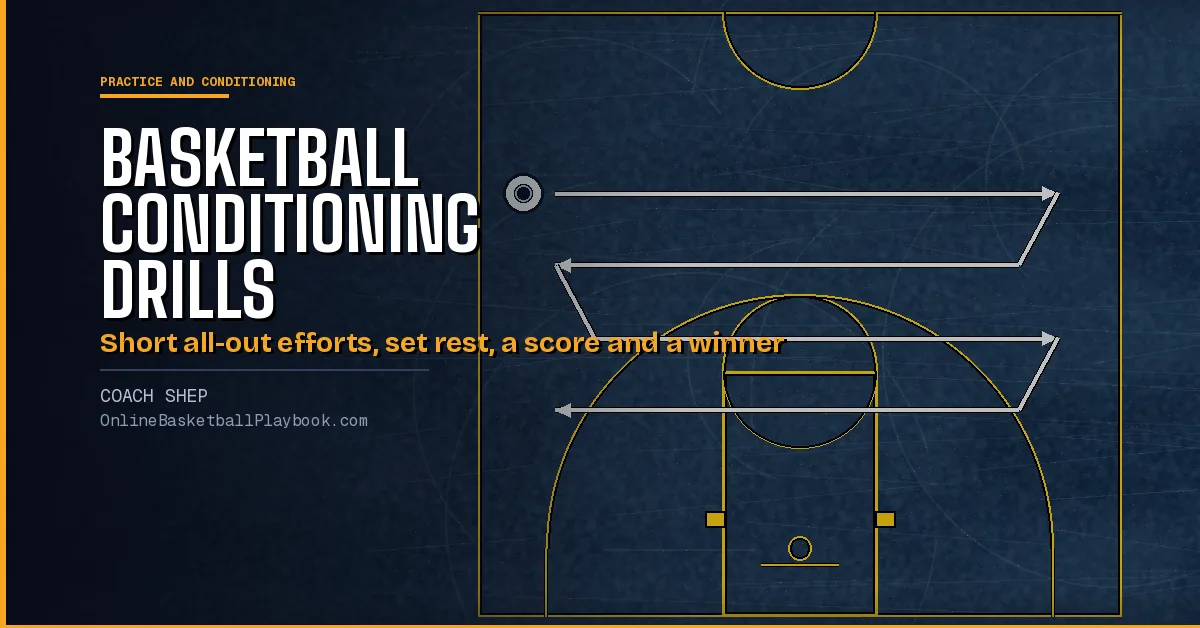
Basketball Conditioning Drills for Teams: Runs, Games and Tests
Basketball conditioning drills in three styles, timed runs, conditioning inside skill drills and scored games, with the tests and yearly plans coaches use.