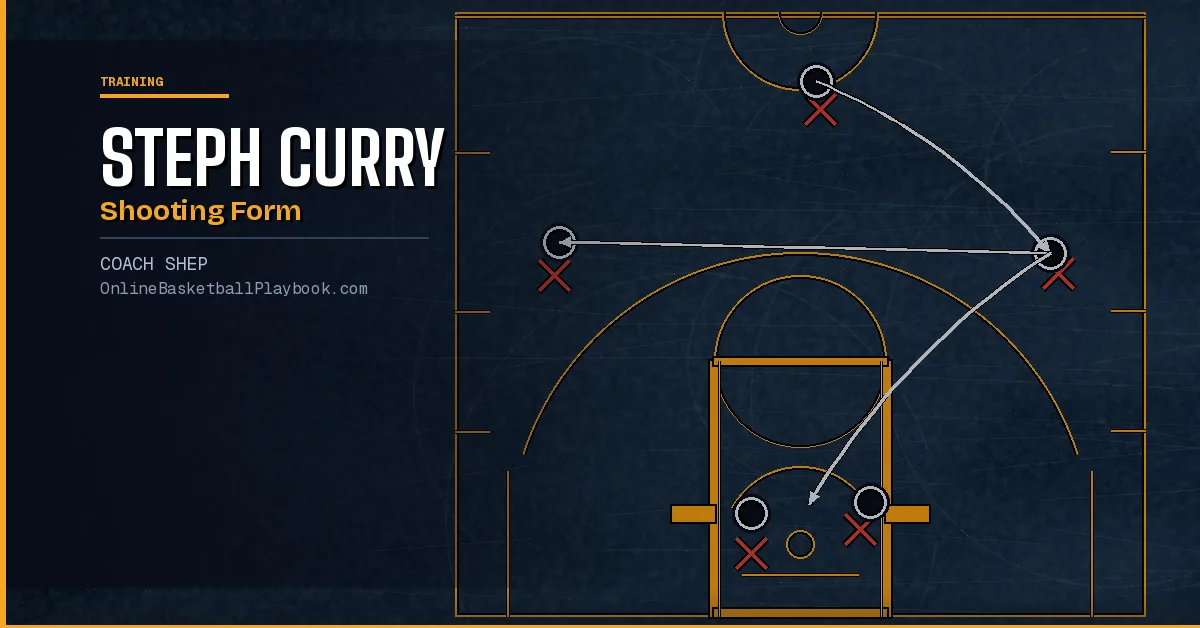
Steph Curry doesn't just shoot well. He shoots better than any player who has ever played the game. Here is what makes his mechanics so repeatable, and what coaches can pull from his form right now.
Stance and Balance: The Foundation Nobody Talks About
Watch Curry on film at full speed and it's easy to fixate on the release. Watch him in slow motion and you immediately see the real story: his feet are always balanced and his base is always ready before the ball arrives. This is not an accident. It is a trained habit built over thousands of repetitions.
Curry shoots with a slightly staggered stance, his shooting-side foot a few inches ahead of his off-foot. His weight is distributed through the balls of both feet, never rocking back onto his heels. When he catches off a pin-down or a DHO, his inside foot plants first and his body is already aligned to the rim before his hands touch the ball. That footwork habit is what separates a quick release from a rushed one.
For younger players learning to shoot, the most common flaw is catching with their feet out of position and then scrambling to align after the catch. Curry does the opposite. He arrives at the spot already squared up, so his feet never scramble. The result is that he can release the ball an entire beat faster than a defender expects.
Jay Wright at Villanova and John Beilein at Michigan both teach the inside-foot-first principle as a non-negotiable. Wright instructs his players to say the sequence aloud during technique work: "1-2, lift, follow through." The convergence of two elite coaching minds on the same footwork detail tells you how load-bearing that single habit is. Curry simply executes it at a level few players have ever matched.
The Set Point: Why Curry's Release Is Nearly Unblockable
Curry's set point is high. The ball sits above his shooting shoulder, with his elbow directly under the ball and over his knee. This is the geometry that makes his shot so difficult to contest. A defender who goes up to block a release this high has to either foul or surrender the shot. There is no middle option.
The elbow-in alignment is the key mechanical detail here. Many players set up with the elbow flared out to the side, which forces a side-spin compensation at release. Curry's elbow tracks straight up under the ball, so when his wrist snaps through, the ball rolls cleanly off the index finger last with consistent backspin and no side-spin drift.
Dr. Hal Wissel's diagnostic framework identifies a flared elbow as the root cause of side-spin misses. The correction is simple to say and hard to engrain: at the set point, the shooting elbow must sit directly under the ball and directly above the shooting knee. Curry does this on every single shot, whether he has caught a clean pass in the corner or pulled up off a ball screen at the logo.
The height of his set point also means he is releasing on the way up, not at the peak or on the way down. This "jumping and lifting / shooting on the way up" timing gives his shot its signature combination of arc and speed. The ball climbs steeply, clears the defender's outstretched hand, and drops through the net at a favorable entry angle, all from a release that takes less than half a second.
Guide Hand Discipline: The Underrated Detail
One of the most common shooting errors at every level is the guide hand, the off-hand, pushing across the ball at release. When that happens, the ball tracks wide right or wide left depending on which direction the thumb fires. Curry's guide hand is textbook: it rides the side of the ball through the set point, and at the moment of release it comes off the ball cleanly, with the thumb pointing upward and away from the shooting line.
This is harder to train than it looks. The guide hand wants to help. The brain sends a push signal to both hands simultaneously, and players who haven't specifically isolated the guide hand end up with it influencing the shot every time. The fix is one-handed form shooting, removing the guide hand from the equation entirely until the shooting hand grooves a clean straight-line release, then reintroducing the guide hand in a passive riding role.
What makes Curry unusual is that his guide hand stays passive even under fatigue and even under pressure. Late in games, when most players are compensating with their off hand, his mechanics hold. That consistency is a product of having drilled the guide hand behavior at form-shot volume before layering in any speed or distance.
Coaches working with players on this detail should use the thumb-lock drill: consciously hold the guide-hand thumb up and away from the ball throughout the motion. It feels exaggerated at first, but the exaggeration is what resets the muscle pattern. After several hundred reps at close range, the passive guide hand becomes automatic.
Footwork Off the Catch and Off the Dribble
Curry is dangerous off both feet because he has two distinct footwork patterns that he executes with equal precision. Off the catch, he uses the hop or the 1-2 step depending on what the defense gives him. Off the dribble, he uses a one-two gather that lets him pull up anywhere on the floor without needing a specific spot to operate from.
The hop gather is his signature off-movement-shooting footwork. Coming off a screen or relocating to an open spot, he hops into a two-footed landing that simultaneously squares his body to the basket. The hop eliminates the directional momentum from his cut and gives him a level launching platform. It is fast enough to beat closeouts and stable enough to produce a consistent release angle.
The 1-2 step, right foot first, then left for a right-handed shooter, is what he uses when he catches on the move going left-to-right. The inside foot lands first, setting the pivot, and the shooting foot follows to complete the stance. This is the footwork that Wright and Beilein both identify as the universal rule for catch-and-shoot mechanics coming off screens.
Off the dribble, Curry's pull-up is what makes his off-ball threat complete. A defender who sags to take away the catch-and-shoot pays for it with an open pull-up in the lane. The pull-up and the hesitation are, as shooting development coaches point out, "lost arts" in the modern game. A player who can take one or two dribbles and pull up around the free throw line is as dangerous as a pure spot-up shooter. Curry is both simultaneously, which is why there is no correct way to guard him.
Range Extension: How He Shoots Deep Without Losing Form
The first thing most coaches want to know when studying Curry's deep range is where the extra power comes from. The answer is his legs, and that answer matters because it is the opposite of what most players instinctively do when they try to shoot from farther out.
When an average player tries to extend range, they add arm. The elbow leads, the shoulder drives forward, and the shot becomes a throw rather than a shot. The mechanics collapse. Curry does the inverse: his legs bend deeper before the jump, and the power comes from the full extension of his legs driving him upward. His arm is a guide, not an engine. The ball rides the energy from his legs up through a consistent shooting arc, with his wrist doing the final directional work at the top.
Dr. Wissel's diagnostic labels long shots with leaning-back compensation as "legs-first errors." The correction is a deeper knee bend before the jump so the legs generate the power rather than the upper body adding lean. Curry's technique matches this correction precisely, which is why his deep-range shot looks mechanically identical to his mid-range pull-up. The only variable is leg drive. The arm geometry is the same.
This is also why his shot holds up at the end of games when his legs are tired. When his legs have less to give, his range shortens slightly, but his mechanics don't break down. He still sets his elbow under the ball, his guide hand stays off the line, and his follow-through finishes high with fingers pointing toward the rim. The foundation remains intact because it was built on leg drive, not compensatory arm mechanics.
Drills That Build Curry-Style Shooting Mechanics
Understanding mechanics is one thing. Training them requires the right drill structure. The following progressions are organized from form-first to competitive, the same sequence used in elite player development programs and in Curry's own documented workout routines.
One-Handed Form Shots
Start every session here. Stand three feet from the basket. Remove the guide hand. Shoot with just the shooting hand, focusing on elbow alignment, high release, and index-finger finish. Every make should have clean backspin and drop through the center of the net. Jay Hernandez calls this "Quarters". Always open with one-handed form shots before adding any distance or movement. Villanova's Jay Wright begins every practice the same way with Set Lifts and the Bradley Drill, reinforcing "elbow under, lift and follow through" before any volume shooting begins.
Sight-Set-Shoot Rhythm Protocol
After form shots, add the full shot with the three-beat rhythm: establish the target (sight), pause at the set point with the ball above the shoulder (set), then release on the way up (shoot). This protocol directly addresses the most common timing error, a rushed release that fires before the natural rise of the jump peaks. Separate the three beats consciously until the rhythm is automatic, then let it compress to full game speed.
Competitive Movement Shooting
Once mechanics are grooved, they must be trained under competitive conditions. Shaka Smart's drill bank uses a "can't shoot the same spot twice" rule to force movement between every shot. Billeter's Purdue Drill requires making four threes in a minute with a rebounder and passer, sprinting baseline to half-court between shots, with a run consequence for each point below four. These drills do what Curry's training does: they force mechanics to hold when the body is stressed and the clock is running.
When a player consistently misses wide, resist the urge to fix the follow-through first. Work backward through the diagnostic: guide hand first, then elbow alignment, then foot position at the catch. The root cause is almost never what the player thinks it is, and guessing wrong wastes practice reps that could be grooving correct mechanics.
- Inside foot first on every catch-and-shoot: whether coming off a pin-down, a DHO, or a pin-screen, the inside foot plants before the shooting foot. This squares the body to the rim before the ball arrives and eliminates scramble-steps at the catch.
- Elbow under the ball, over the knee at set point: check this in slow-motion video review. If the elbow is flared out at the set point, side-spin misses will follow. The correction is form shots with an exaggerated elbow-in position until the alignment is automatic.
- Guide hand thumb up and away at release: drill this with one-handed form shots three feet from the basket before any full shooting reps. If the ball tracks left or right consistently, the guide hand thumb is firing. The off-hand is never supposed to add direction, only to carry the ball to the set point.
- Deeper knee bend for more range: when a player's shot falls short or they start leaning back to "put more on it," the fix is always the legs. Bend deeper before the jump so the legs drive the power upward rather than the arm driving the ball forward.
- End every session with tired free throws: shoot ten free throws at the end of the workout when legs are fatigued, track the makes, and hold players accountable to the number. Game free throws happen when exhausted, so train them that way.
Want more basketball coaching strategies and drills?
Join the Online Basketball Playbook newsletter →
Draw this play free in the play drawer →
Membership: the full library, playbook packs, and Pro drawing tools →
Keep Building
Related breakdowns
Basketball Shooting Form: Step-by-Step Mechanics
Basketball shooting form step by step, from the ready stance and grip to release and follow-through, with drill progressions and where coaches disagree.
Free Throw Shooting: Routine, Form and Drills
Free throw shooting starts with a routine the player never changes. Form cues, the mental side and drills that copy the fatigue and pressure of a game.
Competitive Shooting Drills: Scored Games and Records
Competitive shooting drills with a score on every shot: streak games, timed targets, Beat the Pro, plus and minus, 2-on-1 shooting and record boards.