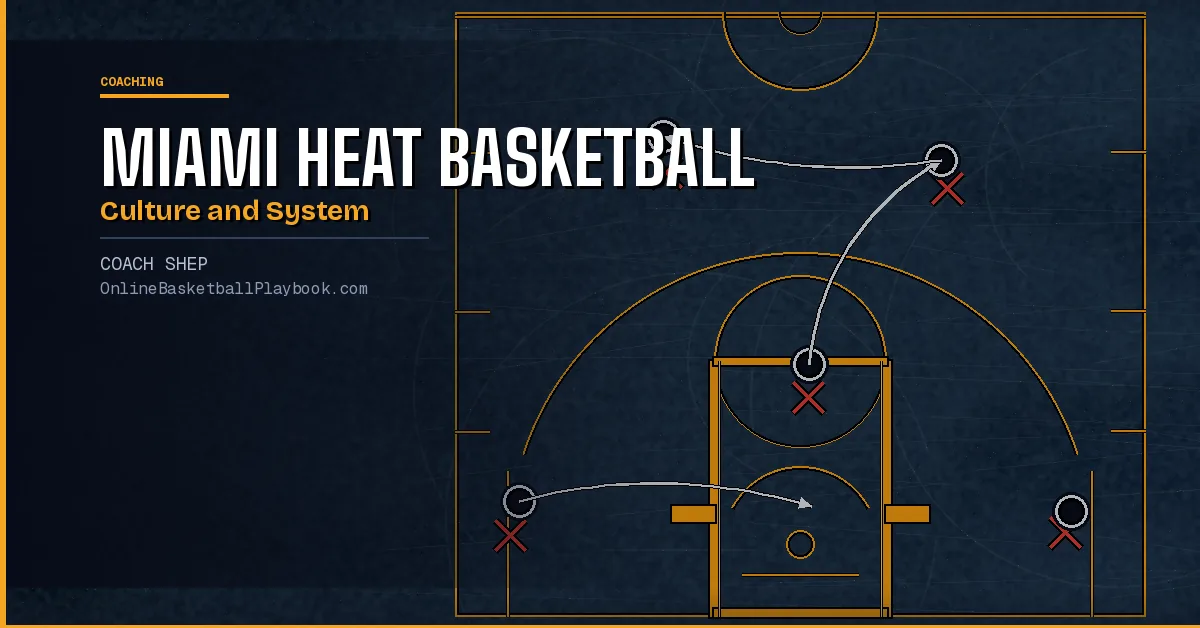
The Miami Heat have built one of the most copied cultures in professional basketball, and it starts long before tip-off. Their system runs on standards, identity, and relentless accountability at every level of the organization.
Identity Before Everything Else
The phrase "Heat Culture" gets thrown around casually, but what actually makes it work is something most programs skip: a defined identity that existed before any specific roster was built. The Heat know exactly who they are before they go looking for players to fill out a team. That sequencing (identity first, personnel second) is the core of what separates a program with real culture from one that just talks about it.
The concept is not unique to the NBA. Euroleague coaching legend Svetislav Obradovic described the same principle to his coaching students: never start from zero. A foundation of core players combined with a known, public team philosophy acts as a magnet for the right additions. The way you play, and the values you stand for, do the recruiting. The Heat have lived this principle for two decades. Undrafted players and second-rounders walk into their system and produce at a level nobody expected, not because of talent alone but because the identity is so clear that role players know exactly what winning looks like and how to contribute to it.
For coaches at any level, the lesson is that your program's identity needs to be written down and visible before tryouts begin. Players, parents, and assistants should all be able to describe what your team stands for in one sentence. If they can't, you don't have a culture yet. You have a collection of people practicing together.
Together, Tough, Trust: The Spoelstra Framework
Erik Spoelstra has been the architect of Heat Culture on the bench for over fifteen years, and his three-word framework captures the system's operating principles as clearly as any coaching philosophy out there: together, tough, trust.
"Together" means the Heat reject individual agendas at the roster and locker room level. Nobody becomes a guru. Nobody creates a separate faction. Spoelstra is explicit about this. He does not allow elephants in the room, and he does not allow separation. Players are peers, the staff is humble, and the collective goal drives every individual decision. This is easy to say. The Heat actually enforce it, which is why the culture survives roster turnover that would destroy other programs.
"Tough" at the Heat level is not a slogan about aggression. It means the organization is comfortable being uncomfortable. They practice harder than they play. They create adversity in preparation so that real adversity in games feels manageable. Spoelstra has said directly that practicing in chaotic conditions (deliberately making practice difficult, disjointed, high-pressure) is what makes game night feel calm by comparison. Anson Dorrance built 22 national championships at UNC Women's Soccer on the same principle: if practice is the hardest competitive environment your players ever face, games feel like relief.
"Trust" is the output of the first two. When players see the staff operating with honesty and consistency (when they know the coaching staff has scouted their own team with the same rigor they scout opponents, when they see role clarity and fair treatment), trust accumulates. Spoelstra does not ask for trust on day one. He builds it through transparency and action over the length of a season.
Scout Your Own Team First
One of the most distinctive and transferable elements of the Heat system is Spoelstra's habit of scouting his own team the same way he scouts opponents. He asks the same question a defensive coordinator asks before a game: "What do they not want you to see? What are they hiding?" Then he applies that lens to his own roster.
This practice does several things at once. First, it forces honest self-assessment. Coaches who only look outward (scouting opponents, planning for what the other team will do) often have blind spots about their own weaknesses. The Heat's willingness to dig into their own identity gaps is what allows them to change direction when the data says a specific approach is holding them back. Spoelstra has changed the team's pace, shot selection, and defensive scheme mid-season when his own scouting revealed the original identity was a liability, not an asset.
Second, it signals to players that the coaching staff is working as hard as they are. Self-scouting is time-consuming, unglamorous work. When players see that level of preparation, the culture of effort gets reinforced from the top down.
Third, it creates radical honesty. When the data about your own team is on the table, unfiltered, excuses become harder to make. You either fix the problem or you live with it. The Heat fix it.
Standards, Accountability, and Daily Non-Negotiables
Kelvin Sampson's coaching philosophy aligns closely with what the Heat practice, even though the contexts are different. His operating standard: every program must have non-negotiables, and those non-negotiables are attitude and effort, held exactly the same every single day. The phrase he returns to repeatedly is "how you do anything is how you do everything." The Heat could have said it themselves.
The mechanism matters as much as the standard. Most programs have values posted on a wall somewhere. What separates the Heat is that their standards have consequences attached, real ones, enforced consistently, from the top of the roster down. Spoelstra holds veterans to the same standard as rookies. The practice habits the staff demands in training camp are the same habits expected in the fourth quarter of a playoff game.
Hubie Brown's four rules (be on time, play hard, know your job, know when to pass versus shoot) map directly onto the Heat's operational model. Brown added a fifth principle that the Heat clearly share: "Nobody is bigger than the team." He fined a star player for refusing to participate in a post-win team ritual. That was a turning point for his program. The Heat have had those same moments over their recent history, where the culture held firm against individual ego, and the program got stronger for it.
The accountability side of culture is where most programs fail. Sampson said it plainly: most coaches fail because they are afraid of confrontation. Setting a standard is easy. Holding a starter to it on national television, in front of his teammates and the organization, is hard. The Heat do it. That consistency (not the talent level, not the scheme) is what makes their standards actually function as standards.
How the Heat Assemble Their Roster
Pat Riley and Andy Elisburg have built the Heat's front office around a principle that coaching legend Ettore Messina stated more directly than almost anyone else in basketball: how the team is assembled is more important than how the team is coached. Recruiting (or in the NBA context, roster construction) is upstream of scheme. You cannot install character in someone who lacks it. You cannot teach a player to perform under pressure if that wiring was never there.
The Heat's four-criteria model for adding players maps directly onto what Obradovic described for his Euroleague clubs: they look for character (the capacity to survive a long, grueling season), genuine hard work (not just a player who talks about it but one whose film shows it in the fourth quarter of March games that don't matter), position-specific fundamentals, and what Obradovic called "hunger for titles." That fourth criterion (hunger) is the one that cannot be coached. You identify it through a multi-source intel process: film across multiple seasons, conversations with past coaches who had different philosophies (not just the coaches who liked the player), network sources like agents and GMs, and a direct conversation with the player himself.
The Heat also protect chemistry through fairness. The principle: do not overpay or over-elevate one player relative to the group. Imbalance in status (whether salary, minutes, or public recognition) poisons a locker room faster than losing does. They align each player's individual goals with team goals through repeated, individual conversations. This is not a one-time talk in training camp. It is an ongoing process throughout the season as roles shift and circumstances change.
Defense Is Where Coaching Shows
Obradovic had a line that captures the Heat's defensive identity better than any stat: "Offense is easy; defense is where coaching shows." Anyone can score when the ball is moving and the defense gives up a lane. Sustained defensive effort (the kind that holds up in the fourth quarter of a playoff game after 80 possessions) is the signature of an organization that has built real habits, not just a nice-sounding identity statement.
The Heat's defensive culture is built on collective accountability. When one player makes an error on defense, the whole unit pays a price: through extra reps, through a timeout, through a direct conversation in the huddle. This peer accountability model, where teammates correct each other rather than waiting for the coaching staff to intervene every time, is what Obradovic described as his operating standard: "One errs, the whole team runs. They talk to each other, not to me."
Thad Matta, who built Ohio State's defensive identity into one of the best in the Big Ten, identified the same three traits that make great defenders: intelligence (playing smart reads), passion (the player has to love the work), and relationships (all five players guarding the basketball together as a connected unit). The Heat select for all three in their roster construction, and they enforce all three in daily practice.
The defense-first priority is also a cultural signal. When Matta ran 75% of his practice time on defense (not because of an imbalanced scheme but as an identity statement) his players understood where the standard was actually set. The Heat send the same message. Winning on offense earns headlines. Winning on defense earns championships.
Applying Heat Culture to Your Program
The coaches who absorb Heat Culture as a lesson and then never apply it to their own programs miss the point. The principles are scalable. They work at the high school level, the club level, the youth level. Here is what the practical application looks like, stripped of the NBA trappings.
Define your identity before tryouts. Write it down. Post it. It should describe how your team plays defense, how your team handles mistakes, and what your team values when the game is on the line. Not a mission statement: actual behavioral standards that you and your players can point to and say "yes, we did that" or "no, we didn't."
Set non-negotiables and hold them unconditionally. Two or three standards, enforced the same way on day one and day eighty. Punctuality. Effort on every defensive possession. Acknowledging the passer on every made basket. Simple, visible, daily. The value is in the repetition, not the complexity of the rule.
Build peer accountability before the season starts. Structure your practices so that when one player makes a mistake, the team responds together. This shifts the correction loop from coach-to-player to team-to-player. By midseason, your players are coaching each other. That is a program, not a practice group.
Scout your own team. Once a month, watch your last three games the same way you watch an opponent (looking for what your team does not want to be held accountable for). Share what you find with your players without softening it. Radical honesty, consistently applied, builds more trust than a dozen motivational speeches.
Protect your chemistry through fairness. Do not have different rules for your star player and your sixth man. The team is watching. When the standard applies to everyone, the culture holds. When it bends for the talented, the culture breaks, and it breaks faster than you expect.
Start your next preseason with a written identity statement that describes your team's defensive standard, your non-negotiables, and what collective accountability looks like in your gym. Share it with every player, parent, and assistant before the first practice. When problems arise during the season, return to the document. It becomes your decision-making tool, not just a poster on the wall. Specificity matters: "we compete hard" is not a standard, but "every defensive possession ends with a box-out attempt by all five players" is one you can measure and hold.
- Define your program identity in writing before tryouts: how you play defense, how you handle mistakes, and what winning effort looks like regardless of the scoreboard
- Hold two or three non-negotiables unconditionally from day one: punctuality, effort on defense, acknowledging the passer. The value is in unconditional repetition, not complexity.
- Scout your own team once a month using opponent-scouting habits. Look for what your team hides and share the findings directly with players to build a culture of radical honesty.
- Build peer accountability into daily practice structure so that when one player errs, the team responds together. This shifts correction from coach-enforced to team-enforced by midseason.
- Apply the same standards to your best player and your last player. The team is always watching how the star is held accountable, and fairness is the foundation that keeps chemistry intact.
- Run practice harder and more chaotically than games so that game night feels calm. If practice is the easiest competitive environment your players face all week, they will shrink under real pressure.
Want more basketball coaching strategies, drills, and tools?
Join the Online Basketball Playbook newsletter →
Draw this play free in the play drawer →
Membership: the full library, playbook packs, and Pro drawing tools →
Keep Building
Related breakdowns
Basketball Team Culture: Standards, Roles and Daily Habits
Basketball team culture as winning coaches build it: identity, recruiting, written standards, accountability, roles, shared language and daily habits.
How to Build a Basketball Program: Identity, Staff and Culture
How to build a basketball program: identity first, written standards, staff roles, the season calendar, feeder programs and recruiting players who fit.
Jay Wright's Villanova System: Habits Over Plays
Jay Wright's Villanova system: the habit doctrine, the daily skill block, shooting and footwork drills, 4 out 1 in spacing, Calculated Risk defense and culture.