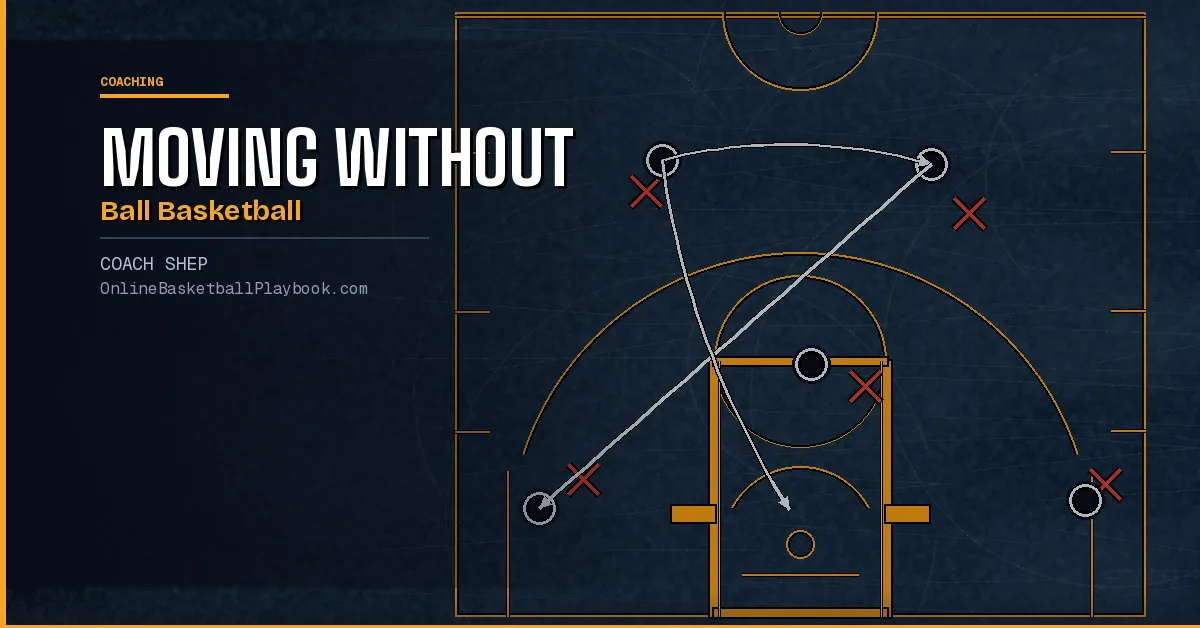
Most scoring opportunities are created before the ball arrives. Off-ball movement (cutting, spacing, screening, and reading the defense) is what separates players who get open from players who just stand and watch.
Why Off-Ball Movement Wins Games
Watch a possession where nothing is happening and you will almost always find the same root cause: four players standing still while one player dribbles. The ball-handler has nowhere to go because nobody has done anything to threaten the defense. The defense relaxes, sags, crowds the lane, and all but shuts down the offense.
Now watch a possession where the ball moves freely. At least two players are in motion at any given moment: one is cutting, one is relocating, one is coming off a screen. The defense cannot commit to stopping one man without leaving another open. That constant movement is what creates the seams the ball-handler needs to make a play.
Off-ball movement is not just about getting yourself open. Every cut you make pulls a defender and changes the angles for a teammate. Every time you screen for someone, you reshape the spacing of the entire half-court. Players who understand this become invaluable regardless of their scoring average, because they make everyone around them easier to play with.
The mental shift required is simple but hard to ingrain: your job does not begin when you catch the ball. Your job begins the moment your team gets possession. What you do in the two or three seconds before you even touch the ball determines whether you will be open when you receive it. That is the mindset of a skilled off-ball player, and it is something any player at any level can develop with the right habits.
The Four Types of Cuts
Cutting is the most direct form of off-ball movement. A cut is a purposeful change of direction intended to create a passing lane and get closer to the basket. There are four cuts every player should know, and each serves a specific purpose depending on what the defense is doing.
The V-Cut
The V-cut is the foundation. A player on the wing takes two or three hard steps toward the basket, selling the idea that they are going to cut through, then plants their inside foot and pushes sharply back out to the wing to receive a pass in a good shooting or driving position. The key is the commitment. A lazy V-cut is easy to defend; a hard V-cut forces the defender to react and creates a genuine opening at the catch point.
The Backdoor Cut
The backdoor cut is the counter to a defender who is overplaying the passing lane. When a defender is denying hard (arm extended, body cheating toward the ball), they are vulnerable on the other side. The offensive player plants hard with their inside foot and cuts directly to the basket in a straight line. Timing matters enormously here: the cut must happen at the moment the ball-handler can see it and deliver a bounce pass or lob before the help defense rotates. A backdoor that arrives too early or too late is just a turnover.
The Basket Cut (Give-and-Go)
After making a pass, many players stand and watch. The players who make offenses difficult to guard do the opposite. After delivering the ball to a teammate, they cut hard through the lane toward the basket. The defender guarding them is almost always watching the ball for an instant after the pass. That split-second is the window. The basket cut, executed right off the pass, catches the defense in transition and creates a layup opportunity off nothing more than deception and timing.
The Curl Cut
The curl cut happens when coming off a screen. Instead of popping out to the perimeter, the cutter reads that the defender is trailing behind them and curls tightly around the screener toward the basket. The shoulder of the cutter should nearly brush the screener on the way through. A defender who gets caught trailing cannot recover in time to contest a curl into the mid-post or lane area. The curl cut is the answer when a defender tries to fight over the top of a screen by trailing aggressively.
Spacing: The Foundation Underneath Everything
Cutting and screening only work if the floor is properly spaced. Spacing is the discipline of maintaining the correct distances between offensive players so that every pass is available, every driving lane is open, and no defender can simultaneously guard two threats.
The most common spacing breakdown at every level of basketball is players drifting too close to the ball. When three offensive players cluster on one side of the floor, a single defender can guard two of them, the lane clogs, and the ball-handler has nowhere to attack. The defense does not need to do anything sophisticated. They just have to stand in the right spot and let the offense crowd itself.
In a five-out spacing model, all five players are positioned on or near the three-point arc with good ball-side spacing between them. The driving lane from the top of the key straight to the basket is completely open, and the two corner players are in a position where a single defender cannot guard both the corner and the lane simultaneously. This is the environment where individual skill translates directly into team scoring: the ball-handler who beats their defender one-on-one will find an open shooter on the kick-out rather than another defender waiting in the paint.
Good spacers are active in their stillness. They are reading the ball, anticipating the next pass, and ready to shoot the moment they catch it. A player standing in a corner who is not mentally engaged is not spacing. They are just occupying real estate. True spacing means you are a threat from where you stand, which keeps the nearest defender from helping on the drive.
When a teammate cuts through the lane, the remaining players must relocate to fill the vacated space. This is called spacing discipline, and it is one of the hardest habits to build in team settings because it requires players to move without the ball, away from the action, for no immediate personal benefit. But the players who do it consistently are the ones who make their teams function.
Reading the Defense to Time Your Move
All the technical knowledge about cuts and spacing is only useful if you can read the defense and act on what you see at the right moment. Timing in basketball is the difference between an open layup and a turnover, and timing comes from reading the defense rather than running a predetermined sequence.
Read Your Defender First
Before every cut, look at your defender. Where is their weight? Where are their eyes? Which direction are they leaning? A defender whose head is turned toward the ball is vulnerable on the backside. A defender who is playing you tight and high is giving you the back door. A defender who has sagged off you and is protecting the lane has told you that you are going to catch the ball at the three-point line uncontested. Take the spacing position and make them pay with a shot.
Read the Ball Handler's Position
Your cut timing is dictated by the ball-handler's situation. When the ball-handler is attacking and drawing help defense, that is the moment to cut because the defender covering you is most likely to be distracted. When the ball-handler is in trouble and trying to get out of a trap, cut to open space to give them an escape valve. When the ball-handler has picked up their dribble, relocate immediately. The dead ball situation requires everyone else to find an open spot to relieve the pressure.
Never Cut into Traffic
One of the most common off-ball mistakes is cutting through the lane when another offensive player or their defender is already in the same space. This creates congestion, turns one defender into two defenders, and eliminates the spacing advantage that the cut was supposed to create. If a teammate is already in the lane, move in the opposite direction. Good off-ball players are always scanning the whole floor, not just watching the ball.
Using Screens as a Cutter, Not a Passenger
Screens are one of the most powerful tools in basketball, but most players underuse them because they treat the screen as something that happens to them rather than something they actively use. A great cutter reads the screen and makes a decision based on how the defense responds. They do not simply run the same route every time.
Set Up Your Cut Before Using the Screen
A screen is only useful if the defender is not already in position to hedge around it. Before using a screen, take a step or two away from the screen to create separation and force the defender to close out. Then use the screen on a sharp cut, not a wide, looping arc. The closer you pass to the screener's shoulder, the harder it is for the trailing defender to recover.
The Three Options Off a Screen
When using a ball screen or coming off a down screen, there are three reads available. If the defender goes under the screen and sags, pop out and shoot. If the defender fights hard over the top and trails you aggressively, curl toward the basket. If the defenders switch, the screener rolls or pops immediately because there is a mismatch to exploit. The offense wins when it reads and reacts to these three options rather than running a fixed route regardless of what the defense does.
Understanding how the defense is trying to cover the screen also affects the screener. A screener who reads that the on-ball defender is going to switch turns a potential screen into an automatic advantage. Their job becomes rolling to an open space to receive a dump-off pass before the defense can adjust. This is why screening and cutting are not separate skills. They are two halves of the same read.
Teach players to make eye contact with the screener before using a screen. This one habit alone improves screen execution dramatically. It forces both players to be on the same page about timing and forces the cutter to actually engage with the play rather than running on autopilot through the motion.
Drills to Build Off-Ball Habits
Off-ball movement skills are built through repetition in small-group drills before they are applied in five-on-five settings. The following drills address the most common breakdowns.
Two-Man V-Cut and Backdoor Drill
Two players and one passer at the top of the key. The wing player starts on the block and executes either a V-cut (the passer looks away, the wing cuts out) or a backdoor (the passer looks at the wing and the wing reads the overplay and cuts back). Run both reads in the same sequence without telling the wing which one to run. They must read the passer's eyes. This builds the habit of reading cues rather than running a memorized route.
Basket Cut Drill (Give-and-Go)
In groups of three: one passer at the top of the key, one player on the wing, one defender on the wing player. The wing receives the ball, passes it back to the top of the key, and immediately basket-cuts. The defender must recover. The passer at the top of the key delivers the ball if the cutter is open. If the cutter is not open, they clear to the corner. This teaches players to cut immediately off the pass and to make a quick read on whether the cut is viable.
Five-Out Spacing Walk-Through
No defenders needed. Five players in a five-out set, walking through the rule: when the ball moves, every player relocates. When someone cuts through the lane, the nearest player fills the vacated spot. Do this slowly and talk through every decision. Then run it at game speed. The goal is to make spacing automatic so it requires no conscious thought during live play.
Shell Drill with Cut Reads
Four offensive players against four defenders in a half-court shell. The offense passes and cuts. Defenders deny and help. Every time a cutter uses a backdoor and receives a layup, the defense runs. Every time a cutter goes backdoor and the defense gets the ball, the offense runs. This makes the read feel like it has consequences, and when players feel consequences, habits form faster.
- V-cut hard, not soft: Two or three real steps toward the basket before pushing back out. A lazy V-cut is defended easily. A sharp one puts the defender on their heels.
- Go backdoor when denied: The moment a defender extends their arm into the passing lane and cheats toward the ball, plant and cut directly to the basket. They have given it to you.
- Cut right off the pass: Do not stand and watch after passing. The defender's eyes go to the ball for a split second. Use that window to cut toward the basket immediately.
- Fill vacated space: When a teammate cuts through the lane, move to fill the spot they left. Good spacing is everyone relocating every time, not just the person with the ball.
- Read the screen, pick your route: Curl if the defender trails over the top, pop if they go under, look for the mismatch if they switch. Never run the same path blind regardless of what the defense does.
Want more basketball coaching strategies and drills?
Join the Online Basketball Playbook newsletter →
Draw this play free in the play drawer →
Membership: the full library, playbook packs, and Pro drawing tools →
Keep Building
Related breakdowns
Basketball Quick Hitters: 25 Sets by Action and Formation
Basketball quick hitters sorted by the action you want, catch-and-shoot to post feed, with each set's formation, diagrams, the read and the counter.
Princeton Offense Drills: Breakdowns, Shooting and Live Reps
Princeton offense drills that teach the reads: spacing, backdoor and hand-off breakdowns, 3-0 Chin and wave drills, Point shooting, a drive drill and an install.
Four Corners Offense Basketball: Roles, Rules and Versions
Four corners offense basketball: the set, the chaser, the corner and post rules, three versions, when to run it, the shots it hunts and shot clock limits by level.