Most coaches run the same practice structure week after week and then wonder why execution collapses in games. The mistakes are predictable and fixable once you know what to look for.
Drilling Skills Without Game Context
The most widespread practice mistake at every level is isolating skills so completely from game situations that players never learn when to use them. A player can make ten consecutive pull-up jumpers off a cone and then air-ball the same shot in a game because the defender's body angle, the clock, and the score all changed the picture.
Skills practiced without read-and-react moments become mechanical habits that get disrupted the instant a live defender shows a different look. When you run a ball-handling drill that ends with a layup every single rep, you are training your players to expect a layup at the end. Games do not end with layups on command.
The fix is constraint-based design. Add a defender at 50 percent speed. Put a shot clock on the rep. Vary the starting position of the help. Make the player read one piece of information (the hip angle of the on-ball defender, the position of the help, the score) and let that read determine the shot versus the pass. This is the difference between skill acquisition and skill application. Both matter, but most practices never get to the second one.
What This Looks Like in Ball-Screen Work
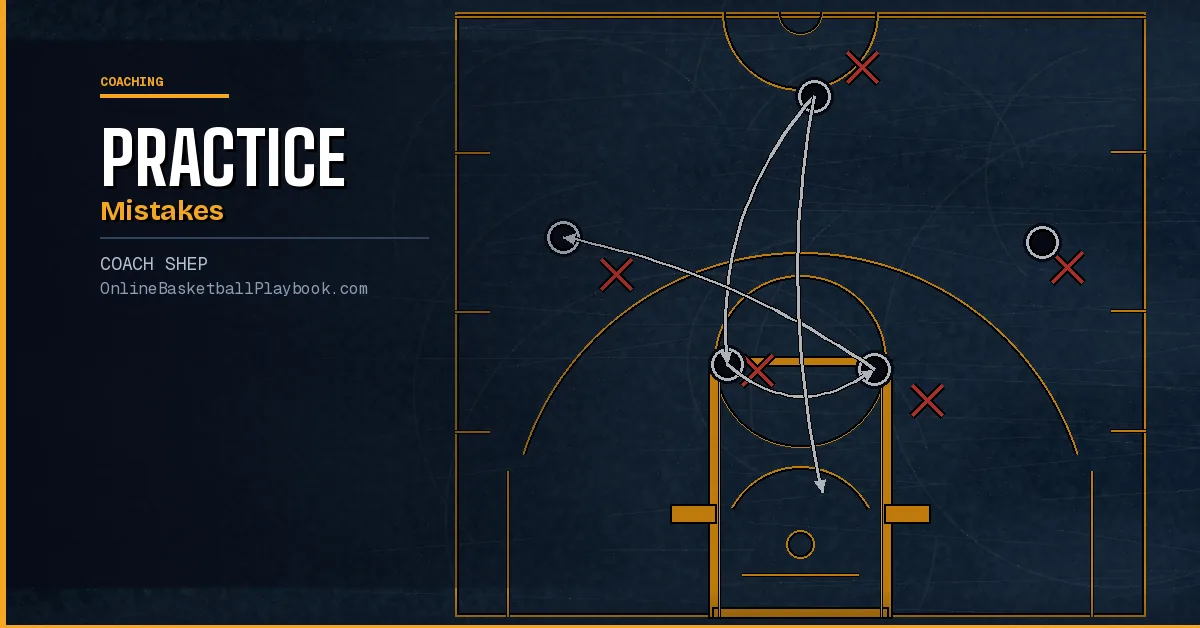
A common example is pick-and-roll drills that end the same way every time. The guard uses the screen, the big rolls, and the guard hits the roll man. Efficient rep, clean action, everyone feels good. But in a game, the defense shows a drop coverage and the roll is taken away entirely. The guard has no trained response because the drill never included a defensive variable. Add a defender playing drop and suddenly your guard has to make a real read, shoot off the top of the screen versus attack the drop versus skip to the weak corner. That three-way read is the skill. The footwork is just the vehicle.
Skipping the Defensive Read
Coaches spend hours installing offensive sets and maybe thirty minutes on defense, and what they call "defense" is usually a drill that tells defenders exactly where to go. When a team faces a read it has never practiced, it panics and over-helps, giving up the corner three or getting cross-matched on a roll.
The specific mistake is teaching a coverage (say, a drop on ball screens) without teaching the protection layer that makes the coverage work. Every coverage has three phases: the two players on the ball doing their job, the three players off the ball providing protection, and then the recovery or closeout after the pass. Most teams only practice the first phase. They drill the on-ball coverage and then wonder why an offense that kicks it out beats them every time.
The off-ball protection has to be practiced as deliberately as the on-ball coverage. Who is the low man when the big drops? What does he do if the screener pops instead of rolls? What if the screener flares to set a screen for a wing? These are not complicated reads, but they require reps with actual decision-making built in. A walkthrough of rotations is not a substitute for live reads at game speed.
Name the Phase That Broke
One of the most practical coaching habits when reviewing defensive breakdowns is to stop asking "what happened?" and start asking "which phase failed?"If the coverage was correct (your on-ball guys handled the screen), but the offense still scored, the problem is in the protection or the recovery. That diagnosis changes what you drill the next day. Sending your whole team back through an on-ball coverage drill when the problem was a missed rotation wastes twenty minutes and teaches nothing new.
Teaching Too Much at Once
A practice plan with six new concepts is not ambitious. It is a guarantee that your players will master zero of them. The human brain consolidates new motor patterns during rest, not during instruction. When you layer new information on top of information that has not yet automated, you get the opposite of what you want: tentative players thinking through movements that should be reflexive.
The best practice plans are built around one or two central ideas at most. Every drill in practice either installs that idea, practices it in a new context, or checks whether it transferred. The coach who runs a five-drill progression on ball-screen coverage (starting with shadow footwork, then live two-on-two, then live with protection, then five-on-five with a scout look) is teaching one thing, but teaching it thoroughly. The coach who hits five different defensive schemes in a ninety-minute practice has given everyone something to think about but nothing to do automatically.
This also applies to language. The vocabulary you use in practice is the vocabulary players hear in their heads during a game. Pick the words deliberately and keep them consistent. When the big calls a coverage, that call should trigger an automatic physical response from every other player on the floor, no processing required. That automatic response only exists if the language has been drilled alongside the action enough times that they are inseparable. New terminology every week breaks that link.
Ignoring Transition Situations
Half-court offense and defense get the majority of practice time at most levels, but transition (both offensive and defensive) accounts for a large share of actual possessions in a game and an even larger share of momentum swings. Teams that are disciplined in transition have usually practiced transition explicitly and repeatedly. Teams that fall apart in transition have usually just hoped it would work out.
The specific mistake on the offensive side is practicing five-on-zero transition drills. Players run in lanes, catch, shoot, score. Nothing about this drill prepares them for a scrambling defense getting back, a sprint-back defender cutting off a lane, or a help defender forcing a pull-up instead of a layup. Five-on-zero transition drills build conditioning and lane spacing habits, but they do not build decision-making. Add even two defenders in scramble mode and the drill becomes a completely different exercise.
On the defensive side, most teams practice no defensive transition at all. They go from a half-court shell drill to a half-court zone and never practice getting back, identifying the ball, and matching up after a change of possession. The first time a turnover happens in a game, players default to the recovery habits they have built, and if those habits come from practice, they are probably poor ones. Sprint-back rules, who calls out the ball, how to handle a numbers disadvantage: these need to be practiced, not hoped for.
No Accountability System for Mistakes
Practice culture is set by what a coach allows to happen without consequence. If players can stand in their spots during defense and no one comments, that becomes the standard. If a missed defensive rotation gets glossed over because the offense made a nice play, the team learns that rotations are optional when the offense executes well. Over time, these small allowances compound into a team that has no standard at all.
An accountability system does not have to be punitive. It just has to be consistent. A simple standard might be: any defensive breakdown gets identified, named, and corrected before play continues. Name the phase (coverage, protection, or recovery) so the player knows what to fix and everyone else reinforces the right mental model. If the on-ball coverage was right but the low man cheated toward the roll and the corner three went up, say "low man read the flare" once, clearly, and move on. Repeated. Every time. That repetition is how a standard becomes culture.
What does not work is the vague critique. Telling a player "you have to be better there" after a defensive breakdown teaches nothing. Players do not respond to abstractions in the middle of a practice rep. They respond to specific information about a specific moment: what they did, what the decision actually was, and what the correct choice looks like. Give them that, and you can hold them accountable without creating anxiety that kills decision-making speed.
Over-Rotating in Help Defense Drills
There is a paradox in coaching team defense: the more you emphasize helping, the more you can train players to over-help. A player who is always looking to rotate early takes himself out of position, leaves his man open, and creates a situation where the offense now has an easy pass that leads to a better shot than the one the initial defense stopped. The goal of team defense is to stop the ball and contest every shot, not to rotate to every drive and leave a corner three uncontested.
Over-helping is as damaging as under-helping, but it gets less attention because it looks like effort. A player sprinting to help on a drive looks like they are doing the right thing even when they are abandoning a wide-open shooter in the corner. The coaching correction has to be specific: your job on that drive was to be the insurance, not the first responder. Stay in your position until the primary coverage breaks down. Know your role in the protection scheme and execute it. Do not freelance.
The drill fix is to install named assignments. Give every off-ball defender a specific role in a given coverage, use that name consistently, and hold them to it. When the low man is named and has a clear responsibility (track the roll, cover the flare, own the corner), he stops freelancing because he has a job that is just as real as the on-ball defender's job. The backside help defender who reads roll versus flare is doing something precise and coachable. The player who "just helps" is guessing.
Before your next practice, write down the three phases of your primary ball-screen coverage: what the two on-ball players do, what the three off-ball players do, and what the recovery looks like after the first pass. If you cannot write all three in two minutes, your players definitely cannot execute all three under pressure. That gap is your starting point.
- One concept per practice: pick one defensive or offensive idea, build every drill around it, and check whether it transferred in your five-on-five segment at the end.
- Name every off-ball role: low man, X-out, weak-side, goalie. Give players a specific title and a specific trigger so they never have to guess what "help" means in a given moment.
- Add a read to every drill: replace at least one drill per practice with a version that includes a live defensive variable (even a half-speed defender) so players build decision-making alongside the skill.
- Identify the phase before correcting: When a defensive breakdown happens, name coverage, protection, or recovery before addressing it. This keeps corrections specific and players focused on the right mental model.
- Practice transition explicitly: run at least one live transition segment per practice with defenders in scramble recovery, not five-on-zero. Defensive habits in transition only exist if they have been built in practice.
Want more basketball coaching strategies and drills?
Join the Online Basketball Playbook newsletter →
Draw this play free in the play drawer →
Membership: the full library, playbook packs, and Pro drawing tools →
Keep Building
Related breakdowns
Fun Basketball Games for Practice: Scored Games for Any Team
Fun basketball games for practice at any level: shooting games, defense-only scoring, rebounding contests and passing games, with scoring rules and records.
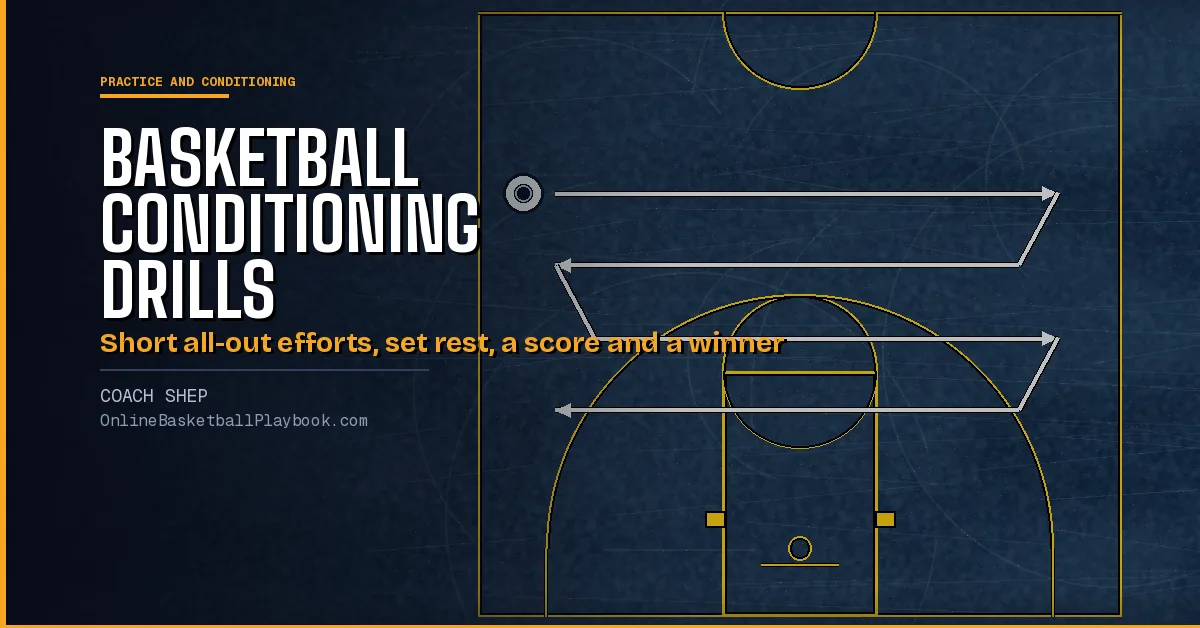
Basketball Conditioning Drills for Teams: Runs, Games and Tests
Basketball conditioning drills in three styles, timed runs, conditioning inside skill drills and scored games, with the tests and yearly plans coaches use.
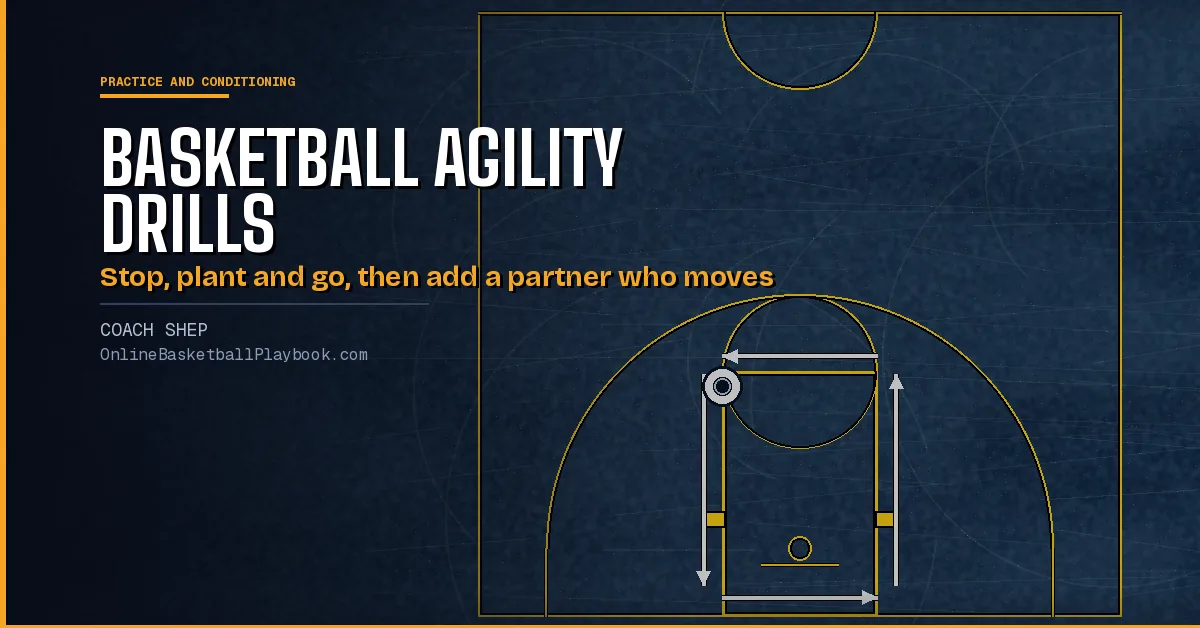
Basketball Agility Drills: Cone, Reaction and Ladder Drills
Basketball agility drills from timed cone tests to reaction, mirror and ladder drills and defensive circuits, with schedules and where coaches differ.