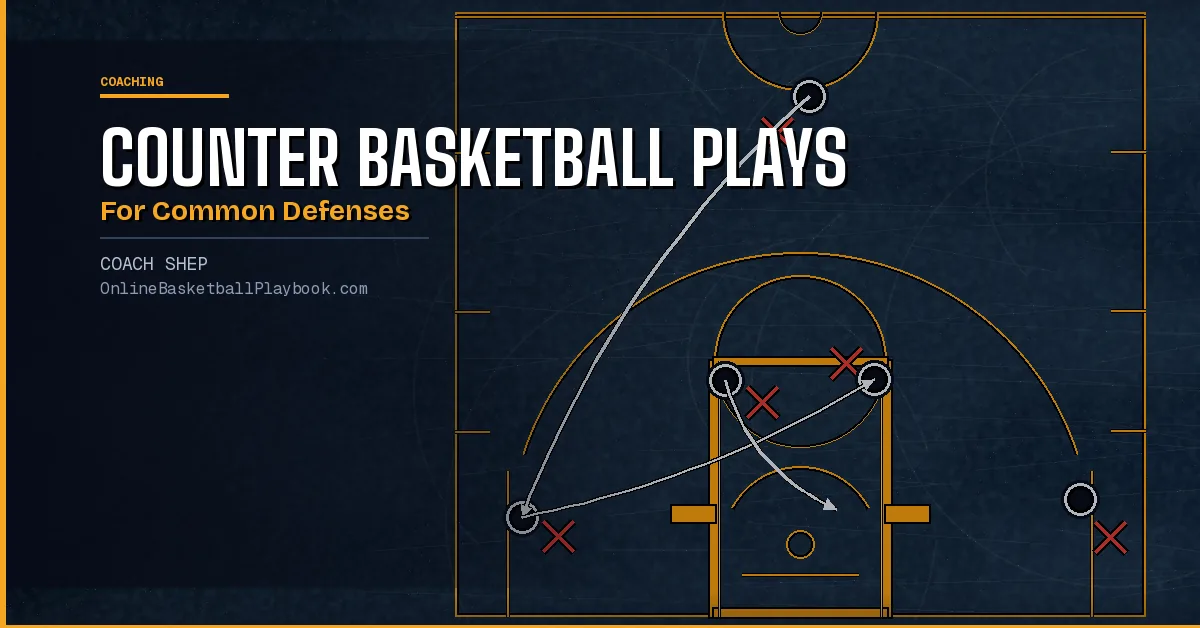
Junk defenses (the box-and-1, triangle-and-2, and their cousins) show up at least once every season. The teams that handle them calmly win. Here is exactly how to attack each one.
Recognize the Defense in Two Possessions
The single biggest advantage an offensive team can have against a junk defense is early recognition. When your players identify the box-and-1 in the first possession instead of the second quarter, you have stolen a mental edge that most teams never recover.
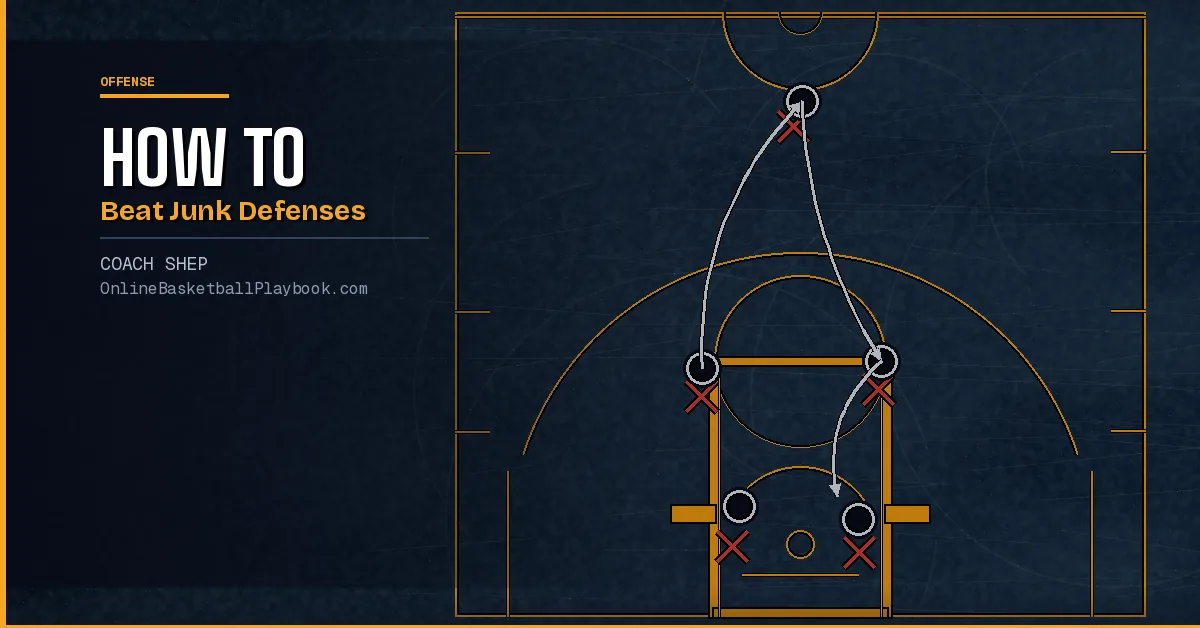
Here is what to look for. If one defender is ignoring the ball completely and tracking your best scorer from the moment he crosses half court, you are looking at a chaser. Count the remaining four defenders: if two are high and two are low in a rough box shape, call box-and-1. If three are playing a triangular zone near the lane, with one baseline, one elbow, and one at the top of the triangle, and a second chaser is denying your second scorer, call triangle-and-2.
The identification drill is something every team should run at least once before the season. Walk your players through the box-and-1, the diamond-and-1, and the triangle-and-2 in a single practice. Not to install all three as defenses, just so your players can name what they are facing within one possession. Recognition speed is the first offensive advantage, and it costs nothing to develop it.
Once players know the name, they know the counter. That is the whole system. Calm recognition leads to calm execution, and calm execution is what breaks junk defenses. Junk defenses are frequently installed without sufficient opponent-specific practice time. The handoff timing between the man-defender and the zone component breaks under sustained offensive pressure. An offense that stays composed and moves with purpose will find the gaps within three or four possessions regardless of which junk look is being thrown at them.
Countering the Box-and-1
The box-and-1 has one built-in structural flaw: the zone component only covers the perimeter with two high defenders. That means skip passes and ball reversal can generate open looks before the box rotates. The offense needs to exploit this consistently rather than trying to win through isolation.
Use the Star as a Decoy
The most effective single counter to the box-and-1 is also the most counterintuitive: do not try to free the star from the chaser. Trying to shake a dedicated chaser with isolation dribbles plays directly into the defense's design. Instead, use the chased player as a decoy.
Send the star to the far corner, away from the ball action. The chaser has to follow. That is the whole scheme. With the chaser occupied on the weak side, run four-man offense on the strong side. Set a back-screen for a cutter, run a dribble hand-off, or get a post touch with the zone defender out of position. The star cuts hard from the opposite corner as a late cutter, and if the box collapses to the ball, the star is open for a catch-and-finish.
Back-screens are especially valuable because the chaser cannot hedge. The box zone provides no help on screens for non-chasers, so one crisp back-screen frees a cutter completely. One or two of these per half and the defense starts making adjustments, which opens up the next action.
Spread the Floor and Run the Zone
The star who does touch the ball should work within the zone gaps, not against the chaser. Sprint into the seams between the high and low box defenders. Force the box to make a rotation decision. A star dragging the chaser through the zone disrupts the box alignment and creates open looks for role players on the perimeter, which is a better shot than a one-on-one against a fresh, rested chaser.
Four offensive players spread to corners and wings forces each box defender to cover maximum court before the star even touches the ball. A box defender who has to sprint to close out a corner three is not in position for the next rotation. Make the box rotate six or seven times before the first shot attempt. Zone defenses fatigue under sustained movement; the chaser is burning even faster under full-denial effort.
The Four-Man Offense Concept
Another direct structural counter: park the chased player in the far corner and run four-man offense with everyone else. This forces the zone component (which now has only four players covering all four remaining attackers) to guard maximum spacing with no numerical advantage. The zone's structural edge disappears immediately. This is particularly effective against a box-and-1 because the box zone is designed around having one defender freed from zone responsibilities (the chaser). Remove the star from the equation and the box has to guard four attackers like a standard zone, which it cannot do efficiently against proper spacing.
Countering the Triangle-and-2
The triangle-and-2 is more aggressive and more physically demanding than the box-and-1, but it carries a larger structural flaw. Three defenders covering a triangle zone instead of four means every zone gap is wider. Add sustained ball movement and the triangle breaks faster than the box.
Overload One Side with Both Stars
The most direct counter is the same-side overload. Put both chased players on the same side of the floor simultaneously. When two chasers are forced to work the same side, the triangle zone loses its shape: one of the triangle defenders must help cover a star, creating confusion between their man and zone assignments. The triangle becomes disorganized, the gaps widen, and patient ball movement finds the open attacker.
This requires the two stars to trust each other and execute the positioning without the ball. One cuts to the strong-side corner, the other sets up at the strong-side wing or elbow. Both chasers collapse there. The remaining three non-stars run motion on the weak side against a triangle that now has a missing piece.
When the Triangle Fails Fastest
The triangle-and-2 fails quickly against teams with three or more real offensive threats. If three of your players shoot above 33 percent from three, the triangle does not have enough zone coverage to contain the perimeter. The math stops working almost immediately. Attack the baseline triangle defender on the weak side. That defender has the longest rotation sprint in the entire scheme, and a skip pass followed by a ball reversal will catch them late on the close-out.
Run the triangle-and-2 counter in short bursts. Two consecutive possessions of same-side overload forces the defense to make a rotation adjustment mid-game. Their adjustment reveals the next gap. Read it and attack.
Ball Movement as the Universal Weapon
Every junk defense (the box-and-1, the triangle-and-2, the diamond-and-1, and any hybrid variation) shares the same weakness. The handoff timing between the chaser (man defender) and the zone component is rehearsed less than a base defense. Coaches install junk defenses as game-plan weapons with limited practice repetition. The rotations break under sustained, patient pressure.
The universal counter is not a specific play. It is a tempo and mentality. Move the ball before the defense can reset. Do not isolate. Do not freelance. Do not let the chased player try to solve the defense alone. That is exactly what the defense wants. Make the zone rotate five, six, seven times before a shot goes up. Screens, hand-offs, skip passes, reversal, short roll reads: keep the ball moving and the defense moving with it.
The skip pass to the opposite wing is one of the most reliable weapons against the box zone specifically. The two high box defenders cannot cover both wings simultaneously on a quick skip. A shooter who can catch and fire before the closeout arrives will put the defense in rotation trouble on every possession. If the team has even one reliable skip-pass shooter, feature that action early. It forces the high box defenders to cheat toward that shooter, which creates backdoor cuts and post entries on the other side.
Role players need to understand their assignment in these situations. Their job is not to score. Their job is to relocate, catch, threaten, and move the ball before the zone can recover. Role players who stand still against a junk defense make the defense's job easy. Role players who sprint to open gaps, catch without hesitation, and make the next pass within one second are what force the zone into broken rotations.
Non-stars should spread to corners and wings on every possession when facing a box-and-1. The goal is not the corner three. It is keeping each box defender pinned wide so they cannot help interior. When a box defender leaves the corner to help on the star, the corner shooter catches and shoots. When the box defender stays in the corner, the star has a cleaner touch. The spacing decision forces the defense to choose, and the offense wins either outcome.
Installing the Counter in Practice
The counter to junk defenses should be installed in the same practice block as the junk defense itself. This is one of the most efficient uses of practice time available to a basketball coach. Walk through the box-and-1 as a defense, then immediately walk through the offensive counter. Players understand the defense better when they see why the counter works. The defensive lesson (why the box rotates that specific way) becomes concrete when they have played both sides of the action.
A 20-minute practice block is enough to install the box-and-1 recognition, the star-as-decoy counter, and the four-man offense concept. Run it in late October and the team has a named response available for the rest of the season. No scrambling, no panic, no calling timeout to draw something up from scratch. The players have the call. They know what it means and they know how to run it.
What the Scouting Identification Drill Looks Like
At the start of the practice block, run five possessions of offense against no defense. Then bring in the box-and-1 with a designated chaser. No instructions to the offense. Just play. After two or three possessions, stop and ask: what are we facing? If players cannot name it, walk through the visual cues again. One defender ignoring the ball equals a chaser. Two high and two low equals a box. Once the team names it in under two possessions, the drill is done. Move to the counter.
Run the same identification drill for the triangle-and-2. Two chasers, three zone defenders in a triangle. Walk through the same-side overload counter: both stars on one side, three non-stars running motion on the weak side. Run it live for five possessions. Then shift back to base offense. The session is complete.
Pre-Game Preparation Against a Known Junk Defense Team
When scouting reveals an opponent who uses the box-and-1 regularly, the preparation shifts. Review the film clip of their chaser with your star player before the game. Point out the chaser's screen-fighting tendencies. Do they fight over the top of screens or go under? If they go under, the counter is a quick hand-off into a pull-up. If they fight over the top, the counter is a hard back-screen from the star that locks the chaser in traffic.
Establish before tip-off which player will be the primary chaser target and which counter the team will run first. Call it in the first possession, not after the defense has already gotten three or four consecutive stops. Running the counter before the defense feels comfortable sends a signal that you recognized the scheme immediately and are not rattled. That psychological edge matters, especially in close games.
Before any game where you might call the box-and-1 yourself, pre-decide the foul-trouble contingency: if your chaser picks up two fouls in the first half, know in advance whether you are shifting to pure zone or pure man. Do not leave this decision for in-game improvisation. Name the backup call before the game starts so the team never flounder in a broken hybrid when your best chaser has to sit.
- Star as decoy first: Send the chased player far from the ball on the first two possessions. The chaser follows, creating four-on-four on the strong side with no chasers involved.
- Back-screens before isolation: One hard back-screen per possession frees a cutter cleanly because the box zone cannot hedge; the chaser has no help.
- Skip-pass shooter on the weak side: Station your best catch-and-shoot player opposite the ball. The two high box defenders cannot close out quickly enough on a skip. Get the shot off in under two seconds.
- Same-side overload vs. triangle-and-2: Both stars to the strong side simultaneously; the triangle loses a defender to confusion and the weak side opens up for the non-stars.
- Count rotations, not shots: Make the box rotate six or seven times before the first attempt; the zone fatigues faster than the offense under sustained movement.
Want more basketball coaching strategies and drills?
Join the Online Basketball Playbook newsletter →
Draw this play free in the play drawer →
Membership: the full library, playbook packs, and Pro drawing tools →
Keep Building
Related breakdowns
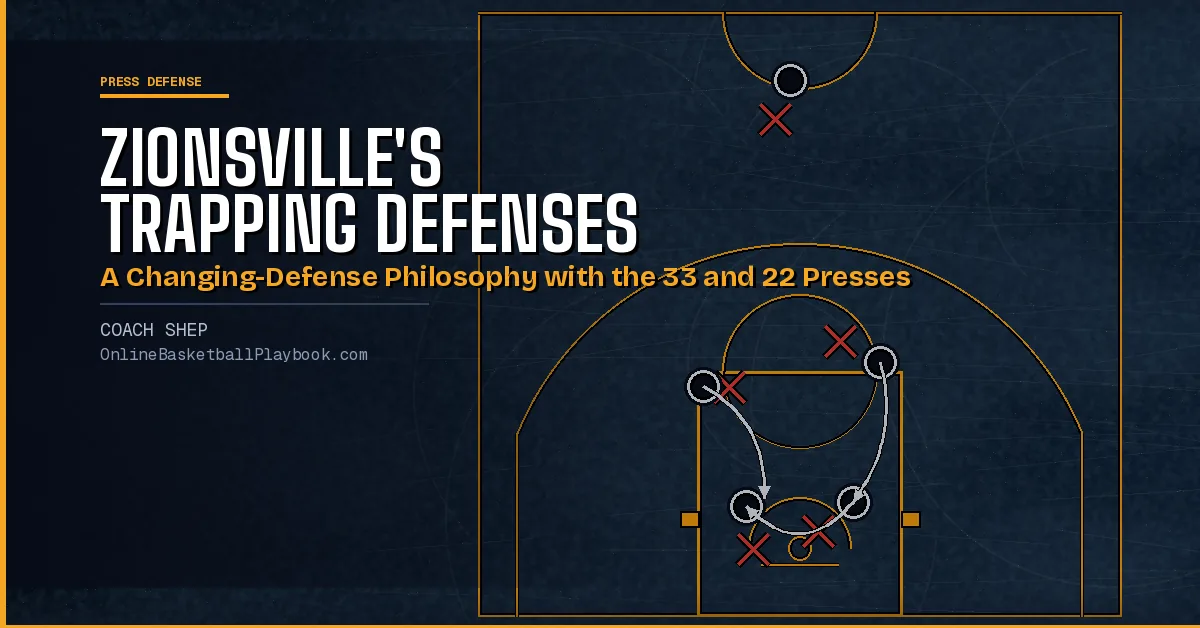
Changing Defenses in Basketball: Three-Quarter and Half-Court Traps
A changing defense taxes an opponent's prep time: a three-quarter 1-3-1 trap, a half-court trap, and a Run & Jump variant that ends in deny-everywhere.
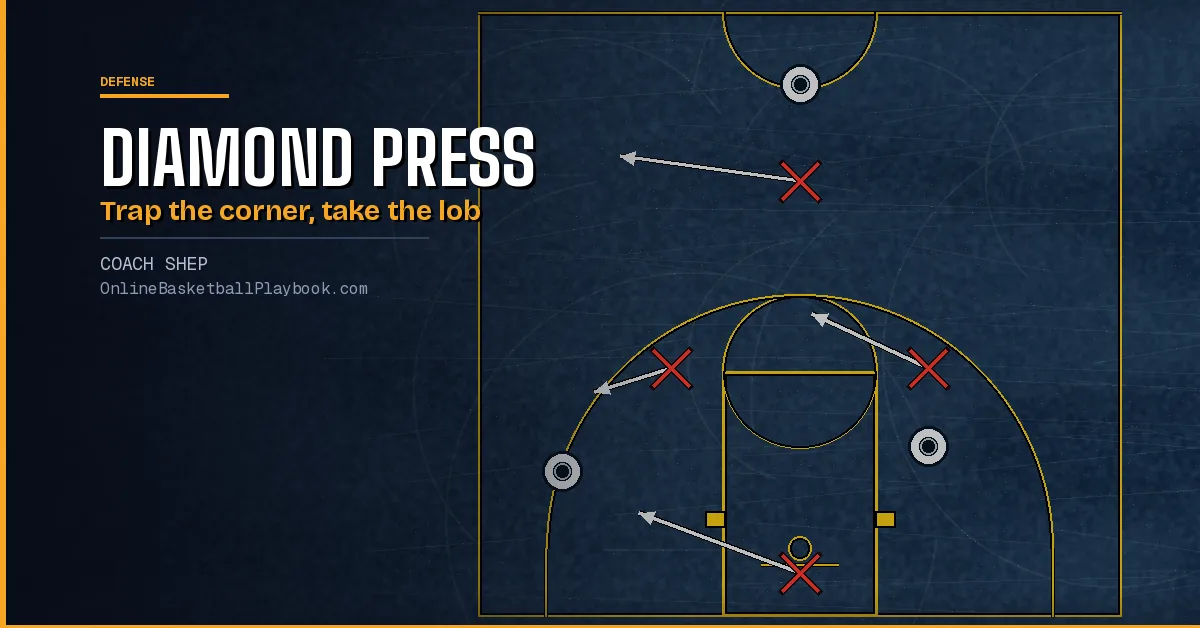
1-2-1-1 Diamond Press Basketball: Roles, Traps and Install
How to run the diamond press in basketball: who plays each role, how to trap the corner, what to do on the reversal and the lob, and how to install it step by step.