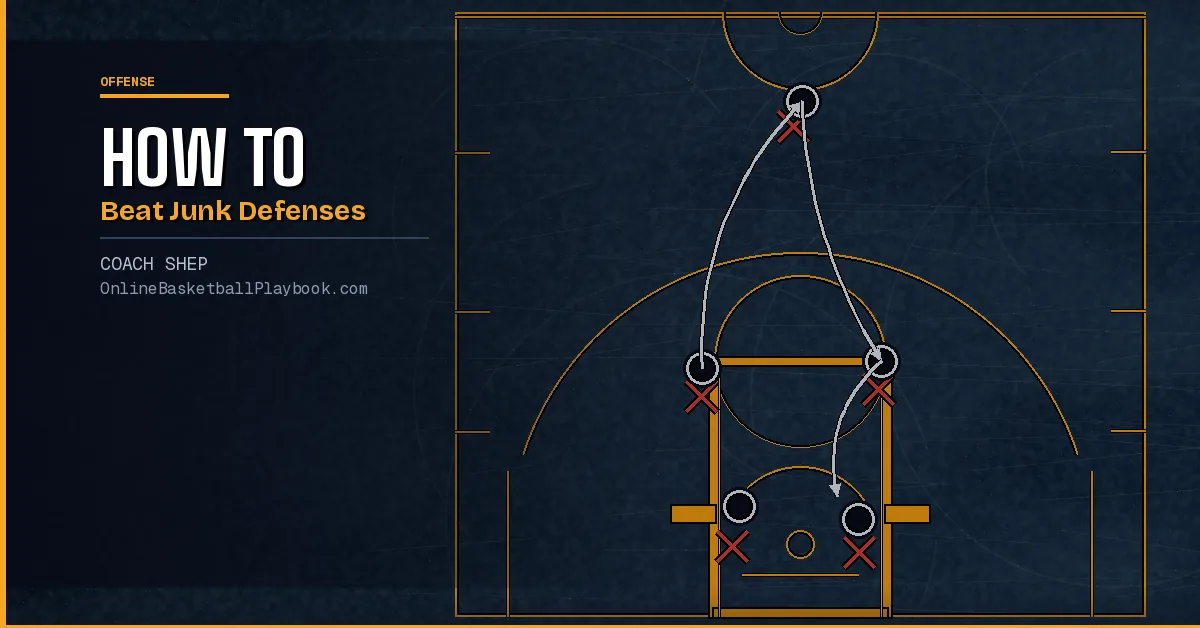
Junk defenses catch coaches off guard because they're designed to. Learn to recognize the box-and-1, triangle-and-2, and diamond-and-1 fast, then attack each one with the right counter before they steal a quarter.
What Makes Junk Defenses Different
A junk defense is not a base defense. It is a game-plan weapon, a hybrid man-zone combination deployed specifically because your offense is built around one or two identifiable scorers. The coach across from you has watched your film, picked your best player, and designed a system to make that player irrelevant for as long as possible.
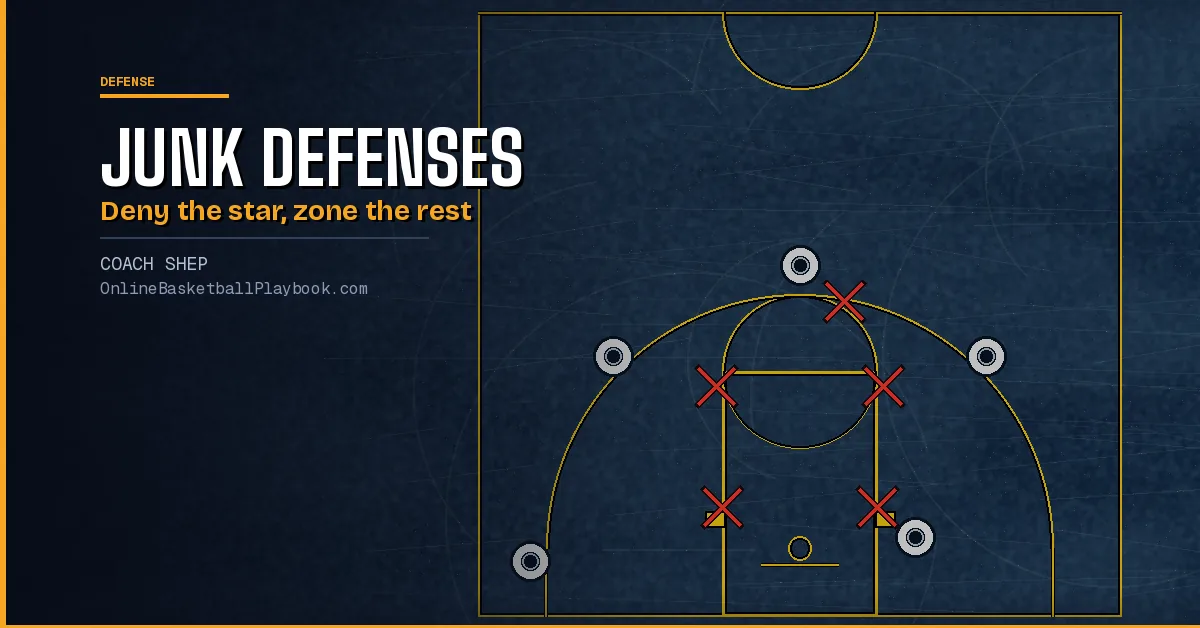
The three forms you'll face most often are the box-and-1 (one dominant scorer), the triangle-and-2 (two dominant scorers), and the diamond-and-1 (a dominant post scorer surrounded by shooters). Each works on the same logic: assign one or two defenders exclusively to your best players, cover the rest of the floor with a zone, and dare your role players to beat them.
At the youth and high school level, surprise value is real. Opponents frequently misidentify the defense on the first possession, calling the box-and-1 a "zone" and running their zone offense, which feeds directly into the defense's hand. The team that recognizes the junk look within one possession already has a significant mental advantage. That recognition is a coachable skill, and it starts in practice.
Junk defenses also have a shelf life. Coaches typically deploy them in 3-to-5 possession bursts, not for full halves. The hybrid is psychologically disruptive more than it is structurally dominant. It breaks the offensive team's rhythm and forces the star to reset mentally. If your team stays calm, moves the ball, and executes the right counter, the defense burns out on its own. Panic is what keeps it alive.
Recognizing the Box-and-1 in Two Possessions
Your first job when you see something unusual is to name it. The wrong offensive counter makes each junk defense more effective, not less. Running a standard zone offense against a box-and-1 is exactly what the defense wants. Here is what to look for.
In a box-and-1, one defender follows your best scorer everywhere: through screens, off the ball, on the inbound. That defender has no zone responsibilities. The other four defenders form a box: two high defenders near the elbows who close out on wing catches, and two low defenders who own the low post and corners. If your star catches in spite of the chaser, all four box defenders collapse toward the ball, creating a help structure designed to force a pass to the perimeter.
The tell is the chaser. Watch the defender who is ignoring the ball and tracking a single player. If one defender is in full denial on your star (body turned, hand in the passing lane, fighting over every screen) while the other four hold a zone shape, you are looking at a box-and-1. Name it on the sideline immediately. Signal your players. The first two possessions are your diagnostic window.
For the triangle-and-2, the tell is two chasers instead of one. Two defenders are in full denial on your two best scorers simultaneously. The remaining three defenders form a triangle zone: two along the baseline and one near the elbow at the top of the triangle. The zone is thinner (three players covering the space four normally cover) and it breaks faster, but it also takes two of your weapons off the board at once.
How to Attack the Box-and-1
The most common mistake against the box-and-1 is running isolation plays for your star. That is playing directly into the defense's hands. The chaser's job is to deny and exhaust the star in isolation. The star's job, when facing a box-and-1, is to make the box zone work harder than it can sustain. That means movement, not isolation.
Make the Star a Zone Disruptor, Not an Iso Scorer
Your star should sprint through the zone gaps and force the box defenders to make rotation decisions. When the star drags the chaser through the high post, the box defenders must choose between their zone assignments and helping on the star. That choice (made at speed, with live defenders) opens gaps for role players. The star dragging the chaser through a crowded zone is doing more offensive work than an isolation dribble from the top of the key.
Spread Four Players to the Corners and Wings
The box has only two high defenders covering the perimeter. If you put four offensive players on the perimeter, corners and wings, those two defenders cannot close out on everyone. A box defender sprinting to deny a corner catch is out of position for the next rotation. Patient ball movement from corner to corner stretches the box until a high-percentage look opens. Do not rush. The zone fatigues under sustained ball movement.
Use the Star as a Screener and Cutter
The most dangerous version of your star in a box-and-1 is not a scorer. It is a cutter the defense has lost track of. When the star sets a back-screen for a teammate while the chaser trails, the chaser cannot hedge and the box zone provides no help. One back-screen per possession earns a layup more reliably than five dribble moves against a locked-in chaser. A late cut from the opposite corner, the "star as decoy" counter, frees the star at the rim precisely because every defender has been watching the four-man offense on the other side of the floor.
Run the Four-Man Offense
Put your chased star in the opposite corner and run offense with the other four players. Now the box zone has four zone defenders guarding four attackers, no structural advantage, no numerical cushion. The chaser burns energy following the star to the corner while contributing nothing to the defensive structure. Meanwhile, your four non-stars operate against a zone that no longer has a spare defender. This is the cleanest geometric counter to the box-and-1 and it requires zero elite skill to execute, just spacing and ball movement.
Countering the Triangle-and-2
The triangle-and-2 is more aggressive and more demanding than the box-and-1, and it fails faster when you know the specific counter. Two chasers burning at full denial intensity for an entire half is not sustainable. Your job is to make them pay for the effort before the defense gets pulled.
Put Both Stars on the Same Side
When both chased players are on the same side of the floor simultaneously, the triangle zone loses its shape. One zone defender must help cover the star, and one chaser must cover the triangle's vacancy, creating role confusion in both assignments. The triangle zone is thin to begin with; forcing it to defend two threats in the same quadrant breaks the geometry entirely. Move both of your top scorers to the same side, watch the defense scramble, and attack the opposite side with the remaining three offensive players against two zone defenders.
Work the Weak Side with Non-Stars
With two chasers occupied on the ball side, the triangle zone has only three defenders covering the weak side and the paint. Quick ball reversal, from the overloaded side to the weak side, forces those three defenders to rotate against four attackers. One of your role players will be open. The catch-and-shoot opportunity will exist if your ball movement is faster than the triangle's rotation. Make four or five passes before the first shot attempt. Do not rush the open look.
Attack the Triangle's Paint Vulnerability
The triangle zone is thinner at every position compared to the box-and-1, one post defender instead of two low box defenders. A strong player posting up on the baseline overloads the triangle's single paint defender. The triangle cannot rotate from the perimeter to the post without leaving a corner open. Use the high-low: one player at the elbow, one in the low post, ball movement between them until the triangle collapses, then kick to the open corner shooter. The triangle's perimeter thinness is the other lever. Skip passes find open shooters when the triangle's two baseline defenders are stuck on the ball side.
The Diamond-and-1 and Other Hybrids
The diamond-and-1 replaces the box with a diamond shape: one top defender, two wing defenders, and one post defender inside. The defense trades interior protection for perimeter coverage, three outside defenders instead of two. Coaches use it when the opponent's dominant scorer is a post player surrounded by perimeter shooters. The standard box-and-1 leaves the high post too exposed against that profile; the diamond solves it.
Against the diamond-and-1, attack the corners and the baseline. The diamond has only one inside defender. Two post players (one at the high post, one at the low post) force the inside defender to choose. The top diamond defender cannot help inside without leaving the high post open. Ball reversal from wing to corner is faster than the single wing defender's close-out. A corner three against a late close-out is a high-percentage look your team should run repeatedly until the defense adjusts.
Other hybrid variants (zone-man combinations you have not seen before) all share the same structural flaw: one or two defenders are spending 100% of their energy on denial while a zone covers the rest. Find the zone's thinnest point, make ball movement faster than the zone's rotation, and attack the gaps with role players. The specific shape changes; the counter logic does not.
Scouting identification matters here. Run the full junk defense family against your own team in practice (box-and-1, diamond-and-1, triangle-and-2), not to install all three, but so your players can name what they face within one possession. Recognition speed is the first offensive advantage. A player who says "box-and-1, four-man offense" in the huddle after the opening possession has already won the recognition battle. A player who spends the first quarter confused is giving the defense free possessions it has not earned.
Before calling any junk defense in a game, pre-decide your foul-trouble contingency. If your chaser picks up two fouls in the first half, the defense loses its fundamental mechanic. Name the backup chaser in advance, or name the defensive call that replaces the hybrid entirely, pure zone or pure man. Do not leave this decision for in-game improvisation; a coaching staff that hesitates mid-game on a blown chaser assignment surrenders possessions to confusion rather than talent.
Practice Protocol: Install the Counter in 20 Minutes
You do not need a full practice to build the offensive counter. A focused 20-minute block installs the recognition drill, the four-man offense concept, and the star-as-decoy cut. Run it once before the season and the response is available any time you need it.
Start with the recognition drill. Walk five players onto the floor in a box-and-1 alignment and give the offensive team ten seconds to call it correctly. Rotate through the triangle-and-2 and diamond-and-1. Do this five times each. Players who can name the defense in ten seconds can name it in a live game within one possession. Move on only when every player calls it correctly.
Next, install the four-man offense. Put your best scorer in the opposite corner. The other four players spread the floor and move the ball. Emphasize: the star stays away. Run four or five passes, find the open look, shoot. Run it until it is automatic, until the players stop wanting to throw it to the star immediately. The urge to feed the star is the biggest obstacle. Train against it.
Finally, walk through the star-as-decoy cut. The star sets a back-screen or cuts baseline from the opposite side while the four-man offense occupies the chaser and the box. Time the cut so the star arrives at the rim when the ball is on the opposite wing. Catch, finish. Run it three times. The timing is simple; the discipline to wait for the right moment is what needs practice.
Twenty minutes. Three concepts. One named call your players can execute under pressure. That is the investment required to take any junk defense away from the opponent who spent a week installing it against you.
- Name it in one possession: One defender ignoring the ball and tracking a single player is the box-and-1 tell. Call it immediately on the sideline and signal the four-man offense.
- Star goes to the opposite corner: Remove the star from the primary offensive action. The chaser burns energy following the star to the corner while four players run offense against an undermanned zone.
- Skip passes attack the box: The box-and-1 has only two high defenders on the perimeter. A skip from corner to opposite wing forces a long close-out sprint that often arrives late. Take that shot every time it opens.
- Same-side overload breaks the triangle-and-2: Both chased players on the same side collapses the triangle zone's geometry. Attack the weak side with three players against two zone defenders.
- Patient movement wins every time: Zone defenses (and the chasers in front of them) fatigue under sustained ball movement. Make six passes before the first shot attempt. The junk defense cannot sustain its intensity beyond three to five possessions at full effort.
Want more basketball coaching strategies and drills?
Join the Online Basketball Playbook newsletter →
Draw this play free in the play drawer →
Membership: the full library, playbook packs, and Pro drawing tools →
Keep Building
Related breakdowns
Junk Defense Basketball: Box and 1, Triangle and 2, When to Use
Junk defense basketball explained: the box and 1, diamond and 1, triangle and 2 and inverted triangle, when to call one, what it costs and how offenses beat it.
Changing Defenses in Basketball: Three-Quarter and Half-Court Traps
A changing defense taxes an opponent's prep time: a three-quarter 1-3-1 trap, a half-court trap, and a Run & Jump variant that ends in deny-everywhere.