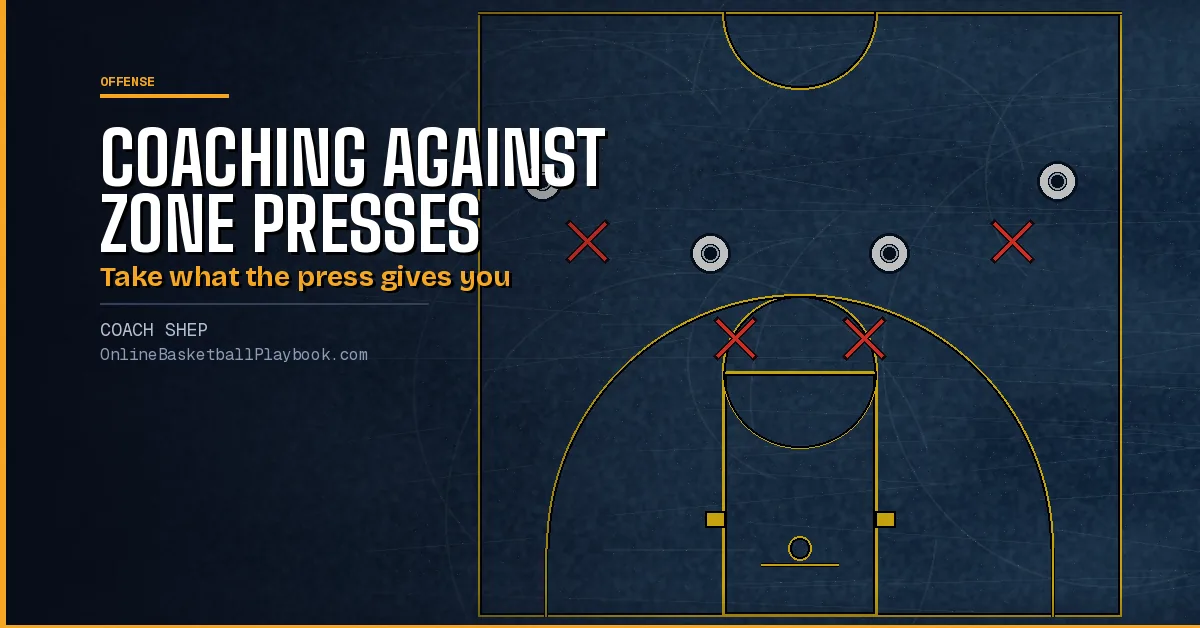
Coaching against zone press defenses starts with one fact. A zone press assigns defenders to areas and traps in set spots, and every version gives up something to take something away. Your job is to learn what each one takes away, keep the spacing that beats any trap and attack the area it leaves open. This guide covers the presses you will see, the spacing rules, how to break the trap, the half-court versions and the drills. For the full plan around scouting, roles and timeouts, read Game Plan Against a Press Defense.
Zone Presses at a Glance
| Press | What it takes away | What to plan for |
|---|---|---|
| 1-2-1-1 diamond | The first catch, with pressure on the inbounder and an early trap | The sideline at midcourt is weak. Keep a receiver on the ball-side sideline and look middle first |
| 2-2-1 | The sideline, with a trap at half court | Take what it gives you and attack the middle |
| 2-1-2 | The middle, from the opening inbound | It is built to invite the sideline dribble, and its designers call a reversal harmless, so do not count on one |
| 1-3-1 | Reversals, with a trap at the half-court sideline | Big, strong teams can throw over the second line into open space |
| 1-2-2 | The middle third and any pass forward | It drops cleanly into man or a 2-3 zone, so know both half-court answers |
What Each Zone Press Takes Away
Zone presses differ in where the defenders stand, which pass they deny and where they trap. Scout the family first, then choose your read.
The 1-2-1-1 diamond. The defender on the inbounder forces the pass to a corner and traps the catch with the near wing, an interceptor reads the lob and a safety protects the basket. Its designers list no middle pass, no fouling in the trap and no dribble down the sideline past the wing among the rules. Against it, one breaker keeps a receiver on the ball-side sideline near half court while the point guard looks to the middle first. A receiver who moves toward the ball is safer than one who moves away, because a pass to a player moving away is easier to intercept. If the middle is covered, pass up the ball-side sideline and use a quick pass fake at the defender who straddles two receivers.
The 2-2-1. Two defenders up front, two at half court and one deep. Some versions let the inbound happen and turn the ball to a sideline. Others deny the inbound or the return pass. The shared rule is that the ball lives on the sideline and never in the middle lane. A 4-across breaker starts from that rule: since the press takes the sideline, attack the middle. See 2-2-1 Press and How to Coach the 2-2-1 Press for the defender's view.
The 2-1-2. A plug defender closes the middle of the floor from the opening inbound. The press is built to take the middle pass away and invite the sideline dribble, and its designers call a reversal harmless because the backcourt count keeps running. A team that only knows how to find the middle has to prepare a second answer.
The 1-3-1. It traps at the half-court sideline instead of near the baseline, and the three defenders across the middle prevent reversal passes. A Kansas-style breaker uses guard, screener and sideline entries with three outlets plus one long pass and centers the ball past half court. Its designers name big, strong teams that throw over the second line into open space as a weakness, and the top defender tires if the offense keeps reversing. See 1-3-1 Full Court Press.
The 1-2-2. The top defender is quick and long and steers the ball up the sideline, and the middle line holds the best anticipators. The rules deny straight-line passes, passes to the middle and easy sideline catches, and a pass to the middle usually means the press is broken. It is rarely broken at full speed and drops cleanly into man or a 2-3 zone, so be ready for either in the half court. See 1-2-2 Press.
Spacing Against Any Zone Press
Sideline, middle and reverse. Any time the ball can be trapped the handler needs three outlets. Two defenders cannot trap the ball and cover all three, so with the spacing right the trapped player stays poised and finds the open teammate. It is the one non-negotiable of every press break.
The 1-4 alignment applies it to a zone press. Four receivers start high with the fifth in a deep diagonal spot. If the ball is reversed, players rotate to fill both sidelines and the middle. The personnel decision is whether your point guard takes the first pass or attacks up the floor on the second.
- Stay out of the trap zones. The deep corners and the sideline near half court are where the boundary line becomes an extra defender. Inbounding too close to the baseline and carrying the ball across half court into a corner hand the press what it wants.
- Keep a release valve. A trailing player behind the ball gives the handler a way to reverse out of a trap.
- Get the ball in fast. After a made basket, inbound quickly with the same player every time, before the press sets.
- Attack to score. A press that sees only an offense content to cross half court will press harder. Hunt the layup first.
Breaking the Trap
The trap is the moment of highest risk and the best chance. Two defenders on the ball leave a three-on-two or a four-on-three behind it. If the handler draws two, two teammates are unguarded. The only question is which one the ball reaches first.

Give the handler a short list of answers.
- Pass before the double arrives. Drill the point guard to pass just before the second defender gets there and not to dribble into it.
- Pull back. Turn the shoulders so the ball is behind you, put the chin on the top shoulder to see the floor and take big push steps backward. Teammates come back toward the ball to shorten the pass. A skilled handler can pull back and re-attack.
- Keep the dribble alive only with a purpose. Dribble to avoid a trap, to score or to improve a passing angle.
- Flash high. Against a trap, the 4-man flashes to a high spot, or the ball skips to the opposite side.
- Swing the ball. Passes made before the double arrives keep the ball moving. Near half court a firm high screen and roll frees the handler, and the screener rolls or pops depending on how the defense reacts.
- Use fakes. Zone press defenders are aggressive and jumpy. A fake at the sideline can move the middle defender and a fake at the middle can move the sideline defender. A pass fake at one wing before the reversal disrupts the timing of the trap.
- Keep your eyes up. Most presses leave someone open deep. The real failure is the handler who panics and never sees him.
Reversal. The trap loads the defense to one side, so reverse the ball as soon as the pressure lets up. Against a 1-3-1 the rotations after a reversal are long, and a sideline pass can come open. Reverse to advance. A pass across the floor to an open teammate attacks the weak side, and an aimless pass sideways or backward slows the advance and gives the defense what it wants.

Attack the middle against the 2-2-1. Two different 4-across breakers start from the same read. In the first, 5 inbounds with 1 and 2 inside and 3 and 4 flared to the sidelines. When the defense denies the sideline passes, 3 fakes long and cuts back hard to the middle while 4 goes long, and if 3 is denied the ball goes back to the inbounder to swing. The second break is built for a 2-2-1 that traps the sideline at half court. The front two make it hard for 1 or 2 to get open, so 2 screens for 1. The inbounder fakes toward them and hits 3 up the side, who breaks long and v-cuts back to the ball. As the defense traps 3, 1 should be open for the quick pass up the middle and can hit 4 going up the opposite sideline. That second break is meant for a 2-2-1 that is the opponent's base press or an adjustment after you have beaten them up the sideline.

Get the next coaching guide in your inbox
One email when a new guide or diagram set goes up. Free.
Half-Court and Three-Quarter Traps
When the trap comes at three-quarter court or half court, the offense has already used most of its floor before the trap arrives. The principles stay the same. The answers below come from breakers built for those traps.
- Beat it down the floor. Push the ball up fast after a made basket with a secondary break, before the half-court trap can set.
- Pass before the double. Against a 2-1-2 trap, drill the point guard to pass just before the second defender arrives, not to dribble into it.
- Commit it, then reverse or go over. Against a 1-3-1 trap, the point guard commits the zone to one side, then reverses or throws over the top depending on how the deep defender slides.
- Move into the box. Against a 2-2-1 style three-quarter trap, the four defenders who form the trap also form a box, and the middle offensive player can step into it to catch the inbound and advance against lighter pressure.
- Put a tall, good-handed receiver in the middle. Against half-court traps, a tall receiver in the middle of the defense and a deep receiver behind the back line give the point guard an outlet before the trap forms. Against a half-court 2-2-1, shooters drop into the corners, where most half-court presses are weak. Against a small point guard, a taller capable passer can stay back, take the sideways pass just before half court and advance the ball himself.
- Get players deep early. Against a half-court 1-1-2-1 or 1-2-1-1, get two or three players into the frontcourt and deep on the sidelines before the ball crosses, then attack with a pass over the top or a screen and cut on the deep defender.
A full treatment is on How to Break the Three-Quarter Press and How to Break the Full Court Press. The versatile 1-4 shell is covered in 1-4 Press Break.
Where Coaches Split on Zone Press Offense
- Middle first or sideline first. Against the 2-2-1 the read is to attack the middle because the press takes the sideline. Against the diamond one breaker looks middle first and still keeps a receiver on the ball-side sideline, because the diamond is weak up the sideline at midcourt. Scout the press you face and set the read order from what it denies.
- Dribble or pass under the trap. Some coaches accept a dribble to avoid a trap, score or improve an angle. A half-court 2-2-1 drill demands a pass with no dribble. Pick one and teach it the same way all season.
- Reversal. Breakers reverse the ball to punish a defense loaded to one side, while some press designers plan for a reversal and call it harmless. The difference is the purpose. A reversal that advances the ball is offense. A reversal to escape only burns time.
- The second trap. Some presses trap again on a reversal or a lob down the sideline, and others treat the press as over once the ball reaches the middle. Expect either and keep your catch-and-face habits for the second catch.
Drills for Breaking a Zone Press
A press break is a full practice curriculum and not a drill you run once before a game. Work on ball handling, passing, spacing, breaking the trap, inbounds plays and a dedicated press-breaker offense with go-to sets.
- Pressure ball handling. Cone dribbling at varied speeds, then live defensive scrimmages where guarded handlers make quick decisions.
- Passing under pressure. Chest, bounce and overhead passes with a defender in the lane. A three-man weave against a live defender is a game-speed progression.
- Four corners. Four players pass in a four-corners setup against a middle defender who tries to trap. It drills quick, decisive passes to the open player.
- Trap and kick. Three defenders trap a handler while two teammates wait in kick-out spots. Rotate after five reps.
- Outlet and go. Inbound, catch, turn, face and attack with two dribbles.
- On-ball screens. Screens free handlers against a press just as they do in the half court, so include them.
- Inbounds plays. The inbound is the first decision of every possession, so give it its own practice time and repeat it off every made basket.
- Find the receiver. The passer dribbles to the three-point line, jump-stops and reverse-pivots while a partner sprints to either corner, then passes and finishes on the return. Players often throw before they see the receiver.
More are on Drills to Teach the Press Break and Press Break Basketball Drills. To understand the pressing team's rules, read Full Court Press Defense and 1-2-1-1 Diamond Press.
Questions Coaches Ask About Zone Press Offense
What is the best way to beat a zone press?
Keep sideline, middle and reverse outlets on every catch, inbound quickly, pass before the double team arrives and attack the space behind the trap. Once the pressure lets up, reverse the ball to punish a defense loaded to one side.
How do you beat a 2-2-1 zone press?
The 2-2-1 takes the sideline, so attack the middle. A 4-across set with a fake-long, cut-back read and a long runner on the other side is one way to do it.
Where is a zone press weakest?
Press designers name the middle pass as their weak point, since most zone presses are built to keep the ball on a sideline. The diamond is also weak up the sideline at midcourt, and the 2-1-2 plugs the middle on purpose, so scout the press before you choose the read.
Should you dribble against a zone press?
Only with a purpose, to avoid a trap, to score or to improve a passing angle. A pull-back dribble with teammates coming back to the ball buys space. Most handlers should beat a trap with the pass.
How is a zone press different from a man press?
A zone press assigns defenders to areas and traps in set spots, so you attack the middle and use reversals. A man press puts a defender on each player, so screens, a screener who seals on the switch and ball fakes get receivers open.
All offense pages sit under the Offense hub, and the press-break library starts at Press Break Basketball.
Want the printable playbook packs?
OBP Pro members get the premium playbook packs: the zone attack, out of bounds and practice plan PDFs, plus each new pack as it is finished. The membership page lists what is in each one. Or draw your own version free in PlayDraw.
See what OBP Pro includesMore Coaching Guides
- Game Plan Against a Press Defense: Scout, Roles and Rules
- Basketball Coaching Leadership: 5 Strategies That Hold Up
- Dribble Drive Motion Offense: Spacing, Reads and Install
- How to Run the Fast Break: Lanes, Reads and Drills
Back to Press Break Basketball and every Offense page.
Keep Building
Related breakdowns
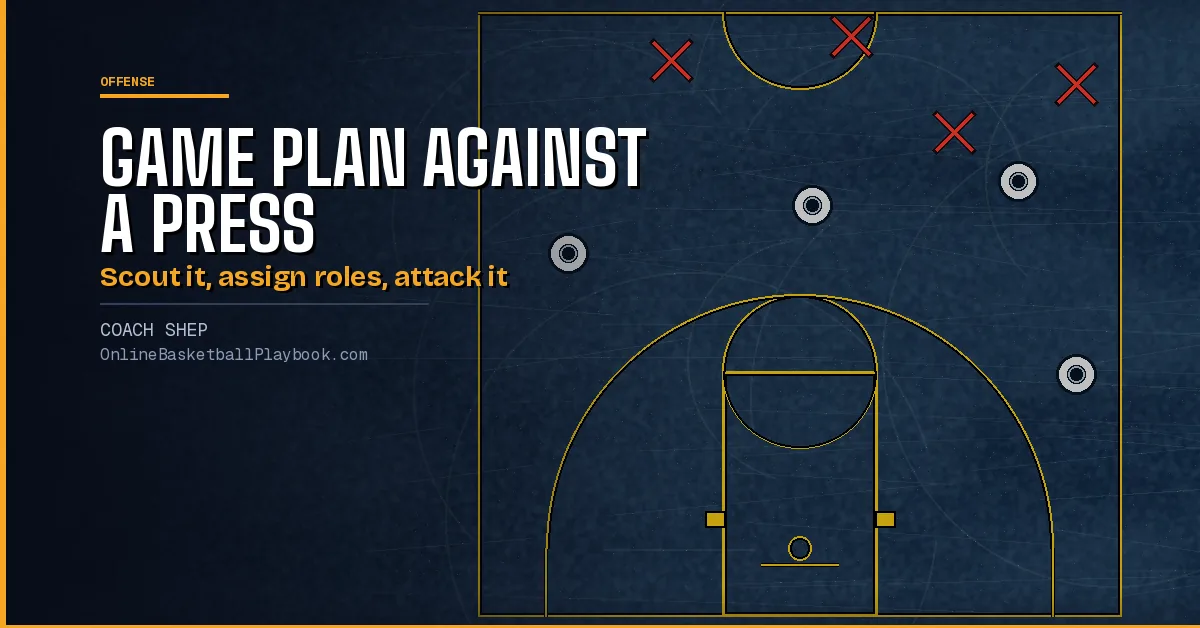
Game Plan Against a Press Defense: Scout, Roles and Rules
Build a game plan against a press defense: scout the press, assign every role, set the rules, plan your timeouts and turn a broken press into a fast break.
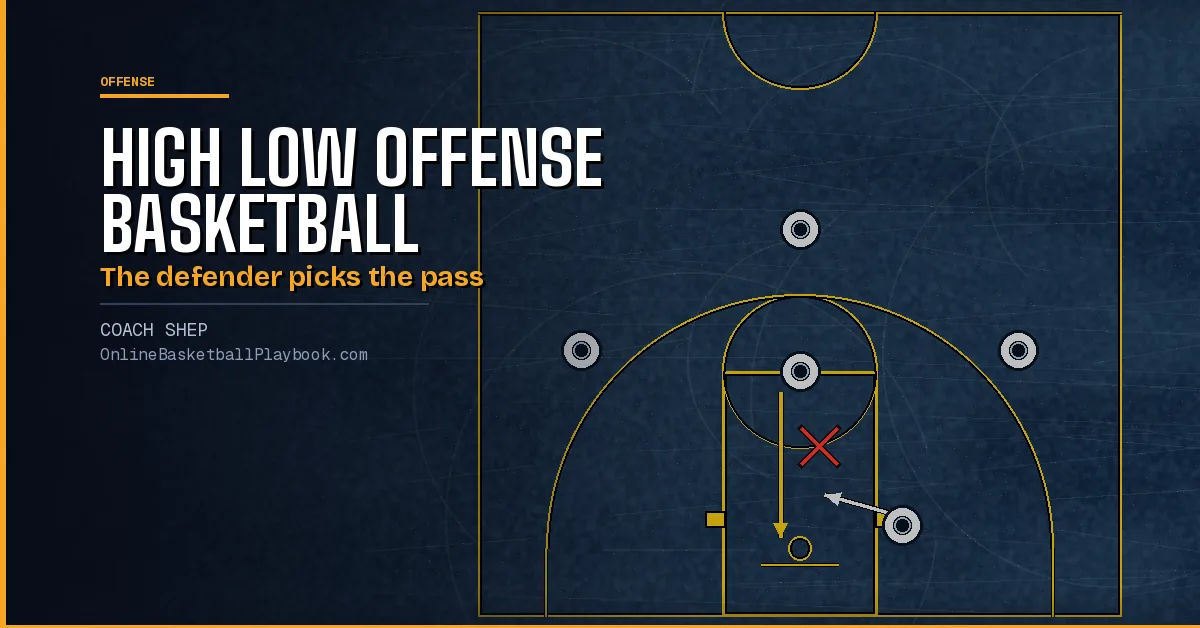
High Low Offense Basketball: Reads, Counters and Zone Rules
High low offense basketball explained: the two-post shell, the lob and bounce reads, answers to a front, down-screen reads, 1-4 low sets and the hi-lo against zones.
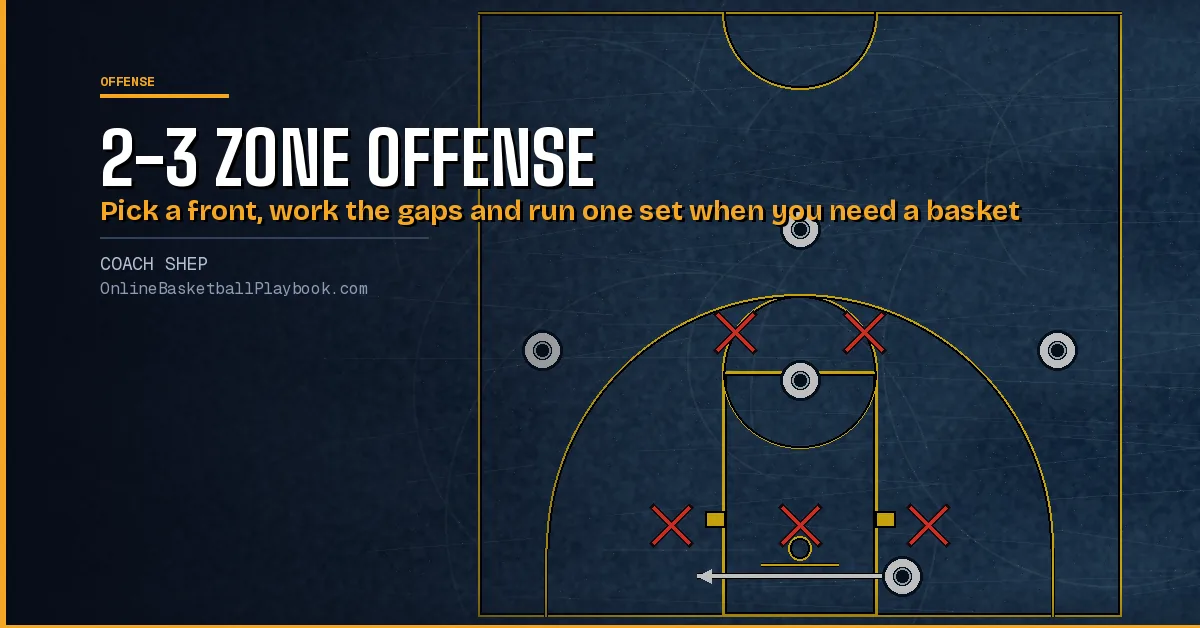
2-3 Zone Offense: Sets, Plays and Continuities to Run
2-3 zone offense with the fronts coaches start from, the continuities they run, quick-hitter plays for a basket, how to choose and where coaches disagree.