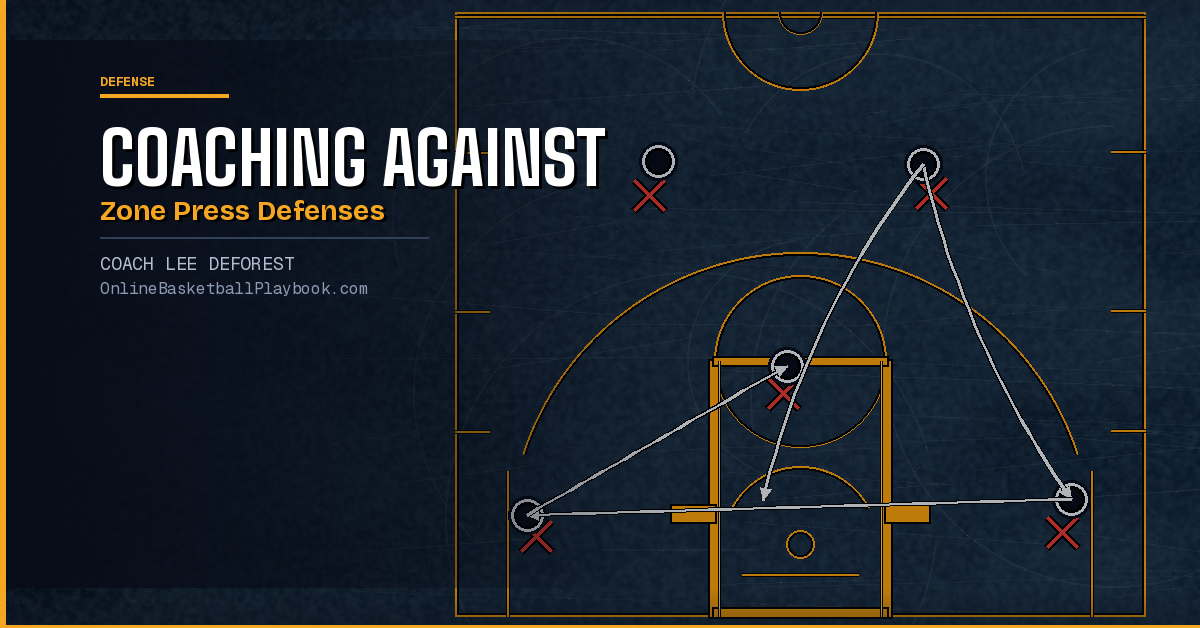

Zone press defenses force turnovers by trapping the ball and disrupting your tempo. Beat them with calm decision-making, smart spacing, and players who know exactly where to go before the ball is inbounded.
Understanding Zone Press Families
Before you can build a reliable press break, your staff needs a working knowledge of what zone press families actually look like. The most common are the 1-2-1-1 (diamond), the 1-2-2, and the 2-2-1. Each has a different trap location, a different trigger for the second defender, and a different weak-side rotation. If your players only see one press look all week in practice, they will freeze the first time an opponent sprints into a different alignment on Friday night.
The 1-2-1-1 is the most aggressive. The point defender pressures the inbounder's options immediately. Two wing defenders sit near the free-throw line extended on both sides, ready to double with the point man the instant the ball is caught near a sideline. A middle interceptor floats near half court reading the ball, and a safety sits at the free-throw line on the defensive end. Georgetown and programs like it have used this structure for decades because it forces teams to make quick decisions in a tight corridor.
The 1-2-2 is slightly more conservative but still dangerous. The key difference is the trap location: rather than trapping near the inbound catch, this press funnels the ball into the half-court trap area around the sideline near half court. The point man keeps the ball out of the middle of the floor, the wings invite cross-court passes and sprint on air-time, and the system drops naturally into a 2-3 zone once the press is broken. Teams that run the 1-2-2 well can do damage even without elite athletes because the system is built around angles, not footspeed.
The 2-2-1 is the most common press you will see at the high school level. Two defenders apply immediate pressure near the inbounder, two more sit in a tandem near mid-court, and one safety protects the basket. This press is designed to force a five-second call or a lob, not necessarily to trap; your players need to understand that distinction so they do not overreact and throw a risky pass when no real trap has formed.
Understanding the full court press defense from the defensive side will help you anticipate where your opponents want the ball to go, and recognizing the look early gives your point guard time to call the right press break before the whistle even blows.
Press Break Principles
Every effective press break rests on a small set of universal principles. Get these right and the specific alignment matters far less than people think.
First: attack the middle. Zone presses are designed to force the ball to a sideline. The moment you reverse the ball to the middle of the floor, the press collapses because defenders have to close from two directions. Your players need to understand that the sideline is the defender's best friend, and the middle of the floor is yours. Practice catching in the middle and immediately pivoting to face the basket before the trap arrives.
Second: advance the ball with passes, not dribbles. The dribble kills press breaks. Once a player puts the ball on the floor in a trap zone, they have one option left — the pivot and kick. If they have already used their dribble, the trap closes and they are held for a five-count. Train your players to catch, look long, and pass forward. The dribble should be used only to escape pressure after a catch, never to advance the ball against a set zone press.
Third: make the ball move faster than the defense can rotate. Zone presses survive on delayed passes. Two quick passes in succession — inbound to the outlet, outlet to the middle — collapse the press before the wings can sprint to their trapping positions. The press break is a rhythm drill as much as it is a spacing drill. Teams that catch and hold, or catch and look at the defender instead of the next outlet, give the press time to reset.
Fourth: never throw a skip pass across the court unless it is open by ten feet. Skip passes against a zone press are the highest-turnover play in basketball. The cross-court pass travels slowly through the air, the interceptor reads it immediately, and the turnover leads directly to a layup. If the skip is not wide open, catch it back to the middle and reset.
"Turnovers are a byproduct, not the measure."
— Basketball Vault
Player Roles and Assignments
A press break works when every player has one defined role and knows it without thinking. The moment a player has to stop and figure out where they belong, the press wins.
The Inbounder
Your best passer, not necessarily your best ball-handler, should inbound the ball. The inbounder is a quarterback reading a defense. They should step wide along the baseline, see the full floor before releasing the ball, and be coached to look immediately for the long pass before settling for the short one. Many teams inbound short by default and work backward from there; better teams look long first and work in when the long pass is not available.
The Point Guard
Your point guard must be your most composed player on the floor. They do not have to be your fastest. The point guard catches near the ball-side sideline only as a last resort. Preferably they receive the ball in the middle of the floor, either from a second pass or by flashing from a wing. Once the ball is in their hands in the middle, the press is broken. Their only job at that point is to push pace and not give the defense time to recover into its half-court set. Good basketball IQ development at this position pays dividends every time an opponent presses.
The Wings
Wing players have two responsibilities: create an outlet at the ball-side sideline for the emergency catch, and flash to the middle or the far sideline when the ball is inbounded away from them. Wings who stand still during a press break are a liability. They should be moving toward the ball or away from it, never planted in one spot while the trap closes on a teammate.
The Big
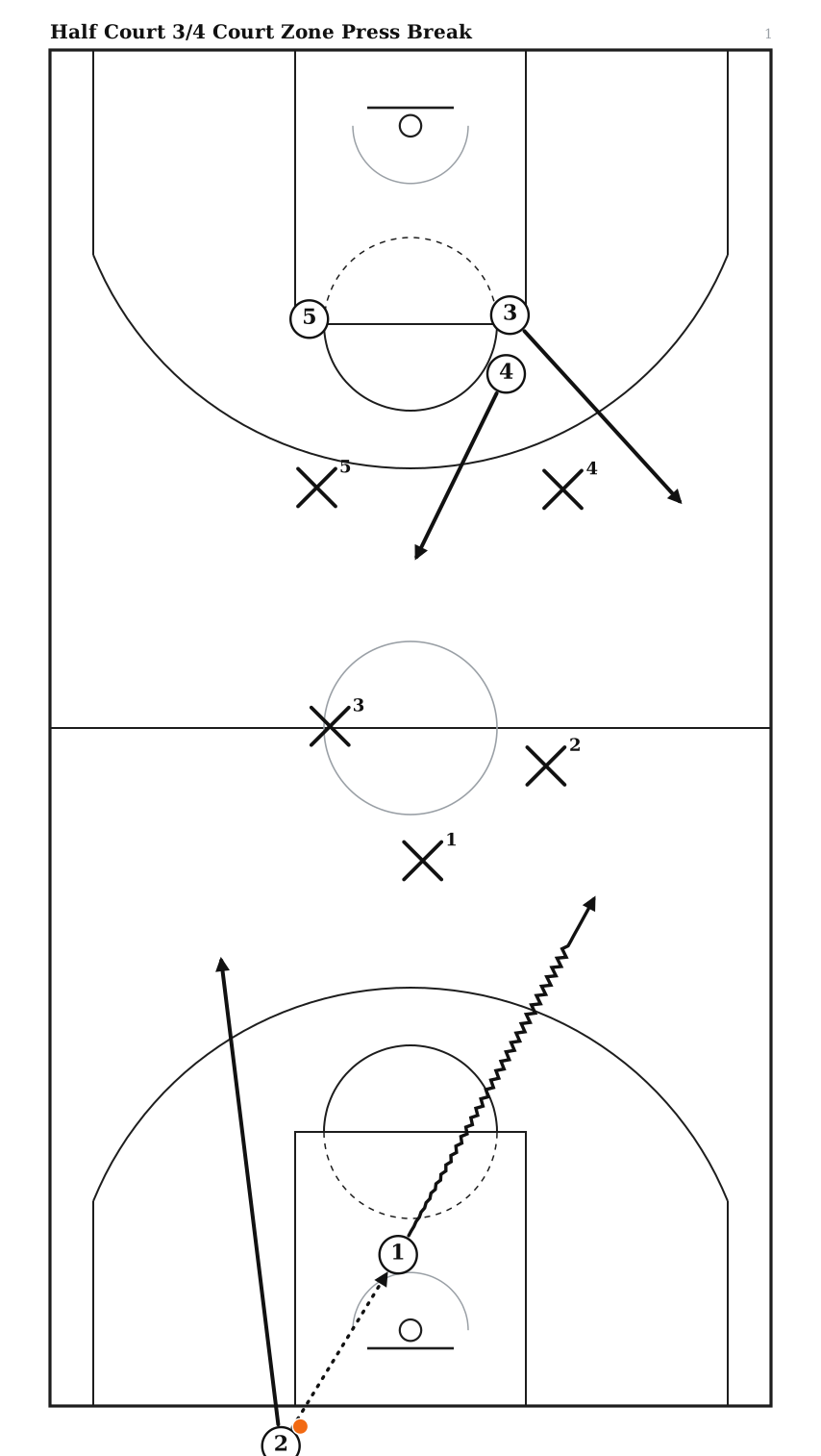
Many coaches pull both bigs up to press break positions. One big should receive the inbound pass as a safety valve at half court; the other trails the play near the free-throw circle as a dump-off option. A big who catches in the middle against a press and draws two defenders creates a two-on-one for the guards ahead of the ball. Never leave your big standing at the offensive end while your guards fight the press alone.
Attacking Traps and Hot Spots
Even a well-designed press break will walk into a trap occasionally. What separates teams that handle traps from teams that crumble under them is preparation for the specific hot spots where traps are set.
The ball-side corner after an inbound catch is the most common trap location in any zone press. Two defenders converge from the point and the near wing, and the receiver is pinned against the baseline and the sideline simultaneously. The only correct response is a quick pivot away from the trap — either a quick hit to the middle or a lob skip if the safety is at least ten feet from the receiver at the opposite sideline. If neither is available, the inbounder should run baseline as an immediate outlet so the trapped player has a legal safety valve.
The half-court sideline is the second hot spot. In a 1-2-2, this is where the press is designed to trap by design. The point man has funneled the ball there on purpose. Your players must be drilled on the correct pivot foot, the correct direction to turn (away from the sideline, into the middle), and the correct pass target. Middle flashing to the ball when the half-court trap forms is the responsibility of whoever is on the weak-side wing — not the big, not the point guard, but the nearest perimeter player on the opposite side of the floor.
The back-tip is a technique many college programs teach for the corner trap. Rather than catching and pivoting, the receiver deflects the inbound pass back out to a teammate flashing behind them. This requires pre-snap communication and a specific type of catch — more of a redirect than a reception — but when executed correctly it eliminates the trap entirely before the second defender can close. It is a high-skill technique worth teaching to mature teams with experienced point guards.
Drill your players to identify a real trap from a fake trap. Many zone press defenders bluff at the ball to force an early panic pass, then recover. Teaching players to hold poise for one full second before releasing the ball eliminates a significant percentage of press-induced turnovers at every level.
Practice Reps That Build Poise
The press break is not a play. It is a skill set, and skill sets are built in practice through repetition under pressure. If your team only sees the press in scrimmage, they will never develop the automatic reads that make a press break reliable in close games.
Build press break reps into your basketball practice plan as a daily segment, not an occasional addition. Ten minutes at the start of practice — five on five, live, full court, with the defense pressing every possession — is enough volume to create automatic reads over the course of a season. Vary the press look each day so your players are identifying and responding to different alignments rather than drilling one specific pattern.
Condition your players to make correct decisions while tired. Press breaks fail in the fourth quarter of close games not because the players forget their roles, but because fatigue degrades decision-making and composure deteriorates. Run press break reps at the end of conditioning sets, not at the beginning of practice when players are fresh. If your players can execute their assignments after two sets of full-court sprints, they can execute them in overtime.
Use the 3-on-2 and 2-on-1 drill progressions to sharpen the finishing reads after the press is broken. Breaking the press only matters if the team can convert the advantage. Many teams struggle the press, create a two-on-one in transition, and then stall because no one has drilled the decision of when to pass and when to finish. Connect your press break reps directly into your fast break execution so the entire sequence — press break to advantage to finish — becomes one connected habit.
Film review is underused in press break development. After every game where the opponent pressed, pull three or four clips of your team's responses — one great decision, one good decision, one turnover — and use them as teaching moments before the next practice. Players who see themselves on film processing a trap correctly internalize the decision far more deeply than players who only hear a verbal correction.
- Look long first on every inbound — check the safety valve only after the deep pass is covered
- Middle is safety: any catch in the middle of the floor ends the press; point guard flashes there by default
- No dribble into a trap — if the catch location is dangerous, use the pivot and pass, never put the ball on the floor first
- Wings stay in motion — press breaks fail when perimeter players stand still and defenders walk into position
- Call the press break before the whistle — point guard identifies the look and calls the alignment as the team walks to the baseline, not after the ball is already in play
- Drill under fatigue — build press break reps at the end of conditioning sets so composure holds in fourth quarters
- One skip pass rule — no cross-court passes unless the receiver is ten or more feet from the nearest defender
In-Game Adjustments
Even when your press break is working, opponents will make halftime adjustments. Knowing how to counter those counters without calling a full timeout keeps you a step ahead of a pressing team's game plan.
If the opponent starts cheating their safety toward the middle to cut off your point guard's flash, attack over the top. The long inbound pass directly to the big at three-quarter court becomes your primary look, not your last resort. Defenders who over-commit to the middle leave the safety position exposed, and a composed catch near half court with no one within ten feet is an easy layup or free throw before the defense can recover.
If the opponent switches from a zone press to a run-and-jump defense — where defenders suddenly switch ball-handlers mid-dribble — your guards must be coached to stop the dribble immediately rather than picking it up or turning it over in traffic. The run-and-jump looks chaotic, but it relies on the offensive player continuing to dribble while the switch is happening. A player who stops, pivots, and finds the open man beats it every time.
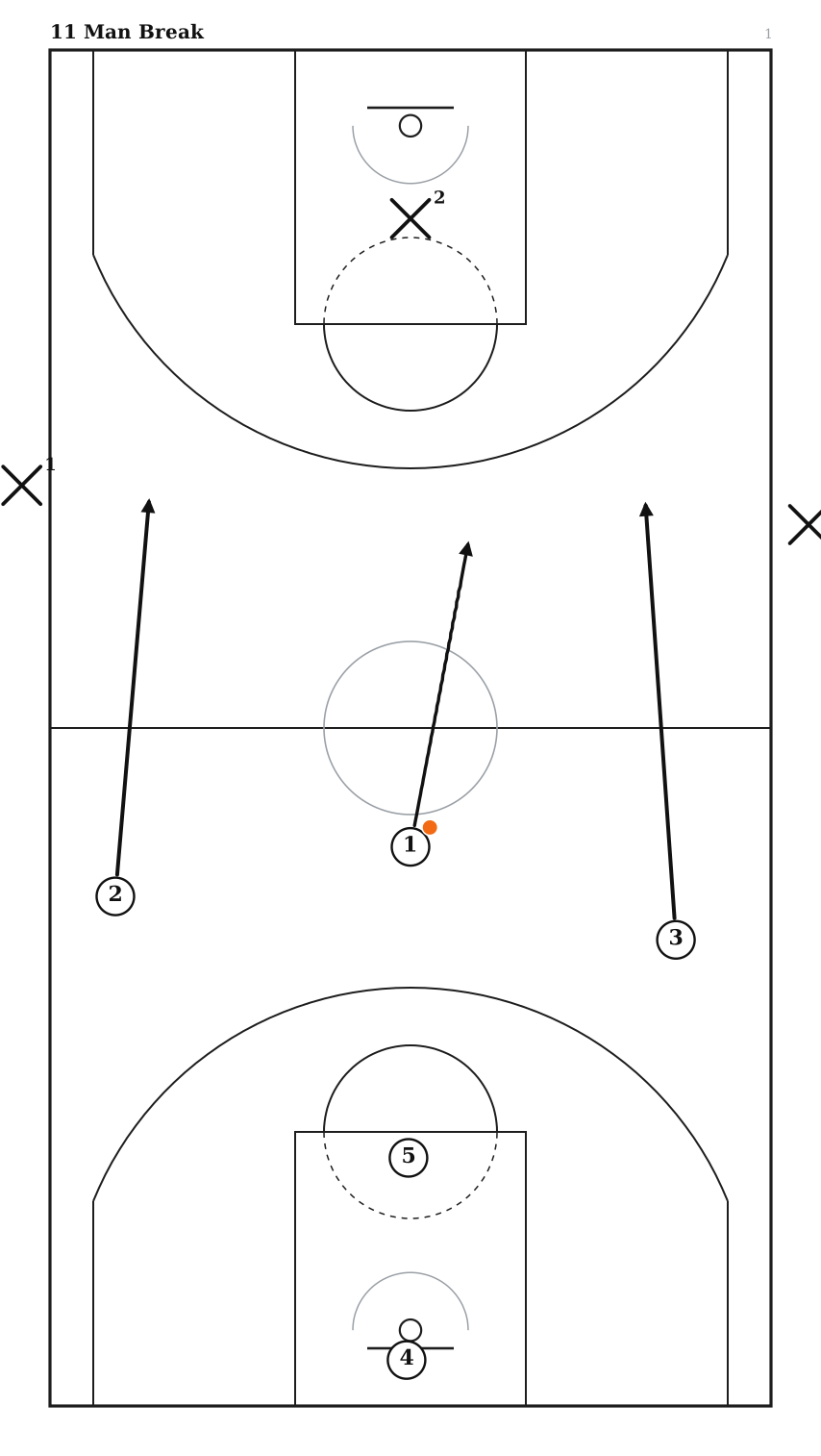
If the press is not affecting you but the opponent keeps pressing, consider taking quick shots off the press break to punish the aggression. A team that presses on every possession commits all five defenders to the back court. When the press breaks cleanly, there is often a wide-open three from the trailer or a post entry that would never be available in a half-court set. Some of the highest-efficiency offensive possessions in basketball come directly off broken presses, and teams that recognize that use aggressive pressing opponents to pad their scoring average.
Managing your timeouts relative to the press is critical in late-game situations. If the press is causing problems in the final two minutes, use a timeout early rather than late. A timeout at the 1:30 mark to walk through the press break calmly and remind players of their assignments is worth far more than the same timeout called in desperation with ten seconds left after a turnover. Prepare your team before the crisis, not during it.
Finally, consider putting pressure back on the pressing team by scoring quickly. Zone presses are partially psychological — the pressing team wants you anxious, wants you calling timeouts, wants you playing their pace. When you break the press cleanly and score in under five seconds, the pressing team has to sprint back, set up their own offense, and usually gets a poor shot. Three or four quick possessions like that will cause many teams to abandon the press entirely, which is the ultimate adjustment.
Get free play diagrams, drills, and coaching guides delivered weekly.
See it drawn up
Related diagrams
Keep Building
Related breakdowns
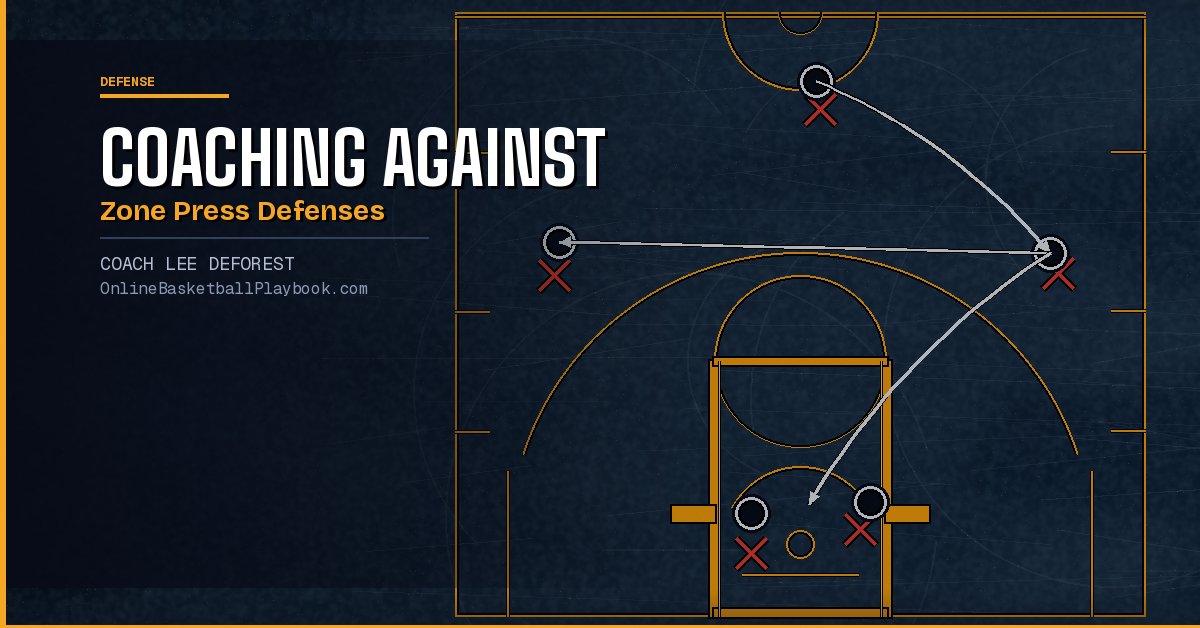
Strategies for Coaching Against Zone Press Defenses
Strategies for Coaching Against Zone Press Defenses
Creating a Winning Game Plan Against a Press Defense in Basketball
Creating a Winning Game Plan Against a Press Defense in Basketball