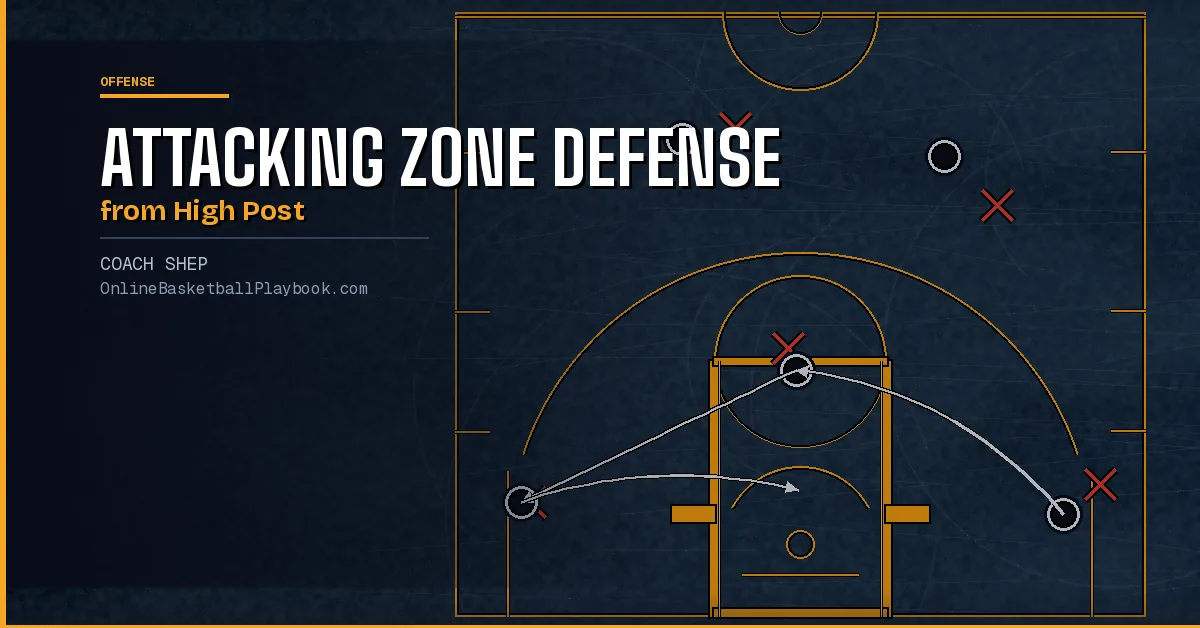
The high post is the single best place to put your most skilled player against a zone. It pins the middle defender, creates a two-on-one for cutters, and opens the skip pass to the weak side.
Why the High Post Breaks Zone
A 2-3 zone defense is built around protecting the paint from below. The bottom three defenders sag to deny baseline drives and interior feeds. That design leaves a structural gap at the elbows and the wings, exactly where a high-post player can catch and operate.
When the ball reaches the high post, the zone faces a problem it cannot solve cleanly. The middle defender (typically the high center in a 2-3) must step up to contest. When he does, the back line collapses inward to help, creating open lanes along the baseline and in the short corner. When the middle stays back to protect the paint, the high-post player has a 15-foot jumper with no contest.
The moment one defender is forced to guard two threats simultaneously, the zone breaks down. The high post is the one position on the floor that creates that problem every single possession. That is why nearly every effective zone-attack system in basketball (from high school programs to the NBA) puts a decision-maker at the elbow or free-throw line.
Understanding basketball IQ development is central to making this work. The high-post player must read two defenders at once and process multiple options before the defense can recover. The reads are straightforward, but they require training and repetition.
The Flash Entry: Getting the Ball to the Elbow
You cannot benefit from the high post if you cannot get the ball there. Zone defenses are designed to deny wing entries and clog passing lanes, so the entry to the high post requires timing and footwork rather than raw athleticism.
The flash entry works best when a wing player initiates. As the guard makes a dribble entry or a skip toward the wing, the high-post player reads the moment and flashes toward the ball. The rule is simple: flash when the wing catches or when the pass is in the air across your face. Timing the flash to the ball's movement means the entry pass arrives just as the player hits the elbow, before the defense can rotate to deny.
Two feet are important here. The high-post catcher should arrive with a jump stop or a strong inside pivot foot so they can face either baseline, both directions for a drive, or straight ahead for a pull-up. A weak, drifting catch gives the defense time to close and takes away most of the high-post player's options.
The entry dribble by the guard is a useful tool on its own. One hard dribble toward the baseline forces the top zone defender to shift, creating the passing window to the elbow. A patient ball-handler who understands when to use the dribble (not to score, but to create the entry angle) makes the whole high-post system run more smoothly. This is one reason passing drills and dribble-to-pass habits belong in every practice that includes zone offense work.
High-Post Reads: What to Do Once You Catch It
The high-post catch triggers a decision sequence. The player should read two defenders (the middle defender who just stepped up, and the nearest bottom defender) and pick the best option from a short list.
Read 1: The Immediate Jump Shot
If the middle defender stays back or is slow to step up, the high-post player has a free look from 15 feet. This shot must be automatic. Zone defenses that give up repeated elbow jumpers will eventually abandon their zone structure to contain the threat. The willingness to shoot (and make) the open mid-range shot is what keeps the defense honest and forces the rotations that open everything else.
Read 2: The Drive to the Paint
When the middle defender steps up aggressively to contest the catch, a flat-footed closeout is a lane to the rim. The high-post player catches, pivots baseline, and attacks the gap before the back line can recover. The drive requires a strong first step and the ability to finish through contact or kick to a corner shooter at the last second. Basketball footwork drills that train the pivot and first step should be a staple of any high-post player's development.
Read 3: The Skip to the Weak Side
If the defense is slow to rotate after shifting toward the ball side, the skip pass from the high post to the weak-side corner or wing is one of the highest-percentage plays in basketball. The zone has moved toward the ball; the skip arrives before it can shift back. This is the moment where proper spacing (keeping shooters in the corners and on the weak-side wing) pays off directly.
Read 4: The Feed to the Cutter
The most dangerous look from the high post is the direct feed to a cutter diving to the rim. When the ball is caught at the elbow, a weak-side player should be reading the moment to cut hard across the lane. If the middle defender has stepped up to the high post and the bottom defenders are watching the ball, a cutter arriving late and fast gets a clean catch at the block with no help in position.
High-Low Action and the Short Corner
The high-low is the defining concept in attacking a 2-3 zone, and the high post is one half of it. The other half is the short corner, the area just inside the baseline, behind the wing defender and in front of the bottom corner defender. When those two positions are occupied simultaneously, the bottom defenders in the zone must each guard two threats at once.
Here is how the action unfolds. The ball enters the wing. The high-post player flashes to the elbow. Simultaneously, the weakside big or wing cuts to the short corner on the ball side. The wing makes the entry to the high post. Now the high-post player looks immediately to the short-corner player, who is caught in a dead zone the 2-3 was not built to defend.
If the bottom defender steps out to take away the short-corner feed, the high-post player hits the diving player cutting to the rim on the weakside. If the bottom defender stays on the cutter, the short-corner player catches and either shoots a mid-range elbow jumper or makes a baseline drive. The defense cannot guard both.
Coaching this action requires patience. Players accustomed to man-to-man offense want to cut toward the basket or set screens. Zone offense asks them to fill a spot and stay there until the moment to cut or catch arrives. The timing between the high-post catch and the short-corner delivery is a skill that must be drilled in practice, not just diagrammed in a film session.
Overload, Reversal, and the Skip Pass
The skip pass is the fastest way to move the ball beyond what the zone can shift to cover. The premise is straightforward: load one side with three offensive players, force all five zone defenders to shift toward the ball, then throw a diagonal skip across the court to the open player on the opposite wing or corner.
The high post accelerates this concept because the skip from the elbow travels a shorter distance than one from the wing, which means the zone has even less time to rotate. A high-post player who catches, surveys, and immediately skips to a shooter in the weakside corner before the zone can slide over is operating at the pace the zone cannot defend.
Overloading the short side of the floor before reversing is a companion concept. When the ball side is loaded with the point guard, wing, and short-corner player, the zone's two bottom defenders are occupied. The weakside guard has drifted into the corner. One skip pass produces a catch-and-shoot three with the defense still in transit. Against a team that cannot get to shooters off the skip, this sequence alone can break a zone attack open for an entire game.
The reversal does not always go directly to the skip. Sometimes the ball moves guard-to-guard between the slots to force the zone to shift, then swings to the wing, then skips baseline. Patience in the reversal (two or three passes before the final skip) gives the offense time to read which bottom defender is slow to rotate. That defender's man is the skip target.
Teach your players to move the ball with pace on reversals against a zone, but never to rush the skip. The skip should come when a bottom defender has already committed, not before. A skip that arrives too early gives the zone time to close out on the shooter and contest the shot.
Drills to Build Zone Attack Habits
Zone offense is not a set of plays memorized in a film room. It is a set of habits and reads that must be trained on the floor until they are automatic. The following drills address the specific skills the high-post attack requires.
3-on-3 Zone Entry Drill
Three offensive players work against three zone defenders in a half-court shell. The goal is to complete a high-post entry, make one read, and finish. No more than four passes before a shot. This keeps players from hunting the perfect look and forces a decision off every high-post catch.
High-Low Feed and Finish
Two offensive players (one at the elbow, one at the short corner) work against two bottom zone defenders. The entry comes from the coach or a feeder at the wing. The high-post player catches and immediately reads which defender moved. The short-corner player reads whether to hold, cut, or seal. Finish with a shot or a layup every rep.
5-on-0 Zone Movement Walk-Through
Run your full zone offense without defenders at half speed. The goal is not execution but timing. Players learn when to flash, when to cut, and when to drift into the weakside corner. Repetitions without defense remove confusion and build the movement habits that hold up under pressure.
Skip and Shoot
A passer starts at the elbow. Shooters are stationed on both wings and in both corners. The passer receives a skip from a guard, pivots, reads which player is open, and delivers the skip. Shooters must be set and ready before the ball arrives. This is the catch-and-shoot habit the skip pass requires. Running this drill at game speed for five minutes per practice produces measurable improvement in zone shooting within two weeks.
For broader basketball practice planning purposes, zone offense drills should appear at least twice per week during any stretch where the team expects to face zone looks.
- Put your best decision-maker at the high post (not your biggest player, your smartest one).
- Flash the high post on the ball's movement, not after the catch. Timing the flash to the pass creates the entry window.
- Occupy the short corner simultaneously with the high post to put the bottom defenders in a two-on-one.
- The high-post player reads two defenders first: the middle defender stepping up and the nearest bottom defender committing.
- Skip the ball from the elbow before the zone can shift. The short skip travels faster than the zone rotates.
- Drill the high-low connection separately before running it in a full 5-on-5 setting. Timing between catcher and cutter must be automatic.
Get free play diagrams, drills, and coaching guides delivered weekly.
Draw this play free in the play drawer →
Membership: the full library, playbook packs, and Pro drawing tools →
Keep Building
Related breakdowns
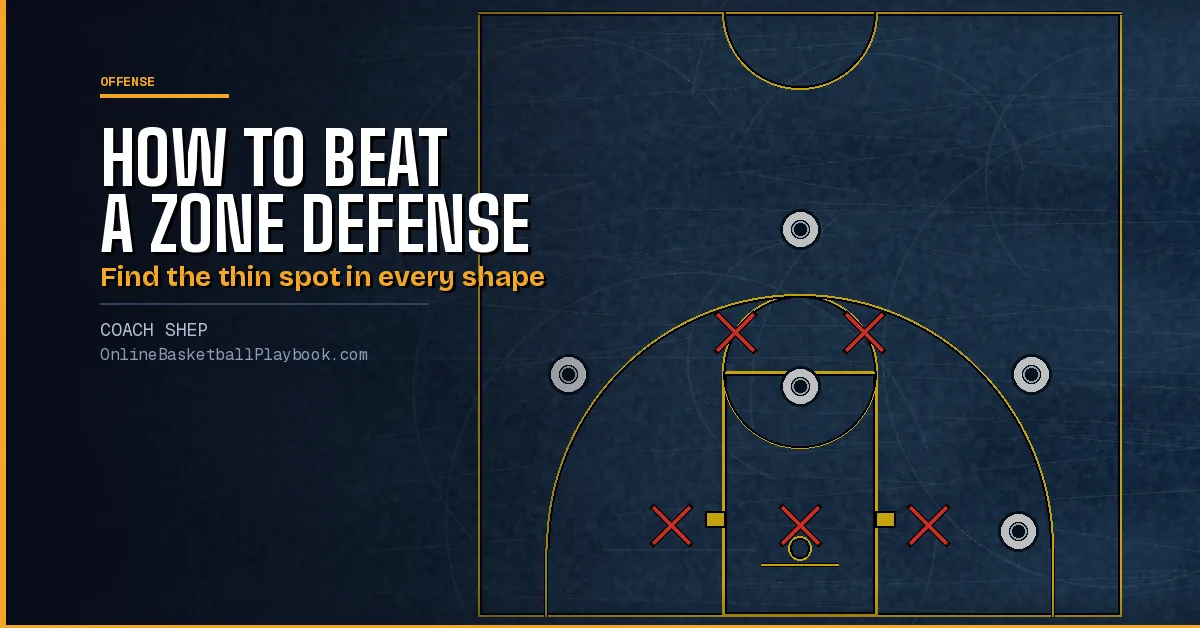
How to Beat a Zone Defense: Every Zone and Where to Attack It
How to beat a zone defense, one zone at a time: what the 2-3, 3-2, 1-3-1, 1-2-2, 2-1-2, matchup and junk zones take away, give up and where to attack.
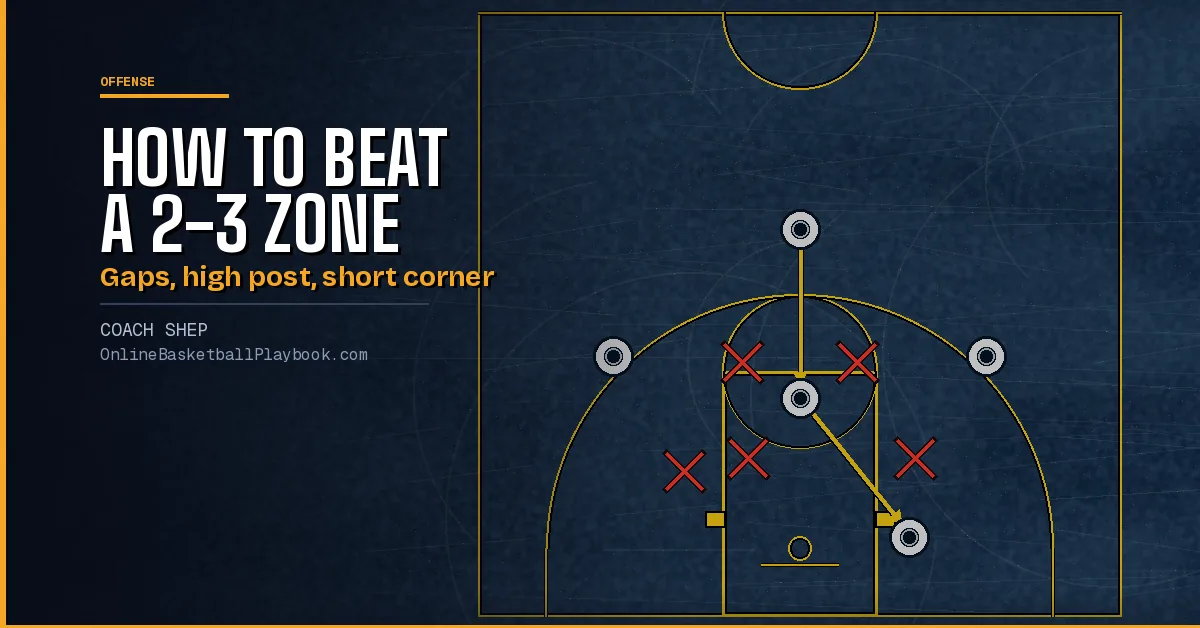
How to Beat a 2-3 Zone: Gaps, High Post and Short Corner
How to beat a 2-3 zone: sit in the gaps, flash the high post, use the short corner, skip to the corner and reverse, plus a simple version for youth teams.
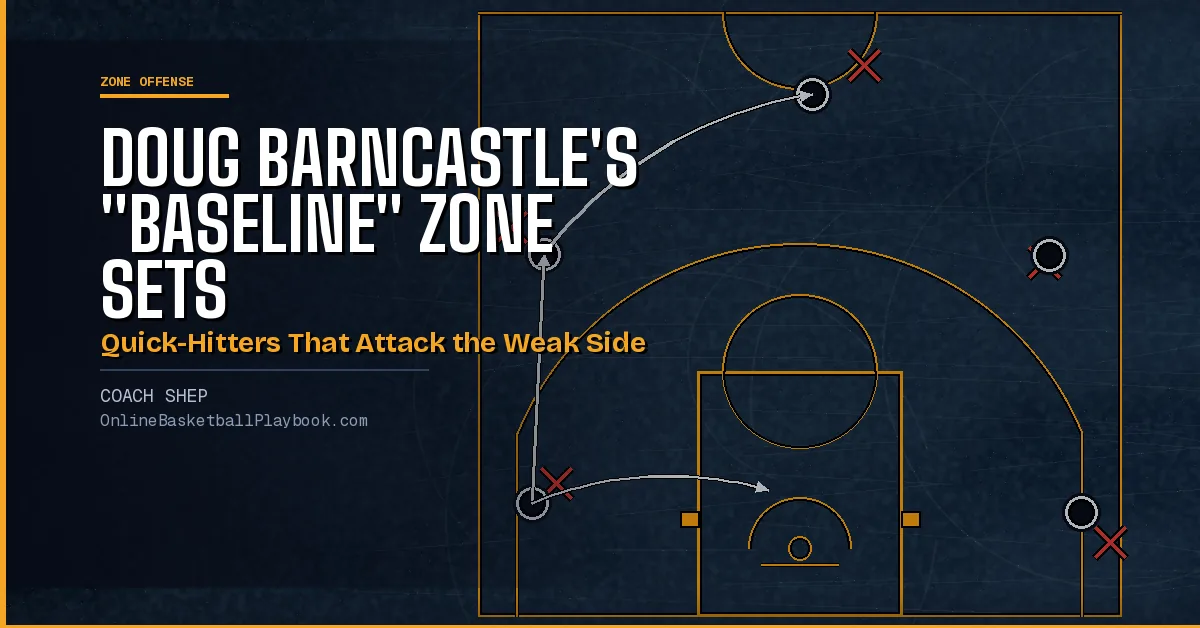
Zone Offense Quick Hitters: 3 Sets That Attack the Weak Side
A handoff-action quick-hitter and two counters, Baseline Push and Baseline Dive, built to attack a zone to the weak side and get clean, makeable shots.