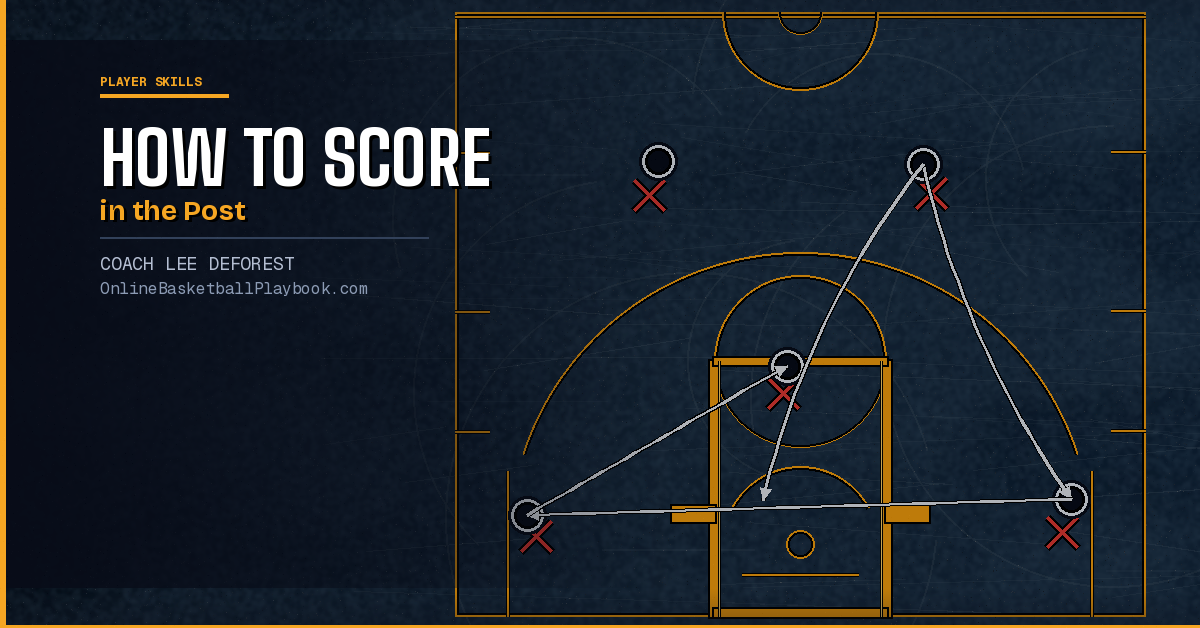

Post scoring starts before the ball arrives. Establish position, seal your defender, and catch ready to attack. This guide covers footwork, move menus, counters, and the reads that make inside scoring reliable at every level.
Seal, Target, and Catch
The catch is the first skill in post play. Everything else — the drop step, the hook, the up-and-under — only works if you catch the ball in a position to score. Before the entry pass arrives, your job is to establish a wide base, pin your defender on your back, and present a visible target hand to the passer.
Wide base means feet beyond shoulder-width, knees bent, and weight low. A narrow stance lets a defender easily reach around, deflect the entry, or slide in front. The moment you go narrow, you give the defender a chance to re-establish position and take away the catch entirely.
The target hand is how you communicate with your passer. Extend the hand on the high-side — away from the defender — at chest height, fingers spread. The passer can see exactly where to throw it, and you receive the ball in a position where you are already loading to make a move. A poor target hand leads to awkward catches, off-balance pivots, and wasted seconds while the defense recovers.
Sealing happens with your whole body, not just your arm. Use your hip and your entire backside to seal the defender before you call for the ball. An arm bar or an elbow push is a foul; a wide, low, full-body seal is a legal and effective post position. Think of it as building a wall between the defender and the spot where the ball is going to arrive.
Timing matters as much as technique. The best post players seal just before the entry window opens — too early and the defender recovers; too late and the passer has already looked away. Watch your perimeter player's eyes and step into the seal as the ball is being picked up for the pass. Work on entry timing in every post practice repetition. For more on footwork technique that applies in the post, see basketball footwork drills that build the base for this skill.
"Read where the defender is, then choose the move — feel the defender (high side / low side / behind) and pick the answer — you're reading, not running a fixed move."
— Basketball Vault
Reading the Defender
Post scoring is not about running a predetermined sequence of moves. It is about reading where the defender is and choosing the correct answer. That distinction separates players who look mechanical from players who look instinctive — the instinctive ones are actually doing more thinking, not less.
There are three fundamental defensive positions to read on the catch: defender behind you (playing behind the post), defender on the high side (between the ball and the elbow), and defender on the low side (playing baseline). Each position has a corresponding first move, and every first move has a counter when the defense takes it away.
Defender behind: this is the easiest situation. You have a direct line to the basket. Power dribble directly into a drop step, jump hook, or short bank shot without needing to create space. Do not get cute here — go straight to the basket.
Defender on the high side: the baseline is open. Step baseline, use a drop step or a power lay-up move, and finish before the help defense rotates. The common mistake is turning back into the middle where the defender is — trust the baseline and attack it decisively.
Defender on the low side: the middle is open. This is often where a turnaround jump shot or a middle drop step works best. Step middle, face up briefly to check the lane, and finish. The help side defense will be collapsing, so the move needs to be decisive and quick — hesitation lets them recover.
This reading framework is what distinguishes a reactive post scorer from one who telegraphs the same move on every possession. Developing this read happens in practice through constraint drills where the coach positions a defender intentionally and the post player is required to make the correct choice before they get the ball. Reps against live defenders build the same instinct over time. Basketball player development for post players should include daily reads-based work, not just move repetition.
The Post Move Menu and Counters
Every post player needs a core menu of moves and a counter for each one. A single move, no matter how polished, becomes predictable by the second or third trip down the floor. The defense adjusts, and that move disappears. Counters are what keep the defense honest and keep the primary move available.
Drop Step
The drop step is the foundation of post scoring. Receive the ball, feel the defender's position, and drop the foot on the open side toward the basket in one explosive pivot. The step should be long enough to create an angle around the defender, and the finish should be a power layup or a short bank shot at the rim.
The counter: when the defense anticipates the drop step and overplays the side you are dropping to, use the up-and-under. Drop step, feel the contact, raise the ball into a shot fake — if the defender jumps, step through the opposite direction and finish under the rim.
Jump Hook
The jump hook is one of the most difficult shots to block in basketball. You release the ball at the top of your jump with your shooting arm extended away from the defender, using your body as a natural shield. A jump hook over either shoulder makes you far harder to stop than a post player who can only hook to one side.
The counter: when a defender plays tight and contests the hook aggressively, use a shot fake into a power drive. Raise the ball as if hopping into the hook, feel the defender elevate or lean, then drive past them into a two-foot power layup at the rim.
Up-and-Under
The up-and-under relies on a convincing shot fake to get the defender in the air. Catch, pivot to face up or half-face the basket, elevate slightly with the ball raised — the shot fake must look real enough to draw a reaction. The moment the defender leaves the floor, step through the open lane and lay the ball in with the off hand or scoop it softly off the glass.
The counter: when a defender stops biting on the shot fake, take the shot. The threat of the up-and-under creates space for a clean turnaround jumper or bank shot. The two moves protect each other — commit to one, and the other opens.
Turnaround and Fade
The turnaround jumper gives a skilled post player a mid-range weapon that is difficult to contest without fouling. Catch, plant the pivot foot, and spin into a one-motion jump shot while squaring the shoulders to the basket. Keep it compact — too much travel on the pivot gives the defender time to recover and contest cleanly.
The fade variation is a turnaround where you drift slightly toward the baseline or the mid-post instead of staying square. It extends the distance between your release point and the defender, but it also makes the shot harder — reserve the fade for situations where the defender is taking away the square-up version.
Face-Up Moves
A post player who can only score with their back to the basket is limited. Modern basketball asks big players to catch in the mid-post, turn and face the defense, and make reads from there. Jab step to test the defender's weight, shot-fake to get a clear driving lane, or drive straight to the rim if the defender sags off.
Face-up post play connects directly to perimeter skills. The same two-foot jump stop, pivot foot establishment, and drive-or-shoot decision that perimeter players use applies to a big who catches at fifteen feet and faces up. This is why basketball IQ development for post players should include perimeter concepts — the skills are more transferable than most coaches assume.
Teach counters from day one, not after players master the primary move. If a player only knows the drop step, they can only score when the defense lets them. Teach the drop step and the up-and-under together as a pair — that pairing is what creates a reliable scorer, not reps of one move in isolation.
Footwork Fundamentals
Post play is pivots and angles before it is strength. A player with superior footwork and average athleticism will consistently outperform a stronger player with poor footwork in the post. Every move in the post menu depends on a pivot that is quick, legal, and decisive. Sloppy pivots produce travel calls; slow pivots give the defense time to recover; wide, low pivots put you in position to score.
The power stance is the starting point. When you catch in the post, your feet should already be wider than your shoulders, knees bent, weight through your hips — not your heels. This stance keeps you low and in control, absorbs defensive contact without losing balance, and loads you to explode into any move in the menu.
The pivot foot matters. When you catch with your back to the basket, you have a choice of pivot foot before you begin your move. The choice determines which directions are available to you. Experienced post players consciously choose their pivot foot based on where the defender is before the ball arrives — not after. Choosing the wrong pivot foot limits you to a subset of your move menu before the play even begins.
A good coaching drill for this: put a post player on the block with a defender, give the ball handler a specific entry spot, and call out which pivot foot the post player must use before they catch. Then put the defender in a position that makes that pivot foot correct or incorrect. The post player has to recognize the defender's position, choose whether to adjust pre-catch positioning, and execute the right move from whatever pivot they have. This kind of constrained practice builds the footwork-reading connection that game reps build slowly.
Footwork at game speed is non-negotiable. Players who practice post moves slowly develop footwork that is slow. Every repetition in post work should be at the speed you would actually use in a game — including the catch, the read, the move, and the finish. Slow practice creates hesitation, and hesitation in the post is what lets help defense arrive in time to disrupt your shot.
Finishing Through Contact
The paint is a physical environment. Defenders in the lane have the angle to draw contact, officials allow more physical play near the basket, and help defenders will often body you as you try to finish. A post player who can only score when given space is not a post scorer — they are a practice scorer. Finishing through contact is a separate skill that requires deliberate work.
Power finishing means driving your body through the defender's contact rather than around it. When a defender steps in to take a charge or body you on a drop step, lower your shoulder slightly, keep the ball high and protected with both hands, and drive through the contact into a short, controlled finish at the rim. The contact often creates the foul — but only if you finish, not if you stop when you feel pressure.
Reverse layups are a finishing tool that the paint teaches you to use. When a help defender is between you and the straight-line finish, use the rim itself as a shield by releasing the ball from the far side of the backboard. This takes repetition to make consistent, but it removes the defender's ability to contest from the help side — they cannot reach through the rim to block a reverse that you release from the far side.
Jump hooks are inherently contact-resistant. Because the release point is extended away from your body at the top of your jump, it is physically very difficult for a defender to block a well-executed hook shot without committing a foul. Teaching young post players the hook early — with either hand — gives them a finishing weapon that survives contact in a way that a straight lay-up does not.
Both hands matter for every finish. A post player who can only hook with the right hand, only reverse with the left, or only bank from one angle is easier to defend than a player who finishes on either side with equal comfort. Build ambidextrous finishing into practice from the beginning. Start with the off hand in low-traffic situations and progressively add defenders until the finish is automatic.
Developing the Modern Post Player
The role of the post player has changed. Defenses no longer commit two or three bodies to stop a back-to-the-basket scorer the way they did in earlier decades. The modern game asks bigs to face up, shoot off screens, play in pick-and-roll at the short roll, and operate from the mid-post with a perimeter skill set — while still being able to post up when the matchup favors it.
This means development programs for post players cannot stop at back-to-the-basket work. Every big who only develops post-up scoring is capping themselves before they reach high school. The most valuable big players today have a face-up drive, a short-range jump shot, and the ability to operate in ball-screen actions as both the handler and the screener — alongside their post game.
Quarter-facing on the catch is the bridge between back-to-basket and face-up play. Instead of catching with your back completely square to the basket, catch with a slight turn — about a quarter turn toward the baseline or the elbow — so you can read the defense and quickly pivot into a turnaround, drop step, or face-up drive. This technique is what high-level NBA bigs use to stay unpredictable at the mid-post and it translates directly to the high school and college level.
Ball-screen work complements post development. A big who can set a screen and then pop to the elbow for a mid-range shot, or roll hard to the rim for a catch-and-finish, is far more difficult to guard than a big who only posts up. If you are building a post player's total offensive skill set, add pick-and-roll reads to the work program alongside post moves. These are not separate skills — they share the same footwork vocabulary and the same reading framework.
From a practice design standpoint, post development should be a daily priority, not a once-a-week specialty segment. Short, focused blocks — ten to twelve minutes of post entry, read, and finish — done every practice build more reliable scorers than a thirty-minute post session once per week. For a structured approach to allocating practice time, see basketball practice plan frameworks that distribute skill work evenly across the week.
Shooting form and touch around the rim develop through volume at game speed. A post player who takes fifty post-move repetitions per practice at game speed will develop more reliable touch than one who takes twenty slow reps and calls it done. This applies to hooks, banks, reverses, and short jump shots — all of them require a feel that only comes from repetition against resistance.
- Seal with your body, not your arm — wide base, hip and back sealing the defender, target hand up for the passer.
- Choose your pivot foot before you catch — read the defender's position pre-catch and position your feet to give yourself the most move options.
- One move plus a counter, minimum — never teach the drop step without teaching the up-and-under; they protect each other.
- Practice at game speed every rep — slow post reps create hesitation; game-speed reps build the instincts that show up under pressure.
- Develop both hands equally — hook, reverse, and bank with either hand; defenders key on the strong hand first.
- Face-up skills are not optional — quarter-face on the catch, read the defense, and be ready to drive or shoot; modern defense forces it.
- Finish through contact — drive through the body, keep the ball high, and let the contact create the foul call instead of shying away from it.
Get free play diagrams, drills, and coaching guides delivered weekly.
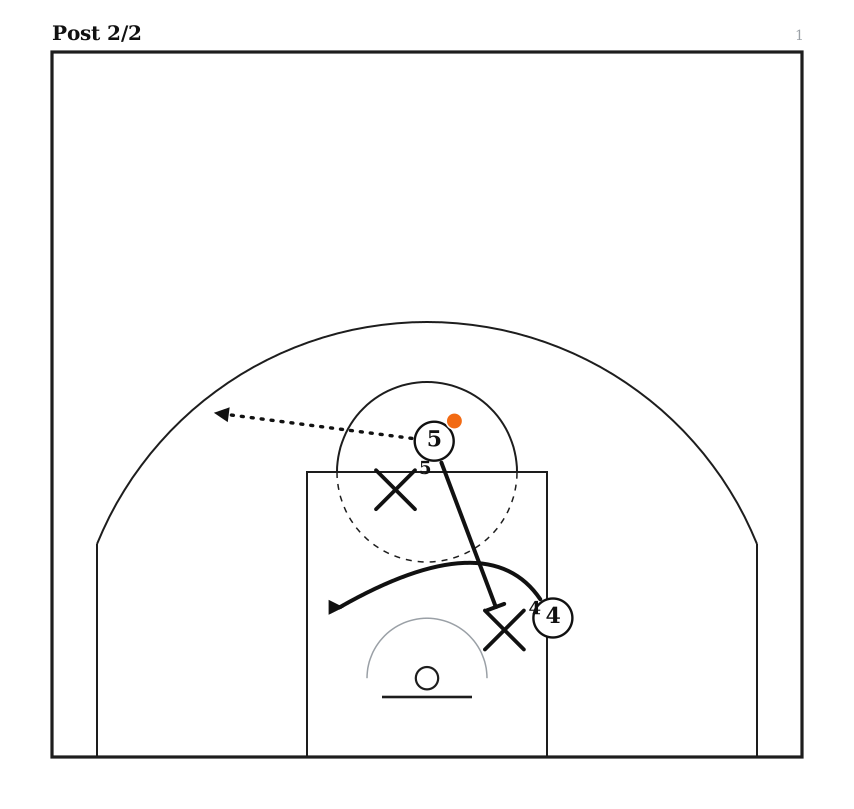
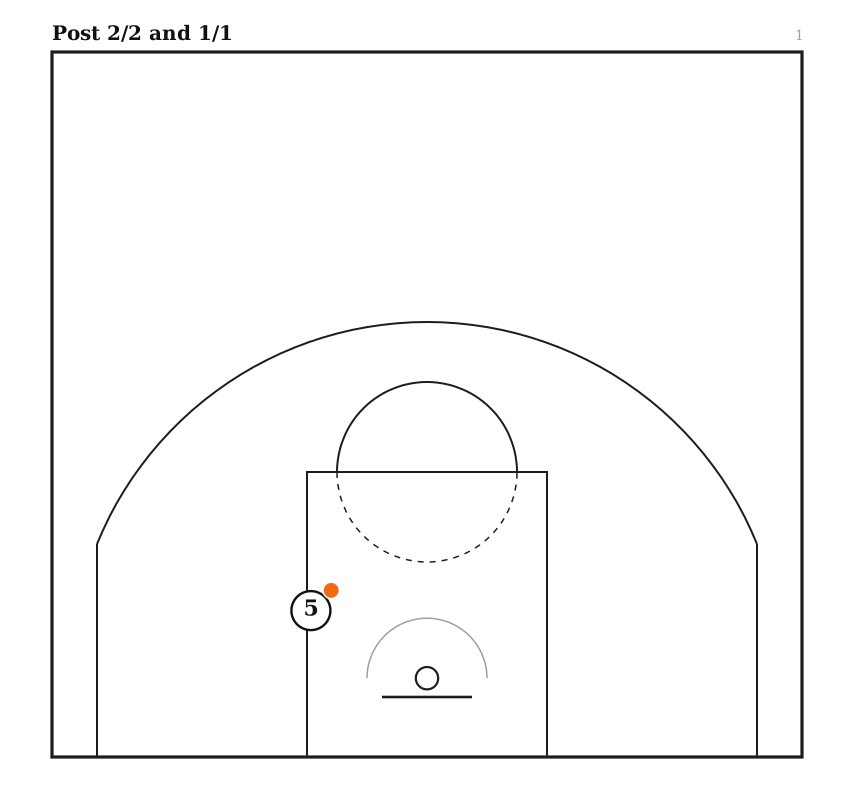
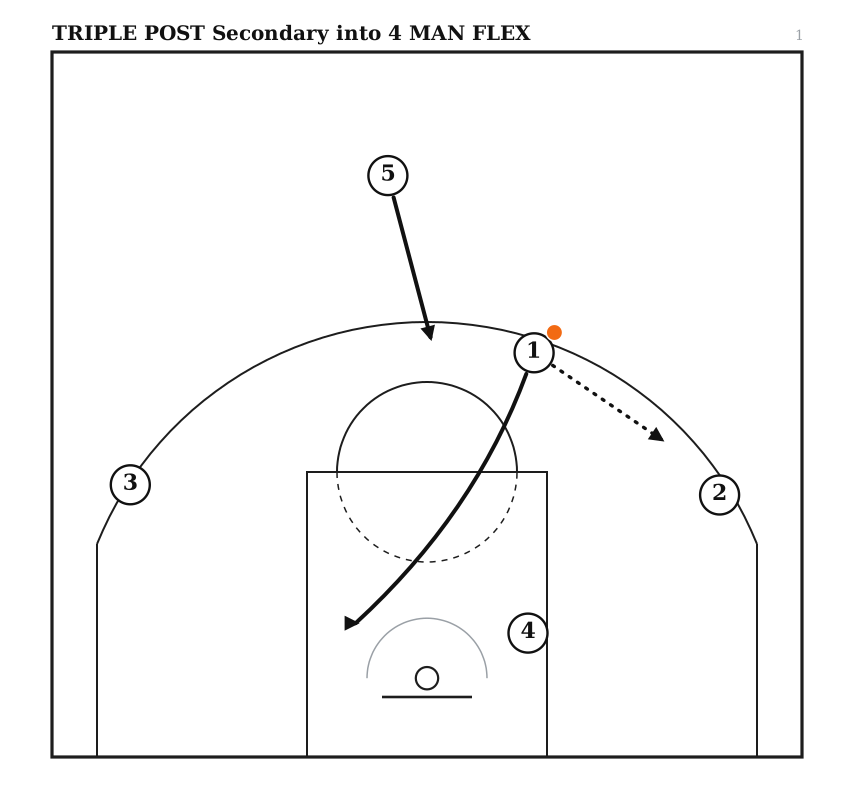
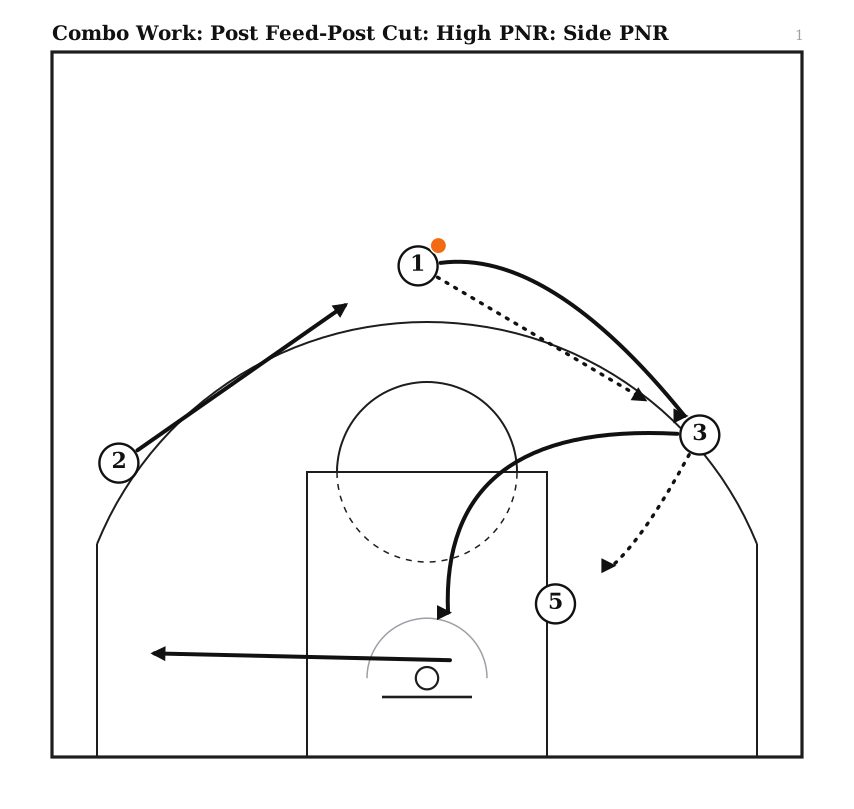
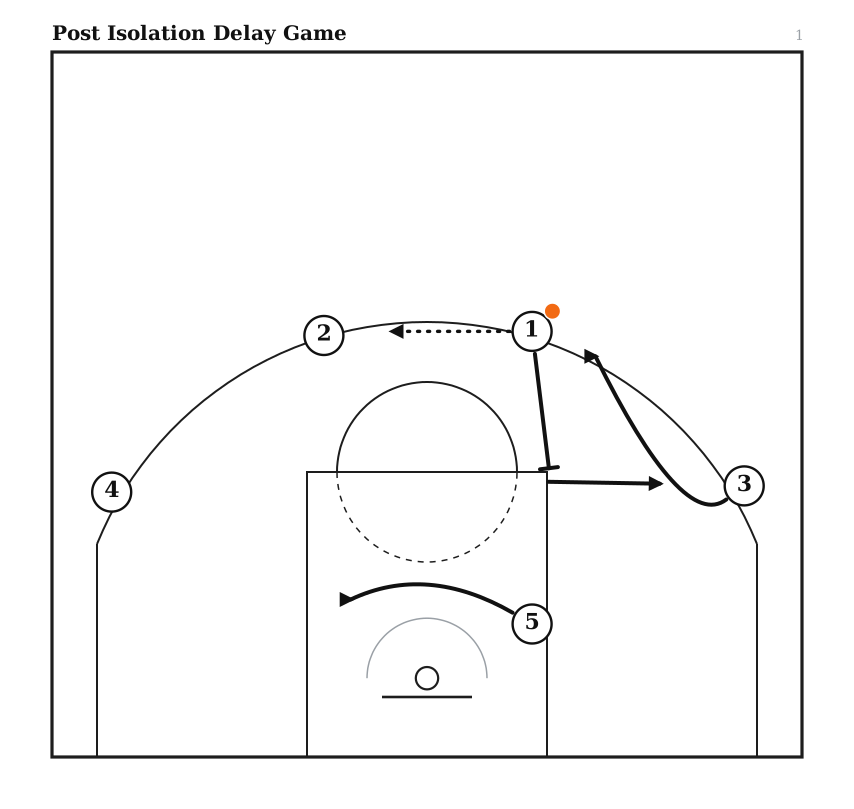
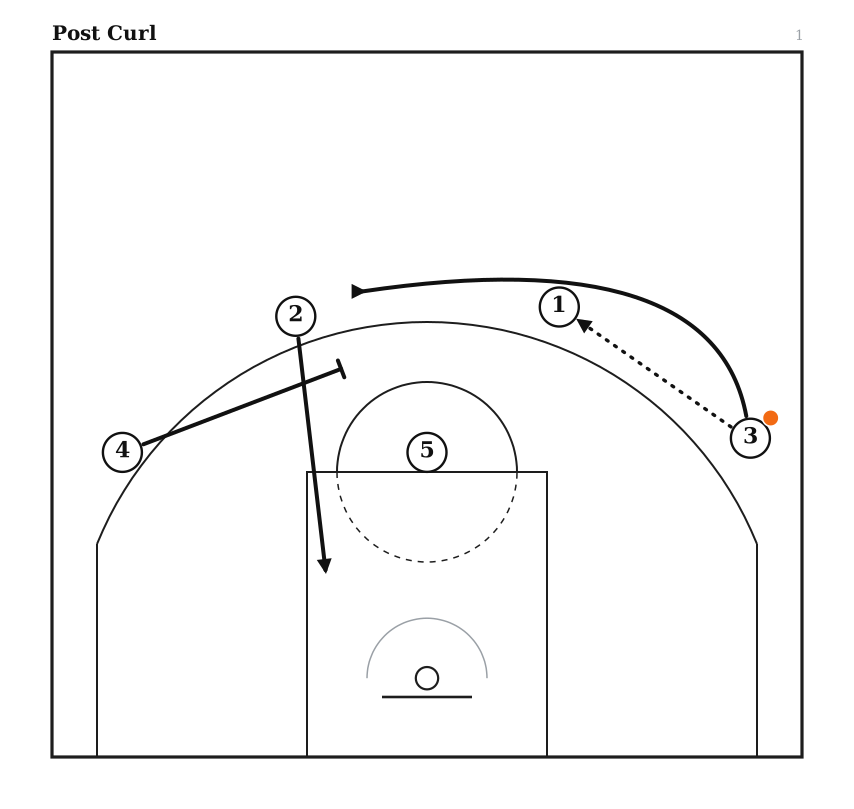
See it drawn up
Related diagrams
Keep Building
Related breakdowns
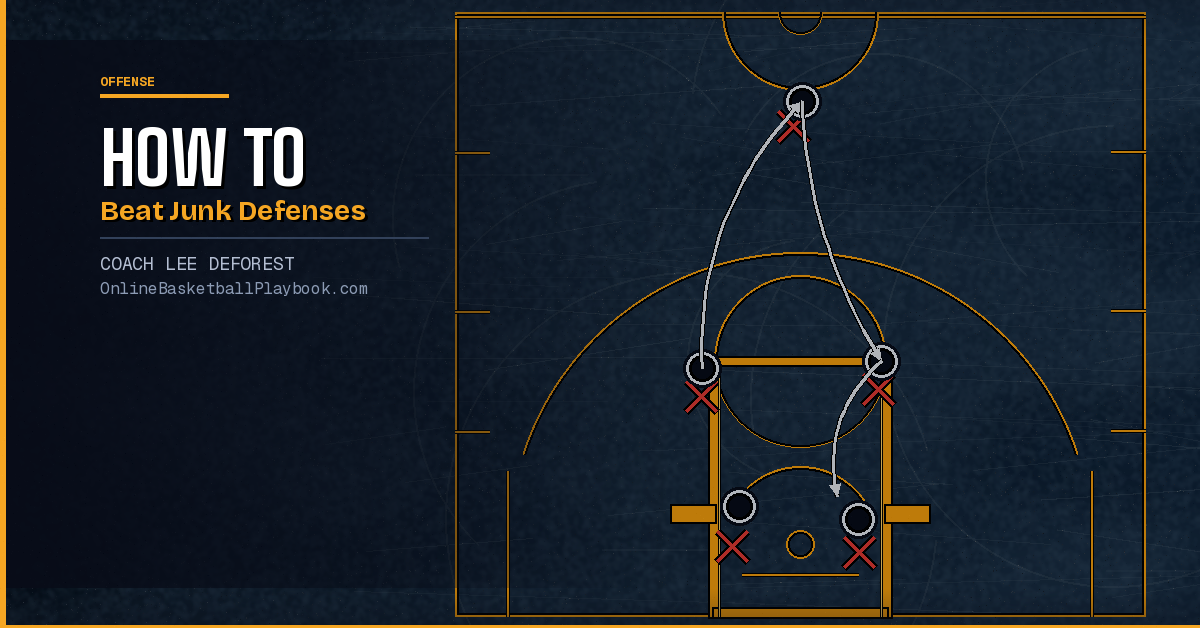
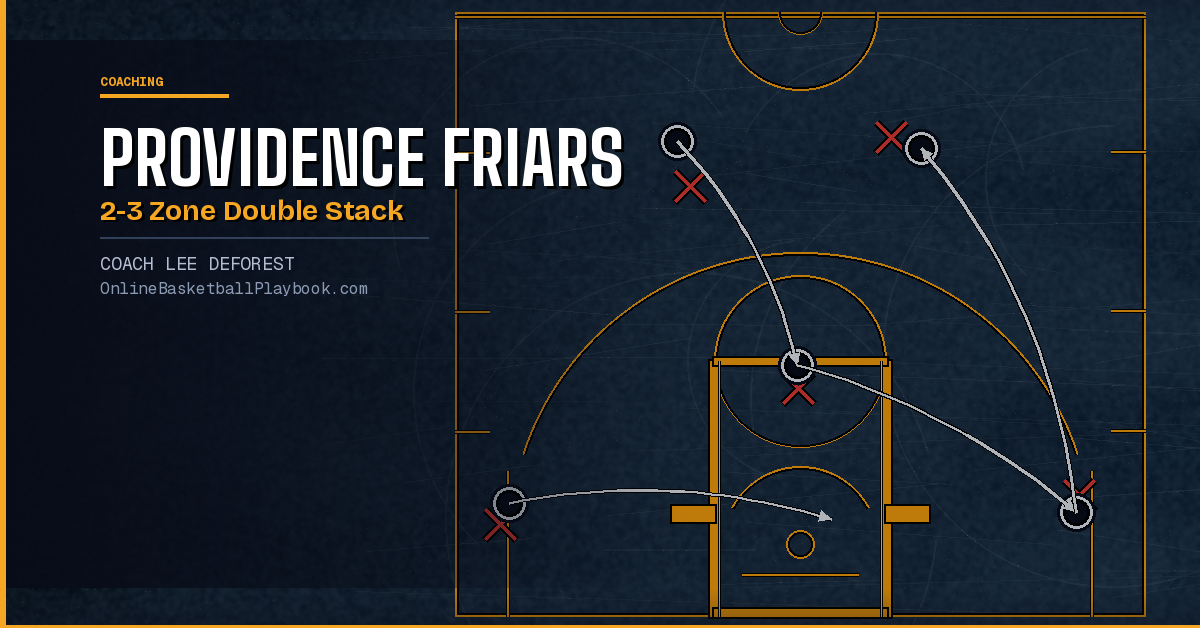
Providence Friars 2-3 Zone Low Double Stack Post Flash Basketball Play
Providence Friars 2-3 Zone Low Double Stack Post Flash Basketball Play