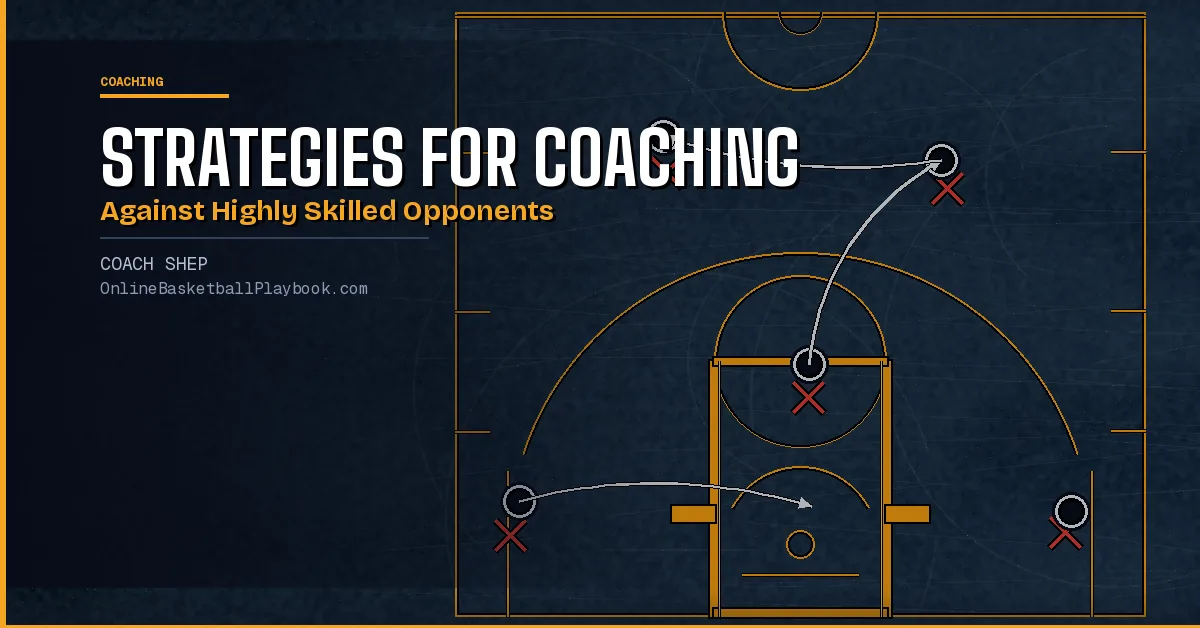
Facing a more talented team is one of coaching's most instructive challenges. The right game plan, built on defensive structure, pace control, and player confidence, gives your team a real chance regardless of the talent gap.
Understand the Opponent's Strengths Before Scheming
The first mistake coaches make against skilled opponents is over-scheming before doing real homework. Your game plan is only as good as the scouting that builds it. Before installing a new defensive wrinkle or specialty offense, sit down with film and answer three questions: where do they score from, who initiates their offense, and what do they do when forced off their preferred spots?
Highly skilled teams typically have one or two players who create the majority of their advantages: a guard who turns the corner at will, a post who cannot be bodied up, or a shooter who can step into threes off any set. Your scheme should force their best player to receive the ball in uncomfortable positions, work through a legal but relentless second defender, or make decisions under time pressure they don't usually face.
Scouting doesn't have to be elaborate. Three possessions per quarter of film on your opponent's top scorers tells you more than any stat sheet. Look for their go-to side, their first-step direction, their comfort zone on the floor. Then build your defensive positioning around removing that comfort. The goal is not to stop them entirely (highly skilled players will still produce) but to make them take longer, work harder, and settle for their second or third option.
Talk to your players early in the week about what you found. Players who understand the scouting report feel prepared. A team that walks into a gym with a specific defensive assignment ("we're taking away his right hand every possession") plays with more purpose than one told generically to "play hard and compete."
Defensive Structure: Make Them Work for Every Bucket
Defense is where less talented teams have the greatest opportunity to close the gap. Skill advantages are real on offense, but defensive effort, communication, and structure are largely coachable regardless of roster talent. The two most effective approaches against highly skilled opponents are disciplined man-to-man with strategic help rotations and well-timed zone changes that disrupt offensive rhythm.
Ball-Pressure Man Defense
If your personnel allows it, start with full-effort man-to-man and make the ball handler make decisions under continuous pressure. The goal is not gambling for steals (that breaks your defense) but forcing the offense to operate two or three seconds slower than they prefer. Most highly skilled teams practice against passive or moderate resistance. Sustained pressure at both the ball and the passing lanes disrupts timing and forces more difficult catches.
Your help-side defenders must stay connected. One aggressive on-ball defender becomes a liability if the help defenders cheat toward the ball handler too early. Teach your team the difference between early rotations (which open corner threes) and late rotations after the drive has committed the defense. The more disciplined your help structure, the more your on-ball pressure becomes a sustained problem for the opponent rather than an occasional nuisance.
Zone Principles That Don't Just Slow Down a Good Offense
Zone defense against skilled teams works when it creates confusion, not when it concedes open looks from the wing. A 2-3 zone that doesn't pressure the high post and wing feeds is simply a gift of good shots at slightly longer distances. If you go zone, commit to an aggressive top, active hands in the passing lanes, and a bottom line that doesn't allow baseline drives without contact from the low defenders.
Mixing defenses (starting the first four possessions in man and switching to a 1-3-1 trap on the fifth) can break a skilled team's early-possession habits. The disruption is not the zone itself but the transition from one to another. Many polished offensive systems are practice-tested against one defensive look; they adjust more slowly when two looks alternate without a clear signal.
Control the Pace and Possession Count
Against a more talented opponent, fewer possessions generally favor the less talented team. This is not a defensive or conservative philosophy. It is math. Over forty possessions, talent asserts itself at a predictable rate. Over twenty-eight possessions, your execution on each one matters far more, and variance works in your favor.
Controlling pace starts with offensive execution, not just slowing down your dribble. Teams that rush shot attempts after fifteen seconds of action are not playing fast basketball. They are giving the opponent extra possessions disguised as tempo. Real pace control means executing your offense for twenty or twenty-two seconds per possession when needed, taking good shots that come from your scheme rather than escape-valve shots taken to beat a self-imposed time limit.
Foul trouble on their best player is a legitimate pace tool. Not by flopping or manufacturing contact, but by attacking them aggressively in the first quarter so their coach must manage their minutes. A star player who picks up two fouls before the first quarter ends will be held out of situations they would otherwise dominate. Your offense should initiate contact with their best defender, not cheap contact, but strong drives and physical post-ups that force decisions from the officials.
Offensive rebounding is also a possession multiplier. Against a superior team, a second-chance basket carries double psychological weight. It signals that their talent advantage did not prevent you from extending the possession. Train your shooters to crash and your bigs to read shot trajectory, not simply sprint back in transition. Giving up a defensive transition basket once per game in exchange for two offensive rebounds is frequently worth the trade against a highly skilled opponent.
Define Clear Roles and Keep Your Players Confident
One of the most damaging things a coaching staff can do before a difficult game is communicate, even subtly, that the other team is simply better and winning is a long shot. Players read their coaches. A practice week that feels like damage control, where coaches spend more time emphasizing the opponent's strengths than their own team's preparation, produces a team that takes the floor already beaten.
Role clarity does the opposite. When every player on your roster knows exactly what is expected of them, not a long list of adjustments but two or three specific responsibilities, they can execute under pressure. Your ball handlers need to know which dribble penetration you want, which reads you trust them to make, and which ones you want them to avoid against this opponent. Your wing defenders need a specific assignment against their best scorer. Your post players need to understand where they are allowed to catch and where you want the ball moved.
The principle applies directly to younger and developing players. Our coaching research library's youth coaching fundamentals are clear that reducing decisions to a small number of binary choices produces better execution than loading players with options. Against a skilled opponent who can exploit hesitation, this is even more important. Two clear choices made quickly beat five theoretically better choices made slowly.
Building Confidence Before the Game
Frame your pre-game and practice-week messaging around things your team can control: their defensive positioning, their communication on switches, their effort on the offensive glass, their ability to execute the first three actions of your primary set. Teams that focus on process metrics rather than the scoreboard play with more freedom. They're not managing anxiety about the gap; they're executing a plan.
Use short, specific praise in practice. "You rotated before the drive committed. That's exactly right" is more useful than "good defense." Specific feedback builds genuine confidence because players understand what they did correctly, and they can repeat it. Against a highly skilled opponent, your players' belief in their ability to execute your plan is a real performance factor, not just something coaches say to be encouraging.
Before your next game against a stronger team, write each player's two or three specific defensive responsibilities on a card and review them together one day before the game, not the morning of. Players who sleep on a clear assignment execute it with more confidence than those who hear the plan for the first time in a pregame speech.
Offensive Game Plan: Attack Their Weaknesses Systematically
Every highly skilled team has something they defend less well. It may be a weak-side defender who gambles too often, a big who doesn't rotate to corner shooters, a guard who helps too aggressively on baseline drives and leaves shooters open, or a team that struggles to guard spread pick-and-roll. Your scouting report should identify this weakness specifically and your offense should attack it on the first five possessions before they can make halftime adjustments.
Structure your primary actions to put stress on their identified defensive liability. If their best defender cannot guard the pick-and-roll, run it toward them early and repeatedly. If their best scorer is a poor team defender who doesn't communicate on switches, run your sets away from him and force him to make switching decisions. If their zone collapses immediately on baseline drives, teach your players to kick to the corner before completing the drive rather than forcing a contested layup.
Exploit Mismatches Without Overcomplicating
When a mismatch appears, through switching or defensive breakdown, your players must recognize it and attack it within two seconds. Highly skilled teams recover quickly. A point guard in the post against a smaller defender is a one-action opportunity, not a half-possession to analyze. Practice mismatch recognition as a specific drill: identify the switch, call the mismatch, attack before the defense can help. This is a skill that requires repetition, not just awareness.
Keep your offense simple enough that your players can execute it under duress. Against a highly skilled opponent, your players will face more pressure, quicker rotations, and higher defensive IQ than they normally see. This is not the game to install a new set or experiment with a new action. Run the plays your team has executed successfully in practice, in the sequences that create the looks you want. Familiarity produces confidence under pressure.
Mental Preparation and In-Game Adjustments
Coaching against a highly skilled opponent is as much about in-game management as pre-game preparation. The first quarter will tell you whether your defensive plan is working, whether their pace is what you scouted, and which of your players is competing well enough to trust in late-game situations. Stay in your scouting plan through the first quarter before considering adjustments. Most early-game struggles are execution problems, not scheme problems.
Manage your team's emotional response to runs. Highly skilled teams will make runs. A 7-0 run that cuts your lead or extends their lead is not evidence that your plan is wrong. It is a normal occurrence in a basketball game. Call a timeout when you need to disrupt their momentum, remind your team of the specific adjustments, and return to your scheme. Coaches who panic and change their entire defensive structure after one bad quarter typically produce more confusion, not better defense.
Half-time should be spent on two or three specific corrections, not a comprehensive review of everything that went wrong. Pick the most impactful fix (one defensive adjustment, one offensive priority) and communicate it with clarity. Players who enter the second half with one clear correction to make are more focused than players who heard twelve adjustments in twelve minutes.
Late-game situations against a skilled opponent require your best decision-makers on the floor regardless of traditional roles. If your second-best ball handler makes smarter choices under pressure than your starting point guard, those late-game minutes belong to the decision-maker. Match personnel to the specific demands of each moment, not to the formality of the depth chart.
Finally, define winning broadly for your team before the game starts. A well-executed defensive possession in the fourth quarter against a superior team is a competitive achievement worth recognizing. Teams that learn to compete at a high level against better opponents develop the habits, toughness, and system understanding that make them genuinely difficult opponents as they improve. The process of closing the gap is itself a coaching and development victory, and players who experience it carry those habits forward.
- Scout three specific tendencies of their top scorer before scheming: identify their go-to side, preferred catch zone, and first-step direction, then build defensive positioning around removing those advantages.
- Cut possession count deliberately by executing your offense for 20-plus seconds per possession rather than rushing shot attempts; fewer possessions reduce the margin for their talent advantage to fully assert itself over the game.
- Give each player two or three clear defensive responsibilities: not a full adjustment list so they can execute quickly under the pressure a skilled opponent applies on every possession.
- Attack their defensive liability in the first five possessions before halftime adjustments close the window; identify the weak-side defender, the poor switch communicator, or the zone gap from film and run directly at it early.
- Use specific praise in practice: "you rotated before the drive committed" rather than "good defense" to build genuine confidence that players can replicate, which becomes a real performance factor when they face superior talent on game night.
Want more basketball coaching strategies and drills?
Join the Online Basketball Playbook newsletter →
Draw this play free in the play drawer →
Membership: the full library, playbook packs, and Pro drawing tools →
Keep Building
Related breakdowns
Strategies for Coaching Against High-Tempo Teams
Strategies for Coaching Against High-Tempo Teams
Basketball Coaching Leadership: 5 Strategies That Hold Up
Basketball coaching leadership in five habits: state who your program is, keep a few standards, build culture in practice, declare roles and develop player leaders.
Effective Strategies for Coaching Basketball for Different Age Groups
Effective Strategies for Coaching Basketball for Different Age Groups