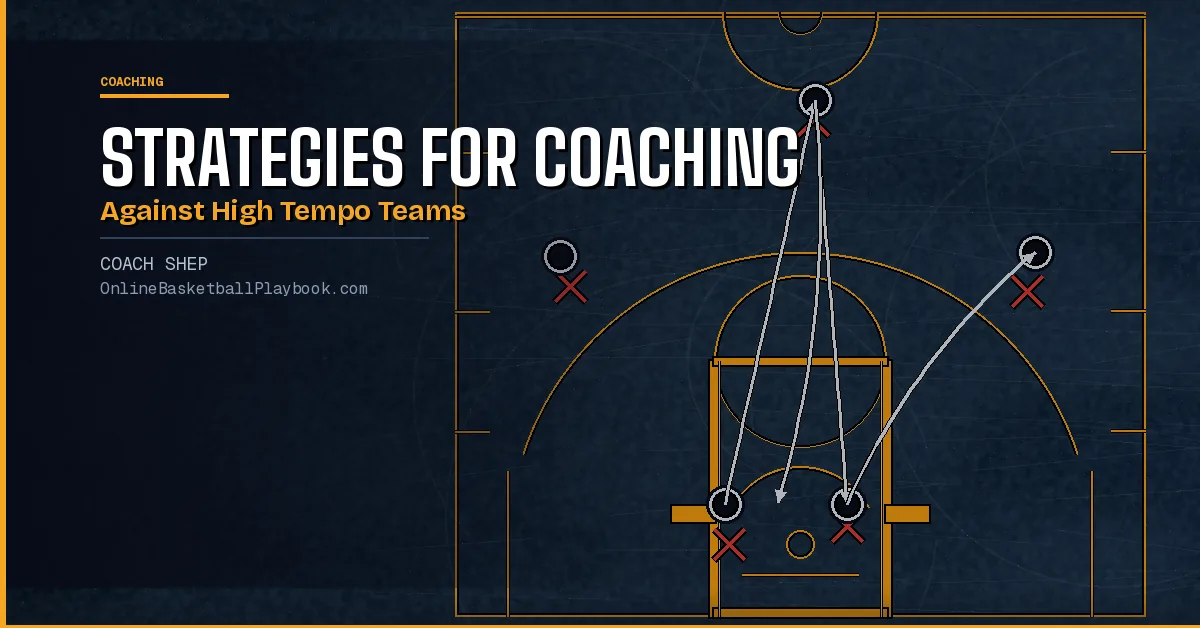
High-tempo teams want the game played fast, chaotic, and on their terms. This guide gives you the preparation, the defensive structure, and the offensive discipline to take that away from them.
Understanding the High-Tempo Threat
Before you can counter a high-tempo team, you need to understand exactly what they are trying to do. These teams are not just running fast for the sake of it. Their entire offensive identity is built around eliminating your defense before it can set up. Every possession is a race. They want to push the ball off a made basket, a defensive rebound, a turnover, even a miss in the corner. The goal is to catch your team scrambling, outnumbered, or out of position. One open layup becomes two, then three, and before halftime the scoreboard has run away from you.
High-tempo teams come in two main varieties. The first is the pure transition team. They get a stop or a rebound and immediately push the pace, looking for the first available advantage before the defense recovers. The second is the press-and-run team. They apply full-court or three-quarter-court pressure to create turnovers and then convert those live-ball situations directly into fast-break buckets. Both types share the same core vulnerability: they depend on your mistakes. Take away the mistakes, slow the possessions, and their advantage shrinks considerably.
Scouting these teams requires a different lens. You are not just charting their half-court sets. You are counting how many of their points come in the first four seconds of a possession. If 40 percent or more of their scoring comes in transition or off turnovers, you are dealing with a team whose identity is speed. That number tells you where to focus your preparation.
Controlling Pace Before the Game Starts
The best time to slow a high-tempo team is before the opening tip. Game preparation and pre-game routine directly affect how composed your players are when the tempo pressure hits. A team that arrives mentally prepared for chaos is far harder to rattle than one that gets surprised by the speed in the first two minutes.
Walk-through tempo is the first tool in your preparation kit. In the days leading up to the game, run your half-court offense at a pace that is deliberately patient. Do not rush the entry pass, do not rush the first action, and do not accept a forced early shot. If your players practice making sound decisions at a controlled pace, that composure transfers to game situations. High-tempo teams win in practice arenas long before tip-off when opposing teams spend the week running with them in simulation instead of practicing patience against their pressure.
Team meetings before facing a press-and-run team should be specific. Show your players where the traps are on film. The baseline corner trap, the half-court trap after a long pass. Name the spots. Assign the outlets. When a player sees a trap in a game and already has a practiced response in their muscle memory, they do not panic. Panic is what produces the loose ball that becomes a layup at the other end.
Ball-handling assignments should also be clarified in advance. Against a high-pressure team, you want your two best decision-makers handling the ball the most. This is not always the fastest player or even the best dribbler. It is the player who sees the floor clearly when the defense is loud and physical. Know who those players are on your roster and build your press-break personnel around them.
Defensive Principles That Slow the Run
Slowing a high-tempo team starts on defense, not offense. The single most effective way to limit transition buckets is to get back quickly after your own shot attempts. This is called transition defense, and it has to be a system, not a reaction. Every player on the floor needs to know their job the moment a shot goes up.
Designate a Safety and Enforce It
Assign one player on every half-court possession whose primary responsibility is defensive balance. This player does not crash the offensive glass. Their job is to be at or near the half-court line before the shot lands. If the ball goes in, they are already back. If the ball comes off the rim and your team recovers it, the possession continues and they re-enter the action. If the ball comes off and the opponent gets it, your safety is the wall that prevents the cheap layup before everyone else recovers. One assigned safety who does their job consistently eliminates a large percentage of your opponent's fastest transition opportunities.
Contest Without Gambling
High-tempo teams thrive on turnovers, and many of those turnovers come from defenders reaching, gambling on steals, or taking poor angles on ball-handlers in transition. Discipline your players to stay in front of ball-handlers rather than lunging for the steal. A clean contest with good positioning is worth more than a gamble that misses and opens a lane. This principle is especially important for your help defenders. The second a helper over-commits to the ball, the skip pass or the dump-off pass goes for an easy two.
Rebound Aggressively and Outlet Under Control
Defensive rebounding against a fast team has a second step that slower teams do not require: the controlled outlet. Your rebounder cannot simply grab the ball and fire a baseball pass up the sideline. High-tempo teams anticipate the outlet pass and will pick it off. Instead, rebounder secures the ball, pivots, finds the guard with two feet planted, and makes a short, safe outlet. The few seconds you spend making a clean outlet are worth it compared to the turnover-to-layup sequence that follows a bad pass.
Offensive Execution Under Pressure
Once you have the ball, your job against a high-tempo team is to make every possession count. You do not need to stall or play at a crawl, but you do need to be patient, purposeful, and willing to reset an action when the reads are not there. A team that scores on 55 percent of their half-court possessions and never turns the ball over in transition is extremely difficult for a run-and-gun team to beat, even if the tempo-team is more talented.
Attack the Press Intelligently
Most press-and-run teams trap at predictable locations: the inbound, the half-court line, the baseline corners. Your press-break should be designed around those specific trap spots, not built as a generic ball-movement drill. Identify two or three pass angles that beat each trap, practice those angles until they are automatic, and teach your players to recognize which trap is coming before they receive the ball. Anticipation beats the press; reaction is always a half-step late.
Dribbling out of a press is rarely the right answer. The ball moves faster than any player can dribble, and the second a ball-handler puts the ball on the floor in a trap, the defense has succeeded. Two or three quick passes split a press far more effectively than one player trying to navigate through traffic. Your press-break should have a forward pass option, a back-door safety valve, and a bail-out reset if neither is open, and players should know all three without having to think about it in real-time.
Use the Clock as a Weapon
When you have a lead late against a high-tempo team, the clock becomes your most important player. Make your opponent foul to stop the clock. Force them to guard you in the half court for extended possessions. Milk the shot clock, but do not milk it passively. Keep moving, keep passing, and keep your spacing so that when the defense reaches or gambles, you have an open shot or a free-throw opportunity. A team that runs tempo well usually has limited patience and discipline when the game slows down. They foul, they gamble, they argue calls. Use that against them.
Practice Drills That Build Tempo Resistance
The preparation you do in practice is the reason your players do not flinch when the pressure hits in a real game. Building tempo resistance is a deliberate skill, and the drills that develop it need to be baked into your regular weekly practice plan, not saved as a one-time walkthrough the day before the game.
Controlled Chaos Scrimmage
Set up live five-on-five scrimmage situations where one team is instructed to push the pace as hard as possible on every possession. The other team must adhere to specific rules: no shots in the first five seconds of a half-court possession, press-break passes only (no dribbling out), and every shot must have a designated safety who sprints back. This drill forces your players to execute under realistic pressure at practice speed. Debrief after each possession. Identify where the safety was late, where the outlet pass was risky, where the first good shot was missed because the player was rushing.
Two-Ball Press-Break Drill
Use two balls simultaneously in press-break reps to accelerate decision-making. One ball is in play with your press-break unit running their assignments. The coach holds a second ball at mid-court. The moment the first possession resolves (whether a made basket, a turnover, or a miss), the coach throws the second ball back to the outlet to restart immediately with no break. This removes any mental rest between reps and forces players to refocus and execute again immediately. High-tempo teams hit you with wave after wave; your preparation should too.
Transition Defense Sprint Drill
After every made basket in five-on-five scrimmage, the scoring team must immediately sprint back to three-quarter court before they can play defense. This forces them to cover ground in live game conditions and teaches the physical habit of getting back quickly. The offensive team gets a three-second head start to simulate the advantage a fast-break team would have in a real game. If your safety and your first defender can contain the ball for three seconds while the rest of the team recovers, you have eliminated the fast break. That three-second window is what you are training.
When you drill tempo-resistance situations in practice, keep the intensity high and the feedback immediate. Name what went wrong in the moment ("outlet was a full second late" or "safety turned around to watch the shot") so the correction lands while the play is still fresh in the player's mind. Corrections delivered a minute later lose most of their sharpness.
In-Game Adjustments and Timeout Strategy
Even with excellent preparation, high-tempo teams will have runs. Every team that plays fast will string together four or five possessions where everything goes their way (deflections, lucky bounces, quick threes). Your job as a coach is to recognize the run early and interrupt it before it becomes a rout.
Take Your Timeout at the Right Moment
The worst time to call a timeout is after the momentum run is already over. The best time is when you feel it starting (after the second consecutive quick bucket, not the fourth). A timeout taken early costs you nothing; a timeout taken too late does not stop the bleeding, it just delays it. Teach your players a specific signal or phrase that communicates "we need a break right now" so they can alert you when they feel the game accelerating out of control.
Adjust Personnel Matchups
If a specific player on the other team is initiating their tempo advantage (pushing the ball off every made basket, making every press-trap pass), consider which of your defenders can best stay in front of them. Matchup changes mid-game can disrupt their flow without requiring a completely new defensive system. A slower-footed defender on their primary ball-pusher is not just a liability in isolation; it is the reason their entire tempo game works. Fix that matchup and you fix a large part of the problem.
Change Your Press Alignment
If you have been playing back (dropping into a half-court set immediately on every possession) and the other team is still getting easy transition looks, consider applying a short zone run or a token full-court extension on select possessions. You do not need to full-court press all game, but showing them a different look once or twice per quarter forces their inbounder and ball-handler to make a decision they have not been making. Indecision produces hesitation, and hesitation kills their tempo as effectively as anything else you can do.
The final note on in-game adjustments is communication. Your players need to hear your adjustments clearly and quickly during timeouts. Keep the message to two or three concrete instructions, what we are doing differently right now, and who is responsible for each piece. A timeout full of five different corrections produces confusion. One adjustment executed cleanly is worth ten that get lost in the noise.
- Designate your safety before tip-off: One player stays back on every possession, no exceptions, regardless of the score or the situation.
- Press-break by number, not by reaction: Assign each player a specific spot and pass angle so decisions are made in practice, not in the chaos of the game.
- Outlet under control, not under pressure: The rebounder pivots, finds the open guard, and makes the short pass. No baseball passes against a run-and-press team.
- Call your timeout after the second quick bucket, not the fourth: Interrupt the run before it becomes a double-digit swing that requires a full-game comeback.
- Use the clock late: When leading against a fast team, make them guard you for the full shot clock. Exhaustion and impatience cause them to foul and gamble, both of which work in your favor.
Want more basketball coaching strategies and drills?
Join the Online Basketball Playbook newsletter →
Draw this play free in the play drawer →
Membership: the full library, playbook packs, and Pro drawing tools →
Keep Building
Related breakdowns
Strategies for Coaching Against Highly Skilled Opponents
Strategies for Coaching Against Highly Skilled Opponents
Basketball Coaching Leadership: 5 Strategies That Hold Up
Basketball coaching leadership in five habits: state who your program is, keep a few standards, build culture in practice, declare roles and develop player leaders.
Basketball Pace and Tempo Strategy for Coaches
Basketball Pace and Tempo Strategy for Coaches