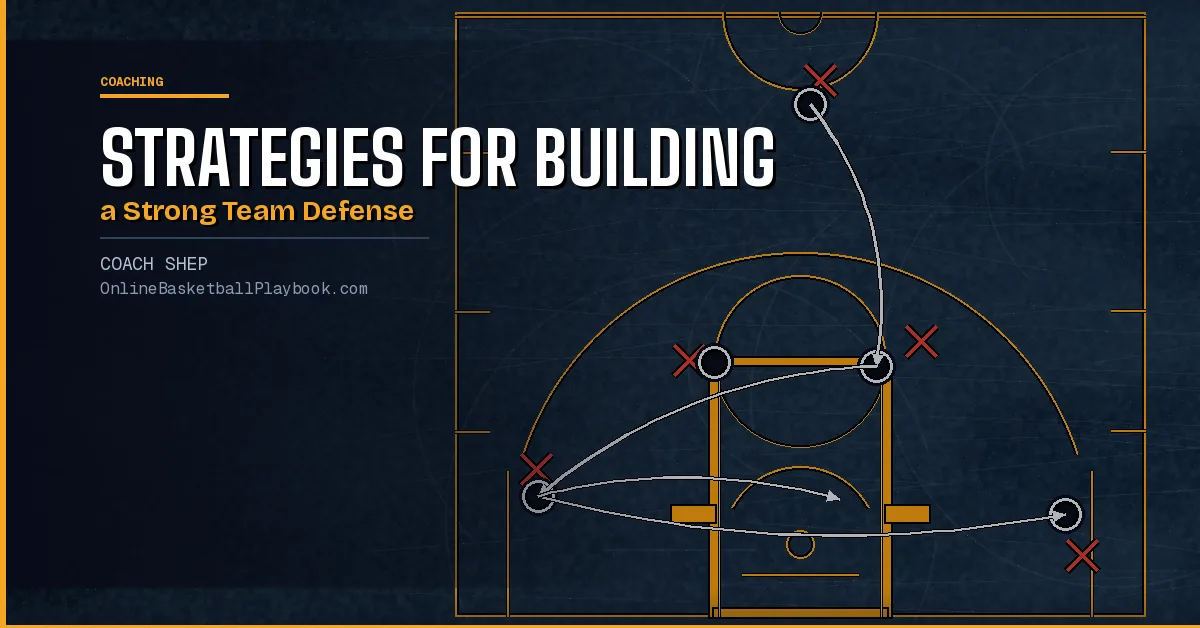
Offense fills the highlight reel, but defense wins championships. The coaches who build programs that last don't wait for a talented roster. They install a defensive identity from day one and enforce it without exception.
Defense as a Program Identity, Not a Game Plan
The most durable defensive teams in basketball share one thing: defense isn't what they do when they're losing, it's who they are. Thad Matta at Ohio State began every practice with 75 percent defense-focused work. That wasn't a balance sheet choice. It was an identity signal sent every single day. When players see where the coach spends practice time, they learn what the program actually values.
Obradovic's clinic captures this precisely: "Offense is easy; defense is where coaching shows." Any team can get excited about scoring. What separates a well-coached program from the field is whether players sustain defensive effort in the fourth quarter of a road game when the scoreboard is against them. That level of consistency doesn't come from a pregame speech. It comes from months of repetition where standards never slip.
The implication for your program is specific: pick your defensive identity before the season opens and commit to it publicly. Whether you run man-to-man, pack-line, or a pressure scheme, the choice matters less than the consistency with which you install and enforce it. John Tauer at St. Thomas put "Play Tough Defense" first on his three non-negotiables list precisely because he understood that defense sets the team's identity in ways no offensive system can. When your players know what defensive standards look like, they can police each other, and that is where real program defense lives.
Peer Accountability Over Coach-as-Enforcer
The fastest path to a defense that holds over an 80-game grind is building a system where players correct each other, not one where every mistake runs through the coach. Obradovic's operating principle is direct: "One errs, the whole team runs, they talk to each other, not to me." When a single player's defensive mistake costs the entire group a sprint, teammates become invested in each other's execution in a way that no individual punishment can create.
This peer accountability model removes the coach from every correction loop. That matters because a coach can only be in one place on the floor. Twelve players watching each other's defensive habits are covering twelve times the ground. But the model only works if two conditions are met. First, the standard has to be clear enough that players can name a mistake when they see it. Second, the coach has to enforce the group consequence without exceptions, the moment the team senses selective enforcement, peer accountability collapses into resentment.
Dean Smith's approach at North Carolina reinforces this from a different angle. His rule that no teammate yells at another in a publicly visible way protects the trust that peer accountability requires. Teammates who snap at each other create a dynamic where players stop communicating defensive switches, stops, and rotations out of fear of triggering conflict. Building a culture where criticism is direct but never hostile is the foundation that makes genuine defensive communication possible.
Practically, you can start building peer accountability in week one of preseason. Run group-consequence drills (where one player's defensive breakdown sends the entire unit through a conditioning rep) and be consistent about it. Over time, players will begin coaching each other in real time on defensive assignments, rotations, and closeouts, because they feel the shared cost of breakdowns firsthand.
Daily Non-Negotiables That Don't Bend
Standards erode the moment enforcement becomes selective. Obradovic's drills are deliberately simple by design and run every single day for exactly this reason. "Fake first" and "look at the basket on the catch" are two-word rules enforced identically in game one and game eighty. The unconditional repetition is the value, not the complexity of the drill.
Kelvin Sampson's framework for non-negotiables applies directly to defensive culture. His standard is that attitude and effort must look the same every day. "How you do anything is how you do everything." A team that sprints back on defense when the score is comfortable but walks back when down by fifteen is not a defensive team, it is a team that plays defense sometimes. The coach's job is to make effort non-negotiable regardless of circumstance, and to hold players to that standard immediately when it slips, not at halftime and not after the game.
The practical mechanism is naming the non-negotiable, posting it visibly, and calling it by name when it's violated. Kevin Eastman observed that short, sticky phrases that "capture the team's attention" become the culture. Once a phrase is named, the behavior becomes repeatable and self-policeable. Pick two or three defensive standards that matter most to your system: contest every shot, take a charge when the angle is there, sprint every transition. Give each one a name, and correct them by name in every practice. The vocabulary becomes the behavior.
Make Practice Harder Than the Game
Anson Dorrance built a 22-national-title program at UNC Women's Soccer on a principle that transfers directly to basketball defense: practice must be more competitive than games. He called it the competitive cauldron. If practice is a safer environment than a game (less pressure, less consequence, less intensity), players will shrink under real game pressure. Inverting that dynamic makes games feel manageable by comparison.
For defensive development, this means building practice segments with real stakes attached. Scored defensive competitions, where the losing unit runs or loses a privilege, are not punishment. They are a simulation of the consequence of defensive failure in a real game. Players who regularly compete in environments where defensive breakdowns have an immediate, tangible cost develop the mental toughness to hold their assignments when the game is on the line. Players who only practice defense at instructional intensity do not.
Mike Dunlap's implementation of this principle is specific enough to apply directly: 15 to 20 minutes of No-Dribble drills daily. No-Dribble forces cutting, passing, pivoting, and communication, and it reveals personalities under pressure in a way that standard scrimmage does not. On defense, No-Dribble situations demand active feet, active hands, and constant communication about who has what coverage. Dunlap's phrase captures the result: "Puts the WE in your gym." Toughness, he argues, is "inch by inch and day by day", a daily structure, not a pregame speech.
Bill Parcells reinforced this from the preparation side: "We don't want players to think during a game, we want them to react. Thinking takes too long." Every defensive rep in practice is depositing into the reflex bank. When your defensive scheme runs automatically (when a player rotates to help-side without consciously deciding to), that is the output of hundreds of high-pressure practice reps where the same action was required and corrected. Coaches who under-pressure their practice environment are writing a check their players can't cash when it matters.
Teaching Five Players to Guard as One
Thad Matta's definition of a great defender lists three qualities: intelligence, passion, and relationships. The relationships quality is the one coaches most often skip. It means all five players guarding the basketball together. A single defender with elite individual tools is not a defensive team. Five connected players who understand each other's responsibilities, communicate their assignments, and rotate to cover each other's mistakes are.
Building that connectivity starts with communication habits that are trained, not assumed. Smith's "acknowledge the passer" principle, pointing to the passer on every made basket, is a daily culture rep that costs nothing and reinforces the team-over-self identity in a concrete, visible way. On defense, the equivalent is requiring verbal calls on every screen, every flash, every cut. Not encouraging players to communicate. Requiring it, and correcting its absence every time it happens, in every practice, from the first day of preseason.
Jay Wright's approach to defending ball screens illustrates the deeper principle. He named the decision to blitz a screen a "Calculated Risk", a principled choice with three trigger conditions, not a reaction. Teaching defense as reasoned decisions rather than reflexive reactions requires players to internalize the why behind every action. When five players all understand why they are making the defensive choice they're making, not just what the play calls for, they can adapt collectively when the offense does something unexpected. That adaptability is what separates a defense that holds in the fourth quarter from one that falls apart when the script changes.
David Richman's possession framework gives coaches a measurable target: win 65 of 100 possessions in a game. Defensive possessions count directly toward that standard. Tracking defensive possessions alongside offensive ones gives players a concrete picture of where the team stands in real time, and makes defense feel like a scoring category, not just a chore. When players see that every stop contributes to a measurable team goal, the motivation to guard consistently increases.
Role Clarity as a Defensive Foundation
Defensive breakdowns most often happen at the seam between two players who both thought the other had coverage. Role ambiguity is a culture leak. Mike Dunlap identified this directly: "Before players play, they need to know their role. Ambiguity about who does what is corrosive." That principle applies on both ends of the floor, but its consequences are most visible on defense, where a single coverage gap becomes an open layup.
Role clarity on defense means every player on the floor knows three things before the possession begins: who they are guarding in man, what their help-side responsibility is, and what the trigger is for rotating. Installing these assignments is not enough. They have to be tested. Parcells' fourth-quarter role test is the right model: at the end of every week, ask each player to state their defensive assignment in a late-game situation without prompting. If they cannot articulate it, the coach has not prepared them. More reps are needed before the next game, not a conversation after the loss.
Dean Smith's Blue Team concept addresses role clarity for reserve players specifically. Players seven through twelve on the roster always enter as a unit, always in the first half, always play one to two minutes together. The predictability keeps reserve players mentally engaged and ensures they know their defensive assignments cold. A reserve who doesn't know when or with whom they're entering a game cannot be mentally ready to execute their defensive scheme when they do. Role predictability is preparation, for the bench as much as the starters.
Run a two-minute defensive role check at the end of each week's final practice: pull each player aside individually and ask them to describe their specific assignment against your next opponent's top action. No notes, no prompting. If they hesitate or guess, you have a preparation gap. Add reps in the next session before the game, not after. This habit catches coverage confusion before it becomes a breakdown on game night and holds you accountable as the teacher, not just the player.
Treating Defensive Errors as Coaching Receipts
The most significant shift any defensive-minded coach can make is changing how they interpret mistakes. Parcells' policy on mental errors is clear: when a player makes an assignment error under pressure, the first question is whether the action was drilled until it was automatic. Mental errors are a coaching receipt, a record of what was not prepared, not a verdict on a player's character or intelligence.
This reframe matters for defensive culture because it removes the blame dynamic that poisons team defense. When a player rotates to the wrong coverage and the coach's first response is "what did we drill?" rather than "what were you thinking?", the player's response is to learn, not to protect themselves. Dunlap's version of this principle: "No dumb players, just dumb coaches not teaching." When players consistently do the wrong thing, the first question is whether the right thing was ever genuinely taught with specific triggers and cues, not a generic instruction to concentrate.
This standard also drives the coach to create better defensive drills. If players repeatedly lose their man on back-cuts, the coach who treats that as a player failure will correct the same mistake twenty times without solving it. The coach who treats it as a preparation gap will design a drill specifically targeting back-cut recognition, run it until the response is automatic, and then test it under pressure. Eustachy's game slippage diagnostic applies here: track how much your defensive execution degrades from practice to game for specific actions. High slippage on a specific coverage tells you exactly where to spend the next week of practice time.
Building a strong team defense is ultimately a program-building task. It requires a defensive identity communicated clearly, non-negotiable standards enforced without exception, practice environments that demand more than games, five players who understand each other's responsibilities, individual roles clarified before the season and tested weekly, and a coaching standard that treats every defensive breakdown as a preparation question first. The teams that hold opponents under their scoring average in March are not the most talented. They are the most consistent. And consistency is a coaching product, built rep by rep over a long season.
- Name your top three defensive non-negotiables before preseason and post them visibly: contest every shot, sprint every transition, take the charge when the angle is there. Then correct each by name every time the standard slips, from day one forward.
- Run group-consequence drills weekly where one player's defensive breakdown sends the entire unit through a conditioning rep. This builds peer accountability faster than any individual correction and makes teammates invested in each other's execution.
- Add 15–20 minutes of No-Dribble drills daily to force active feet, cutting, pivoting, and defensive communication. It reveals personalities under pressure and builds the collective WE that sustains team defense in the fourth quarter.
- Run Parcells' fourth-quarter role test every Friday: Pull each player aside individually and ask them to state their specific defensive assignment from memory in a late-game scenario. If they can't, add reps before game day, not excuses after.
- Require verbal defensive calls on every screen, flash, and cut in practice, not as a suggestion but as a standard corrected every time it's missing. Communication is a coachable skill, not a personality trait.
- Track game slippage on two or three specific defensive actions each week, compare practice film to game film for the same coverage and measure the gap. High slippage tells you exactly where to build more reps before the next opponent.
Want more basketball coaching strategies, drills, and tools?
Join the Online Basketball Playbook newsletter →
Draw this play free in the play drawer →
Membership: the full library, playbook packs, and Pro drawing tools →
Keep Building
Related breakdowns
Teaching Effective Defensive Strategies for Different Matchups
Teaching Effective Defensive Strategies for Different Matchups
Coaching Strategies for Improving Defensive Intensity
Coaching Strategies for Improving Defensive Intensity
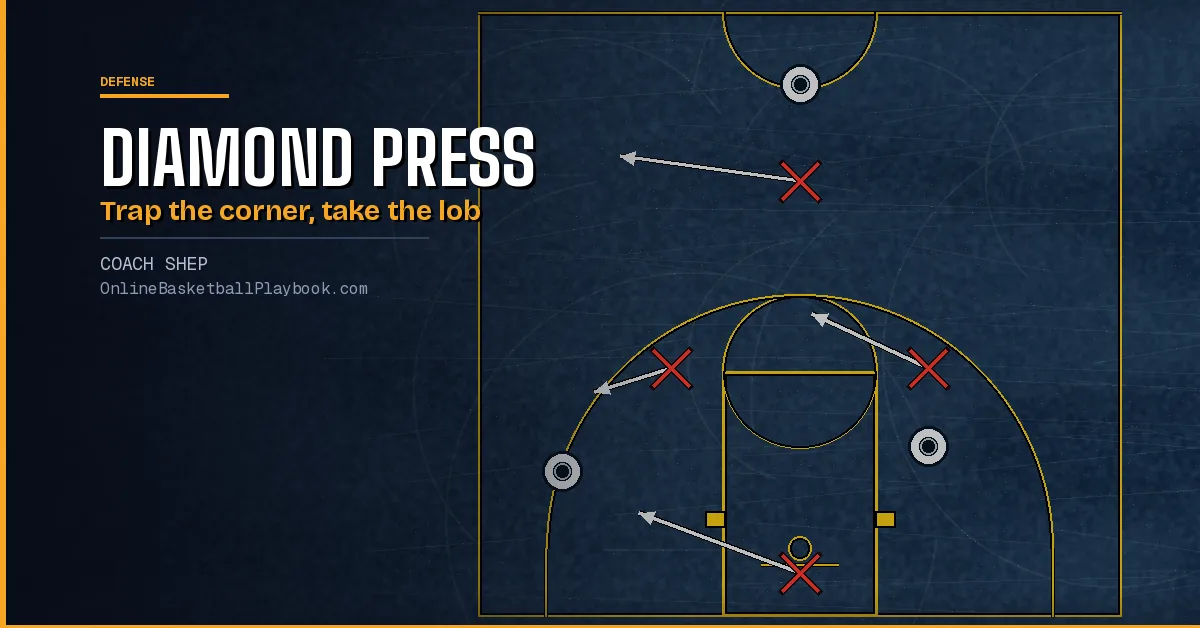
1-2-1-1 Diamond Press Basketball: Roles, Traps and Install
How to run the diamond press in basketball: who plays each role, how to trap the corner, what to do on the reversal and the lob, and how to install it step by step.