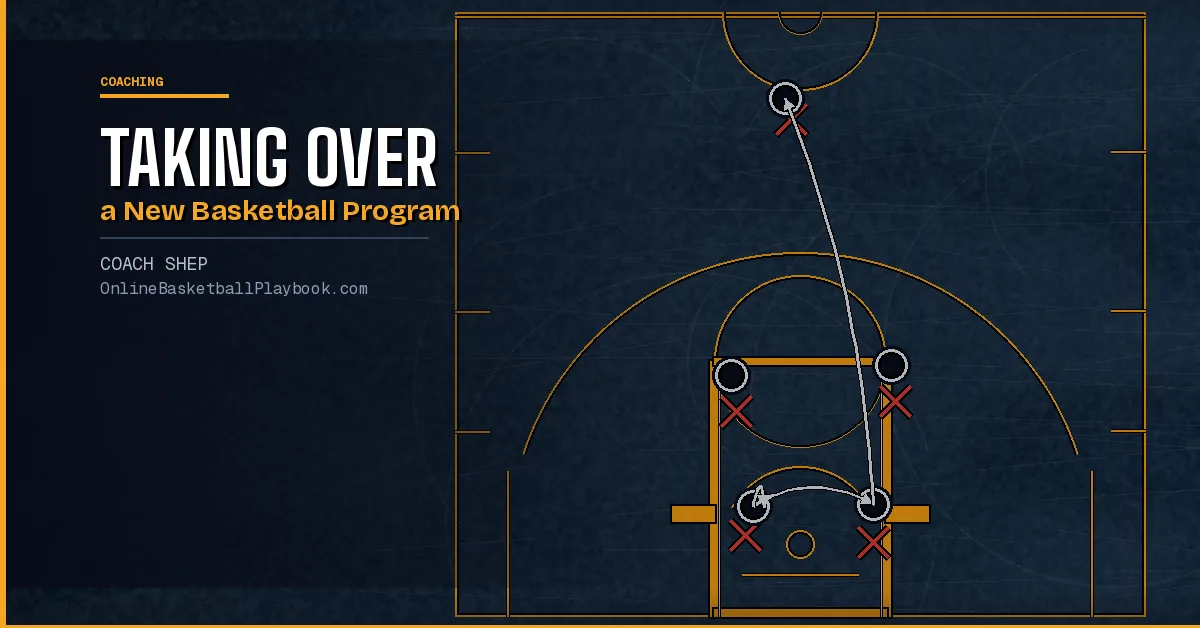
Taking over a new program is not about the plays you run. It is about the culture you build before you ever run one. Get the identity, standards, and trust right first, and the X's and O's follow.
Establish Your Identity Before Anything Else
The first thing any new head coach must do is answer one question clearly: what does this program stand for? Not what offense you run or what defense you prefer, but what values, what style of play, and what standard of behavior define this program every single day. If you cannot articulate that in two or three sentences on day one, players will fill the vacuum with their own interpretation. That interpretation will not serve you.
Jovan Pesic and Ettore Messina both make this point in different ways, but the underlying idea is the same: identity-first recruiting is more powerful than scheme-first recruiting. When your program has a known, public philosophy, it becomes a magnet. The right players come to you because they already know what they are signing up for. Wrong-fit players self-select out. That is the most efficient recruiting machine a program can build.
Practical first step: write down your program's identity in plain language before you meet with the team. Three values. One sentence about how you play. One sentence about what you expect off the floor. Post it. Live it from hour one. Everything else (scheduling, offensive sets, defensive schemes) is downstream of this. A new coach who starts with the playbook before establishing the identity is building on sand.
This is also the moment to define what success looks like in year one. Not wins and losses. Those are outcomes. Define it in terms of effort, culture, and process. Morgan Wootten ran DeMatha Catholic for 46 years on five principles that never changed regardless of personnel or record. His pregame talks did not use the word "win." That is a model worth studying carefully when you are walking into a new program.
Evaluate the Roster in practice
Before your first team meeting, you need an honest read on who is already in the building. Not based on what the previous staff told you, not based on highlight clips, and not based on reputation alone. Watch film across multiple games and multiple seasons. Talk to the players directly. Talk to former coaches, and specifically seek out coaches with different philosophical backgrounds, not just coaches who will tell you what you want to hear. That four-source model (film, past coaches across philosophies, network sources, and direct conversation) is the framework Obradovic uses before signing any player. It applies equally well when inheriting a roster.
What you are evaluating is not just skill level. You are evaluating character, coachability, and competitive fire. Anson Dorrance built 22 national championships at UNC Women's Soccer on a recruiting filter centered on three traits: self-discipline, competitive fire, and self-belief. He is direct about it. These traits can be identified, but they cannot be installed. A player who lacks genuine competitive fire at 17 will not develop it because you coach harder. The sooner you identify who has those traits and who does not, the sooner you can build around the right players.
The coachability signal is especially important. Dorrance's test: when you correct a player, watch their first reaction. A high-character athlete says "thank you, I want to know." A player who deflects or explains away the correction repeatedly is giving you critical information. Document those patterns early. They will matter when you are making hard roster decisions down the road.
Also look for who the natural leaders are, not the loudest voices, but the players others actually follow. Mike Dunlap is explicit that leaders are made, not born, but you need raw material to work with. Identify your one or two players with genuine leadership credibility and build your culture system through them from the start.
Set Non-Negotiables on Day One
Standards erode the moment enforcement becomes selective. This is one of the most common mistakes new coaches make: they set rules in the preseason speech and then look the other way when a starter violates them in week two because the game is important. The players are watching every single time. They are measuring whether you mean what you say.
Set your non-negotiables before problems arise, enforce them uniformly from the first day, and never make exceptions based on a player's status. Hubie Brown's four rules are a useful template in their simplicity: be on time, play hard, know your job, and know when to pass versus shoot. He holds every player to those four things identically. When his benched star refused the team's post-win ritual, Brown fined him and called it a season turning point, not a coaching crisis. The team saw that nobody was bigger than the standard. That visibility is the point.
Kelvin Sampson's framing is direct: "most coaches fail because they're afraid of confrontation." Accountability is the core of the job, and it starts in preseason before the first game puts pressure on you to make exceptions. Set the code of ethics (punctuality, effort, respect) in writing if possible, and enforce it immediately. The players who test it early are actually doing you a favor: they are giving you the opportunity to demonstrate that the standard is real.
A useful structure is Thomason's covenant system: four offensive non-negotiables, four defensive non-negotiables, and four team non-negotiables, visible on the game chart. When you can tie every drill and every game-chart entry back to one of those covenants, culture moves from attitude to trackable system. That is what new coaches need in year one. Something concrete enough to point to.
Build Trust Through Accountability
Trust between a coach and a player is not built through speeches. It is built through consistency (the coach doing what they say, saying what they mean, and treating every player the same regardless of situation). Bill Parcells calls this true candor: the measured telling of truth, not the open venting of rage. The distinction matters. Players can absorb hard truths when they are delivered with respect and without ego. What erodes trust fast is unpredictability. When the standards shift based on who you are or what the scoreboard says.
Parcells also rides his best players hardest, because the team is watching how the stars are held accountable. If the best player gets a pass on punctuality or effort, the message to everyone else is that the standard has a ceiling. That ceiling becomes the program's ceiling.
The accountability piece that most new coaches underinvest in is the personal connection. Hubie Brown's rule: say something to every kid every day. Look them in the eye after a win and give personal congratulations. That relational investment is what makes tough accountability land without resentment. Players accept hard coaching from a coach who they believe genuinely cares about them. They resist the same coaching from a coach they see as indifferent. Building the relationship is not separate from building the program. It is the program.
Tom Crean's framework is worth referencing here. Players expect four things from coaches: competence, sincerity, reliability, and trustworthiness. Sincerity is both what you do and how you do it. A new coach who is technically competent but inconsistent in their sincerity will struggle to hold the locker room. Consistency is the currency of trust in year one.
Structure Your First Preseason
Your first preseason is doing two jobs simultaneously: you are physically preparing the team and you are installing the culture. Both require a deliberate structure, and neither should be improvised. Obradovic's phased preseason model is one of the clearest blueprints available for this: weeks one and two at 70% conditioning and 30% basketball, moving progressively toward 20% conditioning and 80% basketball by week seven. That ratio is not arbitrary. It reflects the reality that a new group needs a physical baseline before they can absorb conceptual information. Trying to install complex offense with a team that is not yet in shape is an exercise in frustration for everyone.
In the early weeks, install only two or three concepts per side, offense and defense. Use your returning players as examples to accelerate newcomer integration. New players learn faster when they can watch how existing players execute the system, rather than receiving only verbal and chalkboard instruction. This also reinforces the returning players' ownership of the culture, which matters for the trust-building work described above.
Define your staff roles before day one of preseason, not during it. Each assistant should know their specific duties (film responsibilities, individual skill work, warm-up structure, conditioning coordination) before the schedule becomes most demanding. Ambiguity among the staff translates directly into ambiguity for the players. The culture the players feel is the culture the staff actually lives. If your assistants are unclear on their roles, the players will sense the disorganization immediately.
During the early preseason weeks, the coaching staff should also be available to help newcomers with the non-basketball logistics of their transition: schedules, team expectations, where things are, who to talk to for what. Onboarding the person before the player is not a luxury; it accelerates basketball integration because players who are personally settled learn faster and trust sooner.
Declare Roles Early and Revisit Often
Role ambiguity is a culture leak. Players who do not know their role spend mental and emotional energy trying to figure it out. That energy should go toward getting better. Dunlap's principle here is direct: before players play, they need to know their role. Declare it explicitly, early, and revisit it when performance shifts. This is not just tactical. It signals to every player that the coach has thought about them specifically. That signal matters enormously in a new program where players are measuring whether the new staff actually sees them.
Tauer's day-one question is worth adopting directly: on the first day of practice, ask the room to raise their hand if they are a role player. The room goes quiet. That discomfort is the point. It resets the hierarchy and makes role acceptance part of the culture from hour one, before anyone has earned the right to resist it.
Dean Smith's Blue Team concept is a useful structural tool for managing role clarity with reserves. Players seven through twelve on the roster enter as a unit, always in the first half, always playing one to two minutes together. Role predictability keeps reserves engaged and prevents the "I never know when I'm going in" disengagement that is common in new programs where the rotation is still being established. When reserves know their rotation slot is real and consistent, they practice with purpose.
For your top players, be specific about their role in late-game situations. Parcells' fourth-quarter role test is a direct coaching accountability tool: ask each player to state their specific assignment in a late-game situation without prompting. If they cannot, the coach has not prepared them. Add reps before the next game. This test keeps the coaching staff honest and gives players a concrete standard to prepare for.
Culture Is a Daily Discipline, Not a Speech
Everything described above only works if it is repeated daily, without exception. Obradovic's non-negotiable drills are simple by design and run every single day precisely because standards erode the moment enforcement becomes selective. A two-word rule enforced identically in game one and game eighty has more power than a fifty-slide preseason presentation that nobody remembers by November.
The physical manifestation of culture matters too. Championship banners, player photos, wall quotes, a feeder program. These are deliberate signals that shape mentality before a player ever touches a ball. The environment you create in the facility communicates your standards before you say a word. New coaches often underestimate how much the physical environment signals what kind of program this is.
Terminology is another underused culture tool. Kevin Eastman calls it "terminology that captures the team." Short, sticky phrases that become the culture. When the phrase becomes the behavior, and when players use it with each other without prompting from the staff, the culture has taken root. Give your program a shared language early and repeat it relentlessly.
Finally, build your practice environment to be harder than games. Dorrance's competitive cauldron principle: if practice is the easiest place players compete all week, they will shrink in games. Run scored competitions with consequences for the losers. Make nothing purely instructional without a competitive wrapper. A team that is consistently pushed harder in practice than in games will play with poise and composure when the real pressure arrives, and in year one of a new program, that composure is the difference between building momentum and losing the locker room.
Before your first team meeting, write down your program identity in plain language: three core values, one sentence on how you play, and one sentence on what you expect off the floor. Bring it to that meeting as a document (not a slide, not a speech) and walk through it line by line. Players take seriously what is written down and handed to them. Make it concrete, make it short, and refer back to it every week of preseason so it becomes vocabulary, not just a first-day memory.
- Write your program identity (three values, one play style sentence, one off-floor standard) before meeting the team. Post it and live it from day one.
- Evaluate the roster using all four sources: multi-season film, coaches from different philosophical backgrounds, network contacts, and direct player conversations.
- Set your non-negotiables (punctuality, effort, respect) in preseason, enforce them uniformly from the first day, and never adjust the standard based on a player's roster status.
- Declare each player's role explicitly before the first practice and revisit when performance shifts. Ambiguity about roles is a culture leak that drains effort and trust.
- Run Parcells' fourth-quarter role test weekly: ask each player to state their late-game assignment without prompting. If they cannot, add reps before the next game.
- Use Dorrance's competitive cauldron every week: at least two practice segments should be harder and higher-stakes than games, with consequences for losers, so games feel like relief.
- Adopt a shared call-and-response phrase that breaks every huddle. Make the program identity a daily physical habit, not just a preseason poster on the wall.
Want more basketball coaching strategies, drills, and tools?
Join the Online Basketball Playbook newsletter →
Draw this play free in the play drawer →
Membership: the full library, playbook packs, and Pro drawing tools →
Keep Building
Related breakdowns
Mentorship Program for Young Coaches: Match, Meet, Review
How to build a mentorship program for young coaches: set goals and a length, match on style and time, meet on a schedule, give one real job and review it.
How to Build a Basketball Program: Identity, Staff and Culture
How to build a basketball program: identity first, written standards, staff roles, the season calendar, feeder programs and recruiting players who fit.
Jay Wright's Villanova System: Habits Over Plays
Jay Wright's Villanova system: the habit doctrine, the daily skill block, shooting and footwork drills, 4 out 1 in spacing, Calculated Risk defense and culture.