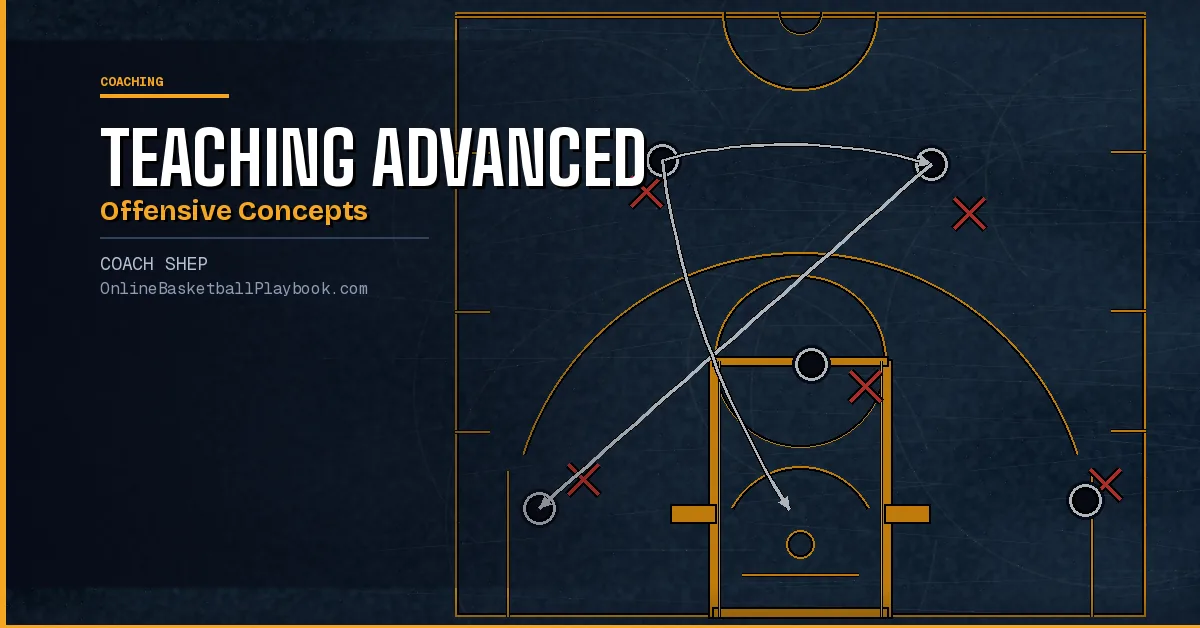
Advanced offense isn't installed in 5-on-5 scrimmages. It's built one read at a time, through structured breakdown drills that isolate decisions, constrain behavior, and scale deliberately toward live play.
Isolate One Read Per Drill
The most common mistake coaches make when installing advanced offensive concepts is trying to teach everything at once. They run 5-on-5 and stop play to correct a dozen different reads simultaneously. Players don't know what they're supposed to be learning, and the corrections don't stick because the player never had a clean repetition of the single decision being taught.
The solution is part-whole teaching. You break the offense down into its smallest decision units (a single read, a specific footwork pattern, one action) and drill that unit in isolation until players own it. Only then do you connect it to the next action and eventually to the full five-player system.
This is the principle behind breakdown drills as a coaching method. Every drill in a well-designed offensive system is designed to enforce one specific decision, not the whole offense. The Blood series from the Memphis offense is a clean example: Blood 1 drills the drive-and-kick, Blood 4 drills the same action but makes mid-range jumpers a turnover (forcing the kick), and Blood 11 adds a second read off the kick. Each drill isolates exactly one more decision than the last.
When you sequence drills this way, players build a mental library of reads that transfers to 5-on-5 play because they've owned each piece separately. The reads don't get confused with one another because they were never taught simultaneously. This is the foundation of installing any advanced offensive concept: break it into reads, drill each read, then connect them in order.
The practical rule: each practice session should have no more than two or three reads as the focus. Pick the part of the offense that needs the most repetition, build two drills around it (one with no defense, one with constraint defense) and spend 15-20 minutes on those reads before moving to 5-on-5 where everything runs together.
Use Constraints to Coach Decisions
Stopping play to lecture players about a bad decision is the least efficient teaching method available to a coach. The player who drove into traffic for a contested two-pointer in the fourth quarter doesn't need a speech. They need a drill where making that same choice costs their team a point.
Constraint-based coaching works by building the rule into the drill itself. The mid-range jumper becomes a turnover. The player who takes more than two dribbles in the half-court gives possession back. The team that fails to validate a field goal with a free throw doesn't get credit for the score. The drill is designed so that the behavior you want to eliminate is punished automatically, and the behavior you want to reinforce is rewarded automatically, without stopping play.
This approach came out of the Memphis breakdown drill system and has been adopted by coaches at every level. The Blood 4 constraint (mid-range shot equals a turnover) installs drive-and-kick behavior faster than any chalk talk because the player experiences the consequence immediately and repeatedly. After twenty reps, the read is wired in.
Dribble limits are another effective constraint for teams that struggle with ball movement. Put a two-dribble maximum on the half-court and watch players learn to read the defense earlier, because they have to. They can't wait until they're already in trouble and then try to dribble out. The constraint forces the skill.
Scoring systems add a layer of competitive constraint that makes the drill matter to players. One common scoring system uses +3 for a charge drawn, +2 for an offensive rebound, +1 for a score, and −2 for a turnover, and losers run the difference. When a turnover costs your team two points and conditioning reps, players police their own decisions. You don't have to stop and coach the read. The scoring does it.
Build Finishing Footwork Before Plays
No offensive concept works if players can't finish. You can run perfect ball movement and get the layup opportunity that the scheme designed, and miss it because the player had no footwork foundation for finishing at the rim with contact, off two feet, or on the non-dominant hand.
Coaches who teach offense from the top down (starting with the five-player system and working backward) discover this problem at the worst possible time, in games, when it's too late. The better sequence is finishing footwork first, always, before any reads are installed.
Walberg's layup sequence is the standard reference: both hands, both sides, straight layups, reverse layups, crossover layups, hesitation finishes, and the jump-stop power layup. All at game speed, all trained before team reads are introduced. The logic is straightforward. The drive-and-kick is only as good as the finish at the end of it. If the player kicking it back to the corner knows their teammate can't finish a reverse layup under pressure, they'll pull up instead of kicking, which defeats the entire read.
Finishing drills double as conditioning when they're scored and timed. Full-Court Speed Layups (make 50 in two minutes) builds conditioning while training the footwork pattern under fatigue. The Chase drill adds a contest: the player must finish through a defender closing out or they do pushups. The drill trains the exact game scenario where finishing breaks down: when the player is tired, moving fast, and has a body in their path.
The X-Layup drill is the most efficient version of this for team practice. Two lines, two baskets, continuous. Players get high-volume reps in a short time and every rep ends with a finish, so the drill trains the habit of completing the action rather than stopping short. Run it for four minutes at the start of every practice before any offensive work begins, and finishing problems at the rim will decrease substantially within two weeks.
Advantage and Disadvantage Games
Once players own individual finishing footwork and can execute isolated reads in constrained drills, the next teaching tool is the advantage game. You engineer a numbers advantage for the offense (3-on-2, 2-on-1, 4-on-3) and teach decision-making under favorable conditions before adding full defensive pressure.
The advantage game works for two reasons. First, it slows the decision enough that players can process it correctly under live conditions. A 3-on-2 gives the ball-handler a clear primary read (attack the back defender) and a clear secondary read (kick to the open wing when the help arrives). The reads are the same ones the player will face in 5-on-5, but the simplified defensive picture makes the decision visible. Second, advantage games build pace. Players learn to push ahead and be decisive, because the numbers only favor them for a brief window before the defense recovers.
The Texas system formalizes this with progressive drill formats: Texas 22, 33, and 44 all train reads under numbers pressure with escalating complexity. The Scramble drill (3-on-2 continuous) adds a transition element. The defense scores, they become the offense and push immediately. Players have to make the read while recovering from one role and transitioning to another.
Alex Sarama's small-sided game framework adds a refinement worth adopting: the coach controls the starting advantage. The ball position in the passer's hands determines what read is available. Inside hip means middle drive, outside hip means baseline drive. The defender must tag the coach to release, which controls the size of the advantage the offense receives. This lets the coach dial the difficulty without stopping play. Early in the teaching progression, the defender tags from far away and the offense gets a large advantage. As players develop, the tag distance shrinks until the drill is nearly 1-on-1. Guided defense (where the defender trails, cuts off, or goes neutral on a rotating basis) gives the offense a varied decision without it ever becoming the same rep twice. The principle is repetition without repetition: the player processes a real read every time, not a scripted sequence they've memorized.
Scored, Competitive Drills Change Behavior
The difference between a drill players go through the motions on and a drill that changes how they play in games is competition. Scoring. Stakes. When players know the drill outcome affects their conditioning, their rotation, or their standing in a team competition, they engage differently, and the behavior transfers differently to games.
Gregg Popovich's 3 Ways scrimmage is the controlled version of this at the 5-on-5 level. One point for scoring, one point for a stop. Even a made three only earns one. Play to 10. After going down-and-back twice, throw to the coach and restart. The scoring makes every possession matter without the scrimmage turning into a track meet. The restart gives the coach natural teaching moments without stopping play mid-possession. Players learn to value stops because stops score. The drill structure solves problems that ten minutes of half-time lectures wouldn't fix.
At the small-sided level, The 1-on-2 Post Double Pass-Out drill uses winner-stays format to create competition within the drill itself. The offensive player attacks before the double arrives or retreats and skips out of it. Winner stays, loser rotates. The drill has a built-in incentive: make the right read and keep playing. Make the wrong one and sit down. Players self-correct because the stakes are real, not because the coach blew the whistle and explained the read for the third time.
The Alabama practice model from Nate Oats scores everything at game speed: the 4-on-4 Blood drill runs +3 for the drive-and-kick three, +2 for the kick-and-score two, +1 for the putback, and −2 for any turnover. Losers run the difference between the scores. Over the course of a practice, that scoring system conditions shot selection more effectively than any pre-practice speech about shot quality. The data is immediate and personally relevant: players see the cost of their decisions in real time.
Scaling from Parts to Whole
The final stage of teaching any advanced offensive concept is the deliberate progression from isolated reads to connected actions to full 5-on-5 live play. Each step in the progression must be owned before the next one is introduced. The most common error coaches make here is moving to the whole before the parts are solid, then spending the rest of the season going back to fix foundational reads in 5-on-5 stoppages, the least efficient teaching environment available.
The 5-on-0 installation is the first step in the progression for any system. Players walk through the spacing, timing, and actions at half speed without a defense. Mistakes get corrected immediately because there's no defensive pressure creating noise in the system. The drill is not about game speed. It's about pattern recognition. Players need to know where they are supposed to be and what the next action looks like before they can execute it at pace.
From 5-on-0, the progression adds one variable at a time. A shell defender who only contests a specific action. A token defender who plays 40% live, enough to create a read but not enough to disrupt the pattern entirely. A full defender who plays live within a constraint. They can't help off the weak side, or they must guard ball-to-ball. Each addition makes the read cleaner rather than more confusing, because the constraint limits what decision is being trained at each step.
Connected-action drill design captures the final stage well. Once players own a single read (say, the 1-on-1 ball screen action) you add the second defender who changes the read (roll or pop, trap or hedge), and then you connect two or three actions so players must keep playing after the first option is covered. A ball screen into a drive-and-kick into a skip pass to a weakside catch-and-shoot is three connected reads. The player who executes all three fluidly in a drill environment will execute them in a game because each individual piece was already wired before the sequence was run.
Popovich's 3 Ways scrimmage is the final tool in this progression, not the starting point. When every piece is installed, the controlled scrimmage teaches players to keep making decisions under live game pressure while the coach still has the ability to stop, correct, and restart. It's the bridge between the drill environment and the actual game, and it works precisely because the individual reads were built in isolation first.
Before running any 5-on-5 to install a new offensive concept, run the Livsey simultaneous shooting battery first: Backpedal, Pepper, and Crack Back as a five-minute rotation. It gets 15-plus players working at game speed simultaneously, builds the finishing reps the reads depend on, and sets the physical and mental tempo for the session before live play begins.
- Isolate one read per drill. Never try to teach the full offense in a single 5-on-5 session. Sequence the reads and own each one before connecting them.
- Build finishing footwork before any team reads. Run the X-Layup drill for four minutes at the start of every practice. The drive-and-kick read is only as good as the finish at the end of it.
- Use constraints to coach shot selection. Make the mid-range a turnover in Blood 4, put a two-dribble cap on the half-court, and require a made free throw to validate the score. The rule does the coaching without stopping play.
- Score every drill with stakes. Use the +3/+2/+1/−2 system (turnover costs two points and losers run the difference) so players self-police decisions rather than waiting for a whistle and a lecture.
- Use the Popovich 3 Ways scrimmage as the bridge to 5-on-5: one point for a score, one point for a stop, restart after two trips. The scoring makes every possession matter and the restart gives you a natural teaching window without stopping mid-possession.
- Add one connected-action drill per week for varsity groups. Once the single-action reads are owned, link two or three actions together so players keep making decisions after the first option is covered.
Want more basketball coaching strategies, drills, and tools?
Join the Online Basketball Playbook newsletter →
Draw this play free in the play drawer →
Membership: the full library, playbook packs, and Pro drawing tools →
Keep Building
Related breakdowns
Basketball Quick Hitters: 25 Sets by Action and Formation
Basketball quick hitters sorted by the action you want, catch-and-shoot to post feed, with each set's formation, diagrams, the read and the counter.
Princeton Offense Drills: Breakdowns, Shooting and Live Reps
Princeton offense drills that teach the reads: spacing, backdoor and hand-off breakdowns, 3-0 Chin and wave drills, Point shooting, a drive drill and an install.
Four Corners Offense Basketball: Roles, Rules and Versions
Four corners offense basketball: the set, the chaser, the corner and post rules, three versions, when to run it, the shots it hunts and shot clock limits by level.