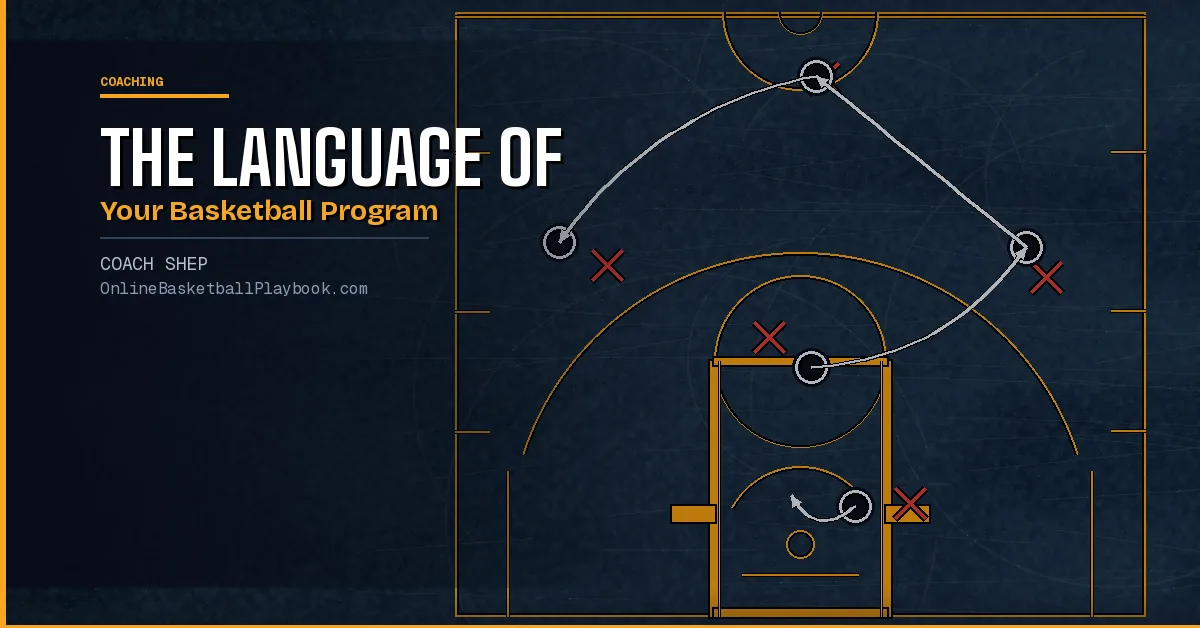
The words you repeat in practice become the identity of your program. Players internalize the phrases they hear every day, so choose them with purpose, keep them consistent, and watch them take hold.
Why Language Is a Coaching Tool
Every basketball program runs on a shared vocabulary. It starts with the coach, and within a few weeks, it lives in the players. The cues you use for footwork, the phrases you repeat when effort drops, the words you choose after a turnover: all of it accumulates into something larger than any single practice. It becomes culture.
Most coaches spend hours designing drills and zero minutes designing their vocabulary. That's a missed opportunity. A drill teaches a skill once. A phrase, repeated across a hundred reps over an entire season, rewires how a player thinks about the game, and about themselves.
Consider the difference between a coach who says "Stop making mistakes" and one who says "Find the fix." One trains players to fear failure. The other trains them to problem-solve. The drill they ran right before those two phrases was identical. The outcome over twelve months is not.
This applies at every level, but it matters most with younger players. Youth athletes are building their relationship with the sport from scratch. If the language of your gym is harsh, corrective, and result-focused, you are teaching kids to associate basketball with shame and stress. If the language is clear, encouraging, and improvement-focused, you are teaching them that this gym is a place where they get better, and where they want to be.
Program language is not softer coaching. It is more precise coaching. A phrase like "eyes up, two hands" drilled into a player's head means they can self-correct during a game without waiting for the coach to yell from the sideline. That is the goal: to externalize your coaching brain into theirs.
The Cues That Build Skill
The best coaching cues share three characteristics: they are short, they are visual or physical, and they target one thing at a time. Research on motor learning confirms that players can only absorb one instructional point per repetition. A sentence-long correction after every missed layup overloads the player and produces anxiety, not adjustment.
The cues that hold up across coaching levels tend to be the ones rooted in imagery. "Pizza waiter" for shooting form (flat palm under the ball, wrist tilted back) gives a young shooter a mental picture that sticks. "Cookie jar" reinforces the high release point without a technical lecture on elbow angle. These are not dumbed-down cues. They are efficient cues. The image does the work that three sentences of biomechanical explanation cannot.
For passing, "step to your target" is one of the most transferable cues in the game. It covers footwork, body angle, and accuracy in four words. Pair it with "2 hands, 2 eyes, 2 feet" for receiving and you have built the entire passing interaction in seven words total. That is a coaching language that scales.
Footwork is where cue design matters most, because footwork is the hardest thing to think about and play at the same time. The jump-stop is the foundation of every finishing and passing sequence in basketball. "Land and stick" reinforces balance on arrival without mentioning pivot rules, spacing, or triple threat, concepts the player will layer in as they're ready. Start with "land and stick" and build from there.
The key principle is consistency. Using "pizza waiter" and "high elbow" for the same cue on the same staff creates confusion even when both cues point at the same behavior. Standardize your cue vocabulary across all your coaches. When a player hears the same phrase from the head coach, the assistant, and the camp counselor, the phrase becomes muscle memory.
How You Deliver Feedback Matters
The content of your feedback is only half the equation. The other half is the delivery: the volume, the timing, and the tone. And most coaches get this backwards.
The rule that holds up is simple: shout praise, whisper criticism. Most coaches do the opposite by default. They correct loudly in front of the group, which feels efficient but actually trains players to hide mistakes so the coach stops looking at them. They praise quietly, if at all, which makes players feel that their improvements go unnoticed. Flip those defaults and you flip the entire psychological dynamic of your practice.
Public praise is specific praise. "Good job" is not reinforcement. It is noise. "You pivoted on balance all three reps, that's growth" tells the player exactly what to repeat. When players understand the specific behavior that earned recognition, they reproduce it. When they get generic praise, they shrug and move on.
Private correction is quick correction. Name what was wrong, give one clear replacement cue, and move. "Your momentum carried you under the basket. Jump to the side of the rim next time" is a complete correction. Anything longer becomes a lecture, and during a drill, a lecture kills the reps that are the actual teaching vehicle. The correction exists to set up the next rep, not to process the last one.
Timing matters too. Correct immediately after the mistake while the player's body still has the feeling of the rep. Wait three more reps and the window is closed. They no longer know which rep you're talking about. This is why coaches who correct from memory at halftime or after practice are fighting uphill. The correction lands hardest when the physical memory is still fresh.
Building a Culture Through Repetition
Culture is not a speech. It is what you repeat. This is the most important operational truth about program building, and it is the one most coaches miss when they talk about culture as something you install in a preseason meeting.
A team code works when it is three words or a short phrase. Something a player can recall under pressure, in the fourth quarter, without thinking. "Compete every rep." "Together." "Standard." Long mission statements posted on the locker room wall are decorations, not culture. The phrase that the coach says at the start of every practice, that the players echo back, that shows up in how the team handles adversity, that is culture.
The mechanics of culture-building are specific and repeatable. Begin every practice with a focus word. One word that anchors the session: "compete," "finish," "communicate." Ask players what it means before the first drill. Return to it at the close. When the session consistently opens and closes with intention, players start to carry that intention into the work in between.
End practices with a shout-out circle. Players recognize each other specifically, not "good practice" but "Marcus helped me fix my footwork on the drive." This trains players to observe each other's improvement, which accelerates learning and builds the kind of mutual accountability that a coach cannot manufacture through systems alone.
Rotate practice captains. Different players leading different drills builds leadership language across your roster, not just in the point guard who was already vocal. When a quiet player has to tell three teammates how to set up a drill, they develop communication skills they will use in a game. The captain rotation is not a feel-good exercise. It is a teaching method.
None of this works without the coach doing it every day. A team code said once is forgotten. A focus word used three times and then dropped teaches players that the program's language is optional. Repetition is the discipline. It is what separates a coach who talks about culture from one who has built it.
Communicating With Parents
Parent communication is a youth-coaching fundamental, not an administrative burden. The families in your program are its extended culture: and the language they use about the team at the dinner table, in the car after games, and on the sideline shapes what their child believes about the experience.
A parent meeting before the first practice prevents the majority of friction that derails youth programs. Cover four things: your playing-time philosophy, game-day behavior expectations, the communication chain, and how parents can actively support the team. When families know what to expect and understand their role in the program, they become assets rather than variables.
The 24-hour rule is one of the most useful pieces of program language you can put in writing. No playing-time discussions the day of a game, not before, not after. The rule exists not to protect the coach's ego but to protect the player from processing a conflict between their parent's frustration and their own team experience on the same day. Give families a clear path: communicate concerns through the head coach, give it 24 hours, and expect a real conversation.
For players ages 11 and up, bring them into the conversation when issues escalate. A player who has to articulate their own role, ask for feedback directly, and engage with a coaching decision is developing one of the most important life skills the sport can teach. The parent meeting establishes the structure. The player's accountability within that structure does the real development work.
The language you use in parent communications should mirror the language you use in practice. If you are telling players that the program values effort over outcome, but your parent emails celebrate wins and ignore growth, the message splits. Align them. "Here is what we worked on this week. Here is what improved. Here is the challenge for next week." That newsletter structure reinforces the program's values in the home environment, which is where players spend far more time than in the gym.
Putting It All Together
Program language does not require a rebrand or a whiteboard session. It requires decisions. Choose your skill cues and standardize them across your staff. Choose a team code and say it every day. Choose how you deliver praise and correction and hold yourself to it. Make those choices explicit and written down, so that when you add a new assistant or run a camp, the language extends rather than fragments.
Audit what you currently say. Record a practice and listen back. Count how often you correct versus how often you affirm. Note which phrases you use more than three times. Those are already your program's vocabulary, whether you designed them or not. If you do not like what you hear, you now have a baseline to change from.
The most durable programs in youth and high school basketball are not always the ones with the best players or the most resources. They are the ones where players, parents, and coaches all speak the same language, where a player who moved up from the JV team already knows what "eyes up" means and what "standard" demands. That coherence is built word by word, rep by rep, over years. It starts today, in what you say at the beginning of tomorrow's practice.
Teaching a basketball skill and teaching a player how to think about basketball are the same job. Your language is the mechanism for both. Use it deliberately.
Before your next practice, write down the three skill cues and one culture phrase you want players repeating by the end of the season. Share those four items with every coach on your staff before the first session. Consistency across voices is what turns a phrase into a belief.
- Standardize your cue vocabulary: Pick one phrase per skill category (shooting, passing, footwork, defense) and use it identically across every coach, every practice, every age group in your program.
- Shout praise, whisper criticism: Public specific praise ("You held your follow-through on every catch-and-shoot rep today") builds the behavior you want to see more of in the next game.
- Open and close with your focus word: One word per practice. Name it before the first drill, return to it in the shout-out circle at the end. Repetition across a season is what turns a word into a standard.
- Write down your parent communication plan: Playing time philosophy, sideline behavior expectations, and the 24-hour rule in writing before the first game means fewer conflicts and more family buy-in all season long.
- Correct in the moment, not at halftime: The correction window is immediately after the rep while the player's body still has the physical memory. Wait too long and the teaching moment closes. Name what was wrong, give one cue, set up the next rep.
Want more basketball coaching strategies and drills?
Join the Online Basketball Playbook newsletter →
Draw this play free in the play drawer →
Membership: the full library, playbook packs, and Pro drawing tools →
Keep Building
Related breakdowns
Mentorship Program for Young Coaches: Match, Meet, Review
How to build a mentorship program for young coaches: set goals and a length, match on style and time, meet on a schedule, give one real job and review it.
How to Build a Basketball Program: Identity, Staff and Culture
How to build a basketball program: identity first, written standards, staff roles, the season calendar, feeder programs and recruiting players who fit.
Transition First Program Model: Push, Defend, Compete
Coach Shep's transition first program model: three core beliefs, push after every rebound, layups and threes, no called plays, one contested shot, scored practice.