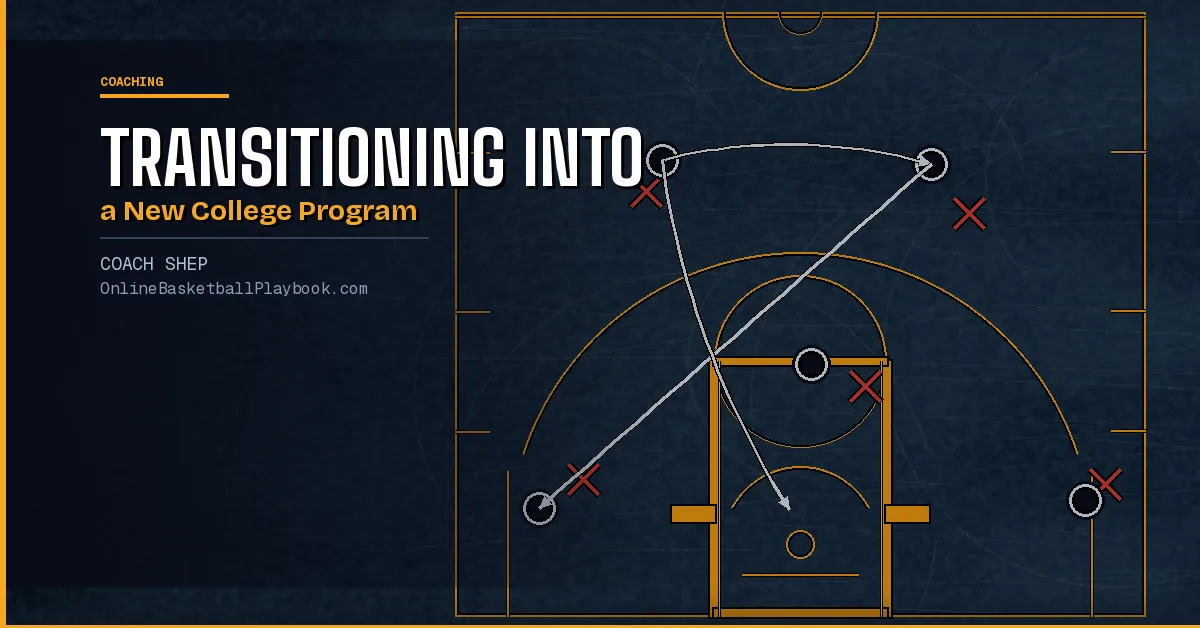
Taking over a college basketball program is one of the hardest jobs in coaching. The first 90 days determine whether players buy in or wait you out. Here is what the research and elite coaches say actually works.
Establish Your Identity Before Anything Else
The first mistake new college coaches make is arriving and immediately installing their system (their sets, their defensive schemes, their press breaks). The players see schemes. What they need to see first is who you are and what this program stands for now.
Euroleague coach Sasha Obradovic's core principle is that you never start from zero. A foundation of core players plus a known, public team philosophy is the magnet that attracts the right additions and, critically, it signals to the players already in the locker room what they are being asked to join. The way you play and the values you stand for do the recruiting and the retaining at the same time.
For a new head coach, this means your first team meeting should be a philosophy meeting. Not a Xs-and-Os meeting, not a "here's what I've done at my last stop" meeting. Tell them what this program is about going forward: the values that will be non-negotiable, the kind of effort you expect on defense, the way the bench will behave, how you treat a teammate who makes a mistake. Name it early and name it specifically.
Dan Hurley's framework at UConn is one of the clearest examples of identity-first thinking at the college level. His four core principles (Strength of the Pack (nothing you do makes the team weaker), Consistent Improvement (process-focused, never outcomes), Relentless Competitive Effort ("be a dog"), and Mindful Communication (emotional intelligence, situational awareness)) are the culture. The plays are downstream. When players know the culture is the system, they stop waiting to see if you mean it and start measuring themselves against it.
Spend your first two weeks answering the question every returning player is quietly asking: "What does it mean to be here now?" Give them a clear answer and they can commit. Leave it vague and they will wait to see who leaves before they decide how bought-in to be.
Assembly Matters More Than Adjustments
Ettore Messina put it plainly: "How the team is being assembled is more important than how the team is being coached." That is a challenging statement for any coach to sit with, because coaching is what you control in the building every day. But it is true at the college level, and new coaches who ignore it lose years trying to coach around a roster problem they should have addressed in the portal or in recruiting.
Roster fit is upstream of everything. A player with great character, genuine competitive fire, and position-specific fundamentals who fits your system will out-perform a more talented player who is fighting the culture or waiting for their moment in a different program. The college transfer portal has changed the landscape dramatically. A new coach now has a realistic window to reshape a roster in year one, but the filter matters more than the volume of additions.
What should you be looking for when evaluating transfers and recruits during a transition? Four things, in order: character (can this player survive a long, hard season without becoming a problem?), authentic work ethic (not "he looks like he works hard in workouts." Does he seek out extra reps or do his assistants schedule them?), position-specific fundamentals (a guard who cannot run pick-and-roll or does not know who to pass to is not actually a guard at your level), and hunger for something bigger than their current situation.
The four-source intel model is the most reliable way to evaluate before committing: game film across multiple seasons, conversations with past coaches who have different philosophies from yours (not just allies who will say good things), network sources like GMs and agents who see players in non-game environments, and a direct conversation with the player. All four, every time. Skipping one creates blind spots that surface in February when the schedule is hardest.
Personality and the ability to perform under pressure cannot be installed in someone who lacks them. Recruiting filters for them. Coaching builds on them.
Set Non-Negotiables on Day One
Every program that has survived a coaching transition and come out stronger has one thing in common: the new coach established a small set of non-negotiable standards immediately and held them unconditionally from the first day.
Kelvin Sampson's foundational standard is attitude and effort, held exactly the same every single day. "How you do anything is how you do everything." That consistency is not a speech. It is a daily operational reality that players learn to trust or resist. The ones who resist it self-select out; the ones who trust it become your program's spine.
Hubie Brown's four rules are a useful template for any new college coach: be on time, play hard, know your job, know when to pass versus shoot. They are simple enough to remember and specific enough to hold someone accountable to. When a player violates one, the response is direct: ask what is wrong, give one chance, then act. The key is consistency. If you let the sixth man slide on punctuality but hold a role player to it, you have not set a standard; you have set a hierarchy of exceptions, which is the fastest way to lose a locker room.
Bob Hurley's operational culture at St. Anthony's adds the behavioral layer: players acknowledge coaches in the hall, they sprint to the bench on the whistle, seniors are responsible for team standards daily because it is their team. These are not speech topics. They are physical habits enforced from the first week. When a player sprints to the bench on the whistle every day in October, he does it in March without thinking.
The preseason is the right time to establish these standards, not the first game week. Obradovic's phased preseason conditioning model (70% conditioning and 30% basketball in weeks one and two, tapering toward basketball-heavy by week seven) gives new coaches a structural reason to be in the gym with their players every day before the season matters, which is precisely when the standards get set and tested in low-stakes reps.
Declare Every Player's Role Explicitly
Ambiguity about roles is one of the most corrosive forces in a new program. Players who do not know where they stand spend mental energy managing their uncertainty instead of developing their game. Mike Dunlap's framework is direct: role declaration is a culture act. Before players play, they need to know their role. Declare it explicitly, early, and revisit it when performance shifts.
This is not just tactical. It signals to every player that you have thought about them specifically. A 12-man roster in which every player knows their role and why they have it is more cohesive than a 12-man roster in which everyone is fighting for status they have never been given clarity on.
Dean Smith's Blue Team concept is a practical application of this principle that new college coaches should steal directly. Players seven through twelve on the roster enter games as a unit, always in the first half, always for a defined stretch of one to two minutes together. Role predictability keeps reserves engaged. It eliminates the "I never know when I'm going in" disengagement pattern that turns reserve players into locker room friction by midseason.
John Tauer's opening-day question at St. Thomas cuts straight to the role question: he asks every player in the first practice to raise their hand if they are a role player. The room goes quiet. The question resets the hierarchy immediately. In a new program, when returning players may have played heavy minutes under the previous coach, this kind of reset (done without threatening anyone) is a useful tool for establishing that the slate is not entirely clean yet.
Give every player a defined role in writing within the first two weeks. It does not need to be permanent, and it should not be framed as a ceiling. It is where we are starting, why, and what you need to do to expand it.
Build an Accountability Culture That Runs Itself
The goal of a transition-year program is not to get players to follow your rules. The goal is to build a culture in which the players hold each other to the standard so the coach does not have to manage every mistake individually. That takes time, but it starts with the right structural choices in the first month.
Obradovic's collective accountability model is worth studying: when one player makes a mistake in practice, the whole team bears a consequence, which forces teammates to coach each other and removes the head coach from every individual correction loop. The effect compounds quickly. After two weeks, players are more attentive to each other's mistakes than they would ever be to a coach's whistle, because the consequence lands on them too.
Anson Dorrance's competitive cauldron principle reinforces this from a different angle. Practice must be more competitive than games. If practice is the safest environment your players face all week (less pressure, less consequence, less intensity), they will shrink when games feel hard. Design practice so games feel like relief. Scored competitions with consequences for the losers, nothing purely instructional without a competitive wrapper, and deliberate adversity built into the daily structure.
Tom Crean's accountability standard is worth posting in every team space: hold everyone to the same standard. His version is literal. He posts "JUST DO IT" and "Hold everyone to the same standard" next to each other. When your best player sees that you hold him the same way you hold your tenth man, he understands what kind of program this is. And your tenth man understands he actually belongs in the same conversation.
Bethel University's Me First, For Us framework gives players a vocabulary for self-accountability that does not require the coach to intervene. Players are taught to ask only "What" and "How" questions that begin with "I." Three forbidden question types (Why (victim thinking), When (procrastination), Who (blame)) are named publicly and replaced with productive alternatives. Post it in the locker room in the first week. Practice it after every loss. Within a month it becomes the team's instinctive response to adversity.
During a program transition, accountability culture breaks down fastest when coaches hold stars to a different standard than role players. Before your first game, decide explicitly how you will respond when your best player is late, dogs a drill, or deflects a correction. Whatever you decide, apply it identically to your walk-on. The roster is watching the gap between what you say and what you do. Close it in October, not March.
Design Practice to Be Harder Than Games
The programs that survive coaching transitions fastest are the ones where the new coach's practice environment is immediately, visibly different from what came before and harder. Players can argue with a philosophy. They cannot argue with what they feel every day in the gym.
Bill Parcells' preparation doctrine translates directly to college basketball: habits, not schemes, survive the fourth quarter. A game plan can break down under maximum pressure, but the habits built in practice cannot. The job of preparation is to make correct execution automatic. "We don't want players to think during a game; we want them to react. Thinking takes too long." Every rep is depositing into the reflex bank. Every rep you cut short or run at half-speed is a withdrawal.
Mike Dunlap's no-dribble drill framework (15 to 20 minutes of no-dribble work daily) is the single highest-ROI culture drill for a new program. It forces cutting, passing, pivoting, and communication simultaneously. It reveals personalities fast. Players who are selfish with the ball look uncomfortable immediately. Players who move without the ball well stand out immediately. And it builds what Dunlap calls the "WE" of your gym in a shorter time than any other structure. Toughness is "inch by inch and day by day," not a speech, a daily structure.
David Richman's operating standard at NDSU gives a measurable target: win 65 of every 100 possessions. The hows matter more than the whats. The atomic detail that compounds over a season: "When catching the ball, catch with two hands, two feet, two eyes." Focus on micro-fundamentals so that under pressure players fall back on automatic tendencies rather than improvising. A new program that trains these details in every drill develops the poise to maintain its standard when the schedule is hardest.
Parcells' fourth-quarter role test is a weekly accountability tool worth running every Friday: ask each player to state their specific assignment in a late-game situation without prompting. If they cannot, the coach has not prepared them. Add reps before next game. It reframes mental errors as a coaching checkpoint, not a verdict on the player's character or intelligence.
Align Your Staff Before You Address the Roster
A program is built by the staff as much as the head coach. The culture players feel in the building is the culture the staff actually lives every day. If assistants are undermining standards in hallway conversations, covering for violations the head coach has named as non-negotiable, or operating in undefined roles that create confusion, the players feel all of it, and they use it to justify their own inconsistency.
Obradovic's preseason staff structure model is specific. Define each assistant's duties (film breakdown, warm-up, individual skill work, strength and conditioning coordination) before day one of preseason, not improvised as the calendar fills. When the schedule is most demanding, ambiguity among staff costs time and credibility the program cannot afford.
Shaka Smart and Jeremy Ballard's staff-dynamics framework adds the relational layer: define roles, communication expectations, and trust protocols among coaches so the culture is unified. If an assistant is the one a player goes to when they are unhappy with a head coach decision, the head coach needs to know that role exists and either formalize it or address it. Surprises inside the staff in a transition year become public faster than coaches expect.
Morgan Wootten's philosophy-first program model at DeMatha Catholic offers a principle that scales to any level: the coaching staff must live the values the program claims, not just state them. If the coach preaches fitness, the staff gets in shape too. If the program values punctuality, the coaches are in the gym before anyone else. Rick Pitino's version of this is blunt: "You can't preach fitness unless you show it." The standard is not a poster. It is a daily behavior.
New college coaches who invest the first two weeks aligning staff on roles, communication, and non-negotiables before they turn that same energy toward the roster will build a more durable culture than coaches who run straight at the players. The roster takes its cues from the staff's coherence, not just from the head coach's conviction.
- Hold a philosophy meeting first, a Xs-and-Os meeting second. Tell players specifically what this program stands for (values, effort standard, bench behavior, how mistakes are handled) before you install a single play.
- Use all four intel sources before committing to any transfer or recruit: multi-season film, past coaches with different philosophies, network sources (agents, GMs), and a direct conversation with the player. Skipping one creates blind spots that appear in February.
- Declare every player's role in writing within the first two weeks. Not a ceiling. A starting point. Revisit when performance shifts. Ambiguity about roles is a culture leak that compounds into disengagement by midseason.
- Run Dunlap's no-dribble drills for 15–20 minutes every practice from day one. No single drill reveals personnel, builds passing habits, and creates team cohesion faster. It puts the "WE" in your gym without a single speech.
- Apply the Parcells fourth-quarter role test weekly: ask each player to describe their specific assignment in a late-game situation without prompting. If they cannot, the coaching staff has more work to do. Add reps before the next game.
- Implement Dean Smith's Blue Team rotation: players seven through twelve enter as a unit, always in the first half, always for a defined stretch. Eliminates the "I never know when I'm going in" pattern that turns bench players into locker room problems.
- Adopt collective accountability in practice immediately: when one player makes a mistake, the team runs. This forces peer coaching, removes the head coach from every individual correction loop, and builds the relational accountability that sustains a culture when the coach is not in the room.
Transitioning into a new college basketball program is not primarily an X's-and-O's problem. It is a culture-building problem with a short window. The coaches who establish identity fast, set non-negotiables and hold them unconditionally, declare roles explicitly, and align staff before addressing the roster are the ones who win in year two instead of waiting for year four.
The players in your locker room right now are not resistant to change. They are resistant to uncertainty. Give them certainty (about the standard, about their role, about what this program is) and they will run toward it harder than you expect.
Want more basketball coaching strategies, drills, and tools?
Join the Online Basketball Playbook newsletter →
Draw this play free in the play drawer →
Membership: the full library, playbook packs, and Pro drawing tools →
Keep Building
Related breakdowns
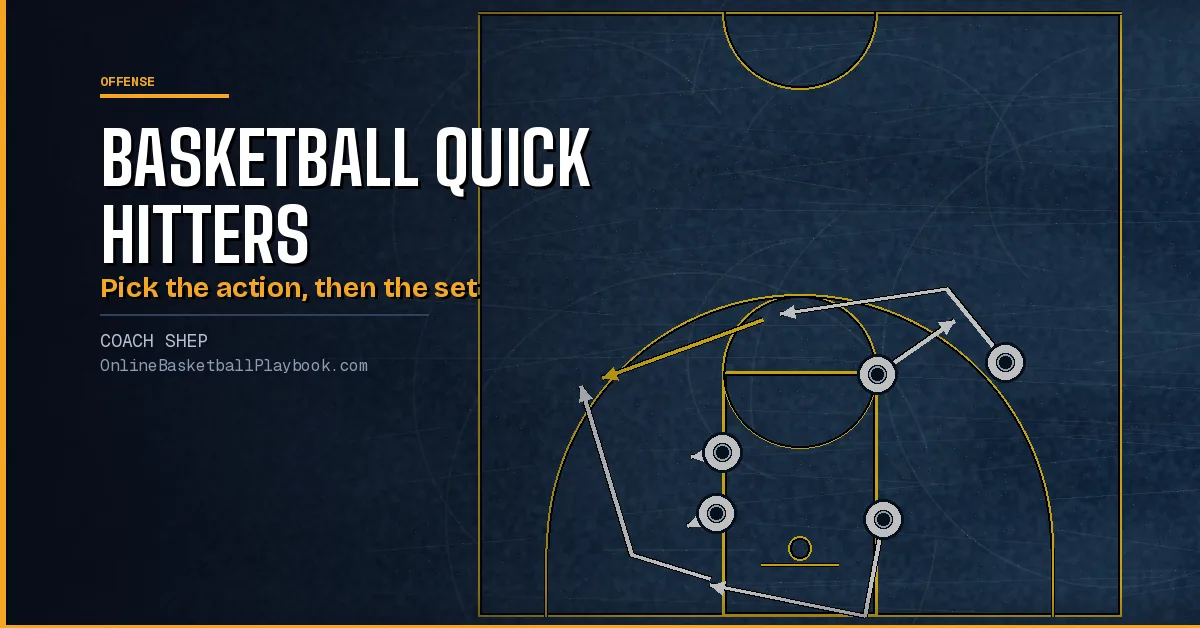
Basketball Quick Hitters: 25 Sets by Action and Formation
Basketball quick hitters sorted by the action you want, catch-and-shoot to post feed, with each set's formation, diagrams, the read and the counter.
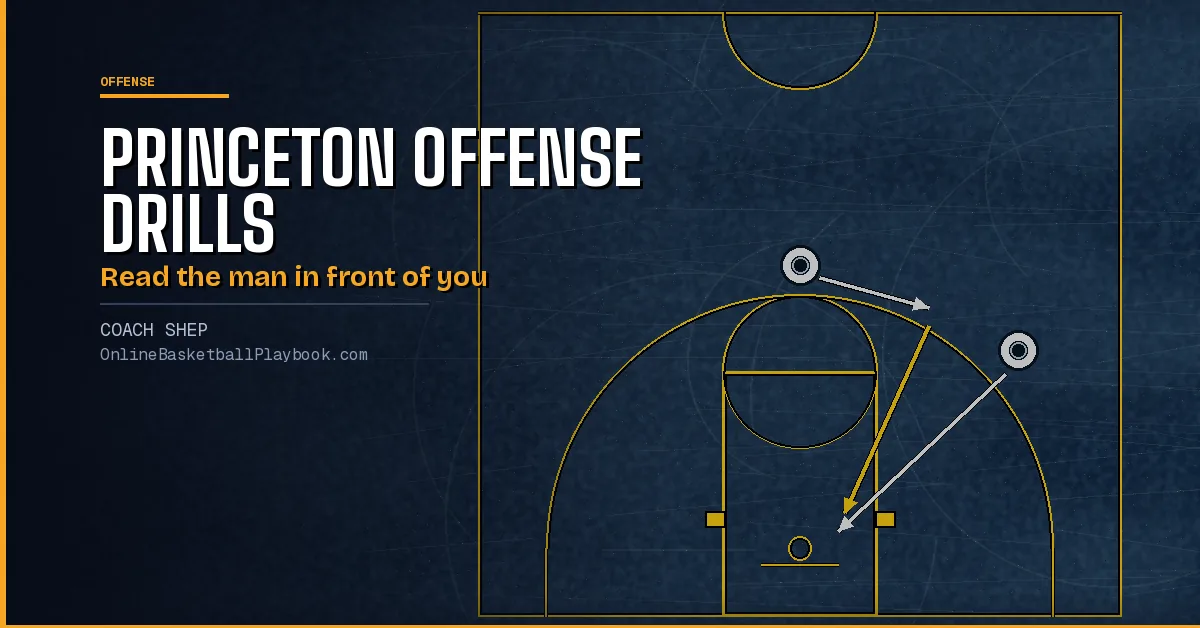
Princeton Offense Drills: Breakdowns, Shooting and Live Reps
Princeton offense drills that teach the reads: spacing, backdoor and hand-off breakdowns, 3-0 Chin and wave drills, Point shooting, a drive drill and an install.
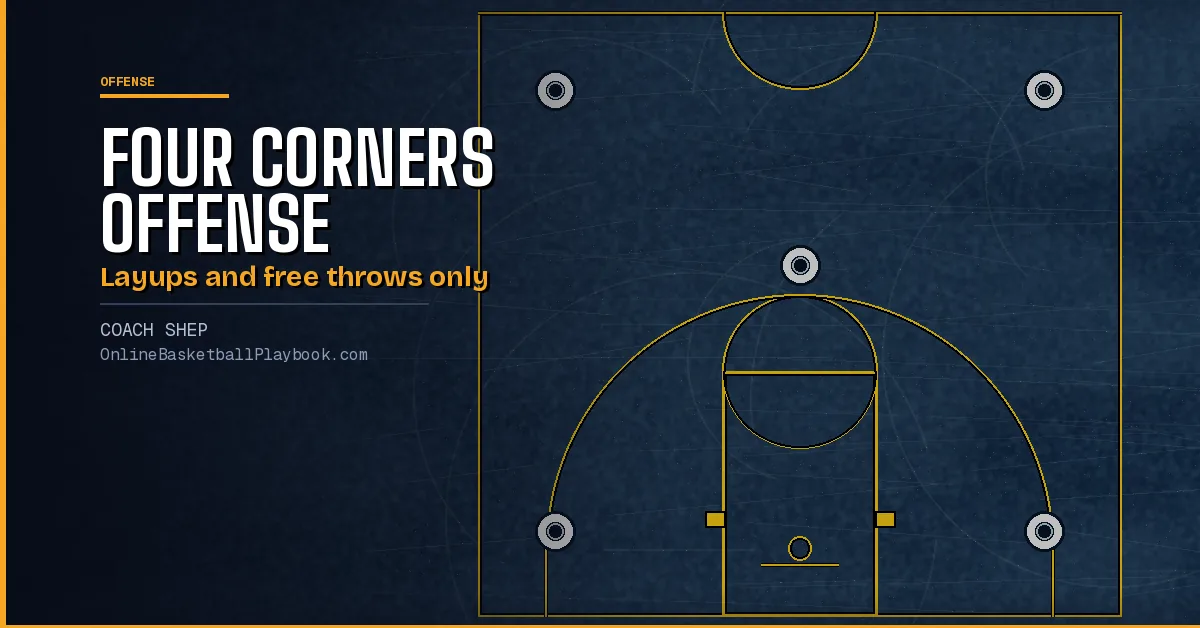
Four Corners Offense Basketball: Roles, Rules and Versions
Four corners offense basketball: the set, the chaser, the corner and post rules, three versions, when to run it, the shots it hunts and shot clock limits by level.