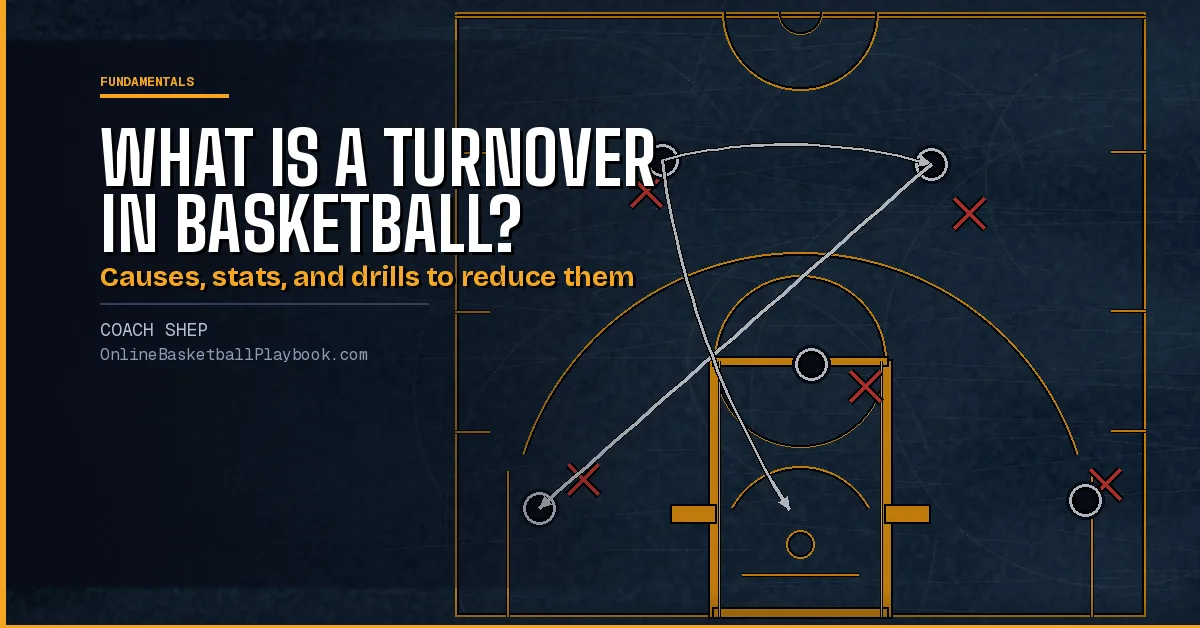
A turnover in basketball is when the offensive team loses possession of the ball without attempting a shot. Turnovers give the defense a free possession, and at higher levels, that possession often converts into points at the other end.
The Definition and Why It Matters
A turnover occurs when the offensive team loses possession before shooting. Every turnover has two effects: it ends the offense's scoring opportunity and it gives the defense a free possession, often in transition, when the defense is already running the other direction.
At the pro level, teams average 12–16 turnovers per game. At the youth and high school level, that number frequently climbs to 20–30 per game, and those turnovers are almost entirely preventable. The difference between a 20-turnover team and a 12-turnover team over a season is hundreds of lost possessions.
The Main Types of Turnovers
Turnovers fall into a handful of recurring categories. Knowing which type your team commits most often tells you exactly what to drill:
Bad Pass
The most common turnover at every level. A pass thrown too hard, too soft, too late, or to the wrong location, or into a defender's hands. Bad passes often happen when the passer is under pressure and panics, or when the passer forces a pass into a window that isn't there.
Ball Stolen (Live-Dribble Turnover)
A defender strips the ball while the ball handler is dribbling or going to the basket. Usually results in a fast-break opportunity. Caused by carrying the ball with the hand under it (legal) too long, weak dribbling mechanics under pressure, or dribbling into a trap without reading it.
Stepping Out of Bounds
A player with the ball (or a player catching a pass) steps on or over the boundary line. Common in baseline drives, inbound plays, and end-of-game scrambles. Footwork and court awareness, both of which are trainable.
Shot Clock / 5-Second Violation
In shot-clock leagues, failing to attempt a shot within the allotted time (24 seconds in the NBA, 30 in college, varies in high school) results in a turnover. Closely guarded violations (5-second call) occur when a ball handler is guarded within 6 feet for 5 seconds without dribbling, passing, or shooting.
Traveling
Moving one or both feet illegally while holding the ball: taking too many steps without dribbling, or picking up the pivot foot. Technically a violation, not a traditional turnover, but it awards the defense possession in exactly the same way.
Offensive Foul
When an offensive player charges into a set defender, or sets an illegal screen, the referee awards a turnover to the defense. This is a "team" turnover and counts against the player who committed the foul.
5-Second Inbound Violation
The inbounder has 5 seconds to pass the ball inbounds. Failure to do so turns the ball over. Common under pressure or in poorly-designed inbound plays.
How Turnovers Are Tracked
Box scores record individual turnovers (TO): The number attributed to each player. Team totals appear in the game summary.
Two more useful statistics:
| Stat | What it measures | Formula |
|---|---|---|
| Turnover % | The % of possessions that end in a turnover | TO ÷ (FGA + 0.44×FTA + TO) |
| Assist-to-Turnover Ratio (AST/TO) | How many assists a player creates per turnover | Assists ÷ Turnovers |
A turnover percentage below 12% is considered excellent at the NBA level. For high school teams, 15–18% is a realistic competitive benchmark. Youth teams commonly run 25–35%, room for enormous improvement with focused practice.
The Three Root Causes Coaches Should Fix
Most turnovers trace back to one of three specific failure situations:
Ball toughness is the ability to handle the ball with calm and confidence under pressure. It builds on Don Meyer's idea of sureness. It is not a fixed trait. It can be taught.
1. Pivoting Errors (Jump Stop / Stride Stop)
A player catches the ball and fumbles the footwork: picks up the wrong pivot foot, travels out of the catch, or falls forward on a drive. These are technique failures, not athleticism failures. The fix is drilling the jump stop and stride stop at full speed until the footwork is automatic.
2. Live-Dribble Passes Under Pressure
The second most common source of turnovers: a ball handler who picks up their dribble under pressure and then panics, throwing a bad pass. The fix is two-part: teach players to keep dribbling under pressure rather than picking it up, and drill catching under defensive contact so they stay calm.
3. Passing and Catching Under Pressure
Bad passes into traffic, dropped catches, and passes that sail wide. These happen when players panic. The ball handler sees a half-open cutter and rushes the pass, or the receiver takes their eyes off the ball. The fix: competitive drill reps with a live defender, at game speed, until the calm response becomes the trained response.
Turnovers are skill failures, not effort failures. A player who tries hard but pivots wrong still travels. A player who is scared of the double team still telegraphs the pass. The coach's job is to build ball toughness: (the trained ability to handle the ball calmly under pressure) through game-speed repetition, not pep talks.
Drills to Reduce Turnovers
Three drill categories directly address the three root causes:
Jump Stop Drill (Pivoting)
Players catch a skip pass and immediately execute a jump stop into a triple-threat position. A defender steps up to pressure them. Players must hold their pivot foot and pass out before 5 seconds. Run with 2-player groups (one passer, one receiver/defender) for maximum reps. No hiding. Every player performs every rep.
1v1 Ball Toughness (Live Dribble)
Ball handler dribbles in a confined space (half the key) against a live defender trying to strip them. Objective is to keep dribbling for 12 seconds without losing control. Teaches maintaining composure under full-speed defensive pressure without picking up the dribble.
4v2 Box Drill (Passing Under Pressure)
Four offensive players on the perimeter of a box, two defenders inside. Offense passes around the perimeter with two-touch maximum before the next pass must go. Defenders sprint to cut off passing lanes. Builds the quick-release passing mechanics and court awareness that prevent live-ball turnovers.
The Mindset Shift That Fixes Most Turnovers
The biggest driver of turnovers at the youth and high school level is not bad technique. It is fear of failure leading to rushed decisions. Players panic when pressured because they haven't trained calm responses to pressure situations.
The fix is simple in concept and demanding in execution: every drill that involves ball-handling or passing must include a live defender. Stationary ball-security drills look great in warmups and do almost nothing in games. If you want players to be calm with the ball under pressure, make pressure the context of every drill from day one.
Drill fewer things deeper. Running 3-5 ball-toughness drills all season at game speed, every practice, builds the automatic response. Rotating through 20 drills in search of variety builds novelty, not competence.
- Track turnovers by type in games (bad pass, live dribble, travel, out of bounds) so you know which situation to drill.
- Jump stop first: The majority of travels and fumbles come from footwork, not inattention.
- Never drill ball security without pressure: Add a defender to every rep, every time.
- Target below 18% turnover rate as a high school competitive benchmark (total turnovers ÷ possessions).
- Reward calm decisions under pressure, not just good outcomes. A player who reads the trap correctly and passes out under pressure did the right thing even if the next player turns it over.
Get drills, play diagrams, and coaching guides delivered free.
Draw this play free in the play drawer →
Membership: the full library, playbook packs, and Pro drawing tools →
Keep Building
Related breakdowns
Basketball Positions: What Each of the 5 Positions Does
The point guard, shooting guard, small forward, power forward and center, what each one does on offense and defense, and when to ignore the numbers.
High School vs College vs NBA Rules: What Changes for a Coach
High school vs college vs NBA rules: shot clock, three-point line, bonus, fouling out, timeouts, backcourt count and defensive three seconds, and what each changes.