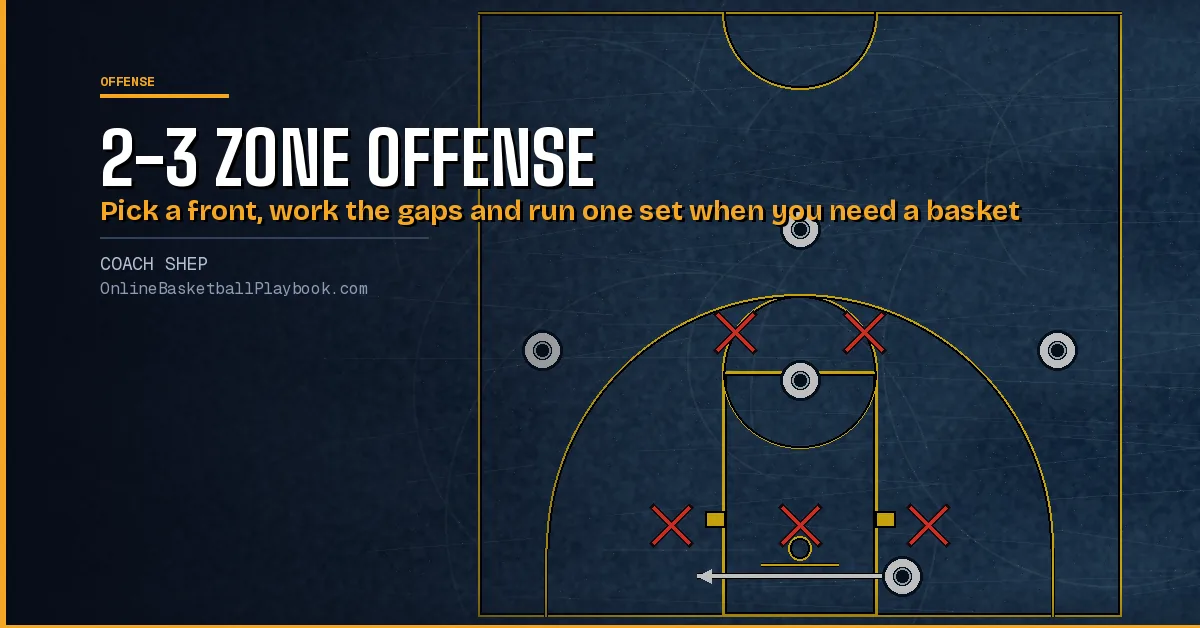
A 2-3 zone offense is the set of alignments, continuities and called plays a team runs against a 2-3 zone. The principles for attacking this zone (sit in the gaps, flash the high post, use the short corner, skip and reverse) are on How to Beat a 2-3 Zone, and this page does not repeat them.
It is the menu that comes next. It names the fronts to start from, the continuities coaches teach, the quick hitters they hold for a basket and the choice between a dedicated zone offense and the man offense a team already runs.
2-3 Zone Offense at a Glance
| Name | Type | Starts from | Built to get |
|---|---|---|---|
| Baseline-runner continuity | Continuity | 1-3-1 | A short-corner catch, a high-post read and a post touch |
| Baseline-runner continuity, 3-out 2-in | Continuity | 3-out 2-in | A wing entry and a catch from underneath the zone |
| Wing-triangle 1-3-1 | Continuity | 1-3-1 with the middle three low | A triangle on the wing against the low defender |
| Heavy-side continuity | Continuity | One post at the line, one on the block | An overload on the heavy side, then a reversal |
| High/Low | Continuity | Four entries, including 1-4 and Horns | Constant two-post movement against any zone |
| Weak-corner skip | Quick hitter | Four out, one in | A skip to the weak corner, then a cut off a screen |
| No-skip corner play | Quick hitter | Same shape as the weak-corner skip | The same finish without the long skip |
| Corner screen-and-cut, right and left | Quick hitter | A runner offense | A layup for the cutter to the block |
| Double back-screen lob | Quick hitter | Two posts below the zone | A lob for an athletic cutter |
| Low-stack curl and low-stack double screen | Quick hitters | A low double stack | An inside jump shot or a post layup |
Choose a Front
The first choice is where players stand. Dave Odom and Jim Harrick teach one rule for it.
- One guard against a two-guard zone. A two-guard zone such as the 2-3 gets a one-guard front, which means a 1-3-1, a 1-2-2 or a 1-4.
- Two guards against a one-guard zone. A one-guard zone gets a two-guard front.
- Go 1-4 high. Put both posts at the elbows to stretch any zone vertically.
- Start from 1-3-1 or 3-out 2-in. The 2-3 offense starts from either front.
- Drop the middle three low. The wing-triangle continuity starts from a 1-3-1 with the three middle players low.
Vance Walberg answers differently. His dribble-drive team lifts the wings to free-throw line extended against a 2-3, and any dribble at a defender triggers a backdoor. He keeps his alignment and changes the spacing. Keeping the man alignment is covered below. Pick the front first, then give every player a spot.
2-3 Zone Offense Continuities
Baseline-Runner Continuity from a 1-3-1
Teach this as the base offense, with plays added later in the season. The runner never posts on the block.
- Wings wide. The wings stand farther out than normal, away from the arc, so the top defenders are out of the passing lanes.
- High post in the gap. He stands at the free-throw line while the ball is at the point and drops a little lower, into the gap between the high and low defenders, while the ball is on a wing.
- Catch and face. The post catches, pivots to face the hoop and passes or shoots without a dribble, because a dribble invites trouble from collapsing defenders.
- Run the baseline. The fifth player runs the baseline from short corner to short corner. He does not post on the low block, since the three low defenders cover it and a pass there is usually doubled.
- Duck under. If the ball goes into the high post, the baseline runner ducks under the zone, seals his defender and takes the quick pass for a layup.

The ball usually reaches the baseline runner after one reversal, because the shift makes the wing-to-short-corner pass easier.
- Skip between wings. Skip passes between wings catch the zone over-shifted, but the zone can jump the skip.
- Fake the skip. The counter is a fake skip and a lob to the weak-side block.
- Cut the weak wing. When the runner has the ball in the short corner, the weak-side wing always cuts to the corner.
- Post touch first. The ball goes inside for at least one post touch before any outside shot, with one exception, a kick-out three in transition.
The short-corner attack turns the rule into a sequence.
- Engage the top defender. The point dribbles to the wing and engages the top defender, the wing slides to the corner and takes the pass, and the low outside defender comes out to guard him.
- Lift the low defender. The corner player takes a couple of dribbles up, which lifts that defender and opens the short corner.
- Pass and dive. He passes to the short corner and the high post dives to the ball-side block.
- Read the middle defender. If he comes out to the short corner, the pass goes to the diver for the layup. If he stays, the short corner shooter has a jump shot or a drive.
- Cut the weak wing. If the low defender helps on the dive, the weak-side wing reads it and cuts to the weak-side block.

The same rules also run from a 3-out 2-in set. The entry comes from the wing. The ball-side post cuts to the short corner calling for the ball, hoping to draw the low defender with him, and the opposite post comes from beneath the zone to the ball-side lane for the wing's pass. Rep the runner's route until it is automatic.
Wing-Triangle 1-3-1
The wing-triangle 1-3-1 is a continuity built around one idea, a triangle on the wing.
- Start closer to the corner. The wings start closer to the corner than in most 1-3-1 sets, and the three middle players stand in a line about halfway between the free-throw line and the block. That makes the low defender guard the ball on the wing and lets the two post players split the middle defender.
- Mid-post and short corner. Once the ball is on the low wing, one post steps to the mid-post area outside the key and the other goes to the short corner. The wing can pass to either one, and the defender who guards the pass leaves the other free to dive.
- Pass back or skip. If neither pass is there, the wing passes back to the point or skips to the weak-side wing, who has a drive against a long closeout.
- Slide across. The posts then slide across to the other side and the triangle forms again.
Run the triangle until the posts slide across without being told.

Heavy-Side Continuity and High/Low
The heavy-side continuity is a one-post continuity.
- Make the heavy side. When the ball goes to a wing, the player on the block moves to the ball-side corner.
- Pass and cut. The wing passes to the corner and makes a cut to the ball-side block.
- Dribble up. The corner player dribbles up out of the corner at the top defender and checks the cutter.
- Slide through. If there is no pass, the cutter slides through to the far corner and the high post dives to the block.
- Baseline wrinkles. It adds two, with a screen on the bottom defender and a slip counter and a back screen for a lob.
A High/Low offense is built on constant two-post movement. The wing first looks for the high post rolling to the basket, then for the second post flashing to the middle, and if neither is open that post steps out to start a reversal. It has four named entries into the same continuity, Dribble Clear, 1-4 Slice, Mid Screen and Horns, and three late-game specials. It is especially hard on matchup zones.
Pages on this site cover other zone attacks in detail, including a one-post zone attack, a zone offense for odd and even fronts, baseline zone sets, a full 2-3 attack and the Providence low double stack.
2-3 Zone Offense Plays
Teach a general zone offense first, then add a few plays as the season goes on. If a play breaks down, the point guard recognizes it and returns to the base offense.
Five of the plays use one mechanism, and it is the most repeated one in zone quick hitters. A pass, a skip or a cutter pulls the outside low defender away, a screener holds him and then lets him go, and the screener screens the middle defender while a second player cuts underneath.
Weak-Corner Skip and No-Skip Corner Play
The weak-corner skip attacks from the back side of the zone. The point passes to a wing, which makes the zone shift.
- Slide and back-screen. A post slides down to the weak-side corner, and a teammate back-screens the weak-side low defender so the skip pass can reach the corner.
- Cut to the elbow. As the pass is made, the high post cuts to the ball-side elbow.
- Slip, then screen. The screener lets the outside defender slip out to the corner and screens the middle defender, and the high post cuts off that screen to the block for the layup.
- No-skip corner play. Younger players may struggle with the long skip, so the alternative has the point dribble at the top outside defender, a screen on the outside low defender and a corner pass with no skip. It works especially when the middle defender cheats up to the high post and the zone starts to look like a 2-1-2.

Corner Screen-and-Cut, Right and Left
A runner offense runs this play to the right and to the left. To the left, the pass goes to a player in the left corner. The post screens the outside low defender so the pass can be made, then lets that defender go out to the corner and screens the middle defender. That frees the other post for a cut to the ball-side block and a layup. To the right, everything is the same on the other side.

Get the next coaching guide in your inbox
One email when a new guide or diagram set goes up. Free.
The Rest of the Menu
- Double back-screen lob. One post back-screens the middle defender while the other back-screens the weak-side low defender, and the two cross for better angles. An athletic player slides below the screens for a lob and a finish, or a catch and a layup off the glass.
- Post flare for the shooter. A play from a man-to-man series for a guard who shoots well. Both posts move up to the high post and the point guard passes to one of them. The opposite post back-screens for the point guard, who flares to the wing for the pass over the top. No zone defender usually steps up with the screener, so no one is there to switch.
- Four-out seam play. From a four-out offense. A post screens the top defender on the ball side, a teammate slides to the corner and a post cuts underneath to the block. The wing dribbles at the seam and reads a pull-up, a pass to the corner and a pass to the cutter.
- Pin-screen skip play. A curl for a post is less likely to be open against a 2-3. The post mostly becomes a screener, pin-screens the weak-side low defender and then screens the middle defender after a skip to the corner, while the other post cuts underneath.
- Low-stack curl. It starts from a low double stack. The shooter is the low player in the stack and curls off a down screen for an inside jump shot.
- Low-stack double screen. It also starts from a low double stack. The point guard's dribble to a wing picks the side, the shooter runs under a double screen to the corner, the two screeners then screen the middle defender and the far post cuts around for the inside pass.
The same pull-and-split idea is used on out-of-bounds plays. For the baseline plays, read Basketball Inbound Plays. Pick a few plays and rep each until the cuts are automatic.
Horns and Ball Screens Against a 2-3
The evidence for Horns against a 2-3 is thin, and it shows three uses.
- Real Madrid's zone set. The 5 pops to the top of the key, the 4 cross screens and the 5 then ball screens for a drive.
- Horns Up look. The Orlando Magic show a Horns Up zone look.
- Entry into High/Low. Horns is one entry into the High/Low offense, where both posts screen at the elbows for the point's drive, followed by a post roll or a reversal pass.
None of the three is a base offense against a 2-3.
Ball screens are a separate tool. Zone defenders do not hedge the way man defenders do, so a ball screen on one of the top two defenders gives a shot or forces a rotation, as Messina teaches. Pitt ball-screened Syracuse's top two defenders and sealed them inside. Save the ball screen for the right moment.
Same Offense or a Zone Offense
| Question | Approach |
|---|---|
| Run a separate zone offense? | Run your man sets: a good zone is a man defense in disguise |
| John Beilein: zone offense should look like man offense with a designated cutter | |
| Sean Miller: do not change how you play | |
| Carry a zone offense: man sets fail against zones | |
| Jamie Dixon: give zone offense about 40 percent of the daily offense time | |
| How many dribbles? | Fewer dribbles, because extra dribbling gives the zone time to recover |
| Bob Knight: dribble at a defender every time you catch on the perimeter | |
| Shots or a post touch? | One post touch before any outside shot |
| Jamie Dixon: a short-corner touch before a jumper | |
| Vance Walberg: about 50 threes with tempo and drive-and-kick | |
| How many reversals? | Reverse early: the best shots come after one or two |
| Reverse patiently: the third or fourth reversal, not the first, is when the zone is likeliest to break |
Keno Davis puts the test in one line. Does your man offense beat zones better than a zone offense would? Principles for attacking any zone are on How to Beat a Zone Defense, the offense against the 3-2 and the 1-3-1 are on How to Beat a 3-2 Zone and How to Beat a 1-3-1 Zone, and the defense is on 2-3 Zone Defense.
A Simple 2-3 Zone Offense for Youth
For young players, keep the offense simple.
- A simple 2-3 zone attack. A separate attack from a 1-3-1 is easy to understand and teach.
- The wing-triangle 1-3-1. It is simple enough for young and inexperienced teams.
- Few rules. Both rest on a few rules. One player runs the baseline, one stands in the gap, wings stand wide and a post touch comes before any shot.
- Call a timeout. If a team keeps firing from outside, call a timeout and set a rule that the ball goes to a post before any shot.
- No-skip corner play. For young teams that cannot throw the long skip, it replaces the weak-corner skip.
Keep the rules few and rep them every day. For drills, see Drills to Teach Zone Offense and How to Attack Zone Defense from the High Post.
Want the printable playbook packs?
OBP Pro members get the premium playbook packs: the zone attack, out of bounds and practice plan PDFs, plus each new pack as it is finished. The membership page lists what is in each one. Or draw your own version free in PlayDraw.
See what OBP Pro includesQuestions Coaches Ask
What is the best offense against a 2-3 zone?
There is no single best offense. Coaches choose a one-guard front, such as a 1-3-1 or 1-4 high, and run a continuity such as the baseline-runner, wing-triangle or heavy-side continuity, with a few quick hitters for a basket.
What is a simple 2-3 zone offense?
The simple 2-3 zone attack and the wing-triangle 1-3-1 are both written for young teams. Each starts from a 1-3-1 and gets the ball to the gaps.
What are good 2-3 zone offense plays?
Good options are the weak-corner skip, the no-skip corner play, the corner screen-and-cut, the double back-screen lob, the pin-screen skip and the two low-stack plays. Most pull the outside low defender out and then screen the middle defender.
Does Horns work against a 2-3 zone?
It appears as a Real Madrid zone set and an Orlando Magic Horns Up look, and as an entry into a High/Low offense. None of the three is a base offense against a 2-3.
Should you run your man offense against a zone?
Coaches split. John Beilein and Sean Miller keep their man offense. Jamie Dixon carries a separate zone offense.
How do you run offense against a 2-3 zone for youth?
Use a 1-3-1 with a baseline runner, wings wide and a post touch before any shot. Use the no-skip corner play in place of the weak-corner skip if the long skip is too hard.
More Guides From This Batch
- Basketball Inbound Plays: Baseline and Sideline Sets to Run
- Basketball Footwork Drills for Teams and Individual Workouts
- Basketball Scouting Report Template and How to Fill It Out
Back to How to Beat a Zone Defense and every Offense page.
Keep Building
Related breakdowns
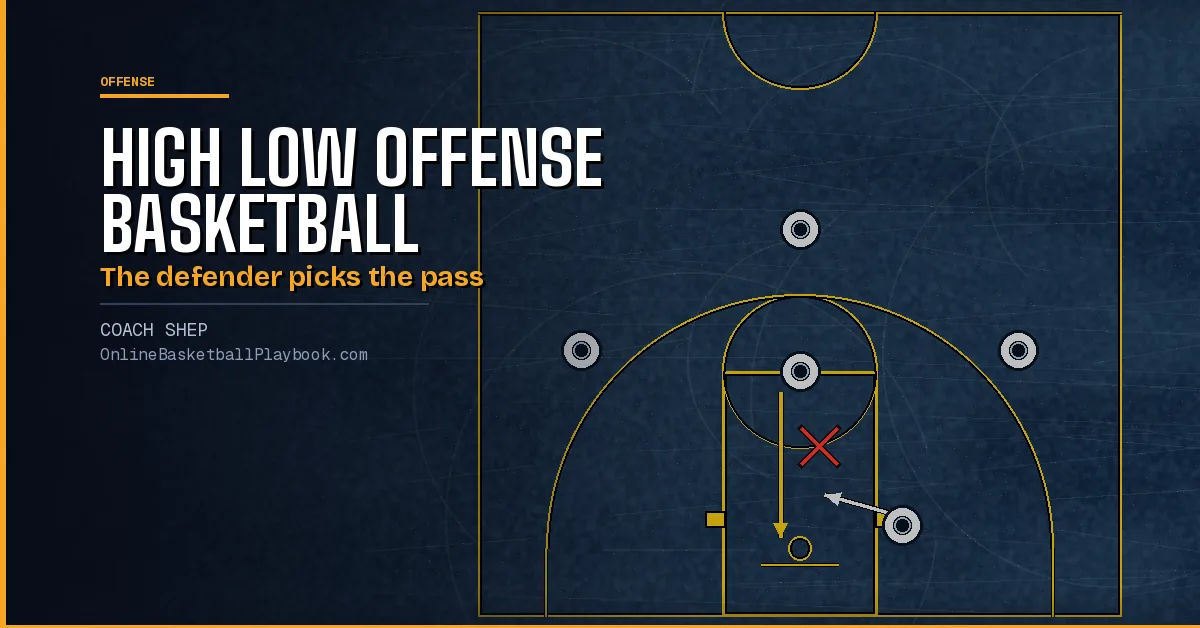
High Low Offense Basketball: Reads, Counters and Zone Rules
High low offense basketball explained: the two-post shell, the lob and bounce reads, answers to a front, down-screen reads, 1-4 low sets and the hi-lo against zones.
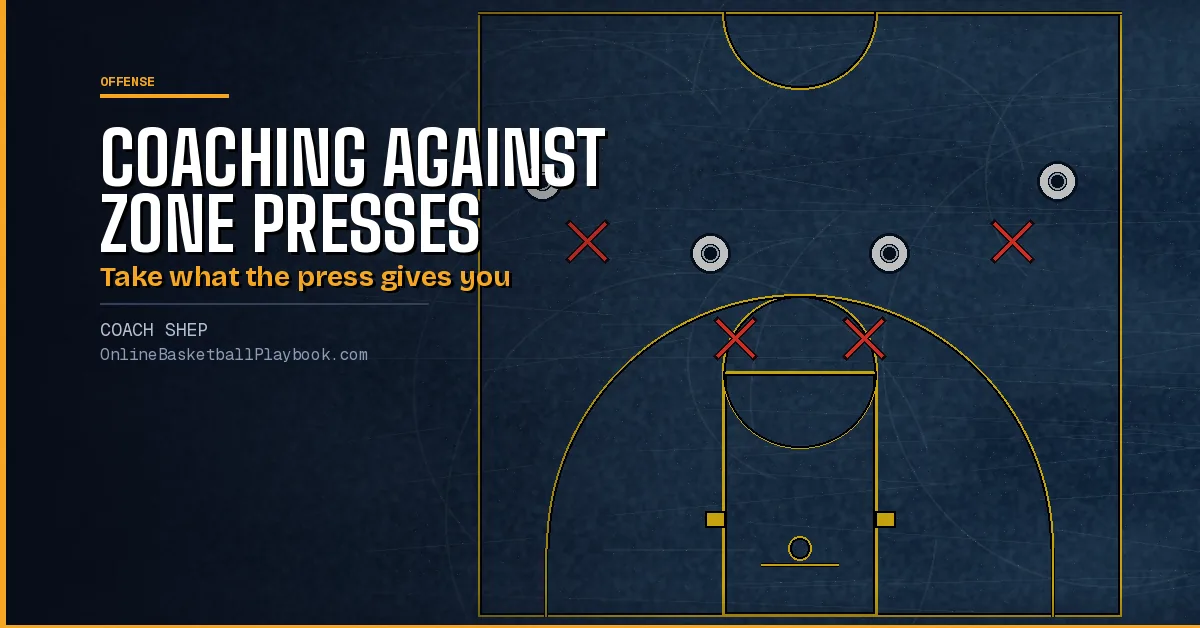
Strategies for Coaching Against Zone Press Defenses
How to coach against zone press defenses: what the 1-2-1-1, 2-2-1, 2-1-2 and 1-3-1 take away, the spacing that beats them, how to break the trap and the drills.
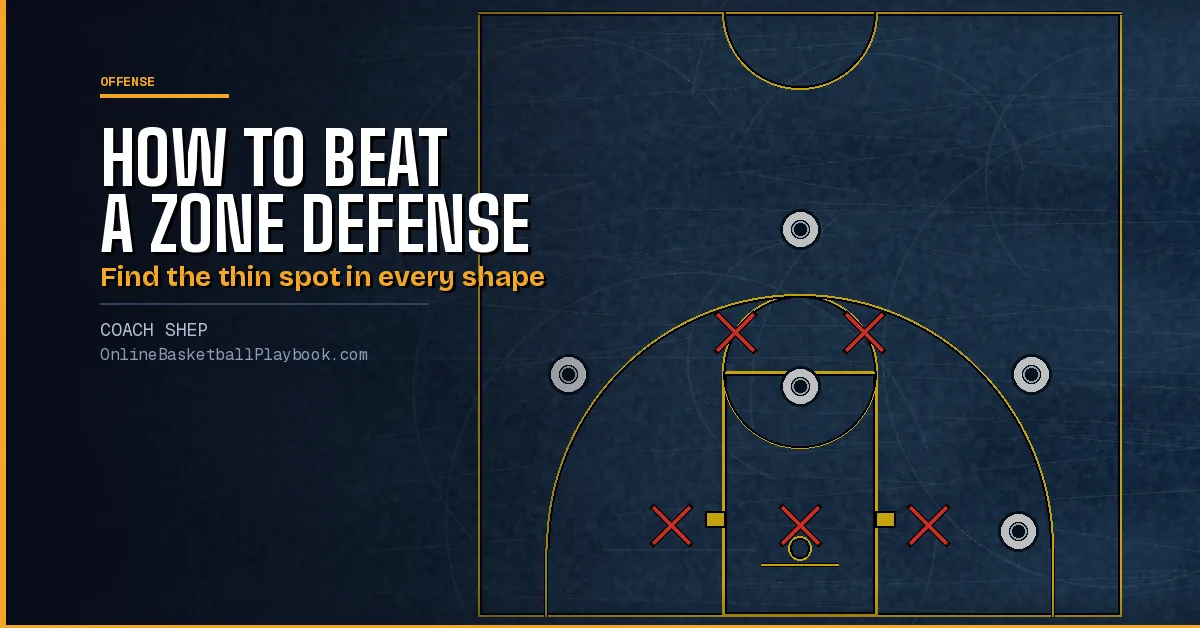
How to Beat a Zone Defense: Every Zone and Where to Attack It
How to beat a zone defense, one zone at a time: what the 2-3, 3-2, 1-3-1, 1-2-2, 2-1-2, matchup and junk zones take away, give up and where to attack.