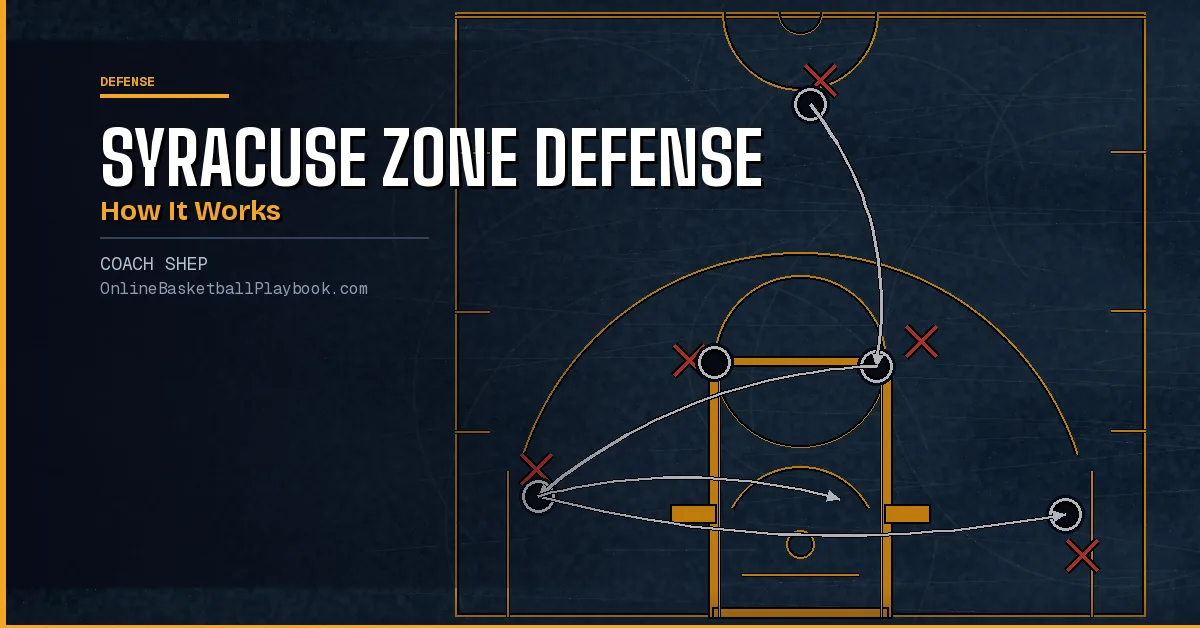
The Syracuse 2-3 zone is one of the most recognizable defenses in basketball. Two guards in the slots, three across the baseline, built to protect the paint, wall off dominant bigs, and force offenses into uncomfortable decisions.
What Is the Syracuse Zone?
The 2-3 zone has been around for decades, but Jim Boeheim's tenure at Syracuse turned it into a household name. Boeheim ran the zone almost exclusively for over 40 years, and in doing so he proved that a single defense, executed at an elite level, can neutralize virtually any offense. The result was a system so associated with the university that it became synonymous with the school itself.
At its core, the Syracuse zone is a standard 2-3 zone defense with two guards positioned near the top of the key and three defenders stretched across the paint and baseline. What separates the Syracuse version from a generic 2-3 is the intensity of the rotations, the discipline of the back three, and the emphasis on denying the high post. Boeheim's teams don't simply set up and react. They attack passing lanes, force reversal, and make the offense work against a constantly shifting wall.
The zone is built to do several things simultaneously. It protects the rim. It takes away the low post. It limits penetration off the dribble. And when executed correctly, it generates turnovers by disguising passing windows that look open but close before the ball arrives. Understanding how those objectives connect is the foundation of teaching this defense.
Starting Alignment and Positioning
The starting alignment of the Syracuse 2-3 zone is specific, and deviating from it breaks the whole system. The two top guards (X1 and X2) position themselves about one step inside the three-point arc. They should be close enough together to deny a direct pass into the high post. If the gap between them is too wide, an offense can skip a pass to the elbow and immediately attack a seam between the top two and the back three. That gap is the zone's most dangerous entry point, and the guards' starting width determines whether it exists.
The back three are not a flat baseline line. This is one of the most misunderstood elements of the defense. The two wing defenders, typically called X3 and X4, play on the wing, forward of the block. This positioning is deliberate. It allows them to close hard to the corner on ball entry without having to sprint six or more feet to contest a catch. If the wings play on the block and a skip pass reaches the corner, the offense gets a clean look at a three-pointer. Wings starting on the wing eliminate that problem.
The center (X5) anchors the paint. This defender is the hub of the entire system, responsible for the low post, corner help when the wing closes out, and communication to the whole defense. X5 must have both the athleticism to cover ground and the vocal leadership to direct teammates. It is the highest-demand position in the zone and often the most underrated in terms of what it takes to play it well.
Ball-Side and Weak-Side Rotations
The rotations within the Syracuse zone are choreographed, and every defender has a defined role that shifts with each pass. Understanding ball-side versus weak-side responsibilities is the key to making the defense function as a unit rather than five individuals chasing the ball.
Ball-Side Responsibilities
When the ball is on one side of the floor, the top guard on that side (X1 or X2) becomes the primary ball containment defender. Their job is to force the dribbler in one direction, deny a reversal pass back through the middle, and be ready to jump-switch with their partner when the ball skips to the other side. This jump switch, where the off-guard quickly bumps to the new ball position, is what allows the zone to maintain pressure through reversal without getting caught in no-man's land.
The ball-side wing closes hard to the corner when the ball enters there. The technique here matters: the wing should arrive with their rear shoulder angled toward the baseline, not perpendicular to it. This body position simultaneously contests the catch and takes away the baseline drive. A wing who arrives flat-footed or with their chest to the corner allows either the three-pointer or the drive, giving the offense an easy decision. The phrase coaches use is "close with butt to corner," and it captures exactly what the position demands.
X5 slides to protect the low post when the ball enters the corner. This leaves the weak-side area briefly open, which is why the weak-side wing must retreat toward the paint simultaneously. The defense trades one gap for another. The idea is to force the offense to make an extra pass to find the open man rather than making easy reads off ball entry.
Weak-Side Responsibilities
The weak-side wing drops a foot into the lane when the ball goes opposite. This position allows them to cover a lob pass or a back-door cut without leaving the paint exposed. The weak-side top guard stays above the free-throw line to cut off ball reversal. These two defenders form a pinch point that collapses the space between the perimeter and the paint on the help side, a key element of what makes the zone difficult to attack with skip passes.
Weaknesses and How to Protect Them
No defense is without vulnerabilities, and the 2-3 zone has well-documented ones. Offenses have been attacking the same gaps for decades. Understanding what those gaps are and how to minimize them is what separates a disciplined zone from one that simply gives up easy buckets.
The most exploitable weakness is the elbow and high-post area. A pass from a guard to a player at the high post splits the gap between the top two defenders and the back three. From there, the offense can skip to the corner, dump to the low block, or drive directly at the basket. This is why the starting width of the two top guards matters so much. They must be positioned to deny that entry pass without leaving the perimeter open.
The corners are the second major vulnerability. When the ball swings from one side to the other via reversal and the defense is slow to close, the wing defender must travel a long distance to contest a corner three. Teams that move the ball quickly, especially against zones that play too far off the ball, can generate corner looks consistently. The response is to keep the wings out on the wing rather than on the block, and to prioritize closing speed on reversal.
Short corners and baseline runners are a third problem area. The offense can place a cutter along the baseline to pull X5 out of the paint, which creates a lob window for a cutting big. Solid help defense principles and verbal communication from X5 are the primary countermeasures here. X5 must decide in real time whether to cover the short corner or protect the paint, and the rest of the defense must adjust accordingly.
The two most common mistakes teams make in the 2-3 zone are wings playing too low (on the block) and top guards spreading too wide. Correct both before you coach anything else. They cause almost every breakdown you'll see in the first few possessions of a game.
Teaching the Syracuse Zone
The 2-3 zone looks simple from the stands. Five players, two up and three back. What could be complicated? The answer is everything below the surface: the footwork, the communication, the anticipation required to rotate before the pass arrives rather than after. Teaching the zone properly takes more time than teaching man-to-man defense for most teams, because the principles are collective rather than individual.
Start with the walk-through. Put five defenders on the floor and no offense, and walk every rotation in slow motion. Have players verbalize their assignments as the ball moves around the perimeter. Each time the ball shifts, every defender moves, even if their position only changes slightly. This habit of moving on every pass, rather than only when the ball enters your area, is the foundation the rest of the defense is built on.
The shell drill is the ideal teaching tool for installing zone concepts. Run a 4-on-4 shell with specific zone assignments to reinforce ball-side and weak-side roles before adding live play. Give each position a numbered designation and call it out during drill work so players understand who has what responsibility in each configuration.
Next, isolate the two most critical positions, the center and the ball-side wing, and drill their individual responsibilities until they're automatic. X5 should be making calls constantly: "ball," "corner," "high post," "lob." Wing defenders should practice the close-out technique until the footwork feels natural at game speed. Most of the defense's efficiency comes down to whether these two positions execute correctly under pressure.
Finally, add live offense and let the defense feel what happens when it breaks down. Controlled scrimmage against offenses designed to attack the corners and high post will expose weaknesses faster than any whiteboard session. Give defenders feedback in real time and pause to correct rotations before bad habits form. Repetition against game-speed pressure is what eventually makes the zone look effortless, even though it isn't.
How Offenses Attack It and Why That Matters for Defenders
Every coach who runs the 2-3 zone should also know how to beat it. Understanding the offensive attack tells you where your defense is most likely to break down, which helps you prioritize what to practice. The best zone coaches spend time on offense-versus-zone concepts precisely because it sharpens their defensive teaching.
The most effective weapon against the 2-3 zone is a skilled high-post player. A guard or forward who can catch at the elbow and either shoot, drive, or pass to both wings creates problems the defense struggles to solve without compromising another area. Teams that have a 6'4" or taller player who handles the ball well specifically exploit this.
Ball reversal with purpose is the second major attack. Offenses that reverse the ball quickly from side to side force the wings to cover more ground than they can recover in time. The antidote from the defensive side is training the top guards to speed up their jump switches and training the wings to anticipate the skip before it arrives, not after. Transition defense Awareness also matters here. Teams that push the pace against a zone before it sets can get layups before the back three are in position.
Dribble penetration from the top of the key is underused against the zone but effective. A guard who can attack the gap between the two top defenders and draw a reaction from the back three opens up kick-out opportunities on both sides. Defensive teams who have practiced their rotations handle this well. Teams who haven't find themselves scrambling after one dribble drive.
Knowing these attack patterns helps coaches understand why basketball IQ development matters for zone defenders. Players who understand what the offense wants to do can anticipate passes and rotations rather than simply reacting. That anticipation is what separates good zone teams from elite ones, and it is developed through scouting, film, and deliberate practice, not just drilling the rotations in isolation.
- Top guards start one step inside the arc, close enough together to deny the high-post entry pass.
- Wing defenders start on the wing, never on the block, so they can close corners without sprinting six feet.
- Ball-side wing closes with butt angled toward the baseline to take away both the three and the baseline drive simultaneously.
- X5 communicates every rotation out loud: "ball," "corner," "lob," "high post" (no silent reps allowed).
- Weak-side wing drops a foot in the lane on every ball reversal to cut off skip passes and lob entries.
- Top guards jump-switch on reversal. The off-guard bumps to the new ball position before the pass arrives, not after.
Get free play diagrams, drills, and coaching guides delivered weekly.
Draw this play free in the play drawer →
Membership: the full library, playbook packs, and Pro drawing tools →
Keep Building
Related breakdowns
Box and 1 Defense: How It Works and How to Beat It
What the box and 1 defense is, how the chaser and the box play, when coaches call it, where it leaks, and how an offense beats it with a decoy star.
1-3-1 Zone Defense: Traps, Rotations and Drills
How to run the 1-3-1 zone defense: the five roles, the corner and wing traps, the skip pass that beats it, loose and tight depth, and the drills to install it.
3-2 Zone Defense: Rotations, Weak Spots and Drills
How to run the 3-2 zone defense: the alignment, the rover, every rotation, the weak spots, the 3-2 matchup zone and the drills, plus when to pick it over a 2-3.