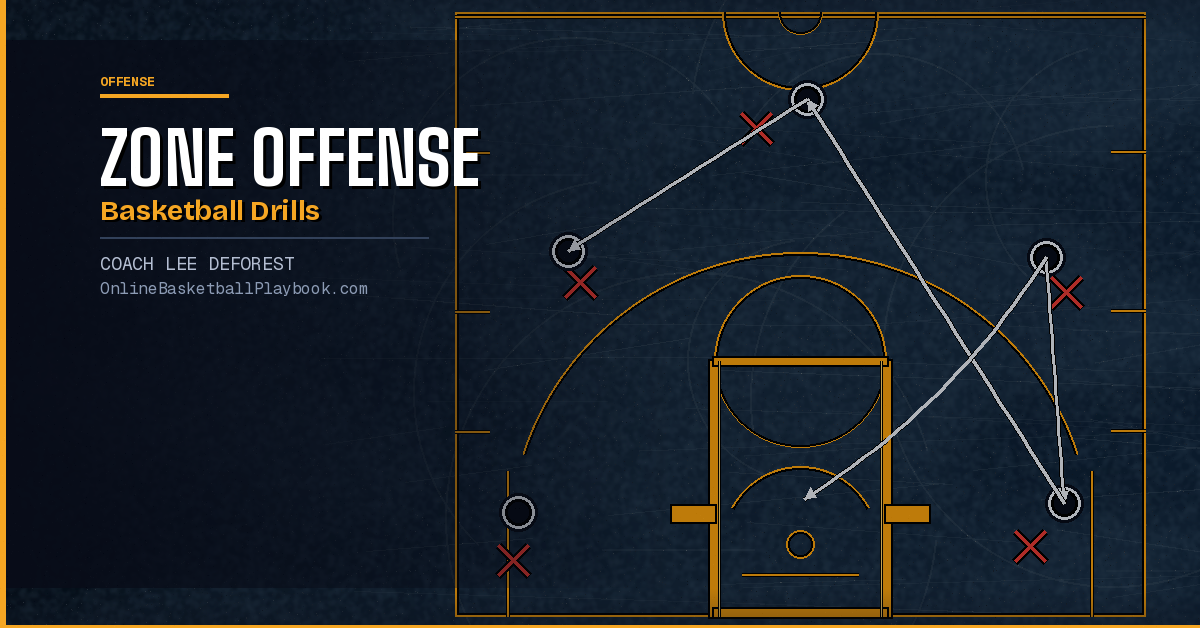

Zone defenses confuse teams that run man-to-man actions at them. These drills train players to find gaps, occupy the high post and short corner, and move the ball faster than any zone can shift.
Why Zone Offense Drills Matter
A zone defense does not chase players — it guards floor space. That single fact changes everything about how you must prepare your offense. Teams that try to run standard motion offense actions against a zone often end up dribbling into traffic or taking difficult mid-range shots over outstretched hands. The zone wins not because it is athletically superior, but because the offense never gave it a real problem to solve.
Zone offense drills exist to build three specific habits: moving the ball faster than defenders can shift, putting a player in every gap and seam, and attacking the two soft spots — the high post and the short corner — before the defense can adjust. These are skills that must be rehearsed in isolation before they transfer to live situations. You cannot simply tell players to "find the gaps" and expect it to happen in a game. The gaps must be trained.
The payoff is significant. A team that has drilled zone offense concepts reads a 2-3 zone the same way it reads a man defense — with clarity and a plan. Players know where to flash, when to reverse, and how to trigger the high-low without calling a timeout. That composure comes from repetition in practice, not from a halftime speech. Building this into your basketball practice plan consistently is what separates teams that score against zones from teams that just survive them.
These drills are organized to build the concept layer by layer: gap alignment first, then high post and short corner occupancy, then overload and skip mechanics, then zone screening, and finally competitive situations that put all the pieces together.
Gap Attack and Reversal Drills
The first thing players must learn is where to stand. Against an odd-front zone like a 1-2-2, you want your perimeter players in the gaps between the two defenders on each side. Against an even-front zone like a 2-3, you push players to the seams above the front line. Alignment is not an afterthought — it is the first read, and it needs to be drilled.
3-on-3 Gap Alignment Drill
Set up three offensive players against a stationary 2-3 skeleton. No live defense yet. The three players must position themselves so that each one is in a gap — one at the high post, one in a wing gap, one at the short corner. The coach calls "reset" and all three must reposition immediately without coaching. Run this for two minutes until positioning becomes automatic.
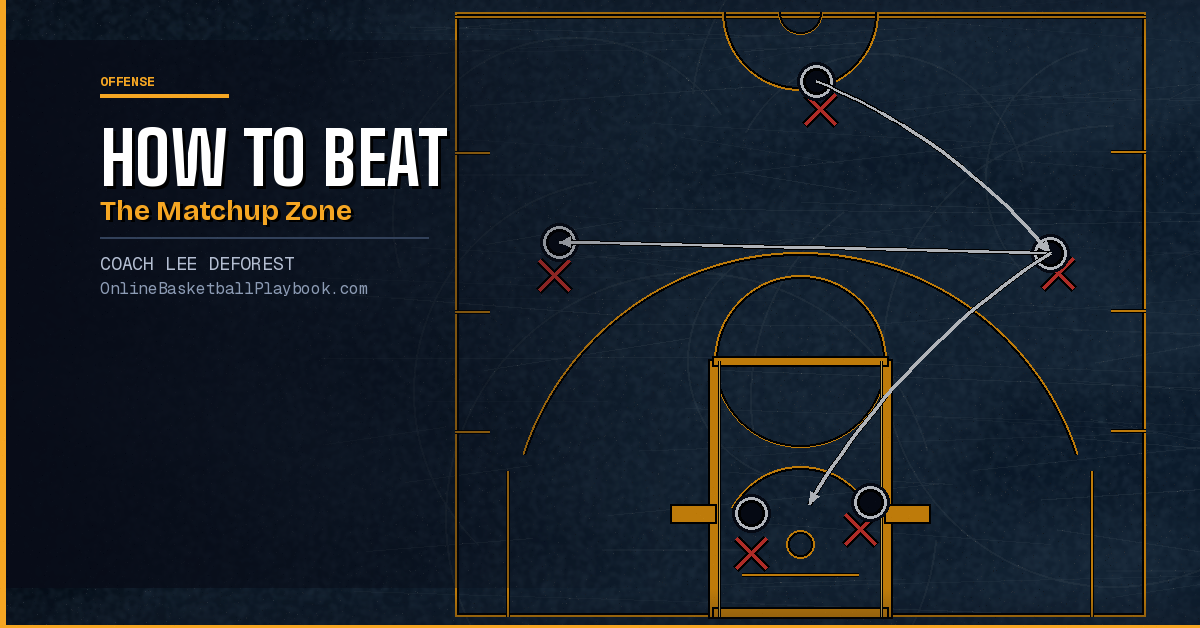
Once players understand where to align, add the ball. The point guard enters to the wing, and the wing makes an entry dribble toward the baseline to commit the bottom defender. As that defender steps up, the point guard reverses the ball across the top. The short-corner player opposite must read the reversal and relocate to the far short corner in real time. The base move of zone offense — entry, commitment, reversal — is exactly what this drill rehearses.
5-on-0 Reversal Flow
Five offensive players walk through a full reversal sequence against air. Ball swings from guard to wing to short corner, back up to wing, to guard, to opposite wing, to opposite short corner. Every player must move on the flight of the pass — not after the catch. If anyone is standing still while the ball is in the air, stop and reset. The goal is to build the habit that movement happens on the pass, not as a reaction to the catch.
This drill sounds simple and coaches often skip it. Do not skip it. Zone offense failures in games almost always trace back to players who are stationary when the ball arrives — the defense has already covered the catch point before the player even has it. Running this in silence, with a coach watching footwork and timing rather than calling plays, is one of the highest-value reps a team can get.
High Post and Short Corner Drills
The two spots that break a 2-3 zone wide open are the high post at the elbow and the short corner on the baseline. Getting a player into the high post pins the middle defender and forces every other defender to make a choice they cannot win. The short corner pulls the baseline defender up and creates a lane for a diving big from the opposite side. Drill these two spots relentlessly.
High Post Flash and Read Drill
Start with the ball at the top. A player flashes from the weak-side elbow to the high post. The passer delivers a two-handed chest pass into the catcher's chest — the high-post player must catch with hands ready, pivot to face the basket, and read three options in sequence: shoot (if left open), hit the short-corner cutter on the strong side, or skip to the opposite wing. A coach or manager stands at each of those three spots and holds up a color — the high-post player calls the color and hits that target. This builds the read without requiring full-speed defenders.
Progress the drill by adding a closeout from one live defender. Now the high-post player must make the same read with a hand in their face. This is where basketball IQ development actually happens — not in a game when the stakes are high, but in practice when the player can process and repeat. Run five reps per player before rotating.
Short Corner High-Low Drill
Place a passer at the wing. A post player positions at the short corner. A second big positions at the high post. The wing enters to the short corner. As the short-corner player catches, the high-post player reads the bottom defender's movement — if the bottom defender slides toward the short corner, the high-post player cuts to the rim for the lob or the dump-off. If the bottom defender stays, the short-corner player shoots the short-corner jumper.
This high-low read is the backbone of attacking a 2-3 zone, and it must be trained as a two-player conversation, not an individual skill. Post players who have never drilled this will freeze in games. Post players who have drilled it fifty times will make the cut automatically before the coach can call it from the bench.
Overload and Skip Pass Drills
An overload puts three players on one side of the floor against a zone that only has two or at most three defenders covering that side. The zone collapses to cover the overload. Then you skip the ball across the floor before the zone can recover. The skip pass — a direct pass from one side of the court to the other — is the single most destructive weapon in zone offense, and it must be a trained skill, not an improvised heave.
3-on-2 Overload Drill
Load the strong side with the guard, wing, and short-corner player. The two bottom defenders of a 2-3 shift to cover. The guard holds the ball until the zone collapses, then delivers a two-hand overhead skip to the opposite wing. That wing must be in a shot-ready stance before the ball leaves the passer's hands. Catch and shoot on the skip — no dribble, no pump fake on the first rep. Players must learn the habit of being ready before the ball arrives. Add a corner shooter as the fifth player so the receiving wing can also drive and kick to the corner.
Skip and Attack Drill
This drill adds the next decision after the skip. Four players — guard, wing, short corner, and opposite wing. Ball starts at the wing. Short-corner catch draws the bottom defender. Guard reverses to the top, then skips opposite. The opposite wing catches and reads: if the help defender is late, shoot; if the help is early, drive the baseline. This forces players to make a real read off the skip rather than treating the skip as the end of the play. Many zone offenses stall because teams skip and then freeze — this drill trains the attack mindset that turns a skip into a layup.
"Overload one side to draw the zone over, then skip the ball to the weak side for a corner three or a lob over the back."
— Basketball Vault
Screening the Zone Drills
Zone defenders can be screened just like man defenders — and most teams never do it. Screening the zone creates two advantages simultaneously: it slows the zone's shift, and after the screen, the screener seals and dives, creating a duck-in opportunity at the elbow or on the block. This is advanced zone offense, and it separates good zone-busting teams from great ones.
Back-Screen the Wing Drill
A post player sets a back screen on the outside wing defender of a 2-3. The perimeter player uses the screen to cut baseline. The big immediately seals the wing defender and dives to the elbow. The ball is at the top — the passer reads: hit the cutter on the baseline, or feed the sealing big at the elbow. Run this with a coach at the top as the passer and two live defenders learning to fight through screens. The key coaching point is the seal and dive after the screen — the big cannot stand after the screen is set. Movement continues immediately.
Teams that add zone screening to their repertoire are much harder to scout. A defense that knows it might get screened cannot shift freely, which opens the reversal and skip reads that the rest of the offense depends on. Integrate this drill into your full zone offense work after the gap and high-post concepts are solid. For more on how defensive concepts relate, see our breakdown of the 2-3 zone defense — understanding what the defense is trying to do makes it much easier to attack.
Pin-Down the Bottom Drill
A guard sets a down screen on the bottom defender of the 2-3. A shooter curls off the screen to the short corner. The screener seals and ducks in at the block. The ball is at the wing — the wing reads shooter or duck-in. This is an excellent action for teams with a guard who can also score in the post on duck-ins, and it creates a genuine two-on-one problem for the bottom defender that the zone cannot solve without help from the middle.
Putting It Together: Competitive Drills
Individual concepts drilled in isolation do not automatically combine in games. Competitive drills that put all the zone offense tools together — under defensive pressure, with a shot clock or possession limit — are what complete the training. These drills should make up the final third of any zone offense session.
5-on-5 Zone Offense with Possession Rules
Play 5-on-5 against a live 2-3 zone. The offense gets three passes to create a high-quality shot — not three seconds, three passes. This rule forces players to move the ball quickly and make decisions early. If the shot is taken before three passes, it counts only if it goes in. Teams rapidly learn that stationary players kill the possession clock, and that moving on the flight of the ball is not optional — it is the only way to get a good look in time.
Track shot quality after each possession: was the shot at the rim, a short corner look, a corner three off a skip, or a high-post mid-range? Over a ten-minute block, quality shots should increase. If they do not, the offense is not reading the gaps correctly and you need to return to the 3-on-0 gap alignment drill.
Scramble Zone Drill
Start with a made basket — the defense immediately sets a zone. The offense must recognize the zone before the ball is advanced past half court and transition directly into zone offense spacing. No walking it up. No calling out the defense. Players must read and react. This drill specifically trains the recognition skill that gets lost when teams practice zone offense in isolation from transition situations. Many youth and high school teams get scored on off zone transition traps because they failed to identify the zone in time. This drill closes that gap.
After every zone offense drill session, log where shots came from. Shots at the rim and short corner represent good zone offense execution. Pull-up jumpers in traffic represent failed reads. If your shot chart looks like the second group, shorten the possession limit and go back to gap alignment fundamentals before adding any new concepts.
- Move on the flight of the ball — every cutter and flasher must be moving before the pass arrives, not reacting after the catch.
- High post first — establish a player at the high post on every possession; it pins the middle and unlocks every other action.
- Short corner + high-low — when ball reaches the short corner, the opposite big dives immediately; this is the primary 2-3 zone killer.
- Load and skip — overload a side until the zone collapses, then skip across before it can shift back; the receiver must be shot-ready before the pass leaves.
- Screen the zone — back-screen the wing defender and seal-and-dive after; most defenses have never practiced fighting through a zone screen.
- Three-pass rule in practice — force the offense to create a quality look within three passes to build decision speed and ball movement habits.
- Recognize on the run — practice transitioning from made basket directly into zone spacing so players can identify and attack without stopping play.
Zone offense mastery also requires solid individual fundamentals. Players who cannot make a crisp skip pass, catch in a shot-ready stance, or make a two-dribble baseline drive will struggle to execute these concepts at game speed. Pair your zone offense drilling with focused work on passing drills and footwork so that the execution layer never limits the tactical layer.
Get free play diagrams, drills, and coaching guides delivered weekly.
See it drawn up
Related diagrams
Keep Building
Related breakdowns
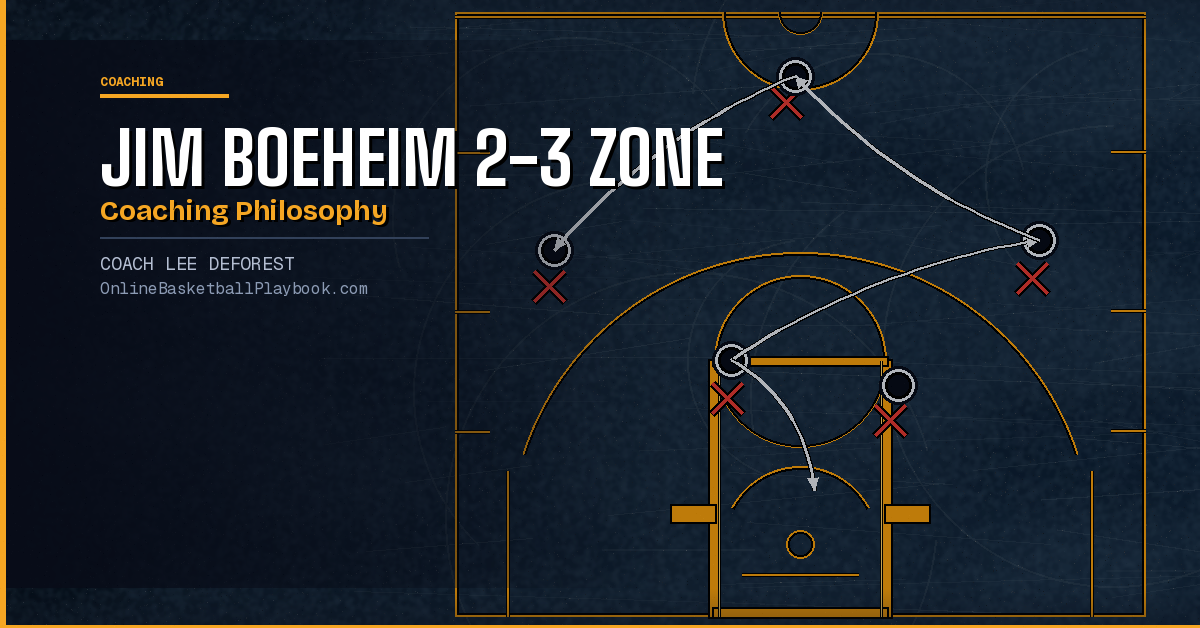
Jim Boeheim 2-3 Zone System and Coaching Philosophy
Jim Boeheim 2-3 Zone System and Coaching Philosophy