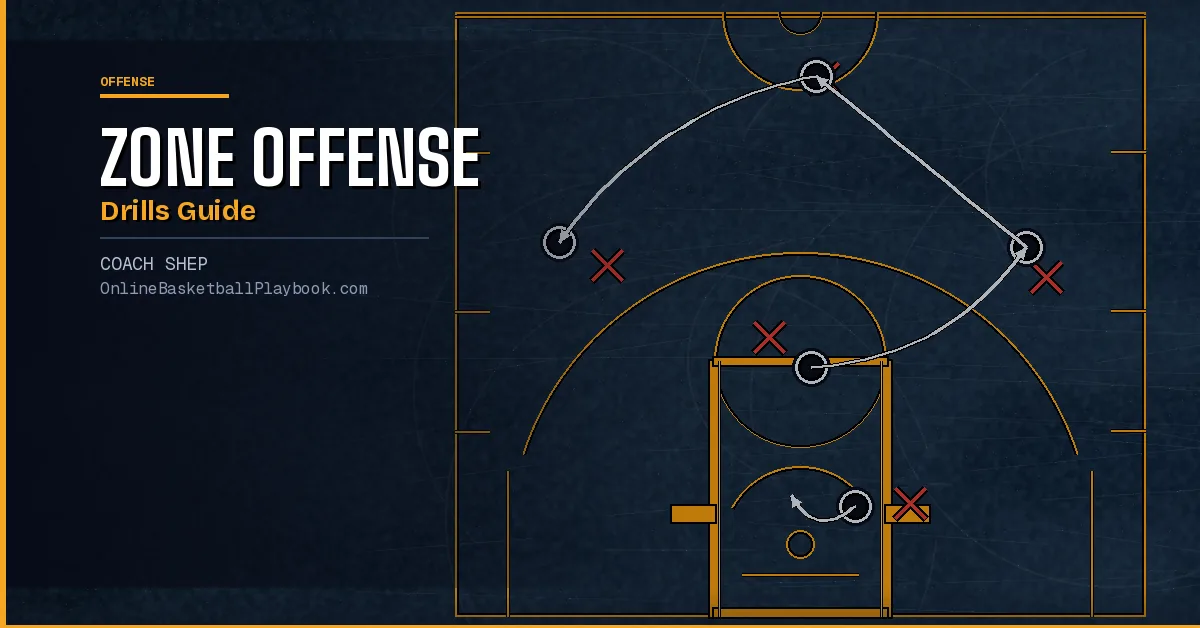
Most teams struggle against a zone because they never drill the specific movements zone offense demands. These drills isolate gap alignment, high-post flashing, short-corner reads, skip passes, and overload principles so players build real zone-attack habits.
Why Zone Offense Drills Are Different
Zone defense guards areas, not people. That single fact changes everything about how you teach offense. A player trained exclusively in man-to-man offense will fight for their spot on the floor, but that spot might be exactly where a zone defender is already standing. Zone offense requires players to find the gaps between defenders, not the space away from a single assigned guard. Drilling that habit takes repetition, and it takes the right repetitions.
The first mistake coaches make is running five-on-five against a zone before players understand the basic geometry. You end up with five players staring at a zone, passing around the perimeter, never threatening the interior. The ball does not move faster than the zone can shift when your players are standing still. Zone offense drills must isolate movement (cuts, flashes, relocations) and connect them to reads so players know not just where to go but when to go there.
The second mistake is treating every zone the same. A 2-3 zone has entirely different soft spots than a 1-3-1 or a 3-2. Your drills should name the zone they are attacking. If your schedule includes opponents who run a 2-3 zone defense, build drills specifically targeting the short corner and the high post. Those are the two areas where a 2-3 is structurally compromised.
Good zone offense drills share three qualities. First, they are deliberately slow at first. Players need to read the defenders, not just execute a choreographed sequence. Second, they build toward decision-making, not just pattern completion. Third, they connect individual skill work (skip passing, flash catches, short-corner footwork) to a recognizable team concept players can recall under pressure. Every drill in this guide follows that sequence: teach the movement, add the read, apply it in context.
Building these habits fits naturally into a well-structured basketball practice plan where zone offense receives dedicated segment time rather than being an afterthought before scrimmage.
Gap Alignment and Entry Drill
Before any movement drill, players must understand where to stand. Gap alignment is the foundation of zone offense. Against an even-front zone like a 2-3, your offensive alignment should place players in the gaps between defenders, not directly in front of them. Against an odd-front zone like a 1-3-1, your alignment flips to attack the seams on either side of the point defender.
The Alignment Walk-Through
Start without a ball. Place five defenders in a 2-3 zone and walk your offensive unit through their spots. The point guard sits at the top of the key in the gap between the two top zone defenders. The wings sit in the gaps between the top and bottom defenders on each side, roughly at the elbows extended. A high-post player occupies the free-throw line area, sitting between the top two and the three bottom defenders. A short-corner player positions below the baseline corner of the zone on the weak side.
Once players understand the alignment visually, add a ball and run a simple entry sequence: pass from the top of the key to the wing, wing drives one dribble to force the zone to shift, then reversal back to the top of the key and swing to the opposite wing. Players observe how the zone moves. You are not trying to score yet. You are teaching players to see the zone's reaction to ball movement.
One-Dribble Commit and Reversal Drill
This drill isolates the most common zone-beating action: force a defender to commit, then reverse into the space he vacated. The point guard drives one dribble at a top zone defender. That defender must step up. The point guard reverses to the opposite guard who has relocated into the gap. The drill runs for five minutes, focusing on the gap the dribble creates, not the score at the end.
Coaching cues: "Make him move before you pass." "Reverse into his spot, not yours." Players tend to pass before the defender commits, which means the reversal lands in a covered spot. The one dribble forces the issue.
High-Post Flash and Short-Corner Drill
Two spots bend a 2-3 zone more than any others: the high post at the free-throw line and the short corner below the block on the baseline. When both are occupied simultaneously, the zone's three bottom defenders face an impossible geometry. They cannot cover the high post, both corners, and the short corner all at once. Your drills must teach players to find and hold these spots and to read the defender's choice.
Flash and Fill Drill
Run this drill 3-on-0 to start. One player occupies the short corner on the right side. One player stations at the wing. The third player starts at the weak-side elbow. On a wing pass, the weak-side player flashes hard to the high post, not a drift, a cut with purpose. The wing passes to the high-post flash. The high-post player reads: if the nearest bottom defender drops to contest, the high-post player hits the short corner for a catch-and-shoot or a power drive to the baseline. If the bottom defender stays, the high-post player shoots the mid-range jumper.
The key coaching point is timing. Players must flash when the pass is in the air to the wing, not after the wing catches. "Flash when the wing crosses your face" is the verbal cue that builds the habit. Early flashers arrive ahead of the ball and allow the zone to recover. Late flashers miss the window entirely.
Short-Corner to Rim-Cut Drill
This drill pairs the short corner with the high post to create a high-low action. Ball is at the wing. The short-corner player catches a skip. The moment the ball leaves the wing's hands, the high-post player cuts to the rim off the top defender's back. The short-corner player reads: if the lob is open, throw it. If not, reverse to the point. Run this 4-on-3 (three zone defenders: two bottom, one top) so the read is live and variable. Players learn that the cut is automatic. What changes is whether the lob is available.
This short corner and high-post pairing is the backbone of most zone-attack systems. When players own it, they have a repeatable scoring action against any 2-3 look.
Skip Pass and Overload Drill
The skip pass is the single most effective way to beat a zone's ability to shift. A zone can follow a ball that is passed around the perimeter one pass at a time. A skip (a cross-court pass that travels faster than the zone can move) leaves a corner shooter open before the corner defender arrives. Teaching the skip pass requires two things: the physical skill of throwing it accurately under pressure and the court vision to recognize when the overload has pulled the zone far enough to make the skip available.
3-on-2 Overload and Skip Drill
Set up three offensive players on one side of the floor: point, wing, and corner. Place two zone defenders on that side. The goal is to overload the two defenders with three offensive players until one of them is forced to choose. Once the corner defender collapses to stop the wing drive, the point guard skips to the opposite corner where a fourth offensive player is waiting. The fourth player catches and shoots before the opposite corner defender can close out.
The drill teaches players to be patient on the overload side. Keep moving the ball until a defender is truly out of position before triggering the skip. Rushed skips when the zone is balanced result in contested corner threes. Patient overloads followed by skips produce open ones.
Skip Pass Accuracy Drill (Individual)
Skip passing is a skill. Many players have never thrown a cross-court pass with pace and accuracy. Run a simple two-man drill where one player stands at the wing and one stands in the far corner. The wing player throws ten skip passes: some from a catch, some off a one-dribble pull-up, some after a pump fake. The corner player catches in a shot-ready stance and shoots. Reverse sides. Track makes and passes thrown accurately to the shooting pocket versus passes that force the receiver to adjust.
Better passing drills like this one build the delivery that makes the skip reliable in a live zone attack. A skipped ball that arrives at the hip or behind the receiver is no better than no pass at all.
Screening the Zone Drill
Screening a zone is underused at every level below college basketball. Zone defenders are fixated on the ball. They are often screened without ever seeing it coming. Treating zone defenders as screen targets creates duck-ins, seals, and high-low feeds that the zone has no structural answer for. The premise is simple: instead of trying to pass through the zone, physically remove a zone defender from the area you want to attack.
Back-Screen the Bottom Defender Drill
This drill targets the bottom corner defender in a 2-3 zone. The short-corner player sets a back screen on the bottom zone defender as the ball is reversed from the wing to the top of the key. The opposite big flashes to the short corner off the screen. The point guard reads the switch or the switch attempt and hits the flashing big for a catch-and-score at the elbow of the zone's vacated area.
Run it 4-on-3 initially. Add the fourth defender only after players can execute the timing cleanly in a reduced-defense environment. The screen itself does not need to be a massive legal pick. Positioning the body in the path of the zone defender's natural rotation is enough to create a step of separation.
Pin and Dive Drill
After the screen, the screener's next job is to seal and dive. This drill isolates that action. A wing-side player sets a pin screen on the zone's bottom corner defender. The moment the ball goes to the opposite side, the screener seals the defender and dives toward the rim. The passer looks for the diving big on the lob or the bounce pass to the duck-in position. If the defender recovers, the screener seals and holds the post position for a short-range feed.
This drill rewards players who do not give up after the screen. The seal and dive is the second half of the action. Players who set the screen and then drift back to their spot miss the opportunity entirely. The scoring comes from committing to the dive.
Combining screening concepts with your zone offense gives you actions that appear in motion offense vocabulary but function as specific zone-attack weapons.
Putting It Together, Live Zone Scrimmage Progressions
Individual and small-group drills build the pieces. Live zone scrimmage progressions put those pieces together in a way that simulates real game pressure. The goal is not to score against your own defense. It is to train the decision-making that carries from practice to games. Structure your progressions so they increase in complexity each day rather than jumping immediately to five-on-five.
Day 1 Progression: 3-on-3 With Restrictions
Run three offensive players against a 2-3 zone's three bottom defenders. Offense must score by using the short corner or high post. No direct wing drive to the basket is allowed. The restriction forces players to use the teaching concepts from earlier drills. Coaches stop play to correct alignment and timing but let the read happen live. Ten minutes in this format is worth more than an hour of choreographed walk-throughs.
Day 2 Progression: 4-on-4 Skip and Overload
Add a fourth offensive player and a fourth defender. Offense is required to overload one side for at least two passes before any skip attempt. Defense is instructed to stay home on the overload side, forcing the skip read. This creates repetition on the hardest decision in zone offense, recognizing when the zone is pulled far enough to commit the skip rather than continuing to probe the overload.
Day 3 Progression: 5-on-5 With Zone Counters
Full five-on-five against a live 2-3 zone. Offense runs a base zone-attack alignment with pre-determined counters: high post flash available on every wing entry, short corner always occupied, skip to corner available when overload pulls the wing defender. Defense competes fully. Coaches track which actions create quality looks (short corner, high-post flash, corner skip, lob off the screen-and-dive) and those become the focal points for the next day's individual work.
This cyclical structure (drill the parts, scrimmage the whole, return to the parts that break down) builds the kind of zone-offense competence that holds up against a good defense in a game that matters. Players who have logged reps on each individual drill recognize the same reads in the five-on-five context because the patterns are already stored.
For coaches building these skills across a full season, integrating zone-offense work into your basketball player development framework ensures players grow in their ability to read defenses at every age and level.
Introduce zone offense drills before players see a live zone in a game. Players who have rehearsed the movements (gap alignment, high-post flash, short-corner positioning, skip reads) arrive at a zone defense with a ready reference rather than a blank screen. Three dedicated practice segments before the first zone-heavy opponent on your schedule is the minimum investment that pays off.
- Align in the gaps between zone defenders, not in front of them. Walkthrough the spots before adding a ball
- High post at the free-throw line bends the whole zone; make sure one player holds that spot every possession
- Short corner + high post occupied simultaneously puts the zone's bottom three defenders in an impossible situation
- Flash to the high post when the wing pass is in the air, not after the catch. Timing is the entire drill
- Overload one side with patience before skipping; a rushed skip into a set zone is a turnover, not an opportunity
- Screen the zone's bottom defenders and seal-and-dive after every screen. The dive creates the scoring action, not the screen itself
- Progress from 3-on-3 restrictions to 4-on-4 to live 5-on-5 across three days before treating zone offense as "installed"
Get free play diagrams, drills, and coaching guides delivered weekly.
Draw this play free in the play drawer →
Membership: the full library, playbook packs, and Pro drawing tools →
Keep Building
Related breakdowns
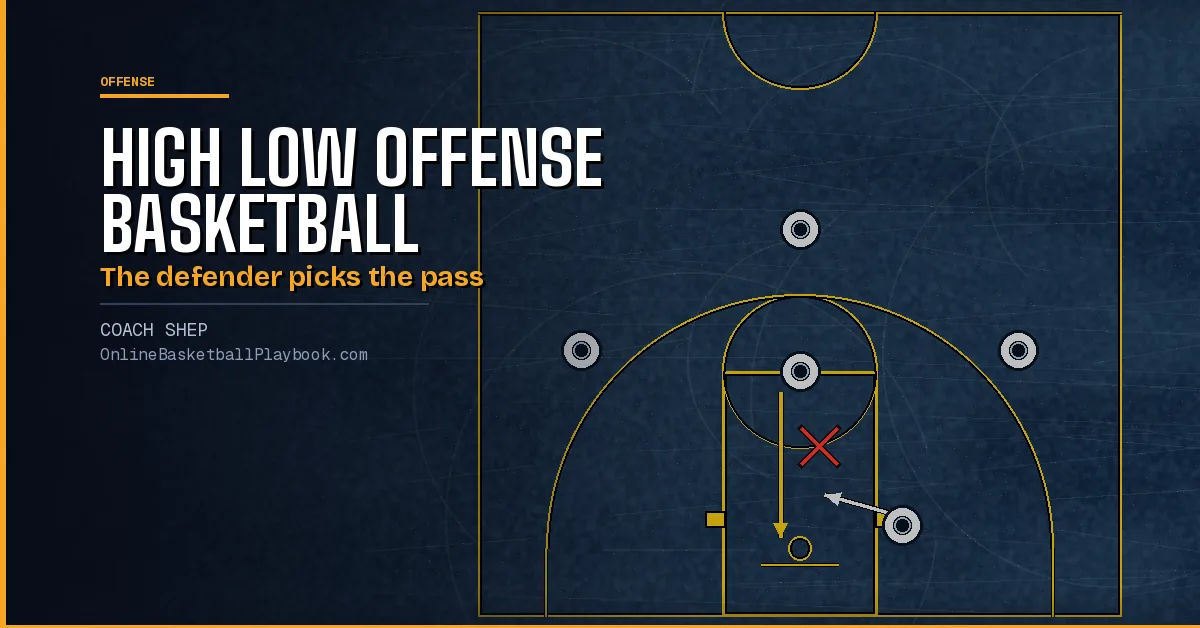
High Low Offense Basketball: Reads, Counters and Zone Rules
High low offense basketball explained: the two-post shell, the lob and bounce reads, answers to a front, down-screen reads, 1-4 low sets and the hi-lo against zones.
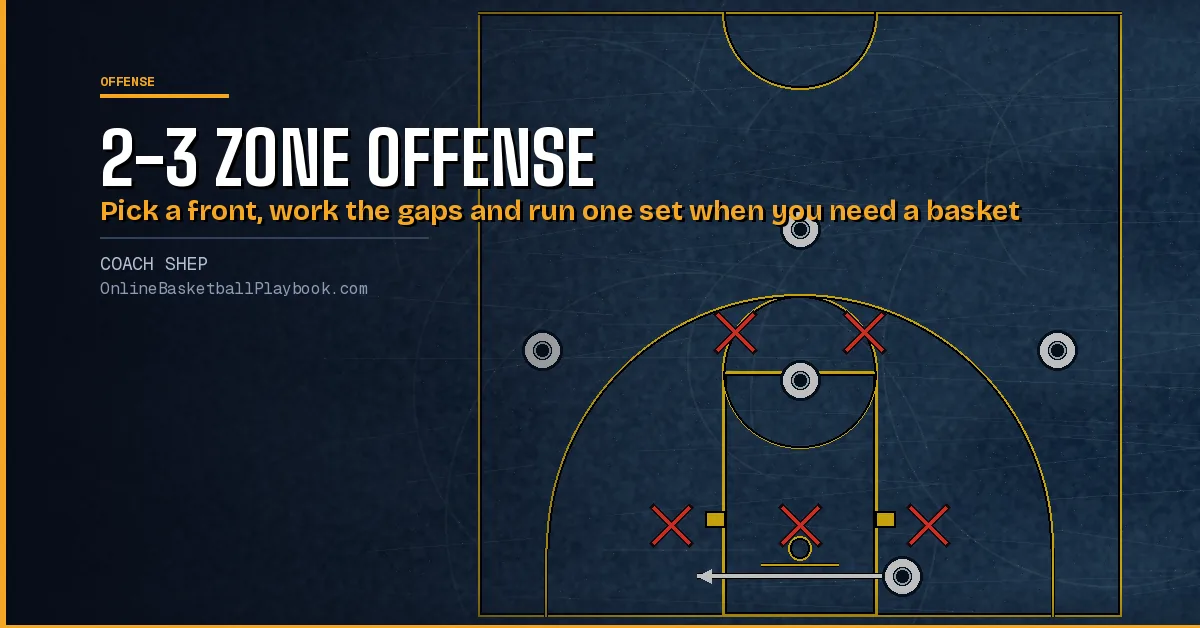
2-3 Zone Offense: Sets, Plays and Continuities to Run
2-3 zone offense with the fronts coaches start from, the continuities they run, quick-hitter plays for a basket, how to choose and where coaches disagree.
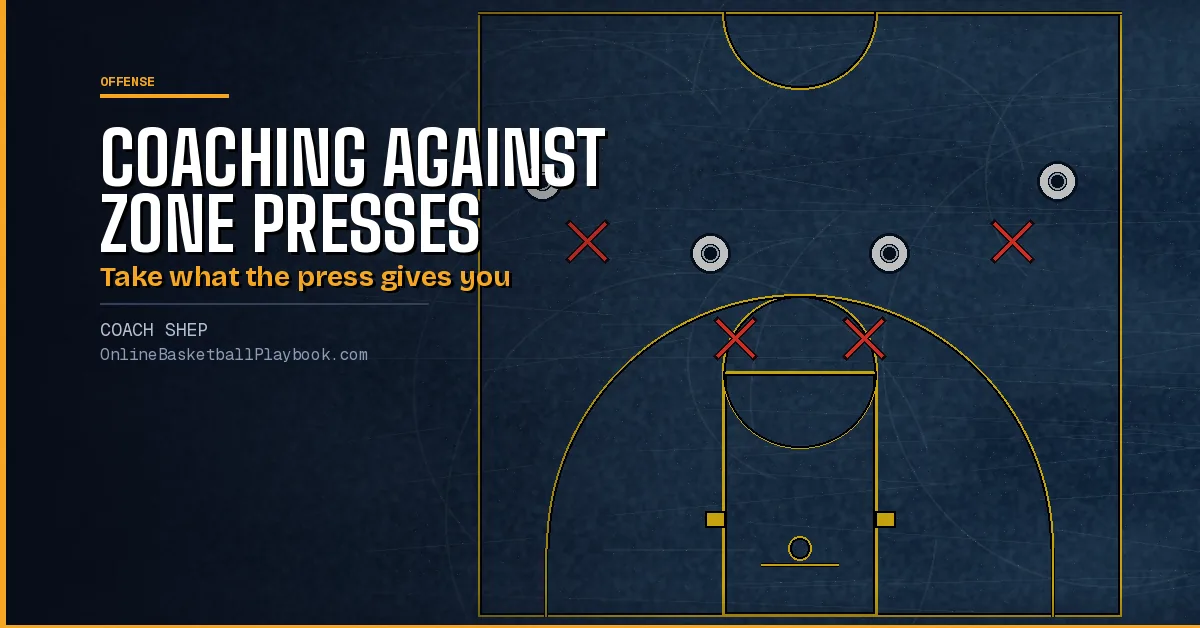
Strategies for Coaching Against Zone Press Defenses
How to coach against zone press defenses: what the 1-2-1-1, 2-2-1, 2-1-2 and 1-3-1 take away, the spacing that beats them, how to break the trap and the drills.