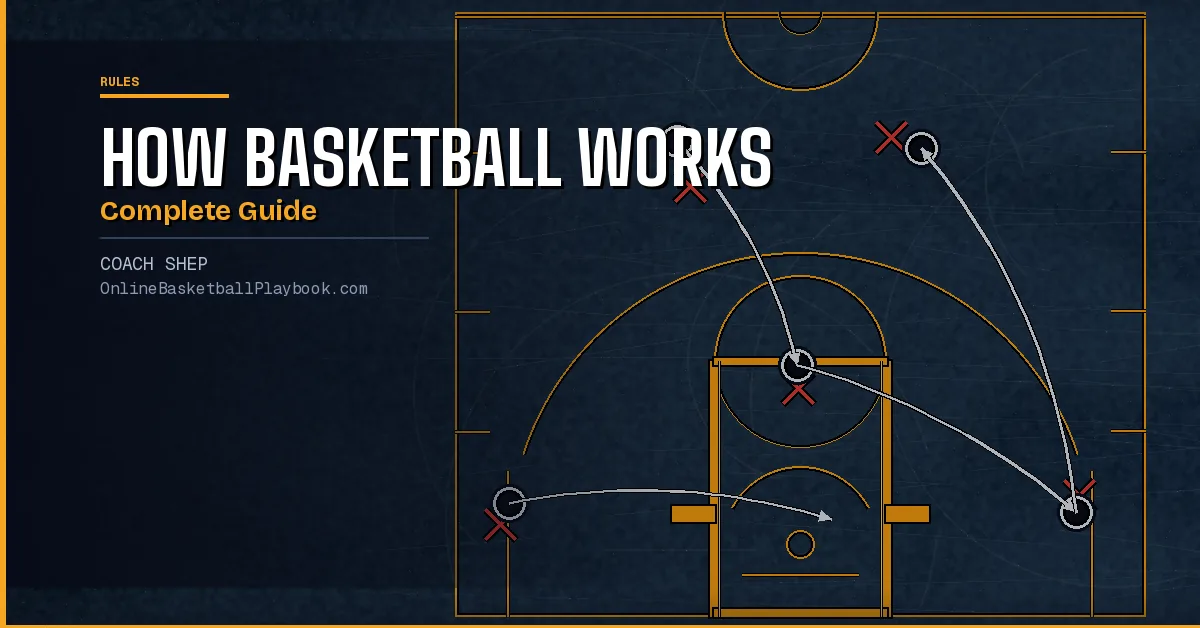
Basketball is a five-on-five sport where two teams compete to score by shooting a ball through the opponent's hoop. This guide breaks down the rules, positions, offense, defense, and scoring, everything you need to understand the game.
The Basic Rules
Basketball is played on a rectangular court with a hoop at each end, set ten feet off the ground. Each team fields five players at a time. The objective is simple: put the ball through the opposing team's basket more times than they put it through yours. But within that simple objective lives a rich and layered set of rules that shape every possession.
The game begins with a jump ball at center court. From there, teams alternate possessions after made baskets, turnovers, or violations. The offense has a set number of seconds (typically 24 seconds in professional play, 30 in college, and 35 at some youth levels) to attempt a shot before the shot clock expires. If the clock runs out without a shot attempt hitting the rim, possession transfers to the defense.
Players advance the ball by dribbling, bouncing it continuously with one hand while moving. Picking up a dribble and dribbling again is a violation called a double-dribble. Carrying the ball or slapping it between both hands improperly is called a carry. Both result in a turnover.
Physical contact is regulated carefully. Defenders cannot push, hold, or impede a ball-handler using their body. Offensive players cannot charge into a set defender. Flagrant or excessive contact draws personal fouls; accumulate enough fouls and a player is disqualified from the game. Understanding fouls (and how to draw them) is a key part of high-level play.
Out-of-bounds lines define the court. Any player who steps on or over these lines while holding the ball surrenders possession. The ball can be thrown out of bounds off a defender and recovered by the offense, but only if that contact is clear to the officials. Mastering these small rules separates players who know the game from those who merely play it.
Positions and Roles
Five positions divide the responsibilities on a basketball team. While modern basketball has blurred positional lines (the era of the "positionless" player is real), understanding the traditional roles still provides a useful framework for how teams are constructed and how plays are designed.
The point guard is the team's floor general. This player handles the ball most, initiates offense from the top of the key, calls out plays, and is responsible for getting everyone else into the right spots. Great point guards have exceptional basketball IQ and can make decisions under pressure at full speed.
The shooting guard is typically the team's best perimeter scorer. This player excels at catching and shooting from mid-range or three-point range, and often works off screens to get open looks. Shooting guards also need to be solid defenders on the wing.
The small forward is a versatile athlete who can score inside and outside, rebound above their size, and defend multiple positions. In many modern lineups, the small forward is the team's most athletic and adaptable player.
The power forward historically operated near the basket, setting screens, rebounding, and scoring in the post. Today, many power forwards extend their range to the three-point line, becoming "stretch fours" who pull opposing bigs away from the basket.
The center is typically the tallest player, anchoring the defense by protecting the rim and disrupting shots. On offense, centers set screens, catch lob passes, and score on close-range opportunities. Post play: The art of scoring with your back to the basket is a skill most centers develop deeply.
How Offense Works
Offense in basketball is the organized effort to create a high-quality shot, ideally an open layup, a clean three-pointer, or an uncontested mid-range attempt from a skilled scorer. How teams create those opportunities is where strategy comes alive.
The most fundamental offensive concept is spacing. Five offensive players must spread themselves across the court so the defense cannot collapse on any one area without giving up something elsewhere. Tight spacing allows defenders to help each other freely. Good spacing forces defenders to make hard choices on every play. 5-Out Motion Offense takes this to its logical extreme, placing all five players outside the three-point line to maximize driving lanes and open catch-and-shoot opportunities.
Ball movement is equally critical. Teams that pass quickly and decisively are harder to guard because defenders must constantly react and recover. The best offenses use player and ball movement together, combining screens, cuts, and quick reversals to break down even disciplined defenses.
Screens (also called picks) are blocks set by an offensive player on a stationary defender to free a teammate. The pick-and-roll is the most common action in basketball: one player sets a screen on the ball-handler's defender, then rolls toward the basket looking for a pass. When executed correctly, it creates a two-on-one advantage that the defense must solve. Teams run dozens of pick-and-roll variations every game.
Cutting is another core offensive tool. A player without the ball who makes a sharp, well-timed cut toward the basket (especially from behind a defender) can receive a pass for an easy score. Backdoor cuts, which attack when a defender is overplaying the passing lane, are particularly effective against aggressive defense.
Good offense also requires proper shooting form developed through consistent repetition. Mechanics matter at every level, from youth leagues through the professional game.
How Defense Works
Defense wins championships. That phrase is repeated constantly in basketball circles because it holds up under scrutiny: teams that stop opponents reliably are nearly always competitive, while elite offenses alone rarely sustain postseason success. Understanding how defense works is just as important as understanding offense.
The two foundational defensive systems are man-to-man and zone. In man-to-man defense, each defender is responsible for one specific offensive player, following that player wherever they go on the court. Man-to-man demands athleticism, communication, and the willingness to fight through screens.
Zone defense assigns defenders to areas of the court rather than individual players. The most common zone is the 2-3 Zone Defense, with two defenders near the perimeter and three protecting the paint. Zones can confuse offenses that aren't prepared for them, but skilled passers can exploit the gaps between zones to find open shooters.
Regardless of system, every defensive scheme depends on the same core ideas. Defenders must stay between their player and the basket. They must communicate constantly: calling out screens, switching assignments, signaling when help is needed. They must close out hard on shooters without overrunning and giving up a drive. Basketball closeout technique is a skill that takes significant practice to develop correctly.
Help defense (rotating to support a teammate who has been beaten) is where teams separate themselves. Weak-side defenders must monitor both their assigned player and the ball simultaneously, ready to step in if a teammate is in trouble. Help Defense Principles teach players when and how to leave their assignment, and how to recover without giving up an easy kick-out pass.
Transition defense (getting back quickly when the other team gains possession) is one of the most critical habits a team can build. A single missed assignment in transition can produce an uncontested layup or a three-on-one fast break. Transition Defense requires discipline, communication, and the willingness to sprint back even when tired.
Scoring and Game Flow
Basketball scores points in three ways. A basket scored from inside the three-point arc counts two points. A basket scored from beyond the arc counts three. Free throws (awarded after certain fouls) count one point each. The three-point line sits 23 feet, 9 inches from the basket in the NBA; it is shorter in college and youth levels. This distance matters because it creates strategic trade-offs: a three-pointer worth 50% more than a two is only valuable if a team can make them at a reasonable rate.
Games are divided into four quarters (at most levels) or two halves (college). Professional NBA games run 12-minute quarters; high school games typically run 8-minute quarters. Overtime periods of varying length are added if the score is tied at the end of regulation.
The pace of a game is controlled by both teams. An offense that values ball security and shot quality may run a deliberate half-court attack. A team built around athleticism might push the ball up the court immediately after every defensive rebound, looking for fast-break opportunities before the defense can set up. The best teams can play at multiple speeds and force opponents out of their comfort zone.
Clock management in the final minutes of a close game is its own discipline. Teams trailing late will foul intentionally to stop the clock, forcing opponents to the free throw line. Teams ahead will try to drain the shot clock on each possession, minimizing the number of opportunities the trailing team receives. Understanding these end-game dynamics separates smart teams from reactive ones.
Player Development and Fundamentals
Every great player in basketball history built their game on the same foundation: ball-handling, footwork, passing, and shooting. These fundamentals are not glamorous, but they are what separate players who plateau early from those who continue improving year after year.
Ball handling drills teach players to control the ball at speed, through pressure, and with both hands. A player who can only go right is easy to guard. A player who handles the ball confidently with either hand forces defenders to respect every direction.
Footwork is equally foundational. Basketball footwork drills teach players how to stop under control, how to pivot without traveling, how to create separation off the dribble, and how to position for post moves. Players with disciplined footwork waste very little movement on the court.
Passing (the most important skill in team basketball) is often undertrained. Teams that move the ball quickly and accurately are harder to guard and score more efficiently than teams that rely on individual creation. Passing drills build the habits and court vision needed to find the open man consistently.
Shooting mechanics take years to develop correctly. The foundation (set feet, aligned elbow, consistent release point, and full follow-through) must be drilled until it is automatic. Learning how to shoot a basketball with correct form from a young age prevents the bad habits that are notoriously difficult to fix later.
Beyond individual skills, players must develop basketball IQ: the ability to read the game, anticipate plays, and make smart decisions without conscious thought. This develops through playing, watching, and studying. Coaches accelerate this process through deliberate teaching and well-designed practice structures. Effective basketball practice creates repetitions in realistic game contexts, not just isolated drills.
If you are new to basketball, the best way to understand the game is to watch a full contest from start to finish while focusing on one team's defense. Notice how they communicate, rotate, and recover. The defensive structure tells you everything about how a team is coached and how well they play together.
- Basketball is five-on-five; the goal is to outscore the opponent by shooting the ball through a ten-foot hoop.
- Offense creates quality shots through spacing, ball movement, screening, and cutting, not just individual talent.
- Defense is built on positioning, communication, help rotations, and the discipline to execute when tired.
- Points come from two-point field goals, three-point field goals, and one-point free throws, each with strategic implications.
- The five positions (point guard, shooting guard, small forward, power forward, center) each serve distinct roles, though modern basketball increasingly demands versatility across positions.
- Player development centers on ball-handling, footwork, passing, and shooting, mastered through deliberate, consistent repetition over years.
Get free play diagrams, drills, and coaching guides delivered weekly.
Draw this play free in the play drawer →
Membership: the full library, playbook packs, and Pro drawing tools →
Keep Building
Related breakdowns
Intentional Foul in Basketball: Complete Guide
Intentional Foul in Basketball: Complete Guide