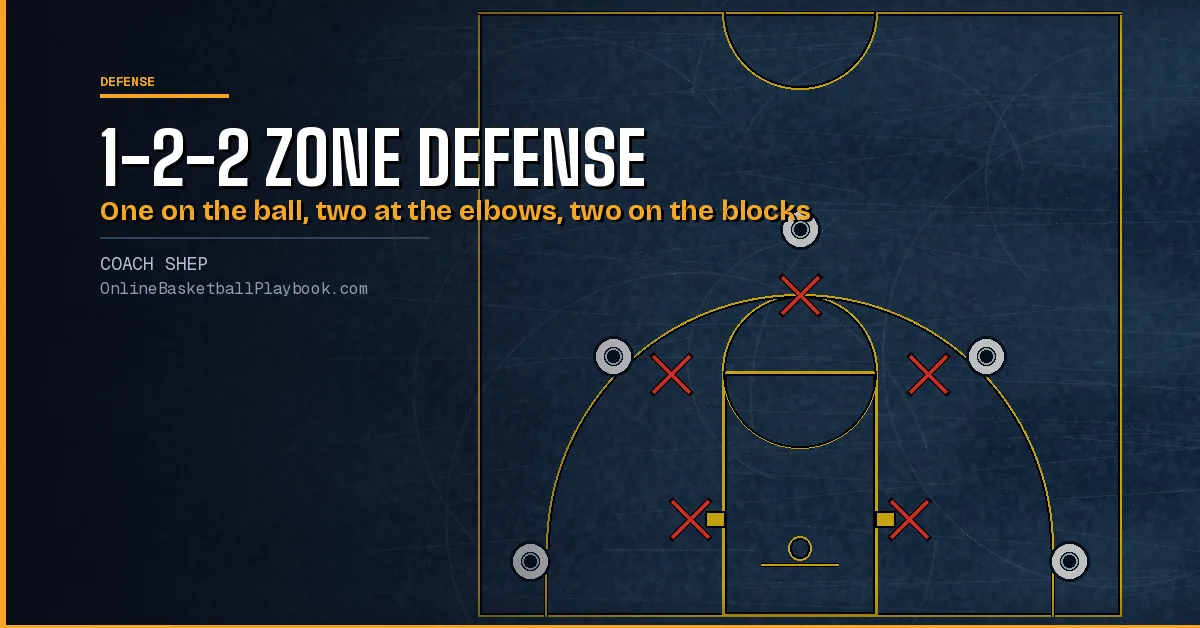
The 1-2-2 zone defense puts one defender at the top of the key, two at elbow height and two near the low blocks.
It is a relative of the 2-3 that gives up some inside strength so all five players can guard the perimeter. It is a good answer to a team that scores from the arc and is weak inside. This guide covers the roles, the rotations for every ball spot, the traps, the high post problem, the variations coaches run and the drills that install it.
The 1-2-2 at a Glance
| Spot | Starts | Main jobs |
|---|---|---|
| Top defender (X1) | Top of the key | Turns the dribbler to a side, then denies the high post whenever the ball is anywhere else |
| Wings (X2, X3) | Elbow height | Guard the high post while the ball is at the top of the key, guard the ball on their own wing, then choose a corner coverage |
| Posts (X4, X5) | Near the low blocks | Protect the paint, rebound, front the low post and close out on the corner |
1-2-2 Zone Defense Diagram and Roles

Every defender owns a piece of the perimeter, so closeouts are quick and every three can be contested. The cost is that nobody starts with a man to box out. A five-rule 1-2-2 runs on these:
- Hands up at all times, to keep the ball out of the paint and the high post.
- Move while the pass is in the air.
- Do not deny passes on the perimeter. Sag and take away the inside pass, much as the Pack Line does.
- Everyone finds a man to box out and then goes for the rebound.
- The bigs front the post when the ball is on their side, so they can reach the corner shooter quickly.
The top defender is the key player, and he needs to be athletic and smart. The top defender's spot suits a long athletic player, and the natural point guard can play a wing. The posts are unusual because they guard the ball in the corner, so they must front a low post and also defend one from behind.
The 1-2-2 is easy to confuse with the 3-2. The difference is the top defender's job with the ball at the top of the key. In the 1-2-2 he guards the ball and the wings protect the high post.
In the 3-2 zone he sags to the free-throw line to deny the high post, which helps against a team that feeds the high post but leaves the point guard open. The cautious approach plays the 3-2 only against a team that cannot shoot from the top of the key.
1-2-2 Zone Defense Rotations by Ball Spot
Ball at the top of the key. The top defender picks up the dribbler as he comes over half court and turns him to a side. Coaches differ on where:
- Deep pickup. Wait until the dribbler is about 2 to 3 meters outside the three-point line, so the offense cannot pass to the wing and into the high post right away.
- Arm's length. Pick up at about 22 feet, an arm's length away, allowing lateral passes but none over his head.
While the top man pressures the ball, the wings pinch toward the high post and the posts keep a foot inside the lane. Nobody pressures the pass to the wing, and the wings close out as the ball is in the air.

Ball on the wing. The wing on that side closes out at once to stop the open shot.
- Top defender. He drops to the high post in denial position.
- Weak-side wing. He sinks a couple of steps with one foot in the lane, which lets him pick off a skip pass and help inside.
- Strong-side post. He gets in front of the low post, since a post stuck behind cannot reach the corner.
- Weak-side post. He plays the split line in the middle of the lane, ready for a lob over the fronting post.
Ball in the corner. The strong-side post closes out with high hands and takes away the baseline, so a drive goes into the middle of the zone. The top defender keeps denying the high post. The weak-side post slides to the ball-side block without fronting, and the weak-side wing drops to the split line.
The strong-side wing has three options:
- Sag. Take away the pass into the lane, which lets the corner player pass back out to the wing.
- Hard deny. Deny the pass back to the wing, which puts pressure on the corner player but leaves a gap for cutters.
- Trap the corner.

Ball at the high post. The high post is the weakest area, so teams settle the answer in advance:
- Name a big to step up. Name the big before the game starts. He goes to the ball while the other big slides to the middle of the lane with his arms wide. The top defender can dig, but the wings do not pinch, because a wide-open three is worse than a long two, so make the opponent shoot a long two over an outstretched arm.
- Hand off the flasher. The posts carry a low post who flashes high to a set line and turn him over to the wings.

Ball in the low post. A fronted low post gets the ball only off a pass from the corner. The strong-side post digs while staying close enough to the corner shooter, and the weak-side post takes the ball. The weak-side wing covers the lane and watches for the skip, and the strong-side wing denies the pass back out.
Decide before the game who owns each rotation.
Defending Skip Passes
All five defenders play the perimeter, so skips are manageable.
- Run at the catch. On a skip from the wing to the corner, or from one corner to the other, the back-side wing runs at the catch from above to cut off the quick reversal. After a second or two the recovering post bumps him up and the zone returns to its base.
- Sprint the post out. When the ball is passed to the corner from the top of the key, the post sprints out to the shooter, so the posts must fight for position and keep a clear run. A smart offense screens the post as the skip is thrown.
- One voice on the ball. The defender on the ball yells "up," and two players never guard the ball at once.
Run at the catch and keep one voice on the ball.
Traps
The usual 1-2-2 trap puts two defenders on the ball and asks the other three to take away the next passes. The corner is the favorite spot because the sideline and baseline act as extra defenders. Coaches differ on how often to trap:
- Corner first. Trap the corner every time once players understand it, use the wing trap as a rare surprise and keep the top trap for a late steal.
- Cautious. Treat the wing trap as a gamble.
- Two settings. Play the same 1-2-2 two ways. The no-trap setting has no corner trap and the trap setting traps every time the ball enters the corner.

Corner trap. When the ball goes to the corner, the strong-side post and the strong-side wing close out together with high hands and no fouls. X1 shifts over to take away the return pass to the wing, and the back-side post plays half in front of any post on the ball side, while the back-side wing jumps the other two passing lanes.
Top trap. The top defender turns the dribbler to one side as he crosses half court. When the trap is called, the wing on that side races up to join him. The strong-side post sprints high to take away the first pass to the wing. The other two defenders read the pass and look for an interception.
Wing trap. It works best right after the ball comes back out of the corner. The strong-side wing and the top defender sprint at it while the strong-side post gets up in the lane to cut off the corner pass.
Tag each trap with a call. "On" means keep trapping after the first one and "off" means one trap and done. In the corner, top and wing traps, two defenders trap and three read. A post trap triple-teams a pass into the post.
Trap the corner and read with the other three.
Where Coaches Differ on the 1-2-2
Coaches disagree on the details of the same shape. Teach one answer, and know the others, because opponents and new players will show them to you.
Who closes out on a corner pass?
- The strong-side post. The other post rotates to the ball-side block (the most common answer).
- The 4 goes out. The 5 guards the post from three quarters baseline.
Where does the weak-side wing go on a corner pass?
- The split line.
- The weak-side low block.
- The weak-side baseline.
Who covers the high post?
- The top defender denies it. He denies it from the wing or corner, and a designated big steps up when the ball arrives.
- The defender at the top of the key protects it. The opposite wing covers it when the zone traps the wing.
- The posts hand off the flasher. The posts walk a flashing low post to a set line and hand him to the wings.
What does the strong-side wing do on a corner pass?
- Sag, hard deny or trap.
- Stay out. Stay out to bait a long skip, or drop to help against a strong low scorer.
- Deny the pass back out. Deny it, or sprint down to trap with the post.
Choose the answer to each question that fits your team.
Weak Spots and How Offenses Attack the 1-2-2
Three weaknesses of the 1-2-2 come up first:
- Rebounding. Nobody has a man to box out.
- The high post. A team that passes well and gets the ball there often can pick the zone apart.
- The corners. The posts have to guard the corners, which hurts if they move slowly.
The high post and the corners are named as the soft spots again, and the middle and the corners are the main holes in the 1-2-2 and 3-2 family.
Offenses attack with a few habits:
- Overload one side. The back line is thin, so overload one side, swing the ball two or three times before attacking and enter at the short corner.
- Seam first. Drive the middle seam first against a 1-2-2.
- Match the front. A team facing a one-guard zone like the 1-2-2 lines up in a two-guard front.
Read How to Attack a Zone Defense, How to Beat a 3-2 Zone and Drills to Teach Zone Offense to see what your players will face. For the box-out work that a zone needs, see Basketball Rebounding Fundamentals.
Know which hole the offense will attack and cover it first.
Get the next coaching guide in your inbox
One email when a new guide or diagram set goes up. Free.
Personnel and When to Play the 1-2-2
The 1-2-2 suits a team with strong guards and shooters that is weak inside. Its soft spot is the high post, so a team with a skilled high post is the hard matchup. It also works as an easy fast-break trigger, because the defenders start in break position, and as a late-game way to protect a lead against a team that has to shoot threes.
- Top defender. The most important player. A long, athletic player who can pressure the ball and deny the high post.
- Posts. They must front a low post, close out on a corner and rebound, which is hard for slow bigs. Use the 1-2-2 to keep the bigs near the rebounding area and let quicker players run the break.
Whether a zone should be your identity or a change-up is a real coaching choice. Read Man to Man vs Zone Defense for the wider question.
Pick the 1-2-2 for the opponent, not the other way round.
Variations of the 1-2-2 Zone Defense
Two Stay Inside. This variation keeps both bigs near the basket and sends the wings to the corners. On a corner pass the wing scrambles to close out and the other perimeter defenders rotate so someone always covers the high post. The posts never front. It is used only against teams that cannot shoot well, and a team that hits the corner three consistently makes it unusable.

Point Drop. Also called the sliding zone. It is played like the base zone until the ball reaches a corner, then the top defender slides down and fronts the post. That keeps the best athlete between the ball and the basket, lets the team front the post, puts a post on the split line and gives the weak-side wing the high post. It fits a team with a standout athletic defender at the top.
Matchup 1-2-2. Flip Saunders ran it as a matchup zone. The defender at the top of the key is the boss, and everyone else matches off where he lines up.
- Two-word language. Cutters get kick-down when a cutter goes in front and kick-back when he goes behind, and every cutter is switched.
- Front or three-quarter. Defenders front the post or play three-quarter, never leave a dribbler, and the four help defenders keep at least one foot in the lane.
- One reset call. Anyone who is confused calls it and the whole team returns to the base 1-2-2.
Read How to Coach a Matchup Zone Defense for the family.
As a press, or a 2-1-2. The 1-2-2 can turn into a 2-1-2 after the first pass, and the five spots already look like a press alignment. See the 1-2-2 press.
Other zone shells are worth comparing, including the 2-3 zone, the 1-3-1 zone and the 2-1-2 zone.
Pick the variation that fits your personnel.
Drills to Install the 1-2-2 Zone Defense
Teach it with man-to-man habits underneath it. A team which only drills rotation diagrams, and neglects ball pressure and boxing out, will fail. Jim Boeheim's 2-3 practice sets a zone block at 10 minutes of breakdowns, 10 minutes of 5-on-5 zone and then a scrimmage. Use the drills below as the breakdown part.
- Slides drill. Saunders introduces his 1-2-2 with the 1-2-2 slides drill on day one.
- Post flash and drive to the corner. The offense reverses the ball while a low post flashes high. The 2 and 3 must drive the ball handlers to the corner.
- Baseline to baseline. The 4 and 5 go baseline to baseline, fight over screens and deny the low post.
- Post-trap 4 on 4. Saunders runs 4 on 4 with one post player. The perimeter cannot dribble, so it can pass inside out or shoot threes. The defense scores a point per trap, and the drill can be timed. It works on post-trap footwork.
- Down-screen closeout. A 4-on-4 drill where a defender touches the coach's hand and then closes out, so he learns to open to a teammate on a down screen and close out without getting screened.
Do the breakdowns first, then go live.
For rotation work that carries to any zone or man scheme, see Drills to Teach Help and Rotation.
Questions Coaches Ask About the 1-2-2 Zone Defense
What is a 1-2-2 zone defense?
A half-court zone that puts one defender at the top of the key, two at elbow height and two near the low blocks. Every defender guards an area of the perimeter, and the posts also close out on the corners.
What is the difference between a 1-2-2 and a 3-2 zone?
The top defender. In the 1-2-2 he guards the ball at the top of the key and the wings protect the high post. In the 3-2 he sags to deny the high post, which leaves the point guard open.
What is the weakness of a 1-2-2 zone?
The high post, the corners and rebounding. The posts have to guard corners, and with no assigned man everyone has to find someone to box out.
What are the rotations in a 1-2-2 zone defense?
The five defenders move with the ball. The top defender denies the high post when the ball is on a wing or in a corner, the nearest wing closes out on a wing pass and the nearest post closes out on a corner pass. The weak side sinks toward the lane.
Can you trap out of a 1-2-2 zone?
Yes. The corner is the usual trap spot, and the top and wing traps are used less often. Programs trap every corner pass or not at all.
The 1-2-2 is one of several zones in the types of defense guide, and the Defense hub lists every defensive page on the site.
Want the printable playbook packs?
OBP Pro members get the premium playbook packs: the zone attack, out of bounds and practice plan PDFs, plus each new pack as it is finished. The membership page lists what is in each one. Or draw your own version free in PlayDraw.
See what OBP Pro includesMore Guides From This Batch
- Basketball Passing Drills for Beginners and Full Teams
- 2-2-1 Press: Setup, Traps, Rotations and Drills
- Basketball Practice Plan: Template, Youth Plans and Examples
- Technical Foul in Basketball: Rule, Penalties and Calls by Level
Back to Types of Defense and every Defense page.
Keep Building
Related breakdowns
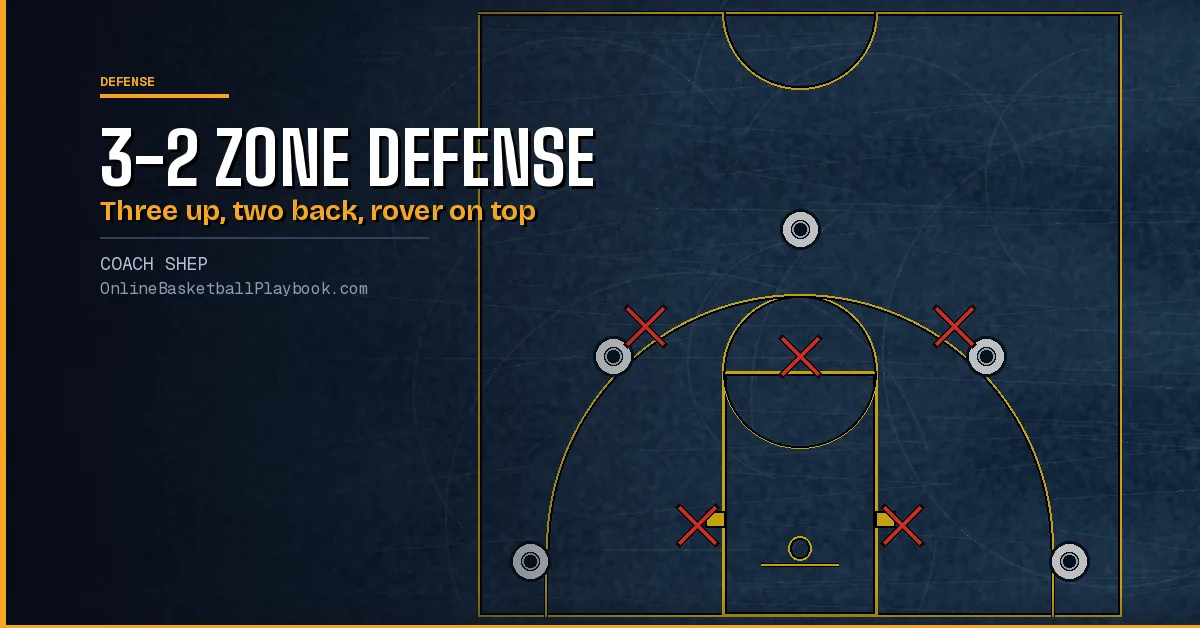
3-2 Zone Defense: Rotations, Weak Spots and Drills
How to run the 3-2 zone defense: the alignment, the rover, every rotation, the weak spots, the 3-2 matchup zone and the drills, plus when to pick it over a 2-3.
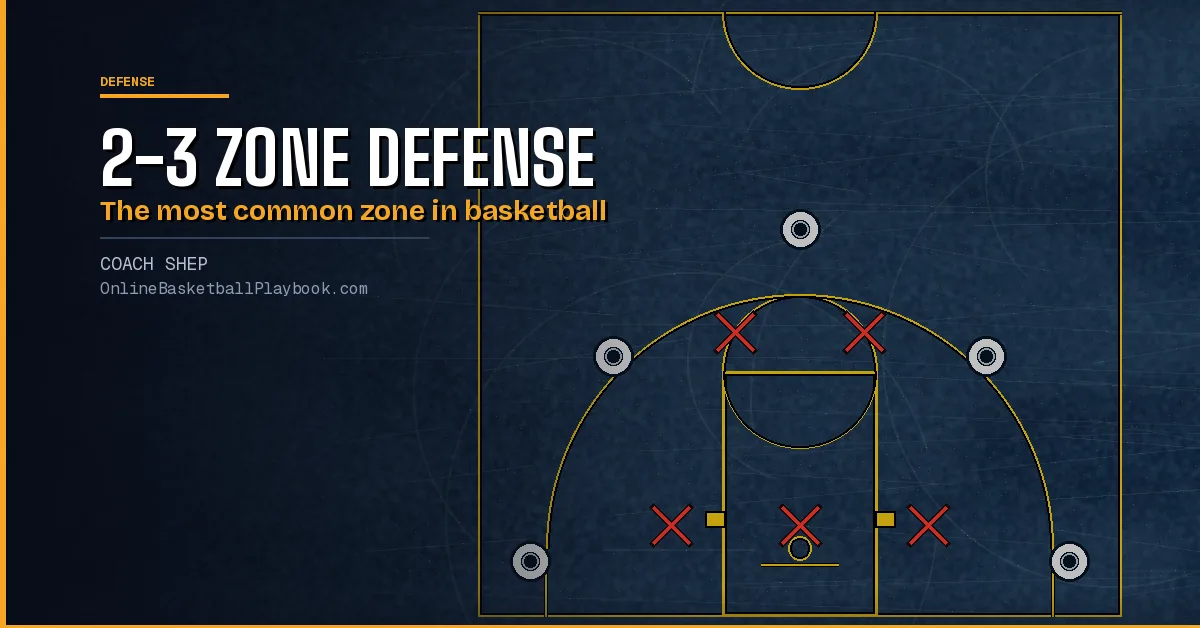
2-3 Zone Defense: Rotations, Weak Spots and Drills
How to play the 2-3 zone defense: the starting positions, how it shifts to the ball, where it leaks, when to trap, and the drills that install it.
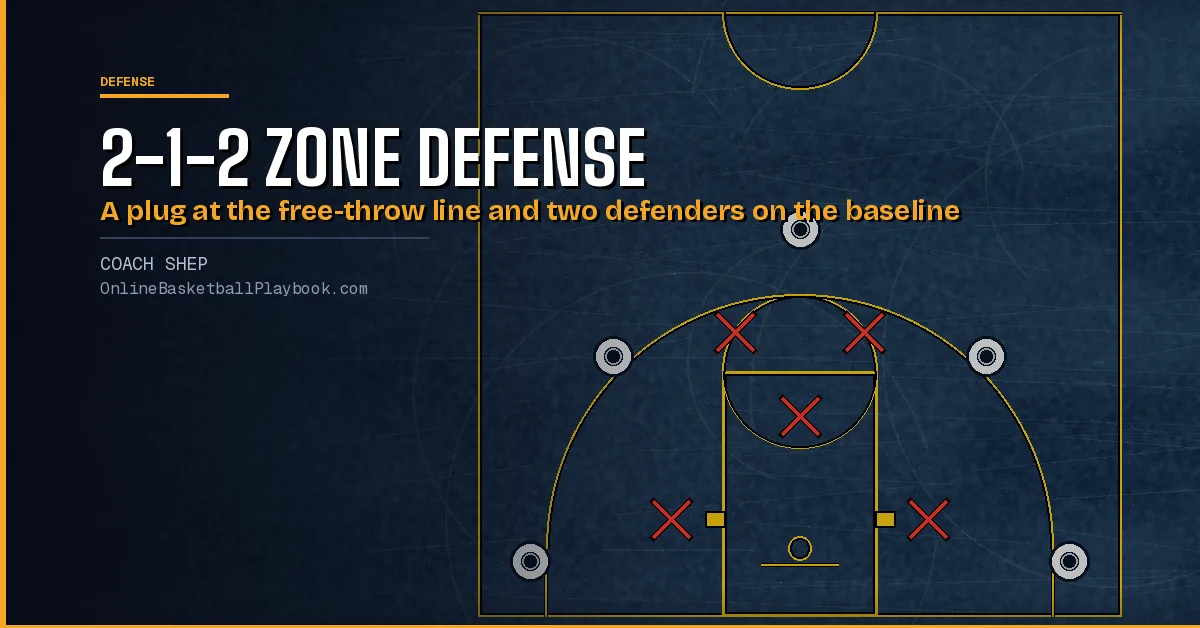
2-1-2 Zone Defense: Rotations, Weak Spots and Personnel
2-1-2 zone defense guide with the alignment, rotations by ball location, how it differs from the 2-3, who plays the middle and its weak spots.