1-3-1 Baseline Out of Bounds Defense in Basketball
Coaching

1-3-1 Baseline Out of Bounds Defense in Basketball

A practical coaching breakdown for your next practice.

By Coach Lee DeForest · Published June 29, 2026 · 14 min read
1-3-1 Baseline Out of Bounds Defense in Basketball

1-3-1 Baseline Out of Bounds Defense in Basketball

Baseline out of bounds plays are scoring opportunities — unless your defense has a plan. The 1-3-1 zone gives you a ready-made structure to deny the easy catch, trap the corner entry, and turn a routine inbound into a scramble the offense was not ready for.

Why the 1-3-1 Works Against Baseline Out of Bounds Plays

Most baseline out of bounds (BLOB) defenses are built around man-to-man principles — a defender on each cutter, a guard trailing the ball handler, and someone responsible for the inbounder's first option. That works until you face a team that runs slick screening actions off the baseline: double stacks, zipper cuts, and flare screens that free a corner shooter in under two seconds.

The 1-3-1 zone changes the math entirely. Instead of chasing specific players, you are loading the zones those players want to occupy. A team running a corner-fade for their best shooter finds that the baseline defender (X5) is already there. A team looking to dump the ball into the short corner high-low finds the middle defender (X4) positioned to front or contest. The offense is not just being contested — they are being channeled into the defense's preferred trap spots before a single screen is set.

The zone's architecture was built for this moment. The 1-3-1's baseline defender is specifically trained to cover corner-to-corner, and the wing-baseline trap is the zone's highest-percentage turnover creator. A BLOB situation removes transition concerns and gives your defense a stationary starting point — which is the best possible condition for setting a trap. You know exactly where the ball starts. You set your zone accordingly. The pressure begins from the whistle.

There is a structural bonus too: the 1-3-1 produces fewer fouls per possession than man-to-man. Baseline sets frequently put defenders in scramble mode against screens, creating foul trouble on calls for over-the-back contact or hand-checking a cutter. The zone removes most of that risk by assigning space rather than players. Kankakee Community College ran the 1-3-1 as their primary defense for 12 years and attempted 227 more free throws per year than their opponents — zone structure protects your players from foul trouble when it matters most.

Initial Alignment: Setting the 1-3-1 on the Baseline

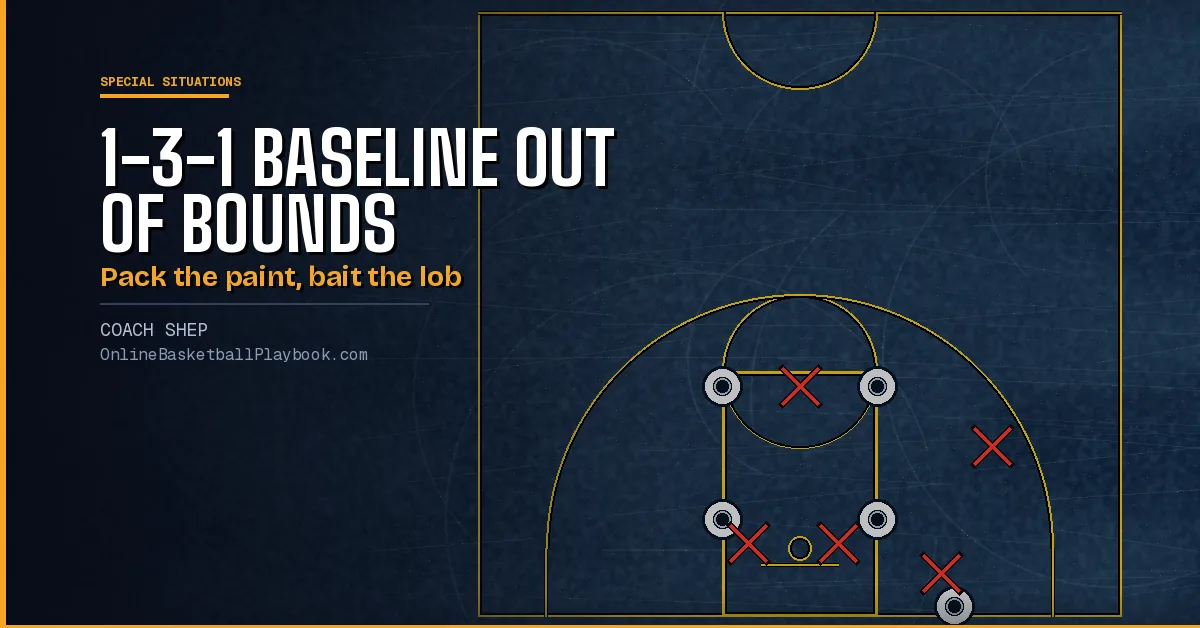
The moment the referee hands the ball to the inbounder, your 1-3-1 must already be set. There is no time to organize after the whistle — baseline plays are designed to score in the first two seconds, and a disorganized defense gives them exactly that window.

Set up as follows from the inbound line inward:

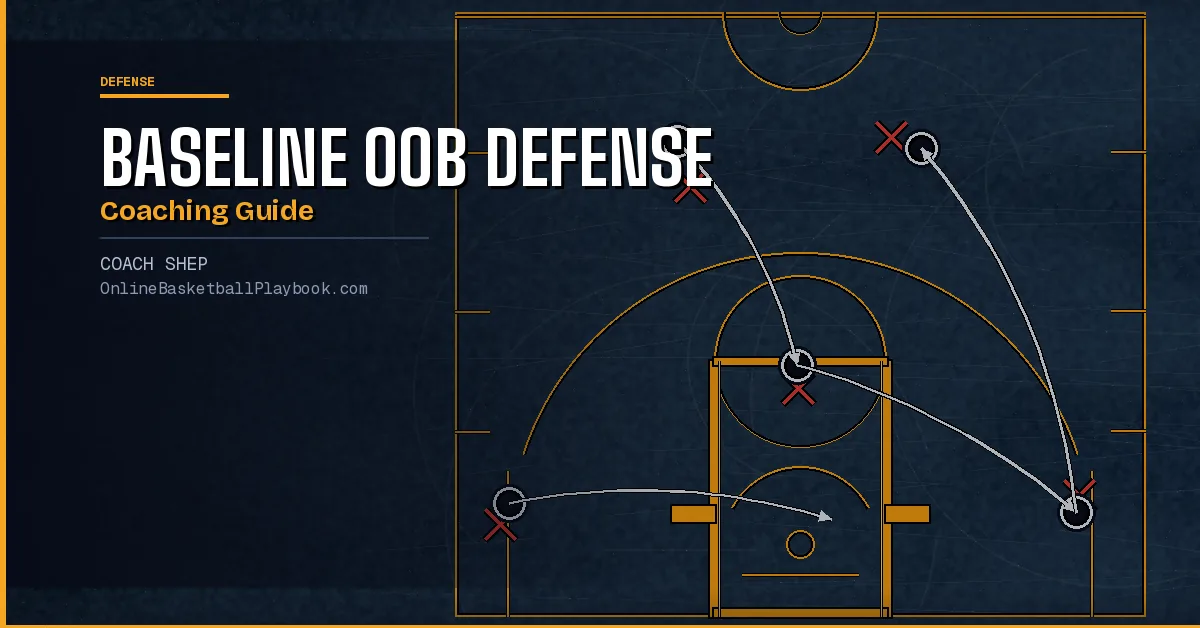
X5 (Baseline Defender): Positions one step inside the paint, reading the inbounder's options. X5 must not commit to either corner early. The baseline defender's job at the start is to be in neither corner so that the initial pass does not immediately free a shooter. Stay central, read the inbounder's eyes, and be ready to sprint left or right the moment the ball is released.

X2 and X3 (Wing Defenders): Positioned at the elbows, roughly at free-throw line extended. Their first responsibility is to deny a catch at the mid-range wing area — the most common first option in BLOB plays that clear a shooter to the elbow. Wings must watch the inbounder while also tracking the cutter nearest their zone.

X4 (Middle Defender): Stands at the free-throw line, facing the ball. X4 is the zone's engine and must be ready to rotate toward a high-post catch, a corner skip, or a dump-in to the short corner. Do not let X4 drift below the block before the ball enters — staying high keeps the skip-pass passing lane more difficult for the offense.

X1 (Point Defender): The tallest available guard, positioned at the top of the key. On a baseline inbound X1's role shifts slightly from the half-court read: instead of denying guard-to-guard reversal, X1 is protecting against a quick outlet to the arc if the inbound pass goes to a wing or guard and the offense immediately tries to reverse the ball. X1 also provides the secondary layer if the inbound pass travels to the elbow before the wings can rotate.

Assignments and Responsibilities During the Inbound

The inbound pass itself triggers your coverage rules. Each defender has a specific read the moment the ball leaves the inbounder's hands.

X5 — React to Ball Side

As soon as the inbound pass is in the air, X5 sprints to the ball-side corner. The baseline defender's initial neutral position now resolves — go to the ball. If the pass goes to the right wing, X5 is already moving right. The goal is to be in the corner before the ball arrives there on a skip or a second pass. If the inbound lands directly in the corner, X5 must get there in time to be the first trap body alongside the ball-side wing.

Ball-Side Wing — Close Out and Contain

The wing on the side of the inbound pass closes out on the first receiver. The close-out is not a full sprint fly-by — stay under control, hands up, and force the receiver baseline if possible. Forcing baseline keeps the ball moving toward X5's corner trap zone rather than the middle. The ball-side wing must not lose body position chasing a cutter behind them. Zone reads mean you defend the area, not the person.

Weak-Side Wing — Crash to Paint

The wing away from the inbound drops into the paint to deny any high-low entry. This is non-negotiable: both wings cannot go to the ball simultaneously. If the ball-side wing closes out and the weak-side wing stays at the elbow, a short-corner cutter catches unguarded. The weak-side wing's interior rotation also discourages the most dangerous pass in any baseline set — the quick dump inside to a sealing big.

X4 — Read High Post and Skip Lane

X4 watches the inbounder's eyes during the delivery and immediately identifies the high post. If a cutter occupies the elbow zone, X4 must deny that catch. After the initial inbound settles, X4 transitions to reading ball location and anticipating the corner-to-elbow skip. The middle defender is the zone's swing player — able to cover the most territory, but only if they resist the temptation to ball-watch.

X1 — Hold the Top, Anticipate Reversal

X1 stays above the arc and reads whether the ball is moving toward a reversal situation. If the inbound goes to a wing and the wing immediately looks to reverse to the top of the key, X1 is in denial position. Against a well-organized baseline offense that inbounds to a guard at the arc, X1 closes that catch and forces the weak hand — the same directional pressure used in half-court coverage.

Corner Trap Trigger and Rotation Rules

The corner entry is the 1-3-1's primary trap trigger in any situation — on a BLOB, it is even more predictable because many baseline sets are designed to put the ball in the corner as a second-pass option. When the ball enters the corner, the defense executes the corner trap immediately.

Trap personnel: X5 and the ball-side wing trap hard — two defenders on the ball, arms up, no easy passing lane. The explicit rule from the Kankakee system: "lock the legs." The second defender steps into the ball-handler's legs to prevent a live dribble escape. This is not a soft hedge. It is a committed trap.

X4's rotation: The moment the trap is set, X4 rotates to deny the first skip-out to the strong-side elbow. This is the most dangerous pass coming out of the trap — a corner-to-elbow skip before X4 arrives is an open mid-range shot. X4 must beat the skip pass, not react to it. Move on air time: when the ball goes to the corner, X4 is already moving toward the elbow.

X1 and weak-side wing: Both defenders sprint to the nearest open pass lanes. They do not stay at their zones once the trap is set. The two perimeter defenders who are not trapping are now interceptors — they read the ball-handler's eyes and position to cut off the most likely outlets. The weak-side wing covers the opposite corner; X1 covers the arc reversal.

X2 communication: The ball-side wing who is involved in the trap must communicate "ball" loudly so that X4 and X1 know the trap is fully committed. Any hesitation in this call leaves the rotation incomplete.

The middle must be strong enough to front post entries and mobile enough to stunt at the wing in a trap. This is not a rest position — it is the zone's engine.

— one-three-one-zone, Basketball Vault

Stopping the Most Dangerous Pass: The Corner-to-Elbow Skip

Every coaching source on the 1-3-1 zone identifies the corner-to-elbow skip pass as the defense's single greatest vulnerability. On a BLOB situation, that danger doubles: the offense has a set play designed around exactly this pass. They know the corner trap is coming. Their play may be specifically drawn up to use the trap as a screen — the corner player receives, draws two defenders, and immediately skips to a shooter at the elbow who catches and fires before X4 arrives.

Stopping this pass is a team-wide priority, not just X4's job.

The X4 pre-read: Before the ball enters the corner, X4 should already be tracking which player is stationed at or moving toward the elbow. That is the skip target. X4 does not wait for the corner catch to begin rotating — the rotation starts the moment the ball-side wing begins closing out on the corner entry. If X4 moves on air time, they can arrive at the elbow before the skip arrives.

Weak-side wing responsibility: The weak-side wing is also a skip-pass threat if the offense has a shooter on the perimeter away from the trap. That defender cannot drop entirely into the paint if a dangerous perimeter player is standing at the wing. Read the floor: if the offense has no threat in the weak-side corner, stay interior. If they have a shooter there, maintain a passing-lane denial position.

X1's elbow awareness: The point defender must maintain awareness of the high-elbow zone even while managing reversal reads at the top. If X4 has been pulled toward a short-corner cutter and the elbow opens, X1 drops to contest rather than staying anchored at the arc. This requires verbal communication — X4 calls "I've got short corner" and X1 knows the elbow becomes their responsibility.

Practice the skip from the offensive side first: The most effective way to teach defenders to stop the corner-to-elbow skip is to run it against them repeatedly in practice. Have the offensive group execute the corner catch and skip pass until the defense has felt where they were too slow. That physical memory translates directly to faster rotation reads in games.

The corner-to-elbow skip pass is the single highest-priority outlet in the 1-3-1 trap — every defender on the floor must know which player covers that elbow the moment the ball enters the corner, or the defense is already beaten before the trap is fully set.

Personnel Decisions for Your 1-3-1 BLOB Defense

The 1-3-1 is not a personnel-neutral zone. Who you put at each position determines whether the defense generates turnovers or gives up wide-open looks. On a baseline out of bounds, where the offense has a set play and your coverage must be organized before the whistle, getting the right player to the right spot matters even more than it does in half-court coverage.

X5: The Most Vocal Guard, Not the Most Athletic

The baseline defender's job on a BLOB is to read corner-to-corner movement while calling out what is in front of the whole defense. Athleticism helps — you need to cover corner-to-corner — but a player who cannot communicate loudly and accurately will break the rotation even if they are fast. Put the best floor-reader and the best talker at X5. On younger teams, this is often a wing who thinks well but does not yet have the vertical or strength to play at the post.

X4: The Zone's Engine Has to Be Physical

The middle defender on a BLOB must be strong enough to front or contest a post player catching in the paint, quick enough to stunt at the wing during a trap, and smart enough to pre-read the skip-pass destination before it is thrown. Against an opponent that targets the high post in baseline sets, X4 is the most critical matchup decision you will make. If your X4 cannot guard a post player and close to the elbow in the same possession, the 1-3-1 will get exploited repeatedly at that spot.

X1: Tallest Guard Available

The point defender needs length to deny the reversal outlet and to contest lob attempts over the top. On a BLOB, the inbounder occasionally looks for a lob catch at the arc if the defense crashes the interior — X1's height and arm length makes that a less attractive option. A guard without length at X1 leaves the top of the zone penetrable.

Wings: Your Best Athletes Cover the Most Ground

Wing defenders on a BLOB are covering elbow-to-corner range in two directions: closing out on the initial receiver, then potentially sprinting to the corner trap, then recovering to the elbow on a skip. This is the most physically demanding rotation in the 1-3-1 on a BLOB rep. Put your two most athletic perimeter defenders at X2 and X3. They must move on air time — every catch-to-pass sequence where a wing is still arriving rather than already there is a potential breakdown.

Coach Note

Before any game where you plan to run the 1-3-1 as your primary BLOB defense, walk your X5 through the specific baseline set your opponent runs most frequently. If they have a corner-fade for their best shooter, X5 needs to see that action on film and know the timing before tip-off — not figure it out during the game's first possession.

Adjustments by Opponent and Situation

The 1-3-1 BLOB defense is not one-size-fits-all. Different opponents expose different parts of the zone, and the best coaches adjust the depth and aggressiveness of the trap based on what the offense is putting on the floor.

Against a Three-Point Shooter in the Corner

If the opponent's BLOB play is designed to curl a three-point shooter into the corner as the primary option, you have two choices: let X5 contest and accept the physical mismatch, or call the Tight setting — extend the wings and X5 closer to the three-point line to deny the catch entirely. The Tight adjustment extends your perimeter coverage but creates more interior vulnerability. Use it only when the corner shooter is the most dangerous offensive player and you cannot afford to give up that shot late in a game.

Against a High-Low Post Action

Some baseline sets are designed to post up a big player at the block and feed them off a quick inbound. The 1-3-1's X4 is the primary defender against this action, but the wing and baseline defender must both provide support. If the opponent's post player is significantly stronger than your X4, call the Drop adjustment — pull the zone back to inside 15 feet, concede the perimeter, and protect the paint. This is the Potsdam "Drop" variation: trade the trap for interior safety when a physical mismatch exists.

End-of-Game Situations

When a team needs a quick score off a baseline inbound late in a game, the 1-3-1 BLOB defense has an advantage: the offense must execute their set perfectly under pressure, and your trap forces a time-consuming escape sequence even when it does not produce a steal. Every second the offense spends trying to exit a corner trap is a second off the shot clock. When you are protecting a lead and the opponent calls a timeout to draw up a BLOB play, setting the 1-3-1 immediately after the timeout tells the offense their play must be run into a trap structure — that mental pressure alone causes mistakes.

When to Switch to Man-to-Man

The 1-3-1 is not the right call for every BLOB situation. If the opponent has a player who is a genuine low-post threat and your X4 is not physical enough to front them, a matchup zone or a switch to man-to-man with your best post defender protecting the block may be the stronger choice. Know your personnel's limits. The 1-3-1 is a higher-variance defense — it generates more turnovers than a 2-3 zone but also gives up more easy catches when rotations break down. Budget for that outcome and make the call based on what your five defenders on the floor can actually execute in the moment.

  • Set the zone before the whistle. X5 central, wings at elbows, X4 at free-throw line — every defender in position the moment the referee hands the ball to the inbounder.
  • X5 reads the inbounder's eyes, not the cutters. Where the inbounder is looking tells you where the first pass is going; react to that read rather than chasing a specific player's movement.
  • Ball enters the corner = full trap, immediately. X5 and ball-side wing trap hard with "lock the legs"; X4 sprints to elbow; weak-side wing and X1 sprint to nearest pass lanes — no hesitation.
  • X4 moves on air time, not on the catch. When the ball-side wing begins their close-out to the corner, X4 is already rotating toward the elbow skip lane — arrive before the pass, not after it.
  • Communicate "ball" loudly when the trap is set. The call tells X4 and X1 the trap is committed and their rotation is live — silence at the trap means the rotation does not happen cleanly.
  • Practice the skip from the offensive side. Run the corner-to-elbow skip against your own 1-3-1 in practice until defenders physically feel the rotation timing they need to close it down in games.

Want more basketball coaching strategies and drills?

Join the Online Basketball Playbook newsletter →

1-3-1 Zone DefenseBaseline Out of BoundsBLOB DefenseZone Defense BasketballBasketball CoachingDefensive Strategy