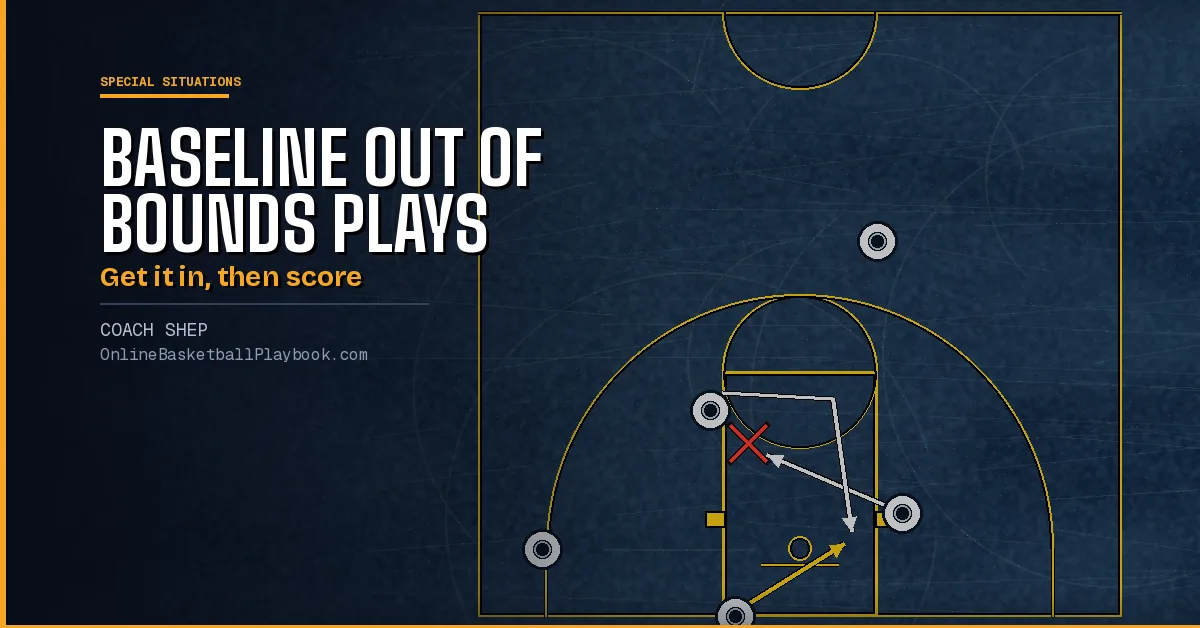
Baseline out of bounds plays (BLOBs, also called BOB or UOB plays) are the called possessions that start with a throw-in from under the basket you are attacking. The ball starts a few feet from the rim, the floor is short, every cut goes straight at the basket, and the inbounder has five seconds to pass. Coaches use them after a foul, a violation, a timeout or any other whistle in the frontcourt.
Find any out-of-bounds play by formation in the play finder.
This guide draws the plays step by step: two box plays, a screen-the-screener play, a double stack, a play against the 2-3 zone and the one-pass youth plays. It also covers who inbounds, the automatic reads, the rules by level, clock and score, and how coaches practice them.
Sideline plays have their own page at sideline out of bounds plays, and both sit under basketball inbound plays in the special situations section.
Baseline plays on game film
Each page pairs the possession with a numbered animation and an editable play download.
- Duke Loop Lob vs. USC Upstate
- Arizona Stagger and Corner Pick and Roll vs. Dayton
- Michigan Loop, Handoff and Flare vs. Maryland
- Auburn Four-Low Slip vs. Ole Miss
- Indiana Box Loop vs. Southern Indiana
Get It In or Score
Both philosophies are on record. Some coaches want the ball inbounded safely before they set up, and others treat every out-of-bounds play as a scoring chance because most teams defend them poorly.
- Safe first. Design the plays to secure the inbound first and the score second, and go into the regular offense if the quick look is not there.
- Score or hold. If the look is not there, do not throw it, and run a double reverse into a ball screen instead.
- Ask the goal first. Ask first whether the goal is to inbound or to score.
- Baseline for relief. Frame baseline plays as pressure relievers and sideline plays as scoring plays.
- Baseline for scoring. Value the baseline play for the opposite reason: the ball starts near the basket with a known shooter in a known spot.
At the youth and high school levels, a good inbounds pass matters more than forcing the scripted look.
Decide which goal this call serves before you draw it up.
The Inbounder and the Automatic Reads
The throw-in is five against four with five seconds and a passer who cannot move from his spot.
- See the whole floor. The inbounder must see the whole floor and throw sharp passes, never a one-handed or soft bounce pass.
- Pick him for passing. Pick the inbounder for passing and quick reads, sometimes for the size to see over defenders.
- Deceive. The inbounder's keys are deceptive eyes, pass fakes, a primary and a secondary read, and some acting before the ball is live.
Who takes it out depends on the play:
| Play | Who inbounds |
|---|---|
| Three-point plays | The best three-point shooter |
| Tom Izzo's Screen the Inbounder | The best low-post scorer |
| Last-second lob plays | The best leaper or finisher |
| Scoring-inbounder sets | The best scorer |
| 4-flat sets and other guard-inbounds sets | The point guard |
| Youth one-pass plays | The 4, always |
| A baseline cross-screen play | The best decision maker |
Under every call sit a few automatic reads, signaled with eye contact and body language instead of a call.
- Cut straight to the basket. A player whose defender has his back turned while watching the ball cuts straight to the basket.
- Give and go. An unguarded inbounder means a give and go.
- Lob over the defender. A defender who faces up on his man with his back to the passer gets the lob thrown over him.
- Bounce off his back. A fourth read is a pass bounced off an inattentive defender's back.
Teach the reads until they happen without a call.
Rules That Shape Every BLOB
- Five seconds to release the ball. NCAA men: a throw-in violation if the thrower-in consumes more than five seconds (Rule 9-4.1.d). NCAA women: the violation is consuming five seconds (Rule 9-4.1.d). NBA: release within 5 seconds of receiving and controlling the ball (Rule 8, Sec. III(a)). FIBA: no more than 5 seconds to release (Art. 17.3.1). High school: check your state association rulebook.
- Three seconds during the throw-in. NCAA men and NCAA women: the three-second rule is not in effect while a team is in control of the ball for a throw-in (Rule 9-9.2.a in both books), which is why posts can set up in the lane before the ball comes in. For other levels, check your league or state association rulebook.
More throw-in rules are on basketball out of bounds rules.
Know your level's clock rule before you draw up a play.
Baseline Out of Bounds Plays by Alignment
Most baseline plays start from one of a handful of shapes. A large set of about 90 man-to-man plays sorts into box, line or stack, triangle or diamond, and random families, with the advice to teach the shell first.
| Alignment | What it gives you |
|---|---|
| Box | Two blocks and two elbows. A back screen for a lob, a stagger for a shooter, a cross screen for a post and a step-in for the inbounder, all from one picture |
| Stack or line | Players stacked under the basket or along the lane. The first players peel to pull defenders, the next cutter takes the gap, the last drops back as the safety |
| 4 low or 4 flat | Four players along the baseline or the blocks, with the post sealing and screening for the corner players |
| Triangle or diamond | Three players in a triangle with the ball on the baseline, aimed at the middle seam of a packed defense |
| T set | One alignment with four reads: lob, pin screen for a shot, post entry and a screen for the inbounder |
Running several calls from one shell keeps the defense from reading the play off the setup.
- Extended box. Run all three baseline plays from one fixed extended box. More box calls are on box set inbound plays.
- One youth box. Start every set from the same box.
- 4 flat. Run every baseline play from a 4 flat with the point guard inbounding and name each play for the player who sets the screen.
- Match your base offense. Match the plays to the starting formation of your base offense so the setup gives nothing away.
Teach the shell first, then hang the calls on it.
Box Plays
Box Back Screen and Roll
The two posts, 4 and 5, line up at the ball-side low block and elbow, and 1 and 3 take the weak-side elbow and block, 1 high and 3 low. 2, a good passer and shooter, inbounds.
- Screen and cut. On "go," 4 sets a screen for 5, who cuts to the opposite block.
- Seal and roll. 4 then seals the defender he screened and rolls to the rim for the pass and layup. 2 can hit 5, and if the defense switches the screen, 4 should be the open man.
- Weak side. 3 cuts around 1's screen and moves out to the top of the key, and 1 cuts to the weak-side corner or V-cuts back to the elbow.
- Look for a three. If nothing is open inside, look for a three from 1 or 3.

Box corner three uses the same setup and the same screens and cuts, with a different finish. This time the target is a three for the inbounder. 2 passes out to 3 at the top of the key, V-cuts toward 5, then cuts quickly to the ball-side corner, and 3 passes to him for the corner three. One alignment, two final reads.
Pick the Picker
Call "Box." 5 inbounds, and he yells "go" to start the action. 3 V-cuts in, then drops back out as the outlet and the safety. 2 sets a screen for 1, who cuts to the corner and shoots if he gets the ball there.

Then the second screen: 4 comes over and screens for 2, the player who just set the first screen, and 2 sprints to the rim down the left side of the lane for the layup. If the two inside defenders switch that second screen, 4 seals the defender who switched onto him and rolls to the right low block for the pass.

Screen the Inbounder
Tom Izzo's Michigan State baseline package includes a play that uses the inbounder as the scorer. The best low-post scorer takes the ball out, a teammate screens for him after the pass, and he cuts around the screen for an inside shot, with a down screen into the corner for a three as the second action. Screening for the inbounder after the pass is the most repeated way plays use him.
Stack and Line Plays
A small package runs from a stack, and more are on stack inbound plays:
- Stack split. Four players line up in a stack. The top two, both shooters, split right and left to draw their defenders, and the third player in line slips into the space they left for the layup. The fourth drops back as the safety.
- Stack triple screen. 1, 2 and 4 set a triple screen while 3 cuts out to the short corner for the shot. 5 breaks weak side for the rebound, and 4 slides out to the top of the key as the safety once the shot goes up.
- Lane-line rub. From the lane line opposite the ball, 2 and 3 cut to the ball-side corner and short corner to pull their defenders away. 5 screens X4 as 4 fakes a cut and rubs off the screen for the pass and layup, and 5 slips the screen if X5 switches onto 4.
Double stack. The two posts stack on the low blocks with the two best shooters behind them. 4 cross-screens for 5, and 5 comes across the lane for a power layup. 4 seals X5, and if the defense switches, 4 should be open. 1 and 2 V-cut to the corners for a three, and whichever guard does not get the pass cuts out to the top of the key as the safety.

Get the next coaching guide in your inbox
One email when a new guide or diagram set goes up. Free.
The Actions Inside the Plays
Strip the names off and the same few actions repeat across many plays.
- Screen the screener. The most repeated action. One design rule is that after the cutter uses the screen, the screener is screened right away, so the inbounder almost always has two looks. Use baseline plays to teach screening, and run screen the screener for your best post and best shooter.
- Back screen for the lob. With the ball a few feet from the rim, a back screen for a big is the first look in many plays, often with a decoy cut first to pull help.
- Stagger, triple or elevator for the shooter. Multiple screens on one shooter for the three, the repeated answer when the offense needs three and the defense knows it.
- Cross screen and seal. A cross screen for the strongest post, with the screener sealing if the defense switches.
- The switch read. Nearly every play writes in the answer to a switch: the screener seals the smaller defender and rolls, or slips the screen before contact.
- Call it again. Call every counter "[play] again," so the defense sets up for the first action while the counter runs.
- Rename the play. Give an identical play a new name so a scouting opponent cannot match the call.
The screens themselves are taught on basketball screening technique and elevator screen. The baseline play can also be the first action of the offense, flowing straight into a ball screen, a hand-off or motion.
Learn the few actions, and every play is a variation.
Baseline Out of Bounds Plays vs 2-3 Zone
Against a zone, the job is to pull one low defender out and make him choose. More zone calls are on inbound plays against a zone.
- Seam flooding. Put two cutters in adjacent gaps so the help defender cannot cover both.
- Screen and seal. Screen a specific zone defender and seal another, then read the defender who is left.
Izzo's Screen the Inbounder carries a zone answer of this kind, with the screener taking the middle low defender instead of a man.
Seal and corner run is a screen-and-seal play against the 2-3. 5 lines up above the blocks between the two low defenders on the ball side, X4 and X5. 4 stacks outside X1, the ball-side top defender, and 1 and 2 form a mini-stack above X1. On "go," 5 seals X5 while 2, the best shooter, cuts around 4's screen to the ball-side corner for the catch and shoot. 1 drops back toward half court.

If X4 steps out to cover 2 in the corner, 4 slides down the lane into the gap he left for the inside pass and shot. Either 2 in the corner or 4 sliding down is open, two offensive players against one defender.

Build calls to work against man or zone, and read man or zone before the ball is handed over, which is one key to every out-of-bounds play. A broader menu against this defense is on how to beat a 2-3 zone.
Make the low defender choose.
Simple Out of Bounds Plays for Youth Basketball
Complex plays with several screens and a pop-out three may work at higher levels but are too hard for young players. The goal is one pass and an open layup, and the plays are called by a player's name.
Box. The called player stands on an elbow, and the 4 always inbounds.
- Cut hard on the slap. Everyone cuts hard when the 4 slaps the ball.
- Cut directly. The called player may step back or outside first, then cuts directly to the basket, not in a circle.
- Look outside. The inbounder looks hard to the outside, not at the lane, so his defender leans toward the near corner.
- Square up. The catcher squares up with no dribble, takes a 45-degree angle and uses the backboard.
- Second option. If he is not open, the inbounder has two strong-side teammates and one on the weak side.
- Pick the player. Call it for a player whose defender is not sagging or watching the ball.
Line. Four players straddle the free-throw line facing the ball. On the slap, three cut hard away toward center court, while the called player may take one step back, then goes straight to the basket for the layup. Let the defenders squeeze between the players, and do not curve the cut.
Rack. Four players stack on the weak side and the called player is the 5. On the slap all cut hard to the other side of the lane, with the 5 a step early. He touches the far lane line and cuts directly back off a teammate's hip, which catches his defender on what becomes a three-player screen. The inbounder ball-fakes outside to make his defender reach.

Show secondary options only after players run the primary ones well. Caps on the number of plays:
- Four plays. A good number for grade school and middle school teams.
- Three to four in total. For youth teams.
- Two per configuration.
- A short menu by defense. A couple of plays against man, one or two against zone and a sideline play for youth.
More youth material is on coaching youth basketball. Keep it to one pass and an open layup.
Clock, Score and the Safety
The clock and the deficit pick the play. File last-second plays by the shot needed, two or three, before anything else. Plays for under a second are a catch and shoot or a lob off the inbound pass, because there is no time to dribble. Two planning grids:
- Three bands by spot. 0 to 3, 4 to 8 and 9-plus seconds, a prepared play for each inbound spot, with a 2-point and a 3-point option.
- Time crossed with spot. 1 to 3, 3 to 6 and 6 to 12 seconds crossed with the inbound spot. The baseline column calls a set baseline play, with the number of passes set by the time.
How the play starts splits three ways.
- Slap start. Everyone cuts when the inbounder slaps the ball.
- No-slap start. The count starts when the official hands over the ball, so a slap wastes time.
- A player's call. A player calls it, such as a post yelling "go."
A safety on every call.
- Safety near the top of the key. Build a safety receiver, usually deep near the top of the key, into every play, because opponents scout the primary options as the season goes on.
- Safety in the corner. Park the safety in the half-court corner where the inbounder can see him.
Late-game plays are collected on inbound plays for clutch situations and end of game situations.
One-shot baseline and sideline sets with under two seconds left are on buzzer beater plays.
Let the clock and the score pick the play, and keep a safety on every call.
How Coaches Practice Them
- An execution scrimmage. The case for it is that a team cannot be good at baseline, sideline and after-timeout plays without practice time set aside for them. Its formats: a ten-minute scrimmage with five minutes per team, score kept and fouls called, a daily walkthrough without defense, and one play inserted between drill transitions with the losing group running.
- Five chances, three scores. The offense gets five chances to score three times, plus a weekly run-through of last-second plays.
- Daily time. Give 15 to 20 minutes a day, or spend the last ten minutes of practice on last-second situations.
- Against defense. Plays that only work five on zero fail in games.
How the other team guards these plays is on how to defend baseline out of bounds.
Rep them against a defense, not just five on zero.
Want the printable playbook packs?
OBP Pro members get the premium playbook packs: the zone attack, out of bounds and practice plan PDFs, plus each new pack as it is finished. The membership page lists what is in each one. Or draw your own version free in PlayDraw.
See what OBP Pro includesQuestions Coaches Ask
What is a BLOB play in basketball?
A baseline out of bounds play: a called play run when the offense inbounds the ball from the end line under the basket it is attacking.
What is the best baseline out of bounds play?
No single play is the best. The most repeated action is screen the screener, as in Pick the Picker, and the box is the deepest family in a large set of plays, and it holds a lob, a shooter look, a post look and an inbounder look in one picture.
What are good baseline out of bounds plays vs a 2-3 zone?
Plays that seal one low defender and make another choose between two players, such as the seal and corner run, where the shooter runs to the corner and the screener slides down the lane if the low defender closes out.
What are easy out of bounds plays for youth basketball?
One-pass plays called by a player's name: a box or a line where the called player cuts straight to the basket on the slap, with the inbounder looking outside first.
How long does the inbounder have on a baseline out of bounds play?
Five seconds in the NCAA men's and women's books, the NBA and FIBA. For high school, check your state association rulebook.
More Guides From This Batch
- How to Beat Man to Man Defense in Basketball: Reads and Drills
- High Low Offense Basketball: Reads, Counters and Zone Rules
- Four Corners Offense Basketball: Roles, Rules and Versions
- Princeton Offense Drills: Breakdowns, Shooting and Live Reps
Back to Basketball Inbound Plays and every Special Situations page.
Keep Building
Related breakdowns
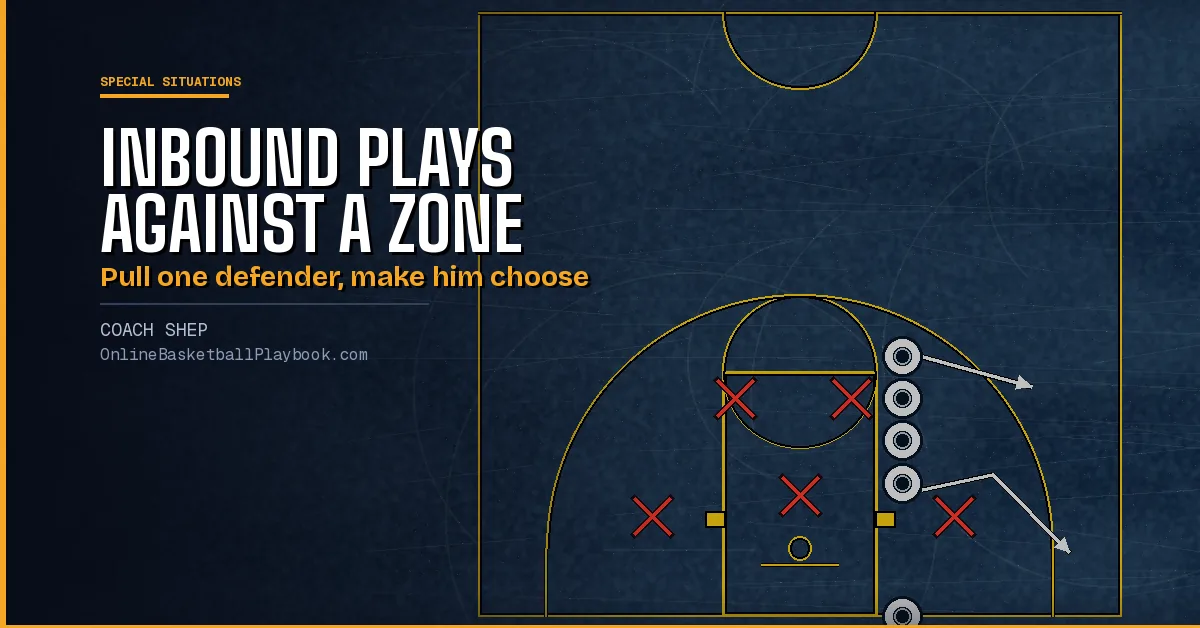
Inbound Plays Against a Zone: Baseline and Sideline Sets
Inbound plays against a zone from the baseline and sideline: the read, the stack near the elbow, short-corner pulls, split cuts, two-part sets and sideline answers.
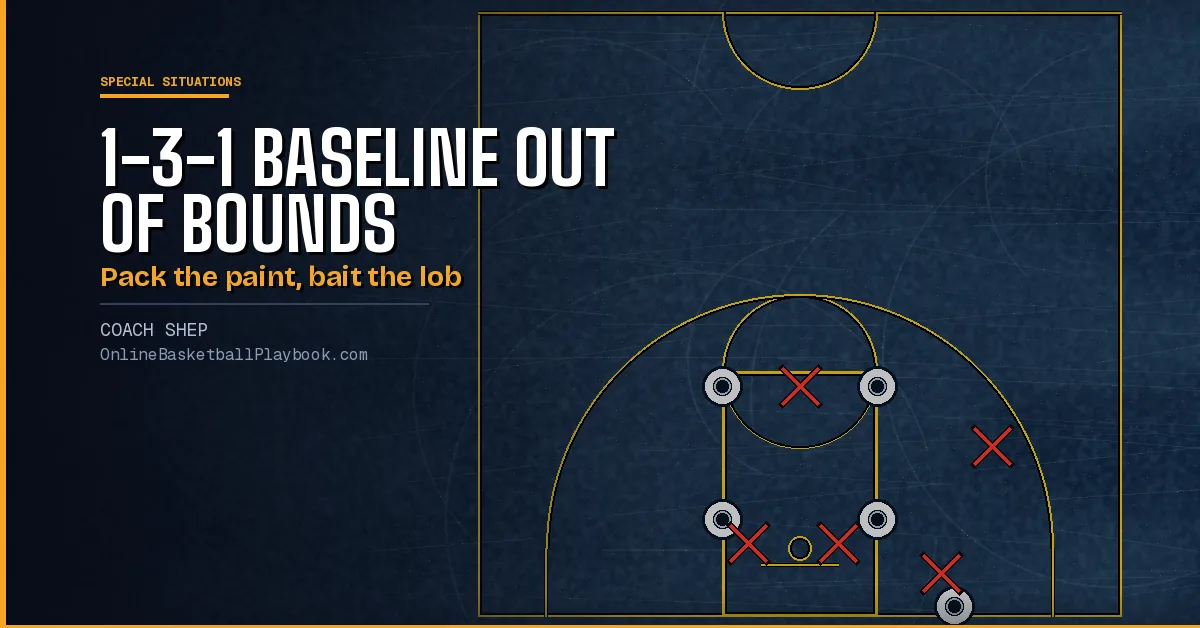
1-3-1 Baseline Out of Bounds Defense: Shape, Jobs, Traps
The 1-3-1 baseline out of bounds defense packs the paint and baits a deep lob. See the five jobs, the corner trap, the pass above the line and when to use it.
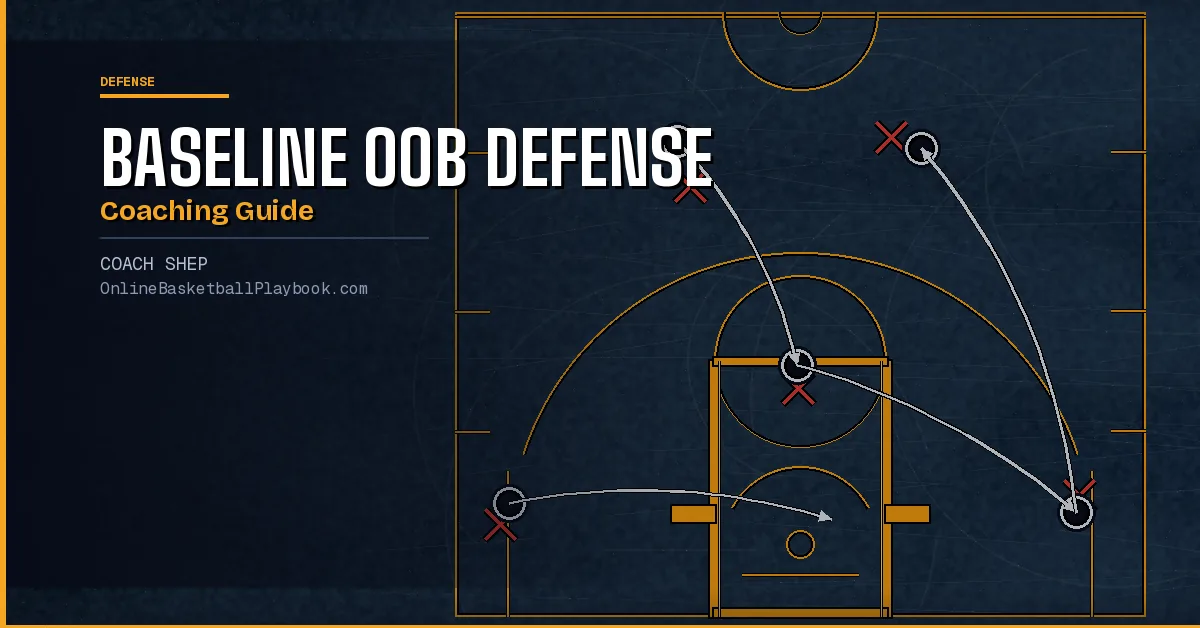
How to Defend Baseline Out of Bounds Plays
How to Defend Baseline Out of Bounds Plays