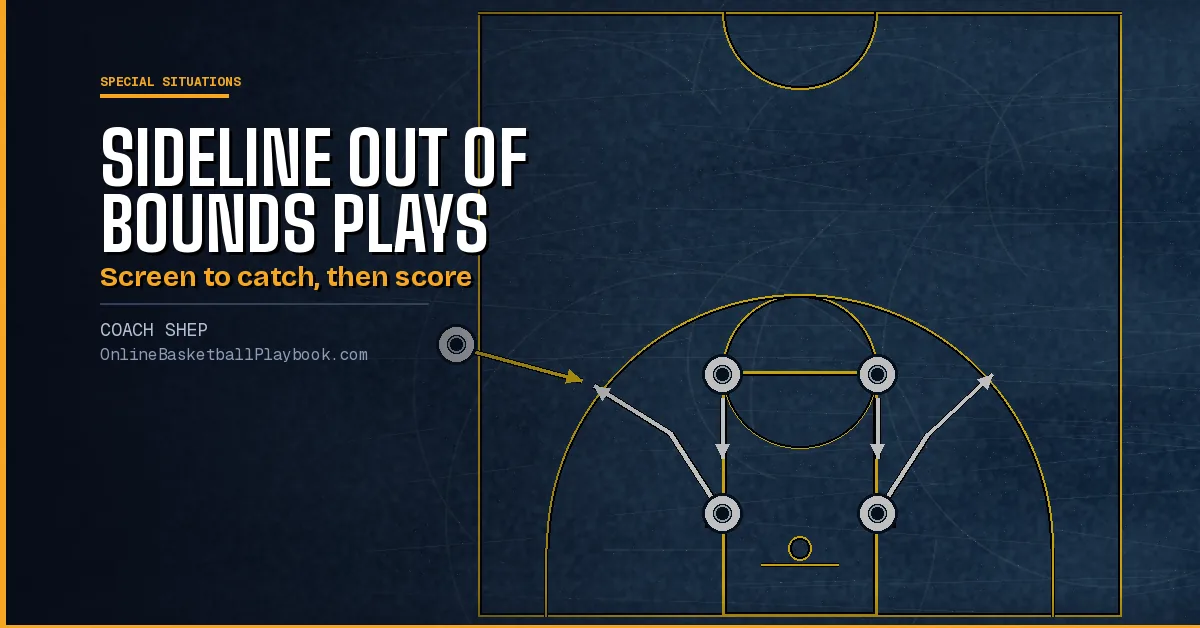
Sideline out of bounds plays, also called SLOB plays, are the called sets a team runs when the ball is dead and a teammate throws it in from beside the court. The throw-in can come from anywhere along the sideline, from the baseline extended to half court, and coaches use it after a timeout, a foul or any other dead ball.
Find any out-of-bounds play by formation in the play finder.
Compared with a baseline throw-in, the ball starts farther from the rim, the floor is wider and the inbounder can step back onto it as a fifth option. This guide is about the sideline throw-in only.
It draws five sets, describes more in words, and covers the reads under every call, how coaches choose a play by the defense, the clock and the way to practice. The baseline and sideline basics, with two drawn sideline plays, are on basketball inbound plays and are not repeated here.
Sideline Out of Bounds Plays at a Glance
| Set | Starts from | Built to get |
|---|---|---|
| Box with a back screen | A box, the best guard inbounding | A return pass and a layup for the inbounder |
| Elevator screen for a three | Two screeners above the free-throw line | A catch-and-shoot three |
| Backdoor cut | Two in the slots, two on the wings | A layup against an overplay |
| Give and go | Any set where the inbounder is unguarded | A return pass at the rim |
| Curl and counter | A pop to the top of the key and a curl around a screen | A shot, then a back cut when the defense overplays the curl |
| Down-screen entry | Any set with a post above a guard | A catch, then a post touch, a drive or a ball screen |
| Lob off a back screen | A box, stack or line | A lob over a defense with its back turned |
| Double or stagger for a shooter | A box or a line | A three off two screens |
A Box Sideline Play
This play starts from a box, with the posts at the elbows and the guards down on the blocks. The best offensive guard takes the ball out, so he can score on the return pass.
The opening is a pair of down screens. Each post screens down for the guard below him, and the guards cut out to the three-point area. The inbound pass goes to the guard on the ball side while the other guard stays back as the safety, ready to protect against a fast break.

The second phase is a back screen for the inbounder. The post who screened on the ball side moves out toward the inbounder and screens his defender from behind. Then the reads run in order:
- Return pass to the inbounder. He cuts hard on the baseline side to the rim for the return pass from the wing. That is the first look.
- Seal and roll. If the cut is covered, the post seals and rolls toward the rim as the second option.
- Pass to the safety. If both are denied, the wing passes out to the safety, the inbounder fills the opposite wing and the team flows into a 3 out 2 in set.
Get the ball in, then take what the defense gives. The 3 out 2 in basketball offense page has what happens next.

Getting a Shooter Open
Elevator screen for a three
Two screeners stand together just above the free-throw line, with one teammate in the corner and the shooter out by a sideline. The shooter runs between the two screeners, who close behind him to seal his defender off, and the inbounder passes to him for a three. The two screeners have to close at exactly the right moment. Time the close and the shot is clean. See the elevator screen page for the legal timing and counters.

Double and stagger shooter plays
- Two-read shooter play. One post down-screens for a guard who goes to the corner for a three. If that is blocked, a second guard runs off a stagger from two teammates for a wing three.
- Back screen then stagger. A post back-screens the shooter, who then comes off a staggered down screen from two teammates. It works as a call for a game-winning three.
- Reverse off a double. The shooter fakes a basket cut and reverses off a double screen from the two posts for a three. The post can slip the double for a direct catch.
- Curl over a double. The shooter curls back over the top of two posts for a three.
- Three screens at once. A two-second sideline play stacks a down screen for one player, a cross screen and a flare for another, and the passer looks for the corner shooter or the player coming off the flare.
Pick the shooter, then pick the screens that free him.
Backdoors and the Inbounder as a Scorer
The backdoor set puts two players in the slots and two on the wings with the inbounder on the sideline. The inbounder passes to a slot player, a wing cuts hard to the basket and the slot player pretends to pass or dribble, which pulls the defense the other way. The wing catches the backdoor pass for the layup.

One rule for every backdoor set is to manufacture the overplay first, with a handoff fake, a screen decoy or a drive threat, and to cut the moment the defender turns his head.
A Kansas sideline play credited to Bill Self is built to run twice:
- First run. The inbounder's teammate pops out to catch at the top of the key, and a second player curls around a screen for a shot or a pass to the rolling screener.
- Second run. The curler fakes the curl and back cuts, because a defense that was just beaten will overplay it.
The three automatic reads
Three reads sit on top of any call, and players signal them with eye contact and body language, not a call, since talking tips the defense.
- A defender who watches the ball with his back to his man loses that man, who cuts straight to the basket.
- If the inbounder is unguarded, he passes and cuts to the basket for the return.
- If a defender faces up but keeps his back to the passer, the passer throws the lob over him.

The inbounder scores in other sets too:
- Pass and basket-cut. A line play credited to Tom Izzo's Michigan State teams has the inbounder pass to a teammate posting up and then basket-cut for the return.
- Rip-cut behind. A teammate L-cuts for the catch while the inbounder rip-cuts behind a defender still in his throw-in stance.
- Stagger screens. Send him off stagger screens for a three.
- Return for a three. If the defense guards the inbounder in the paint, the ball returns to him for a three.
- Shoot when his man sags. The fifth read of a half-court sideline play is the inbounder shooting a return pass when his own defender sags.
Know your inbounder's job before the whistle.
Get the next coaching guide in your inbox
One email when a new guide or diagram set goes up. Free.
Down Screens, Doubles and Lobs
Most sideline plays use a small set of screens. The down screen and the zipper, a down screen that brings a guard up to the ball, are the most repeated ways to free the catcher, and the screen-the-screener is the second. Here are six entries.
| Entry | What happens |
|---|---|
| Corner screen, then down screen | One player screens for a teammate cutting to the corner. Then the post down-screens for the team's shooter, who pops to the top of the key for a three. If the defense switches the down screen, the post seals inside for a layup |
| Curl around a double | A guard curls around a double screen from the two posts to the far wing while the second guard trails around it for the inbound catch. The posts re-screen for the first guard coming back for a three or a drive, and a post can slip the screen if the defense switches |
| Two screening pairs | The team splits into pairs. A post screens for the shooter, who reads over the top or under depending on where the ball is inbounded, while another post screens for a guard as the safety valve. A post mismatch is the counter to a switch |
| Stack | The stack lines up on the lane line extended with real spacing. One player screens for a guard who fakes a V-cut and runs the near sideline for the catch, while a post back-screens for a teammate cutting to the other side. A direct lob is the third look. More stack calls are on stack inbound plays |
| Down-screen entry with three finishes | A post down-screens for a guard who catches the inbound at the top of the key. The finishes are a post touch, a fake hand-off into a dribble drive, or a real hand-off to a wing who runs a ball screen with the other post while the guard clears |
| Away pass, then cross screen | The inbound pass goes away from the ball side, then a cross screen frees the team's strongest post to score inside |
The lob family uses a back screen because of the space behind the defense:
- Three back-screen lobs. One of them has a high-low look as a second option.
- One-second lob. One player screens a teammate to the corner, another back-screens the post and the post cuts to the rim for the lob from the inbounder.
- Late-game big sprint. The post dives, another big sprints to the elbow and back-screens a wing for the lob, and if the first guard is denied he back cuts for a pass from the big.
Throw the lob only when the screen turns his back. The cutter's route is on the basketball screens page.
When the defense switches or jumps the screen, the screener becomes the shot. Sets have the post seal for a layup after a switch, or slip a double screen, or fake a screen, slip it and cut to the rim. A playbook can have slips in its full-court, three-quarter and baseline plays and none in its sideline plays, so check the counter before you install a play.
Choosing a Play by the Defense
Teams change defenses after a dead ball, so read whether the defense is man or zone before the ball is inbounded and come out of a timeout with a call for each. Coaches handle it in three ways.
| Approach | How it works |
|---|---|
| A call for each defense | A separate sideline call for each look, such as one for a 2-3 or 3-2 zone, one for a 1-3-1, one for a matchup, a couple for man and one for tough denial |
| One play for man and zone | All five players move at once, the post seals the middle against a zone and a ball screen frees a guard to throw the ball back to a teammate |
| Sets that work against man, an even-front zone and an odd-front zone | The same play is practiced against all three because defenses switch after a dead ball |
Pick the answer for the look you see:
- Space and reverse. Against a zone, space, reverse the ball, keep both a short pass and a long pass available and replace any area you leave.
- Pull the outside defender. Against a zone, a box play has the guard come to the ball to pull the outside defender out while a teammate curls under a screen on the forward. More zone calls are on inbound plays against a zone.
- Flash the post. Against full denial, a post flashes hard for the inbound pass and hands off or passes short to a teammate cutting to the rim.
- Throw to a wing. Answer pressure by throwing to a wing for a drift or a mid-post look and having the point guard pass to the 2 and come back for the ball.
- Put a safety on every play. Usually a good free-throw shooter flashes to the ball. Use a big as the inbounder late in games, with the weak side as the bail-out.
Read the defense before the ball is inbounded. For how the defense sees it, read how to defend sideline out of bounds plays.
The Clock and the Setup
The clock picks the play. Three plans:
- A play for each time band. Prepare a sideline play for each band, 0 to 3, 4 to 8 and 9 or more seconds, with a 2-point and a 3-point option in each.
- Time crossed with the inbound spot. A sideline throw-in with 6 to 12 seconds left allows two or three passes before the last shot. Under 30 seconds and within 8 points, the team holds for the last shot, with players set at 10 seconds, the play started at 8 and the shot and crash at 3 to 5 seconds.
- Read, do not script. Script no end-of-period plays and teach players to read a pick-and-roll weakness or a size mismatch.
Know the number before you draw the play. See drills to teach late-game situations for clock practice.
Set up slow and start fast. The inbounder takes his time and looks busy before he takes the ball from the official, to be sure everyone is in position. Once the ball is handed over, the clock is running, and slapping the ball to start the play wastes time. The two passes that last-second plays depend on are a crisp skip pass and a baseball or semi-hook pass to the opposite elbow, and without them a last-second play is worthless.
One-shot sideline and baseline sets with under two seconds left are on buzzer beater plays.
How to Practice SLOB Plays
- A scored execution scrimmage. Ten minutes where each team gets five minutes to run its own out-of-bounds plays, with score kept and fouls called.
- A daily shadow run. A walkthrough without defense, and one inbounds play inserted between drill transitions with managers keeping score and the losing group running.
- Chances and scores. The offense gets five chances and needs three scores (first run as a baseline scrimmage), with a weekly two to three minute run-through of last-second plays.
- A daily block. Fifteen to twenty minutes a day, with a running list of the scenarios the team has seen.
Use drills to teach quick hitters for the install steps. The pass work comes first, since a last-second play is worthless without the skip pass and the baseball pass.
Want the printable playbook packs?
OBP Pro members get the premium playbook packs: the zone attack, out of bounds and practice plan PDFs, plus each new pack as it is finished. The membership page lists what is in each one. Or draw your own version free in PlayDraw.
See what OBP Pro includesWhere Coaches Differ
| Question | Answer |
|---|---|
| Safe or attack? | Get the ball in safely first, with a safety on every play, then set up the offense |
| Attack, because most teams defend out-of-bounds plays poorly | |
| A separate menu? | Run any wing-entry half-court set as a sideline play, so there is no separate menu |
| Keep dedicated sideline calls and practice them as their own menu | |
| How many plays? | Three or four in the pocket, at least one baseline and one sideline |
| About five rehearsed plays per game, including one sideline set | |
| Hold a favorite sideline play back for the postseason | |
| Fixed or read? | A prepared play for each time band |
| No fixed plays, read a mismatch and practice reading |
A youth sideline scoring play will not work if it is run too often, so rotate your calls. The baseline side of the same decision is on baseline out of bounds plays, the throw-in rules are on out of bounds rules and more clutch sets are on best inbound plays for clutch situations.
Questions Coaches Ask
What is a SLOB play in basketball?
A sideline out of bounds play, a called set that starts with a dead-ball throw-in from the sideline.
What is the best sideline out of bounds play?
It depends on the roster and the defense. Coaches pick a play that fits their best inbounder and their best shooter or finisher, and keep a few for man, zone and denial.
What is the difference between SLOB and BLOB?
A SLOB starts from the sideline, where the court is wider and the inbounder can step back in. A BLOB starts from the baseline, closer to the rim with a tighter floor.
How do you run a sideline out of bounds play against a zone?
Space the floor, reverse the ball quickly, keep a short and a long pass available and replace any area you leave. Carry a separate call for zone.
How many sideline plays should a team have?
Keep one dedicated sideline call inside a short list of three to five special plays, and rehearse them instead of keeping a long menu.
Can the inbounder score on a sideline play?
Yes. If the defense ignores him, he passes and cuts to the basket, and sets put a back screen or a stagger screen in his path.
More Guides From This Batch
- 3 Out 2 In Basketball Offense: Spacing, Actions and Reads
- Hook Shot Basketball: How to Do It and How to Teach It
- Fun Basketball Games for Practice: Scored Games for Any Team
- Elevator Screen Basketball: How It Works, Plays and Counters
Back to Special Situations and every Special Situations page.
Keep Building
Related breakdowns
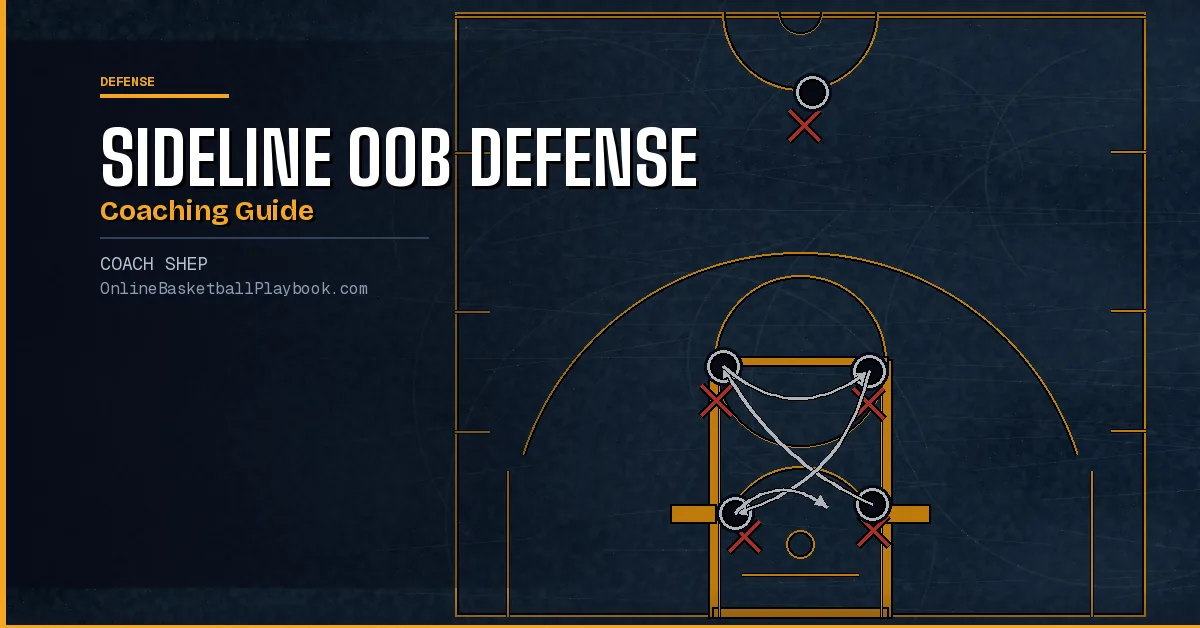
How to Defend Sideline Out of Bounds Plays
How to Defend Sideline Out of Bounds Plays
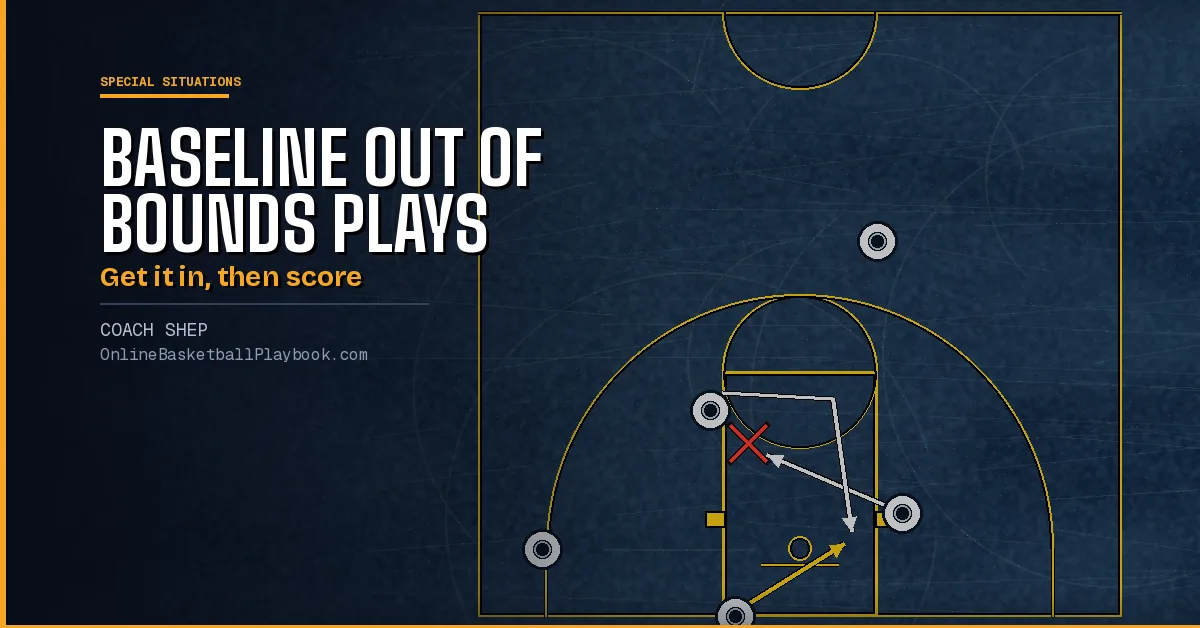
Baseline Out of Bounds Plays: Sets vs Man, Zone and for Youth
Baseline out of bounds plays drawn step by step: a box back screen and roll, Pick the Picker, the double stack, a 2-3 zone play, youth one-pass plays, the rules and the reads.
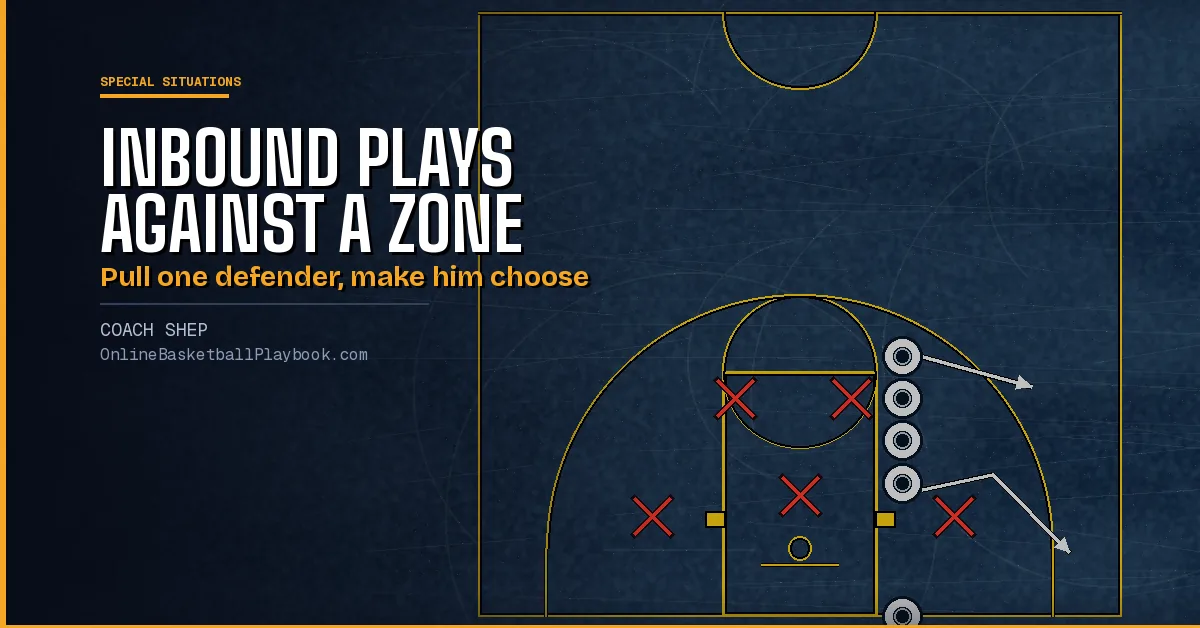
Inbound Plays Against a Zone: Baseline and Sideline Sets
Inbound plays against a zone from the baseline and sideline: the read, the stack near the elbow, short-corner pulls, split cuts, two-part sets and sideline answers.