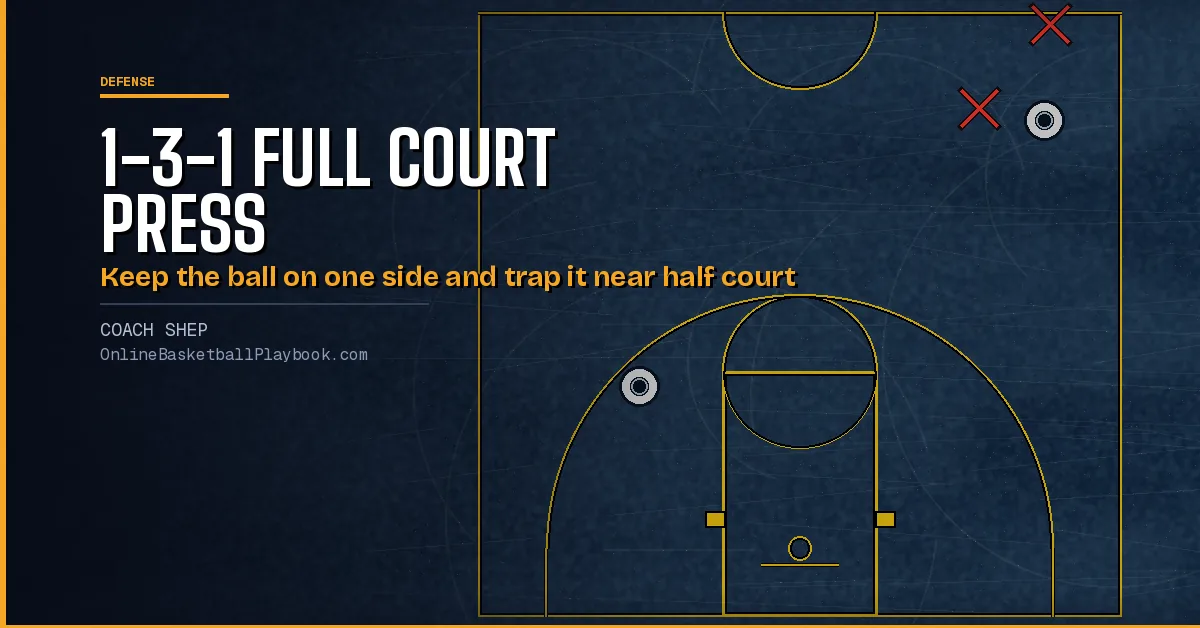
The 1-3-1 full court press is a different defense from the half-court 1-3-1 zone, even though it uses the same shape. The goal comes in one sentence. Push the offense to one side and trap the ball on the sideline close to half court. A turnover is not required for the press to pay off, because the offense still loses time and rhythm getting across.
This guide covers the roles, the traps, the rotations on a reversal, an aggressive version, the costs and the other places coaches use a 1-3-1 trap. For the whole press family see full court press defense.
The Five Roles
The roles go in this order, top, middle, back, then the wings. The diagrams on this page use these numbers. X2 is the top, X1 the middle, X4 and X3 the wings and X5 the back.
| Role | Player | Job |
|---|---|---|
| Top | The most important spot. Athletic, covers ground side to side and is long if possible | Starts around the backcourt arc. Pressures the ball after the inbound instead of denying the inbound, opens fully to the ball side to keep the ball there and helps trap near half court |
| Middle | Possibly the second most important. Very quick | Keeps the ball out of the middle, rotates to the ball-side sideline as the trap forms and can stop a completed sideline pass for a second trap |
| Back | The best rim defender, not necessarily the tallest | Stays in the paint, never goes past the top of the key in the frontcourt and leaves the lane for a steal only when certain |
| Wings | Long, good at trapping without fouling | Start level with the middle player near half court, wide enough to cut off the sideline. The weak-side wing replaces the middle when the middle leaves |

Inbound and Advance
Steer the ball to one side and hold the rest of the spots until it moves.
- Top gets inside the ball. On the pass to 1, the top defender gets inside the ball with his shoulders parallel to the sideline, which steers the dribbler to stay on that side.
- Middle closes the middle. He steps in front of the second guard.
- Wings and back hold. They hold their spots and wait to rotate as the ball advances.
- Stay on the inside shoulder. As 1 dribbles, the top defender steers him toward the ball-side wing.
- Retreat, then attack. That wing can retreat a couple of steps as if there is no trap, then attack, and must not give up the sideline.
Steer first, then trap.
The Backcourt Trap
Trap at the sideline so the only pass the offense should see is a reversal backward in the backcourt.
- Ball-side wing steps up to trap.
- Middle takes the far rotation. He leaves the middle to deny the sideline pass. Aim for the receiver's hip so a late arrival can still get behind him.
- Weak-side wing rotates to the middle. The defender who rotates into the middle starts at the top of the key and works up, staying with the deepest player.
- Back stays inside the three-point line.

The Reversal
A good backcourt trap forces the reversal pass backward, which gives the defense more time. The top defender does not chase the pass, and the other three rotate together.
- Top runs to where the dribbler is going. He stays on the inside.
- Weak-side wing sprints to the new sideline. He may have to set the trap just past half court because the rotation is so long.
- Middle sprints all the way across. He denies the new sideline receiver.
- Old ball-side wing drops to the middle. He leaves the first trap.
Because the rotations are long, the offense may complete a sideline pass. That does not end the press. It means the trap moves to the frontcourt. Rotate together and the trap moves with the ball.

The Frontcourt Trap
When a sideline pass is completed, the trap moves to the frontcourt.
- Get in front and stop the ball. The player who sprinted across gets in front of the pass, stops the ball and cuts off the sideline.
- Finish the trap. The wing who was passed turns and sprints to finish the trap the moment the ball passes his head.
- Back takes away the basket. He takes away any pass toward the basket and, if nobody is there, waits for a late cutter or a drive.
- Top and old wing take the reversals. One plays high and one low. They do not need to deny anything into the backcourt, because that pass would be a violation.

Get the next coaching guide in your inbox
One email when a new guide or diagram set goes up. Free.
The Aggressive Version
The aggressive version is for coaches who want more pressure. The setup is the same except everyone starts 10 to 15 feet closer to the ball.
- Push the inbound to the corner. The top does it.
- Trap the catch. The two nearest defenders trap it immediately. Their job is maximum pressure without fouling, not a steal.
- Back steps up. He comes up to take away the sideline pass.
- Far wing denies the return. He sprints to deny the pass back to the inbounder.
- Middle is the safety. He takes away any flash to the middle from in front or behind.
- If the ball is reversed to the inbounder. Either the original top bumps the defender who stepped onto the ball and takes the top again, or he sprints to the far side and leaves that defender on the ball.
It is high risk and high reward, and a completed pass to the middle means everyone sprints back to half-court defense. Know the risk before you call it.

Strengths and Costs
The standard press has three strengths.
- It disrupts tempo. The offense has to reverse and take time to cross half court.
- The top can pressure hard. Three teammates are across the middle and one is home.
- It is not overly risky. A goaltender is always in the lane.
It has three weaknesses.
- Throw it over the second line. Big, strong teams can throw over into open space.
- The top tires. The offense keeps reversing.
- One rim defender loses. One rim defender against several attackers loses.
The half-court 1-3-1 zone fronts the post and traps the corners hard, while the press keeps the back defender conservative. The same shape carries different risk in the back. Know what the press costs before you install it.
When Coaches Call It
Coaches call the 1-3-1 in set spots.
- Take away every inbound. Rick Pitino uses a 1-3-1 to take away every sideline and baseline inbound pass.
- Call it by situation. Hubie Brown's situation map calls a 1-3-1 on backcourt sideline out-of-bounds plays and after timeouts, a three-quarter 2-2-1 after every foul shot and full court man or a 1-2-1-1 after a made field goal.
- Rotate into it on one call. A 2-1-2 press rotates into a three-quarter 1-3-1.
- Trap by the dribble. Pitino's "5" call is a 1-3-1 trap zone played like his white press, with a wing trap on a lateral dribble and a middle trap on a dribble toward the basket.
- Press, then trap in the half court. Georgetown under Esherick paired a full-court press with a half-court 1-3-1 trap instead.
The general question of when to press has its own answers.
- Press after a score. Bruce Pearl presses only after a score to protect transition defense.
- Press misses too. Walberg does.
- Press in bursts. Run the press in the opening minutes and the last two to three minutes of a half.
- Press with a lead late. Jay Wright does it to slow the opponent.
The press family page and the best full court press comparison set these side by side. For traps in general, see the 1-3-1 zone defense page and the three-quarter court press guide. Decide when you press before the game.
How to Install It
The role order has no drill list, so build from the teaching points. Walk the five roles at half speed through the inbound, the trap, the reversal and the frontcourt trap, then add offensive players. Players who run the press need a plan for the first reversal.
- Top runs to where the ball is going.
- Weak-side wing sprints to cut off the new sideline.
- Middle sprints across to deny.
- Old trapping wing drops to the middle.
Teach those four moves before any live possession. See full court press drills for station work and press terminology for call names.
Coaches who face this press as an offense should read press break basketball and how to build a press break. Quick reversal and a tall passer who can throw over the second line are the two answers. A half-court 1-3-1 is covered on how to beat a 1-3-1 zone.
Want the printable playbook packs?
OBP Pro members get the premium playbook packs: the zone attack, out of bounds and practice plan PDFs, plus each new pack as it is finished. The membership page lists what is in each one. Or draw your own version free in PlayDraw.
See what OBP Pro includesQuestions Coaches Ask
What is a 1-3-1 full court press?
A press with one defender at the top, three across the middle and one at the rim. It keeps the ball on a side and traps it near half court.
Who plays the top of the 1-3-1 press?
The athletic, long player who covers ground side to side. It is the most important spot.
Where does the 1-3-1 press trap?
Along the sideline near half court, in the backcourt first and in the frontcourt if the offense completes a sideline pass.
What beats the 1-3-1 full court press?
A quick reversal and tall, strong players who throw over the second line to open space.
Is the 1-3-1 press risky?
The standard press is not overly risky because a rim defender stays home, and the aggressive version is high risk and high reward.
What is the difference between the 1-3-1 press and the 1-3-1 zone?
The press starts in the backcourt and traps near half court with a goaltender at the rim. The zone waits in the half court and uses different roles.
More Guides From This Batch
- Defensive Stance in Basketball: Weight, Feet, Hands and Drills
- Pack Line Defense: Rules, Post Coverage and How to Install It
- Fun Basketball Drills for Kids: Team Games, Relays and Contests
- Basketball Agility Drills: Cone, Reaction and Ladder Drills
Back to Full Court Press Defense and every Defense page.
Keep Building
Related breakdowns
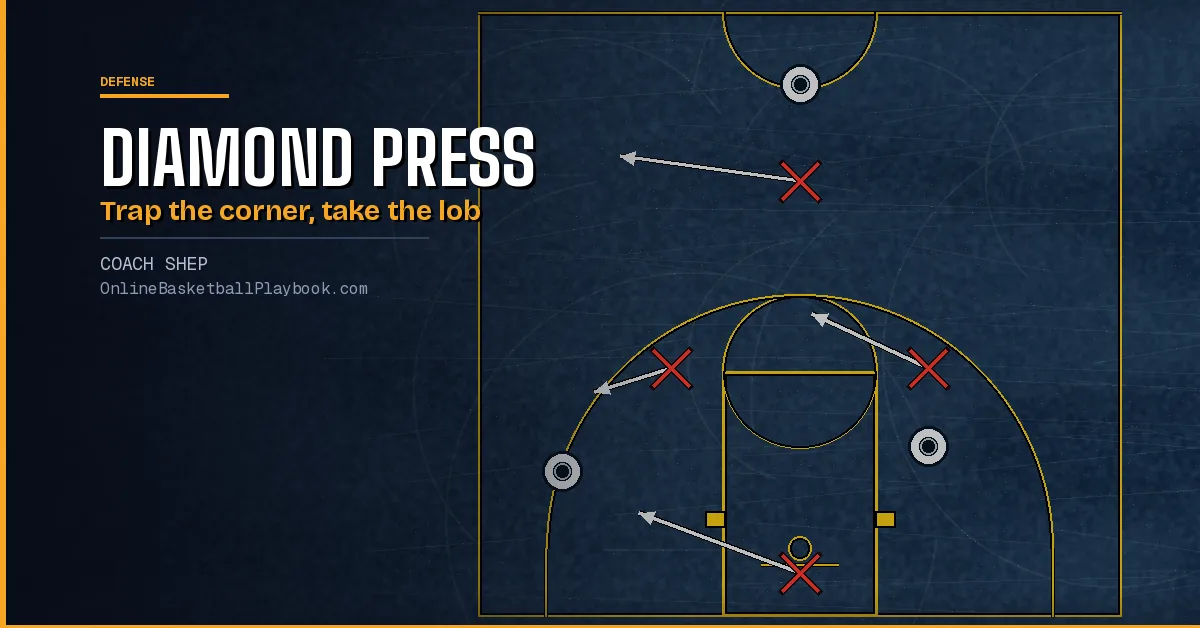
1-2-1-1 Diamond Press Basketball: Roles, Traps and Install
How to run the diamond press in basketball: who plays each role, how to trap the corner, what to do on the reversal and the lob, and how to install it step by step.
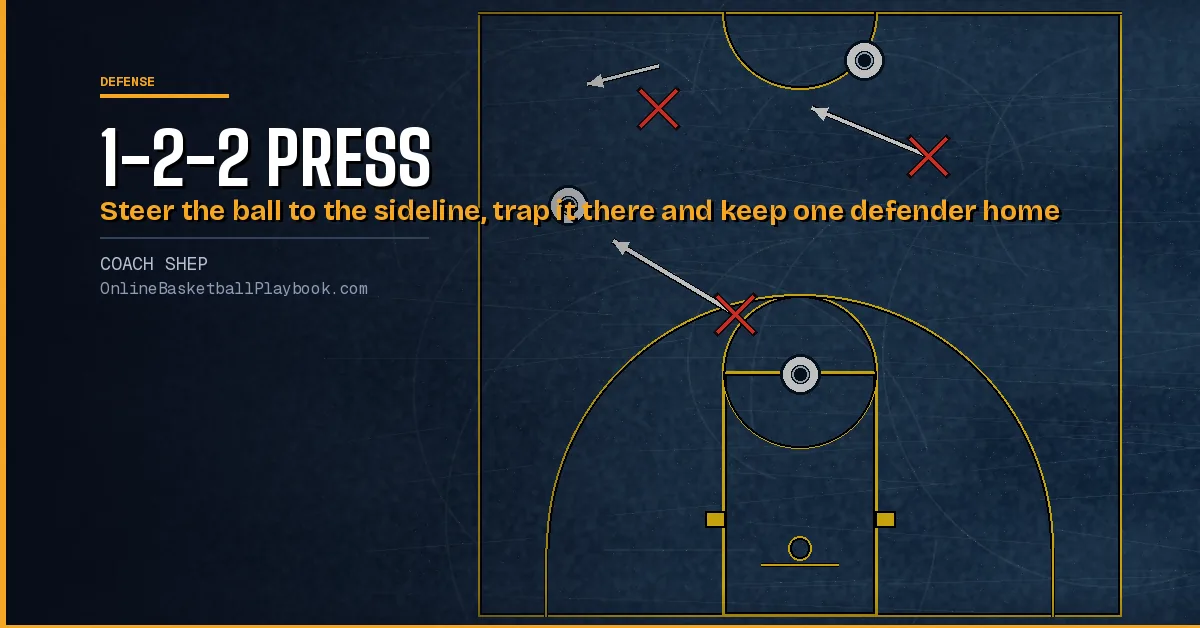
1-2-2 Press: Roles, Traps, Rotations and Breakdowns
1-2-2 press guide covering who plays the top, middle and back line, where each version traps, how it rotates on a reversal and what to do when it breaks.
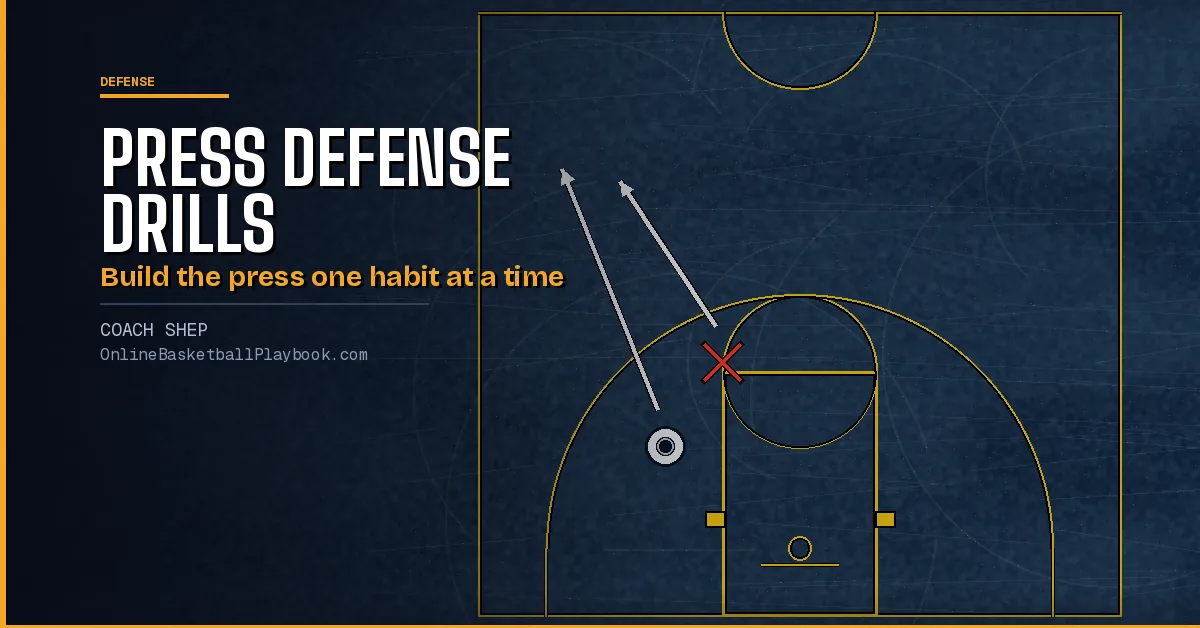
Full Court Press Defense Drills: Traps, Rotations and Live Reps
Full court press defense drills that build the press in pieces: footwork, trap drills, back-tips, sideline traps, rotation drills, live games and how to score them.