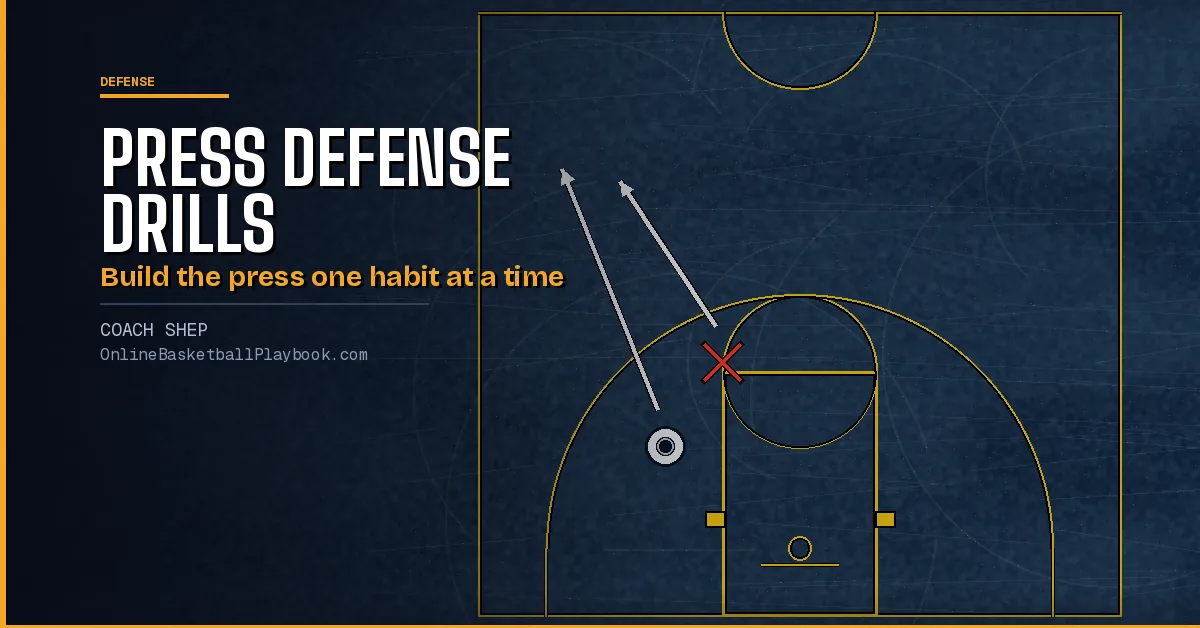
Full court press defense drills break a press into the few habits it runs on, drill each habit at game speed, then put the press back together live. Every press in the playbook, the 1-2-1-1 diamond, the 2-2-1, the 1-2-2 or full-court man, needs the same things: a defender who can turn the dribbler, two trappers who cannot be split, interceptors who move on the flight of the pass and a back man who never gives up the layup.
This page collects the press defense drills that build those habits, draws the setups, and shows how coaches order and score them.
How to Build Full Court Press Defense Drills
Coaches teach the press whole, then in parts, then whole again. Show the full press, break it into 1 on 1, 2 on 2, 3 on 3 and 4 on 4 pieces, then rebuild it 5 on 5.
Billy Donovan's press day is two blocks of about 8 to 15 minutes each: a breakdown block of 1 on 1 up to 4 on 4 with back-pursuit, back-tip and stunt work, then a 5-on-5 block. The ladders differ in their middle rungs.
- Rick Pitino's ladder. 1 on 1 for angles and tips, 2 on 2 trapping only the uncontrolled dribble, then 3 on 3, 4 on 4 and 5 on 5.
- Whole press first, all scored. Walk the whole press, then 1 on 1, 1 on 2, 2 on 3 and 3 on 4, every drill scored, about 20 minutes a day.
- 2-2-1 breakdown. 1 on 1 full court, the 1-on-2 alley drill, 2 on 2 for the bump, 2 on 4 with a coach inbounding, then 3 on 4 with a middle man.
- Match-up press. 1 on 1, 2 on 2, 2 on 2 cut and double, 2 on 2 run and jump, 3 on 3, 4 on 4, then 5 on 5 against different press-break shapes.
- Trap and rotate scramble. 3 on 3 with a steal on the return pass, 3 on 3 with one man rotating, 4 on 4 with two rotating, 5 on 5, then live 4 on 4 on 4.
In a 1-2-2 press, turnovers are a byproduct, not the measure, so the drills grade the habits, not the steals. Which press you drill is your call, and the choices are compared on the best full-court press hub.
Pick one ladder and run it the same way every day.
Press Footwork and the Full-Court 1 on 1
The footwork ladder. An effort-first press is built from the floor up.
- Boxer stance. A boxer stance with a wide base.
- Half-squat.
- Step-slide with towels. The towels are held overhead to keep the defender low.
- One-step and two-step full-court work. Catch the first move with a big step.
- Run-recover. The defender gets beat, punches a cone, sprints and takes a big step to cut off the sideline.
- Box drill. It chains all of it.
Here the press is about effort and will more than trap spots, and every drill is played fast.
The full-court 1 on 1.
- Zig-zag. Bob Knight runs it every day for 3 to 5 minutes and reads it as his toughness test. In the four-trip zig-zag the defender turns the ball in the backcourt, channels it to the sideline in the frontcourt, keeps his hands above his shoulders and finishes with a contest and a box-out.
- Straight up. Play the handler straight up and only keep the ball out of the middle.
- Short side. Donovan keeps the handler on the short side with the defender's chest up and hands showing. If he is beaten, he sprints to a spot ahead of the ball and turns the handler again.
How many turns are enough? Vance Walberg's on-ball defender has done his job with one change of direction before half court and a great job with two. The defensive stance and slide work behind all of this are on defensive footwork.
Turn him early, turn him again, and keep him on the sideline.
Trap Drills
Circle trap. Three offense and three defense spread around a circle.
- Trap together. The coach passes to one offensive player, the two defenders next to him trap at once, and the third defender plays the gap between the other two as the interceptor.
- Feet wide, arms up. The trappers keep their feet wide and next to each other with arms up and out.
- No dribble, no lift. The trapped player may not dribble and must pass-fake and pivot to get out, and he may never lift the ball above his head, because that lets the trappers close in.
- Rotate on the ball. When the ball moves, the old interceptor sprints out to trap and the other defender becomes the new interceptor.
- Place the circle. Put the circle where your press traps, near the end line or near half court.

Walk underneath. In the walk-under circle drill, the trappers keep their feet together, hands above the eyes, and walk under the handler so he cannot split them. The goal is a deflection or a pass that hangs in the air. The three rules are never get split, never run at a handler with no defender on him, and never put three on the ball.
Three in a corner. Don Meyer puts three players in a corner of the gym: one tosses to another and the other two trap. His traps come in at a right angle so they cannot be split, toe to toe with hands up. He starts team trapping 3 on 3 with the order trap, shoot the gap, rotate, and says getting the trap is not enough without the gap shot.
No lob. Sylvia Hatchell's corner trap drill bans the lob. The coach throws in to a player who is trapped in the corner and the drill goes live, first with no dribble, then with it.
Mirror the ball. In a man-in-the-middle drill, two passers stand about 15 feet apart with a defender between them. The passers fake one way and pass the other, with no lobs, and the defender mirrors the ball with both hands until he deflects a pass. Then the passer who threw it goes to the middle. It teaches active hands in the trap without reaching.
Two on the ball, feet closed, hands up, and nobody reaches.
Back-Tip Drills
The steal in a press comes after the ball leaves the trap or from behind the dribbler, not from a reach. Donovan wants his only on-ball steal to be a back-tip, and the walk-under drill steals off the ball, not on it.
- Chase and tip. Two defenders and one offensive player. A defender passes to the offensive player, who speed-dribbles for a layup at the far basket while both defenders sprint to tip the ball from behind. The tipping hand stays low near the floor and tips up from below, because tipping down from above usually draws a foul.
- Sprint out and run through. When the ball leaves the trap, the trappers sprint and run through the ball instead of reaching for it.
- Beaten trappers become tippers. In the diamond press, trappers who are beaten turn and chase as tippers.
The trap technique these drills train, feet, hands and angles, is on trapping in basketball.
Chase from behind, tip from below, never reach from the side.
Get the next coaching guide in your inbox
One email when a new guide or diagram set goes up. Free.
Sideline Trap Drills
Sideline to the trap. This is a 2-2-1 drill.
- Set up. With the ball, the coach waits out of bounds under one basket, guards line up on the end line and forwards at half court. One guard plays offense, one plays the top of the press, and one forward plays the half-court spot.
- Run the rep. The coach inbounds, the defensive guard keeps the ball out of the middle and pushes it down the strip near the sideline, and the rep ends when the two defenders set the trap at half court. The handler tries to beat the guard to the middle or get around the trap.
- Add the denial. Once the guards can do it, the defender starts the drill by denying the inbound.
- Go again. If the trap fails, the same players go again.

The 1-on-2 alley drill. In the step-up-and-bluff 2-2-1, one defender plays against the handler and a second waiting up the sideline. The first defender takes away the handler's inside foot to force the sideline. The second steps up once and back twice to bluff, then traps when the handler's head is down and he is out of control. Once he commits, he stays committed.
3 on 2, trap and deny. The containment 2-2-1 that uses the sideline-to-trap drill opens its 3 on 2 with a shell.
- Shell first. Three offensive players pass around the perimeter while two defenders guard the wings with on-ball, denial and help positions.
- Switch after reversals. After a couple of reversals, the point guard passes to a defender and the teams switch, so two players bring the ball up against three.
- Trap, deny, adjust. The two defenders closest to the ball trap, the third denies the other offensive player, and they adjust on every pass.
- Finish. It ends with a score or a steal and a 3-on-2 break the other way.

The guard sends it down the sideline, and the trap meets it there.
Rotation Drills Behind the Trap
The first pass out of a trap leaves the defense a man short, so the three defenders who are not trapping have to move while the ball is in the air.
The tag drill. Four offensive players, a point guard, two wings and one in the middle, against the two front defenders of a 2-2-1. Each defender owns one half of the floor.
- Play the ball and sink. On a pass to a wing, one plays the ball and turns it toward the sideline while the other sinks below the ball to guard the middle.
- Tag on the way back. On the pass back, the middle defender does not leave until his partner slides in and tags him.
- Reverse three or four times.
In the containment 2-2-1, the physical tag is not the point, the two guards working as a pair is.

6 on 5. The containment 2-2-1 presses against six offensive players, one possession at a time. The reversal is always left open and the middle pass always covered, because the press gives up the reversal while the offense works against the clock.
4 on 4 plus 1. Bob Huggins runs this rotation drill every practice. Four on four, plus an extra offensive player with no defender who moves between the blocks. The point guard may not pass straight to him. On each pass the help rotates to the open man, and the coaching point is to be moving while the pass is still in the air. Make it a game by switching after five possessions and keeping score.

The help rules behind these rotations are on help defense principles.
Move while the ball is in the air, not after the catch.
Live Press Games and How to Score Them
4 on 4 on 4. Three teams of four, so at least 12 players, play continuous transition. On a score, the team that scored presses right away until half court, where the next team picks up the ball. One point per basket or foul drawn, and the first team to five or seven wins.
Scoring the defense.
- Defense-only game to five. Half a point for a deflection, one for a steal, a defensive rebound or a basket in conversion. If the offense scores, the teams swap.
- Point scrimmage with a 20-second clock. A 20-second shot clock once the ball crosses half court. Plus 2 for a forced quick or bad shot, plus 2 for a turnover, plus 3 for a 5- or 10-second count, minus 2 for a foul.
Count deflections too. Tubby Smith's goal was 35 a game.
Score the defense, so the habits you want are the ones that win.
Putting It in Practice
Daily time. The whole-press-first ladder runs about 20 minutes a day, against Donovan's two blocks above. Gary Williams presses at the end of practice, when players are tired, and gives close calls to the pressing team.
A five-day install. The containment 2-2-1 lays out a week:
- Walk through the whole press, then scrimmage.
- The 3-on-2 trap and deny, a review, then scrimmage.
- The sideline-to-trap drill, then scrimmage.
- Trap and deny, the tag drill and 6 on 5.
- Add the inbound denial and play a full scrimmage.
No reaching in the drills. A defender who reaches in a trap drill fouls in the game.
- No reaching, grabbing or slapping. Donovan wants none, and an effort-first press counts reaching on the ball as a foul.
- Sprint to the paint. Once the press is beaten, everyone sprints to the paint first and finds a man second, the habit on transition defense.
- Defend the half court. In an effort-first press, a team presses only as well as it defends in the half court.
The offense's side is on press break basketball, the press families on full court press defense, and pressing as an identity on how to build a pressing team.
Short, fast and every day beats long and once a week.
Questions Coaches Ask About Press Defense Drills
What are the best full court press defense drills?
A full-court 1 on 1 to teach turning the dribbler, a trap drill such as the circle trap, a back-tip drill, a sideline trap drill for your press, and a rotation drill such as 4 on 4 plus 1. Then play the press live with a score.
How do you teach a full court press?
Whole, part, whole, as in the ladders above: show the full press, drill the pieces, then rebuild it 5 on 5.
How do you drill a trap in basketball?
Start with two trappers on one handler, feet next to each other and hands up, then add an interceptor, then a second trap as the ball moves. The circle trap does all three.
How do you practice the press without a full roster?
Use the small pieces: 1 on 1 full court, 1 on 2 in the alley, 3 on 2 trap and deny, and the tag drill with six players.
How do you score a press drill?
Score the defense: deflections, steals, forced bad shots and count violations count for it, fouls count against it.
Want the printable playbook packs?
OBP Pro members get the premium playbook packs: the zone attack, out of bounds and practice plan PDFs, plus each new pack as it is finished. The membership page lists what is in each one. Or draw your own version free in PlayDraw.
See what OBP Pro includesMore Coaching Guides From This Batch
- Half Court Trap Defense: The 1-3-1, 2-3 and 1-2-2 Traps
- Full Court Man to Man Pressure: Pickup, Deny and Trap Rules
- How to Teach a Press to Youth Teams: What to Teach First
Back to Best Full-Court Press and every Defense page.
Keep Building
Related breakdowns
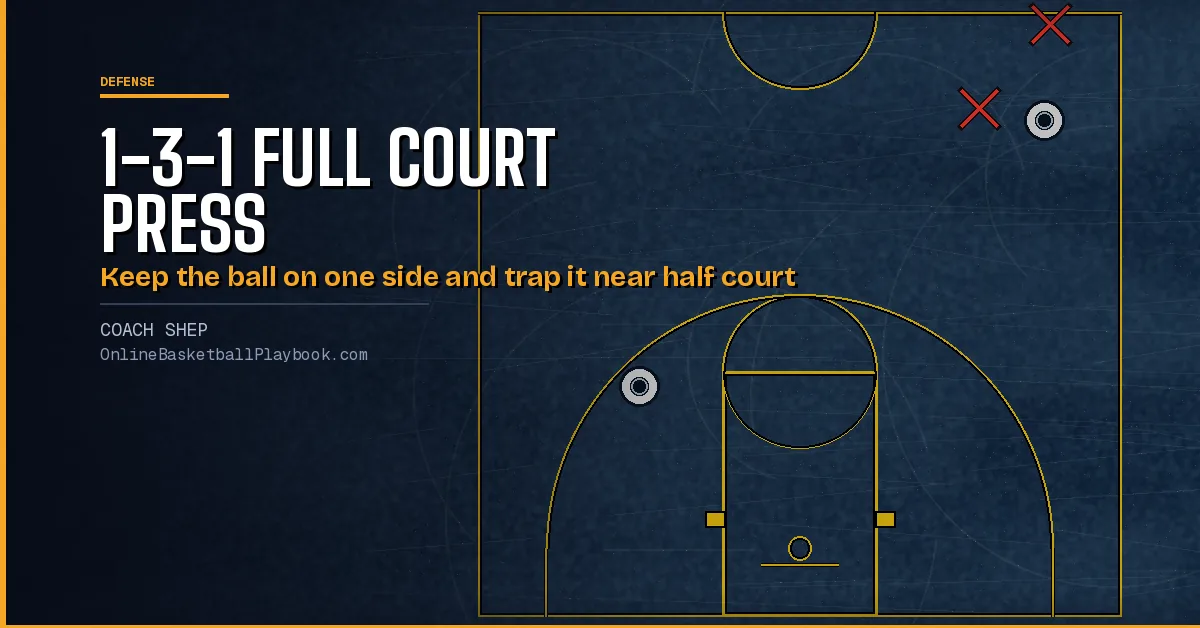
1-3-1 Full Court Press: Roles, Traps and Rotations to Install
The 1-3-1 full court press from setup to frontcourt trap: each role, the reversal rotations, an aggressive version, the costs and when coaches call it.
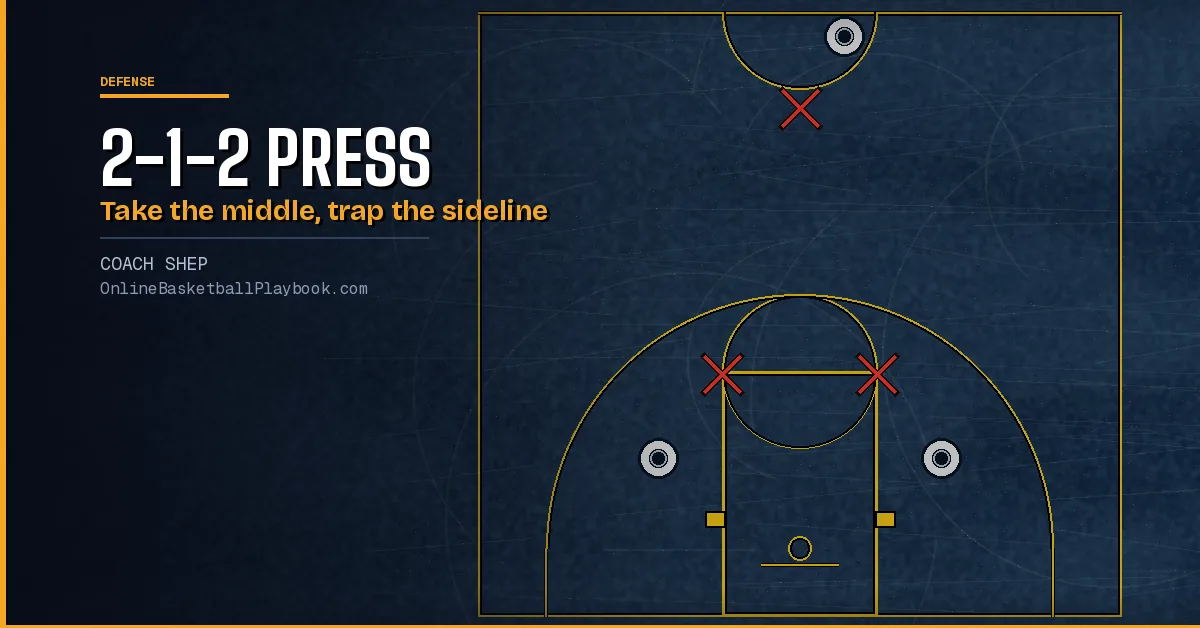
2-1-2 Press: Setup, Traps and Rotations of the Full Court Press
The 2-1-2 press explained: the full court setup, each line's job, the inbound, the first and second sideline traps, reversals and the match-up and tempo versions.
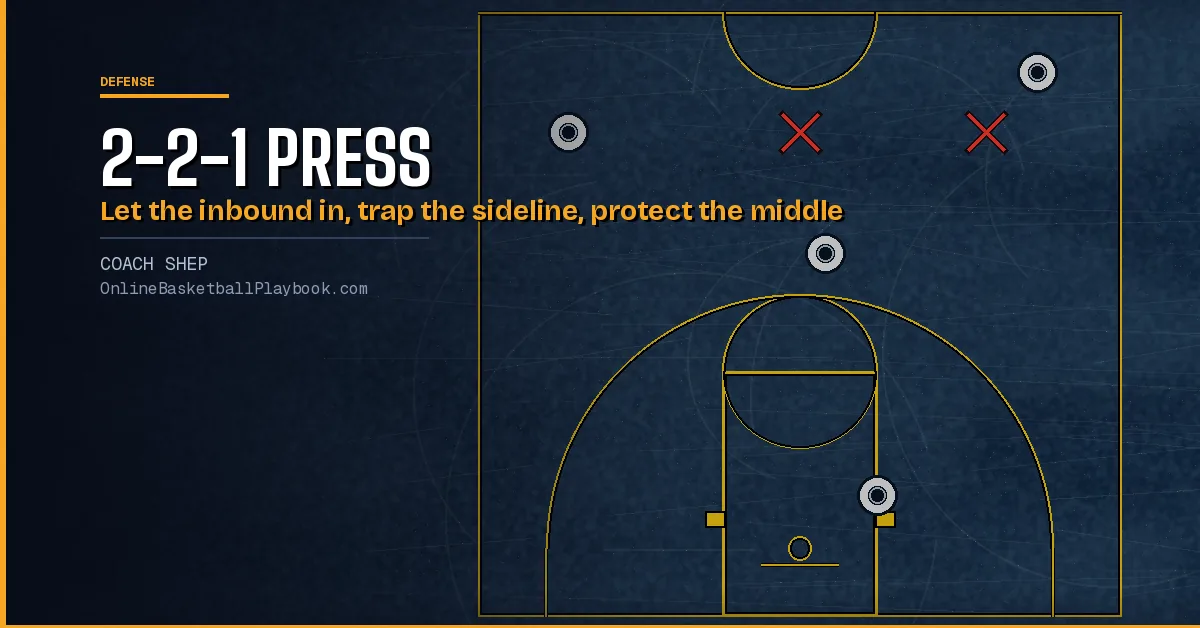
2-2-1 Press: Setup, Traps, Rotations and Drills
How to run the 2-2-1 press: who plays each spot, how coaches trap the sideline, the rotations after a reversal, how it breaks, how offenses attack it and the drills.