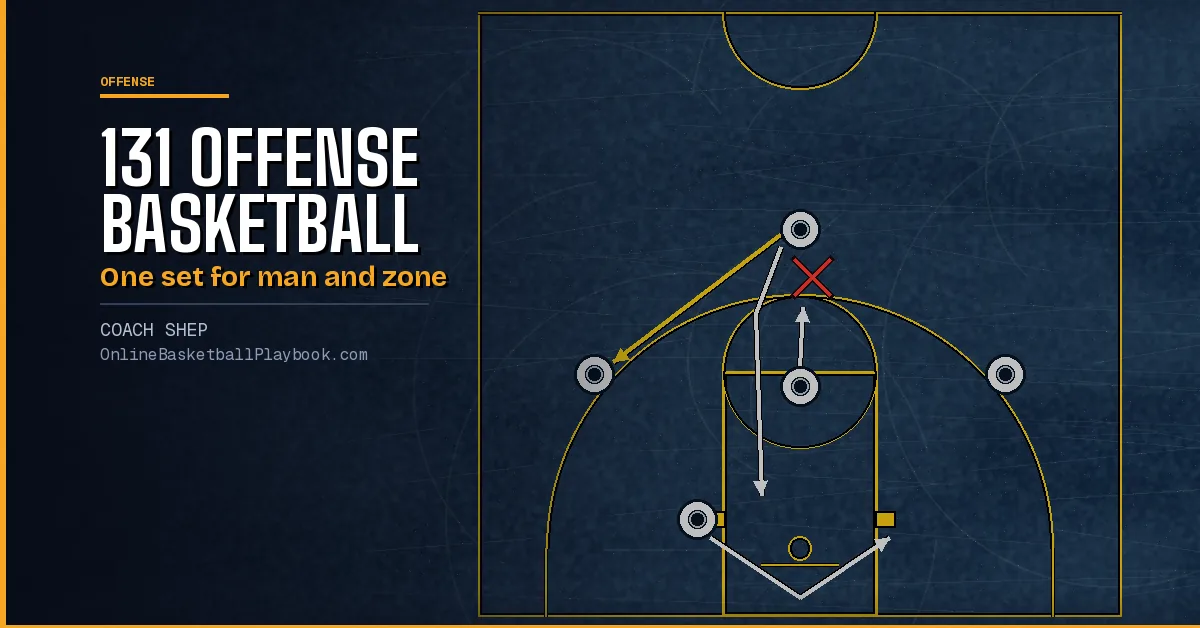
The 1-3-1 offense in basketball is an alignment: one player at the point, three across the middle (two wings and a high post) and one low post. This page is about running that set on offense. It is not about the 1-3-1 zone defense, which shares the numbers and is covered on 1-3-1 zone defense. The set is recommended because one alignment can attack both man-to-man and the 2-3 zone, which simplifies things for young teams and teams with limited practice time.
This 131 offense basketball guide covers the set, three motion patterns against man-to-man, the high-post options, two zone patterns against a 2-3, a youth plan and what changes when the defense is itself a 1-3-1 zone. It sits with the other read-based offenses on motion offense basketball, part of the offense section.
The 1-3-1 Set
The standard set puts 1 at the point, 2 and 3 on the wings, 5 at the high post and 4 on the low block. It is simple and easy to learn, with good spacing and both a high-post and a low-post presence, and it is recommended for youth and middle school teams.

The roles differ by pattern. In the motion patterns below, the high post screens, catches and makes hi-lo passes, and the low post posts up and moves from block to block. In the low-triangle zone offense, the jobs are a point who sets up the side, a middle player who patrols the high area of the key, two wings who make the big decisions and a baseline player who patrols between the short corners.
131 Offense Basketball Against Man-to-Man: Back-Screen Motion
Back-screen motion is the simplest of three motion patterns, and it chains two screens into a post touch.
- 1 passes to either wing. 4 moves to the block opposite the ball.
- 5 back-screens for 1, who cuts around the screen on the ball side. The wing can hit 1 for a layup or shot.
- If 1 is not open, he keeps going and screens for 4, who cuts to the ball-side block to post up. 5 moves back up to the free-throw line, and 2 swings out to the top of the key to hold the spacing.
- The wing feeds 4 for a post move. When 4 shoots, 1 goes to rebounding position on the opposite side. If the ball comes back out, 1 returns to the wing.


The wing's options:
- Hit the cutter. The cutting 1.
- Feed the post. The posting 4.
- Find the high post. 5 at the free-throw line.
- Swing it back. A pass back out to 2.
- Shoot. His own open shot.
If 4 is fronted in the low post, the wing passes to 5 at the high post and 4 seals his defender and steps into the paint for the pass from 5. The screening habits behind the pattern are taught on drills to teach off-ball screens. Set the screen, make the cut, then read.
High-Post Options Against Denial
When the defense denies the pass to the wings, enter to the high post instead. Four options:
- Back cut and back screen. 1 passes to 5. One wing takes his defender out high and back-cuts for a pass, and on the other side 4 back-screens for the far wing.
- The high post drives. If 5 is athletic, he shot-fakes and drives. With 4 out of the paint to set the back screen, there should be no help side, so it is one on one.
- Hand-off. The wing slides to the corner, 4 screens for the other wing, and that wing cuts around 5 for a hand-off and a drive. If 5's defender cheats over, 5 fakes the hand-off and drives himself.
- Hi-lo. If 4 posts well, he cuts into the middle of the paint for a quick pass from 5.
More on the high post as a hub is on attacking from the high post. Read the denial and use the high post.
UCLA Motion and Its Set Plays
UCLA motion is the fullest pattern in the series and is written for man-to-man only. It strings together a UCLA screen, a second screen for the cutter while the first screener cuts to the rim, a post-up and a reversal.
- UCLA cut. 1 passes to a wing and cuts around 4's screen for a give and go. 4 seals the screened defender.
- Second cut. If 1 is not open, he clears out around 5's screen, and 4, who now has inside position, cuts to the rim for the pass. If the defense switches and jams 1's cut, 4 can slip the screen. The opposite wing rotates out to the point.
- Post-up and flash. If 4 is not open on the cut, he posts on the ball-side block and 5 flashes to the ball-side elbow.
- Reversal. If neither post is open, the ball is reversed through the point or skipped, the two posts slide across the lane to the new ball side, and every option repeats there.
After the posts slide across, a gap opens up the far side of the lane, and the point can pass-fake and drive that seam with a kick-out to the corner. Three set plays come from the same set:
- High-post hi-lo. Read it off a high-post catch when the low post is fronted.
- Short-corner back screen. 4 back-screens for 1, who cuts to the short corner while 4 seals and rolls to the rim.
- Same-side posts. Both posts go on one side of the lane to open a driving seam on the other.
The aim is that players learn to play the game well enough that the coach no longer has to call plays.
Get the next coaching guide in your inbox
One email when a new guide or diagram set goes up. Free.
The 1-3-1 Against a 2-3 Zone
Start the 2-3 zone offense from a 1-3-1, because the one-guard front splits the two top defenders of the zone. Two patterns are drawn here, and more continuities and quick hitters are on 2-3 zone offense.
Corner overload. This zone pattern comes from the same motion series, written for a team that sees man-to-man one possession and a 2-3 or 2-1-2 zone the next. It helps to have a three-point shooter at 4, since he may get the corner shot.
- 1 passes to a wing and 4 sprints to the ball-side corner.
- The wing feeds 4 in the corner and cuts through for a possible return pass. If it does not come, he fills the opposite wing, 1 rotates to the ball-side wing and the far wing rotates to the point.
- 5 waits until the cutter has cleared, then dives from the high post to the low block for a pass from 4, which creates two-on-one chances on the overloaded side.
- If nothing is open, the ball is reversed quickly or skipped, 5 returns to the free-throw line and 4 follows the ball to the new ball-side corner, and the pattern repeats on the other side.

The pointers that go with it: reverse the ball quickly to make the zone shift, and use quick passes and pass fakes to move it.
The low triangle. This youth zone continuity changes the shape. The three middle players stand in a line about halfway between the free-throw line and the block, not at the free-throw line extended, and the wings start closer to the corners. That start makes the low defender of the 2-3 guard the ball on the wing, so the two posts can split the middle defender.
- The point dribbles to make an angle and passes to a low wing.
- The middle player steps toward the ball into the mid-post just outside the lane, and the baseline player moves to the ball-side short corner. With the wing, they form a triangle.
- The wing feeds either post. When the low defender takes the ball, the other post dives for the layup pass.
- If neither feed is there, the ball goes back to the point to reverse, or skips to the far wing for a long closeout and a drive. If the drive is not there, both posts slide across to build the triangle on the new side.

Tara VanDerveer's Stanford pattern. A patterned zone offense from a 1-3-1 with 4 shifted down to the corner, built to attack the short corner of a 2-3.
- Drag the low defender out. The corner player dribbles up.
- Cut behind the zone. The wing who passed to him cuts to the short corner, and the post sits above the block.
- Reverse if denied. If the short corner is denied, the ball reverses and the action repeats on the other side.
- Beat the trap. A counter was added for teams that trap the corner pass: a quick pass back out, then penetration or reversal.
Three more sets fit a team that lines up 1-3-1 against a zone, and each one shifts the zone with a pass or dribble before it attacks.
| Set | The action |
|---|---|
| Double dive | Hit the wing to shift the zone, both posts dive to the blocks, reverse to the point, who attacks and finds a post in the middle or the far wing fading to the corner |
| Double screen through | A wing dribble shifts the zone and returns the ball to the point. 4 screens the bottom outside defender, 5 screens the middle defender and 2 sprints through the double screen |
| Corner entry pin-down | A dribble entry to the corner, the point fills the wing, then 4 and 5 pin down the middle and bottom outside defenders as 2 cuts into the gap, with 5 slipping if his defender fights through |
Shift the zone first, then attack the gap.
1-3-1 Offense for Youth Basketball
The 1-3-1 suits youth teams.
- The motion patterns. They are pitched at youth and middle school teams because one set attacks both man-to-man and the common 2-3 zone, which simplifies things for teams with little practice time.
- The low triangle. It is written for young teams that keep throwing up long shots against a 2-3, and it is simple enough for inexperienced players while still working for older ones.
- VanDerveer's pattern. It is simple enough for youth teams while still being the base Stanford ran.
A 1-3-1 zone offense built with a 7th-grade team gives each position a short rule:
- Point guard. Keep the ball moving with little dribbling, except to split the top defenders or open a lane, and stay back on defense to stop the fast break.
- High post. Point toward the ball: the free-throw line when the ball is at the point, the elbow gap when it is on the wing, the low block when it is in the corner. Look to score, pass inside or pass to the far wing, and rebound.
- Low post. Run the baseline to the ball-side short corner, duck into the paint when the high post has the ball, and crash the offensive glass.
Teach it first on a clipboard with coins as players, so the kids can move the offense and find the gaps themselves, then on the floor with hoops and mats marking the gaps, for walk-throughs only. The principles for the whole team:
- Pass and move quickly.
- Dribble only with a purpose. Penetrate a gap, improve a passing angle or escape trouble.
- Crash the offensive glass. Zone defenders have no clear box-out assignment.
More youth offense ideas are on coaching youth basketball. Keep the rules short and let the kids find the gaps.
Zone Offense vs 1-3-1
When the defense is a 1-3-1 zone, many coaches change the offense's front. The rule is to line up where the zone is not: a two-guard zone such as the 2-3 gets a one-guard offense like the 1-3-1, and a one-guard zone such as the 1-3-1 gets a two-guard offense. Bill Self shifts to a 2-1-2 look against a 1-3-1.
A two-guard zone offense with a baseline runner shows the idea. Two guards split the top defender, both posts start low, and the best shooter runs the baseline to the ball-side corner. The guard engages the top defender with the dribble before feeding the corner, and if the baseline defender runs out to the corner, the ball-side post gets an easy feed.

Coaches split on this.
- Change the front. A two-guard front against the one-guard zone.
- Keep the 1-3-1 look. Run the standard 2-3 zone offense out of a 1-3-1 alignment against a trapping 1-3-1, so the offensive players line up almost man-to-man on the defenders and there is always an easy outlet. The low post runs short corner to short corner.
The full menu for this defense, including the corner skip, screens on the top and baseline defenders and overloads, is on how to beat a 1-3-1 zone defense, and the principles for every zone are on how to beat a zone defense. Decide your front before you see the zone.
Which Pattern to Teach
| Pattern | Against | What it needs |
|---|---|---|
| Back-screen motion | Man-to-man | A high post who can back-screen and a low post who can score on the block |
| High-post options | Wing denial | A high post who can catch, face up and pass, or drive if athletic |
| UCLA motion | Man-to-man | Two posts who can screen, seal and slip, and a point who can drive the seam |
| Corner overload | Man-to-man or a 2-3 / 2-1-2 zone | A low post who can shoot the corner three |
| Low triangle | 2-3 zone | Two posts who move side to side in the gaps and wings who drive and decide |
| Two-guard front | 1-3-1 zone | A shooter who can run the baseline and guards who engage the top defender |
Back-screen motion is the simplest pattern and UCLA motion the most advanced. Teams that also want a 5-out look can compare drills to teach motion offense.
Want the printable playbook packs?
OBP Pro members get the premium playbook packs: the zone attack, out of bounds and practice plan PDFs, plus each new pack as it is finished. The membership page lists what is in each one. Or draw your own version free in PlayDraw.
See what OBP Pro includesQuestions Coaches Ask
What is a 1-3-1 offense in basketball?
An alignment with one player at the point, two wings and a high post across the middle, and one low post. Coaches run motion patterns from it against man-to-man and zone patterns against a 2-3.
Is the 1-3-1 offense good for youth basketball?
It suits young teams. One set attacks both man-to-man and the 2-3 zone, which saves practice time, and the zone patterns are short enough for young players.
What is the best offense against a 1-3-1 zone?
Many zone coaches use a two-guard front against a 1-3-1, since it is a one-guard zone. A 1-3-1 alignment against a trapping 1-3-1 gives every player an outlet.
Does the 1-3-1 offense work against a 2-3 zone?
Yes. The one-guard front splits the two top defenders, and patterns such as the corner overload and the low triangle are built for the 2-3.
Is the 1-3-1 offense the same as the 1-3-1 zone?
No. The 1-3-1 offense is how the offense lines up. The 1-3-1 zone is a defense with one player at the top of the key, three across the middle and one on the baseline.
More Guides From This Batch
- Spread Offense Basketball: Alignments, Rules and Versions
- Basketball Coaching Tips: Practice, Talk, Games and Parents
- Basketball Coaching Philosophy: Examples and a Template
- List of Basketball Violations: Every Violation by Level
Back to Motion Offense and every Offense page.
Keep Building
Related breakdowns
Dribble Drive Zones: Rack, Drag, Drop and Breakdown Explained
Dribble drive zones explained: the maps of the Rack, Drag, Drop, Breakdown and Blow Out zones, what to do in each, the stops, and the call words built on them.
Basketball Quick Hitters: 25 Sets by Action and Formation
Basketball quick hitters sorted by the action you want, catch-and-shoot to post feed, with each set's formation, diagrams, the read and the counter.
Princeton Offense Drills: Breakdowns, Shooting and Live Reps
Princeton offense drills that teach the reads: spacing, backdoor and hand-off breakdowns, 3-0 Chin and wave drills, Point shooting, a drive drill and an install.