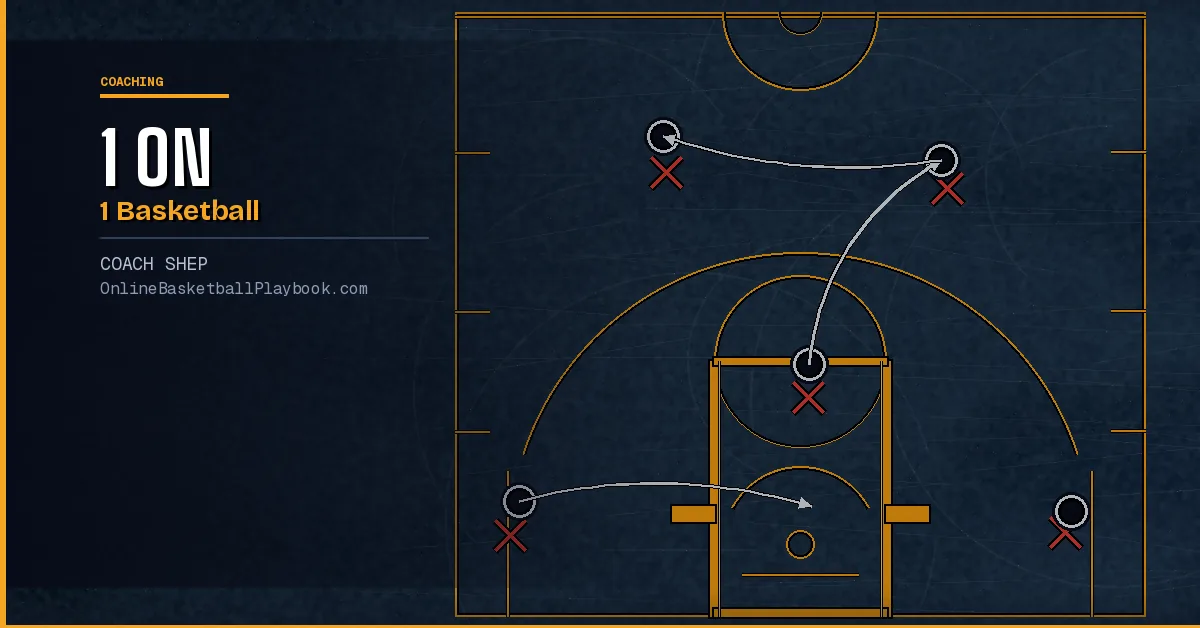
Every great defensive team is built on individual defenders who can guard the ball. This guide covers the stance, footwork, pressure principles, and screen survival skills that let any player win 1-on-1 battles.
The Defensive Stance
Before any footwork drill, before any scheme, the stance has to be right. Coaches call it "bucket down": knees bent, weight on the balls of the feet, chest out, hands and feet shoulder-width apart. The inside hand mirrors the ball, ideally touching it as often as possible. The outside hand acts as a deflector.
The common mistake at every level is treating the stance as a resting position. It is not. A good defensive stance is active and energized. The moment a defender drops his heels to the floor, he loses the ability to move first. He can only react, and reaction is always one step behind.
Think of the stance as the chair: knees above the toes, seat low, back straight. Your weight should feel balanced over the balls of your feet at all times. When you move, you push off that position. When you stop, you return to it. Coaches who drill this use the Slide drill. Defenders in stance, moving laterally to a hand signal without ever crossing their feet.
One simple check: watch the defender's head. It should move slightly up and down as the knees bend and extend during movement. A head that stays flat means flat feet, which means a defender who cannot change direction quickly.
Three Footwork Tools
Most defenders, especially young ones, backpedal when the ball-handler drives. Backpedaling loses the angle almost every time. There are three specific footwork tools that replace the backpedal, and they can be taught in isolation before any team concept is introduced.
The Retreat Step
When the dribbler attacks, drop the threatened foot back and open the angle. You are not backpedaling. You are pivoting your body to open toward the direction of the drive, which allows you to run with the ball-handler rather than chasing from behind. The retreat step is the most important of the three because drives are the most common attack.
The Advance Step
Rather than waiting for the ball-handler to set up and attack, force the dribble before the offense gets organized. Take an aggressive step toward the ball. This puts the offensive player on his heels and takes away his ability to read the defense before committing. The advance step is particularly effective in the half-court against methodical ball-handlers who rely on setting up their drive.
The Swing Step
When the dribbler tries to drive toward your front foot, swing your opposite foot to cut off the angle. This prevents the blow-by without requiring you to retreat. The swing step is a counter move. You use it when the ball-handler has committed his shoulders to a direction and you need to seal the lane.
These three tools are taught in isolation in Morgan Wootten's system using the Slide and "Hey!" drills before any 5-on-5 work begins. Five minutes on these drills at the start of every defensive session builds the muscle memory that makes on-ball defense consistent under game pressure.
Pressure Principles
The two unacceptable outcomes in 1-on-1 defense are straight-line drives to the rim and lob passes over the top. Every other result (a contested mid-range jumper, a pull-up three, a pass that takes one extra second to deliver) is a win for the defense. Keep those two forbidden outcomes in mind and most on-ball decisions become simple.
Nose on the Ball
The best on-ball cue is specific: keep your nose on the ball-handler's ball hand, not his hip, not his chest, not his torso. This keeps the defender in the offensive player's field of vision, which creates psychological pressure, and it positions the defender to deflect without reaching. Reaching is a foul. Nose-on-the-ball is the posture that makes deflections happen cleanly.
Rick Pitino frames the risk the other way: "If you allow an offensive player to set up in the middle of the floor where they can shoot, pass, and drive, you are giving them too many options." The goal of every on-ball positioning decision is to eliminate at least one of those three options at all times.
Force the Extra Pass, Not the Turnover
The mental goal of on-ball pressure is to make the offense handle the ball more times than they want to, farther from the basket than they want to be. This framing matters because it prevents reaching. Defenders who chase turnovers reach for the ball, pick up fouls, and get blown by. Defenders who are trying to force the extra pass stay disciplined.
Frank Martin's cue: "Back up on a jab or a fake. Don't go side-to-side." Going sideways when the offense jabs or shot-fakes opens a gap alongside the defender rather than in front of him, which is actually worse than getting beaten straight-line.
Belly Up on the Dead Dribble
The instant a ball-handler picks up his dribble, the on-ball defender should crowd the space. Both feet close, both hands active. A dead-ball-handler has no option but to pass. At that moment, the defender's job is to shrink the passing lanes and apply maximum legal pressure without fouling. Coaches call this "violent hands": active, quick, relentless hand movement that disrupts passing angles without grabbing.
Teach "belly up on the dead dribble" as a conditioned reflex from day one. In practice, call it out loud every time a ball-handler picks up his dribble in a 1-on-1 rep. After two weeks, your defenders will do it automatically in games without a verbal cue, and it is one of the highest-leverage habits in on-ball defense.
Denial and Closeouts
On-ball defense does not start when the player catches the pass. It starts before the catch, in denial positioning. And it does not end when the player drives. It includes the closeout when the ball swings.
Wing Denial
When guarding a player one pass away on the wing, the defender's body goes between the ball and the man with one body part (typically the near arm extended) in the passing lane. The feet angle toward the ball, not toward the offensive player. This stance invites the backdoor cut while keeping help in position to intercept the lob. The key read is a flat triangle: the defender should be able to see both his man and the ball without turning his head fully to either side.
High-Post Denial
The high post (the elbow) is one of the most dangerous catch points on the floor. A player who receives the ball at the elbow can shoot immediately, drive baseline or middle, or feed the low post. Denying the catch is the highest-percentage defensive play. The high-post defender in Wootten's 22-Tough system never rotates off his man. He is the one immovable anchor. Body in the passing lane, active hands, constant pressure before the ball arrives.
The Closeout
Dick Bennett's closeout rule is the clearest version of this skill in the coaching literature: sprint two-thirds of the distance to the ball, then chop steps for the final third. High hands throughout: the hand in the shot pocket disrupts rhythm even if the shot goes up. Arrive low and wide, not running past the offensive player. Then settle into stance, level off the dribble, and take away the straight drive.
The two most common closeout mistakes are arriving out of control (running past the shooter and giving up the drive) and arriving with low hands (letting the shooter get into rhythm before any pressure arrives). The chop-step approach solves both.
Surviving Ball Screens
Ball screens are where individual on-ball defense most often breaks down. The defender who is excellent 1-on-1 in isolation frequently gets lost when a screener arrives. Three things fix this.
Communication Before the Screen
The on-ball defender must know the screen is coming before it arrives. That information comes from two sources: seeing the screener approaching in peripheral vision, or hearing a teammate call it. Dick Bennett's rule is simple and hard to argue with: "If you touch your man at all times, you cannot be screened without knowing it." Maintaining forearm contact with the offensive player you are guarding means you feel the screen the instant it makes contact. You are never surprised.
Three Options at the Screen
Each option is tied to a scouting read on the ball-handler, not a default preference.
Fight over the top: Used against a shooter. The screener's defender opens up to create a gap. The on-ball defender fights through that gap rather than going around the outside of the screener. Hard and physical. This is the default against anyone who can make pull-up or catch-and-shoot threes.
Go underneath: Used against a non-shooter. The screener's defender steps off the screener, and the on-ball defender goes below the screen. This frees up the curl but takes away the pull-up. Appropriate only when the data is clear that the ball-handler cannot shoot the three.
Switch: Emergency option. Wootten: switching handicaps your team late in the season because it creates mismatches that compound over time. Use it only if the team is mature enough to re-sort immediately. For younger teams, switching is a crutch that hides the inability to fight through screens, and good offenses will hunt the mismatch the switch creates.
The Wall Principle
Multiple elite defensive systems use the same image to anchor on-ball behavior: the defender is a wall between the ball-handler and the basket. A wall has three properties. It does not move backward when pushed. It does not lunge forward. It has no gaps. Applied to basketball defense, those three properties translate into specific habits.
Do not retreat on a shot fake. Pitino's line: "Never leave your feet with your feet." The shot fake is designed to make the defender jump or lean forward, opening space for a drive. A wall does not move forward on contact. Neither should the defender. Stay grounded, stay between the ball-handler and the rim, and contest from your feet.
Do not reach for the ball. The lunge is the gap. When a defender reaches, his weight shifts forward and his feet stop moving. That is the moment the ball-handler changes direction and goes straight to the rim. Reaching is not aggressive defense. It is the exact mistake the offensive player is looking for.
Stay between the ball and the rim. The rim is what the defense is protecting, not the three-point line. This mental image keeps the defender from chasing the ball laterally across the floor and losing his position between the handler and the basket.
Pitino adds one mechanical detail with outsized practical value: thumbs pointing toward the shoulders in the stance. This elbow angle keeps the hands quick and narrows the over-the-shoulder passing lane simultaneously.
Coaching Standards by Level
On-ball defense should be taught progressively, with clear standards at each level so players know exactly what is expected of them.
JV standard: No blow-by straight to the rim. Contest every shot. Communicate ball screens. Call them out loud before they arrive. Build the wall, hold the wall. Do not switch unless the coach calls it explicitly.
Varsity standard: Everything in the JV standard, plus: fight over every screen against a shooter regardless of how physical it gets. Allow no rhythm shots. Close out with high hands on every catch. Force the extra pass on every possession. Belly up instantly every time the dribble stops. Earn the right to guard the other team's best player by mastering every habit on this page.
The progression matters because the JV standard is achievable for players at any athleticism level. No blow-by straight to the rim is a will decision as much as a skill decision. Once that standard becomes habit, the varsity additions are refinements built on a solid foundation rather than new concepts layered onto chaos.
- Teach the three footwork tools in isolation first: Retreat step, advance step, and swing step each get their own drill reps before any 5-on-5 work. Most youth defenders know none of them.
- Install "nose on the ball" as the primary on-ball cue: Replace the vague "guard him" with a specific target the defender can track regardless of what the ball-handler does.
- Drill the closeout with high hands every session: Sprint two-thirds, chop-step one-third, arrive with the hand in the shot pocket. One drill session builds a habit that pays off against rhythm shooters all season.
- Call "belly up" out loud whenever the dribble stops: Condition the reflex in practice so it fires automatically in games without a verbal trigger.
- Communicate screens as a team standard, not an individual skill: The on-ball defender cannot see everything. Train the weak-side defenders to call picks early and loud so the on-ball man is never surprised by a screener he did not see coming.
Want more basketball coaching strategies and drills?
Join the Online Basketball Playbook newsletter →
Draw this play free in the play drawer →
Membership: the full library, playbook packs, and Pro drawing tools →
Keep Building
Related breakdowns
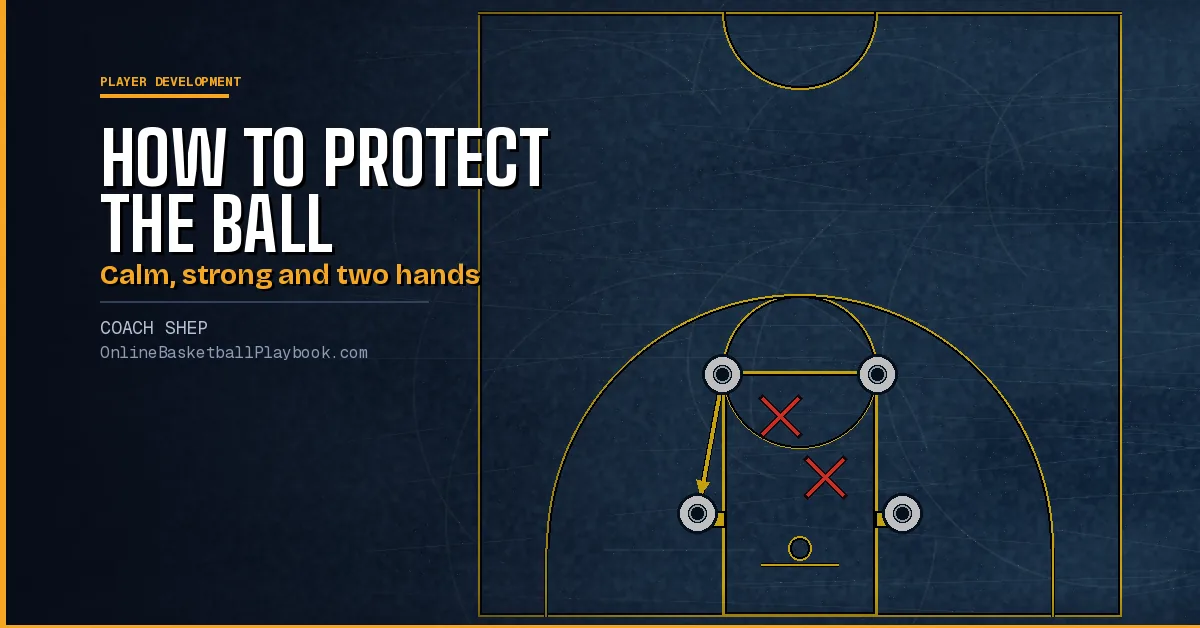
How to Protect the Ball: Ball Security and Fewer Turnovers
How to protect the ball in basketball: where turnovers come from, ripping and catching, the sure pass, beating a trap, ball security drills and pricing turnovers.
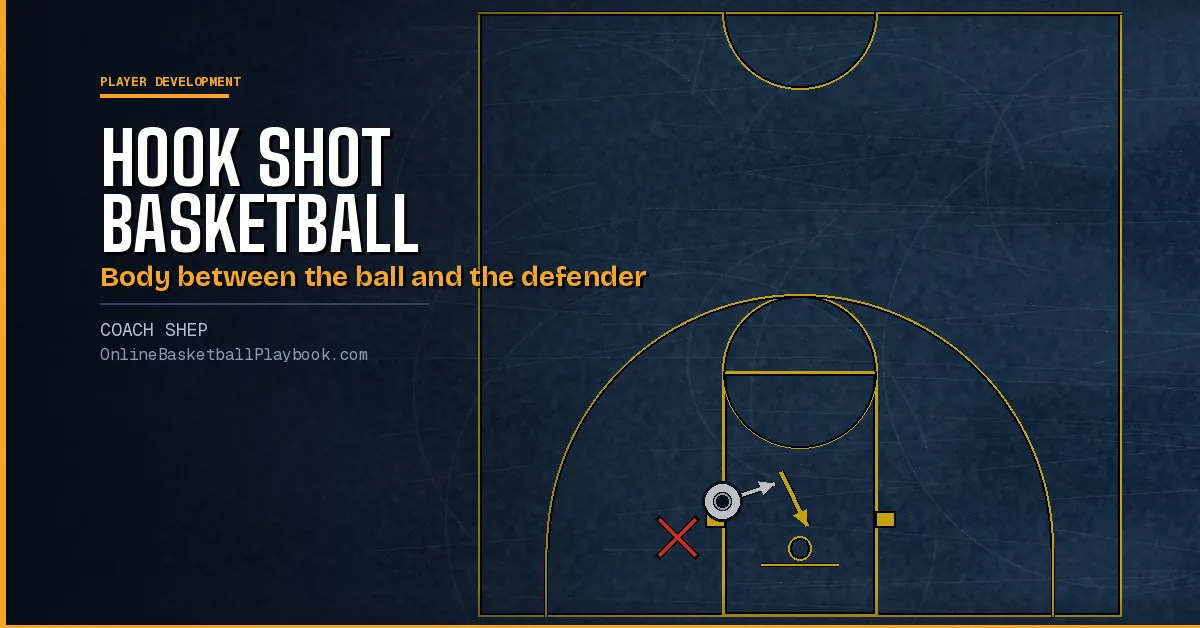
Hook Shot Basketball: How to Do It and How to Teach It
Hook shot basketball for post players and coaches: the classic hook, sky hook and jump hook, the footwork steps, when to use it, the pivot foot rules and drills.
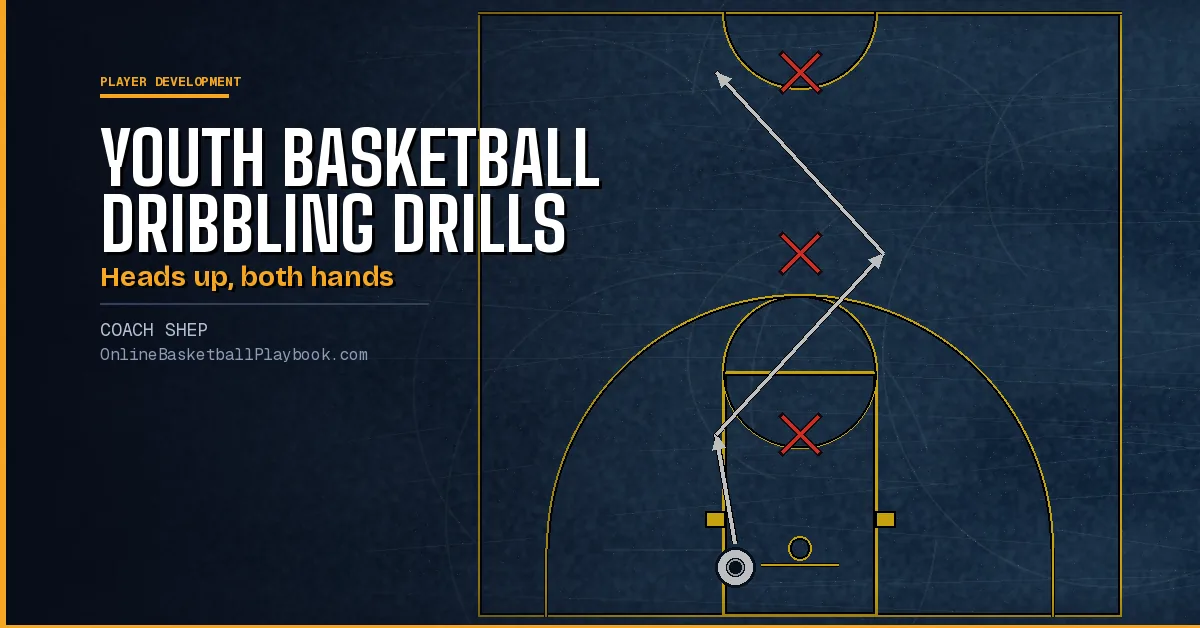
Youth Basketball Dribbling Drills: Cone Drills and Games by Age
Youth basketball dribbling drills for kids: finger-pad work, eyes-up games, cone dribbling drills, line drills and harder drills by age.