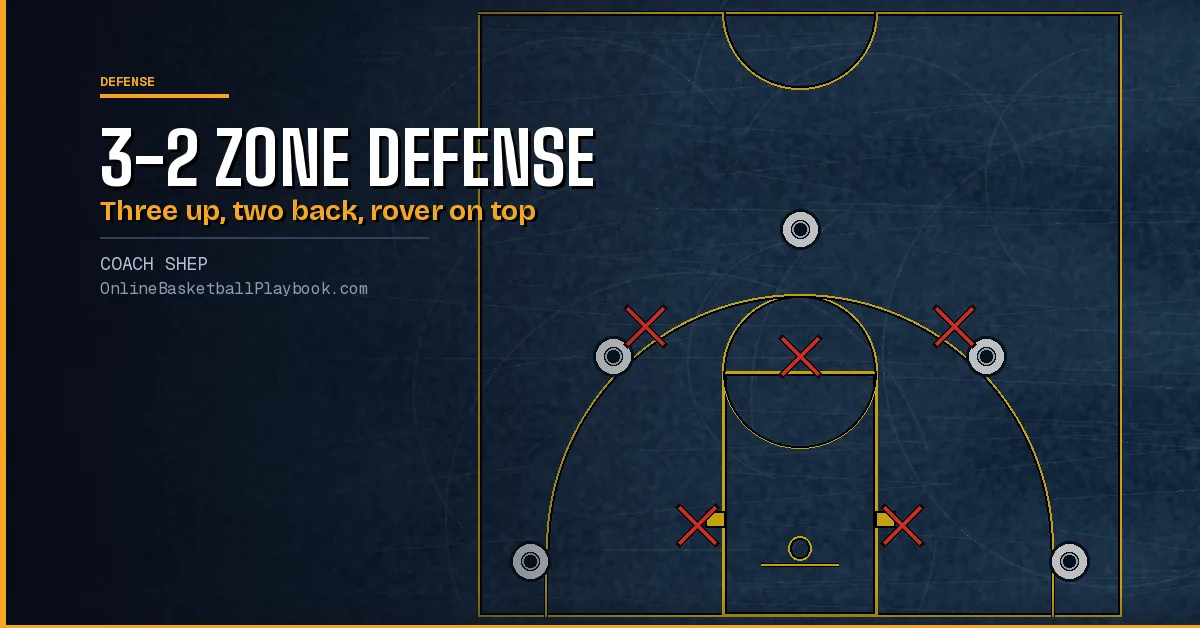
The 3-2 zone defense flips the 2-3. Three defenders stand across the free-throw line and two guard the blocks. The middle player of the three, called the rover, sits on the high post, and the two wings deny the wing pass. The ball handler at the top of the key is left alone on purpose. This guide covers the alignment, every rotation, the weak spots, the 3-2 matchup zone and the drills.
The 3-2 Zone Defense at a Glance
| Piece | Where he plays | Main job |
|---|---|---|
| Rover | Middle of the front three, on the free-throw line | Own the high post, pick off lobs, crash the glass. Usually a long, athletic forward |
| Two wings | Either side of the rover | Deny the wing pass and trap. Usually guards |
| Two back players | The blocks | Guard both blocks and both corners |
3-2 Zone Defense Diagram: Alignment and Roles

Do not confuse the 3-2 with the 1-2-2. In the 1-2-2 the top defender pressures the ball and the wings pinch to protect the high post, which allows the wing pass. In the 3-2 the middle player of the front line sags to the free-throw line with his arms wide, and the wings deny their men. The two are different defenses even though people mix up the names.
The two back players carry an unusual load. They guard both blocks and both corners with one fewer helper than the 2-3. They need to be bigger and more mobile than a 2-3 back line.
How to Run the 3-2 Zone Defense
Everyone moves on the flight of the ball, like every zone. The shape asks a lot of the front line, because it has to deny passes as well as react to them.
Ball at the top of the key. The rover stands on the free-throw line with his arms wide. Both wings are in full denial. The offense must play through the elbows or skip to a corner.

Ball on the wing. The wing defender pressures the ball. The rover slides to keep denying the high post. The weak-side wing drops into the key to stop flashes. The strong-side post fronts the low post, because that player also has the corner to cover.

Ball in the corner. The strong-side post steps out to the ball. The weak-side post slides to the ball-side block and plays behind. The weak-side wing drops toward the basket and the rover steps toward the ball.
The best trap in this zone is the corner. The strong-side post and strong-side wing double with high hands and no reaching, while the weak-side post is already on the ball-side block. The rotations are simple and the risk of a layup is low.
Get the next coaching guide in your inbox
One email when a new guide or diagram set goes up. Free.
The High Post

A high post entry is the vulnerable moment. The rover takes the ball. Both posts pinch in, and both wings drop to the middle ground between the high post and the corner. The goal is to force the pass back out. Every shooter is one short pass away, so the pinch has to be quick and the closeouts short.
Skip Passes

On a skip pass the weak-side wing closes out first. He takes the high side and pushes the shooter toward the post defender. The post then bumps him back to the free-throw line. Everyone changes sides while the ball is in the air.
Offenses often screen the low defenders on a skip from the top of the key to the corner. The posts should fight for top position and keep a clear path to the corner.
Weak Spots in the 3-2 Zone
- Dribble penetration. With only two low defenders, penetration is the real weakness. From the top of the key the ball-side post steps up and the ball-side wing drops to take the corner three. From the wing the post stops the drive a couple of feet outside the paint and must be ready to sprint to the corner.
- Baseline drives. Coaches disagree. One view says a baseline drive should never happen, so the post closes out and forces the ball to the middle. If one does happen, both posts trap it and the rover drops to the middle. A 2-3 handles a corner drive differently, with a fronting center behind the play.
- Corner-to-corner skip. A team with shooters in both corners can create a two-on-two the top line cannot help quickly enough. The skip is nearly the same weakness the 1-3-1 has.
- Open shots at the top of the key. The point guard gets some room on purpose. If he can really shoot, some coaches shade toward a 1-2-2 or a 1-3-1.
- Overloads. Three attackers on one side against two back defenders forces a corner shot or a high post dump-off. The back defender has to call his choice before the catch.
To see these spots from the offense, read How to Beat a 3-2 Zone.
Rebounding
Rebounding is a hidden strength. Every perimeter shot produces a triangle. The weak-side post takes the ball-side low spot, the rover takes the top of the key and the weak-side wing takes the weak-side low spot. On wing shots the strong-side post adds a fourth body. The shape also gets defenders into their break lanes when a shot goes up.
The 3-2 Matchup Zone

A matchup zone looks like a zone and plays with man rules. Every offensive player who enters a defender's area belongs to that defender. If nobody is in his area, he backs up and finds the nearest open man. Some coaches run a 3-2 matchup as a named situational call. Use it with a big lead or when a key player is in foul trouble. It is a hard zone to attack.
The rules that make a matchup work:
- Call every cutter out loud. A silent handoff breaks down every few possessions.
- Never cross over another defender at the handoff. Exchange cleanly at the seam.
- Keep a foot in the paint on the weak side. One defender on the ball and four in help.
- Front the post.
- Use a reset call when anyone gets confused. Everyone returns to the base shape and matches up again.
Coaches split on cutters. Some hand off every cutter automatically. Others let a cutter who moves away from the ball go and play a cutter toward the ball one on one until a teammate takes him. It is a talking defense, so save it for a group that talks. The full breakdown is on How to Coach a Matchup Zone Defense.
3-2 Zone Defense Drills
- Skip-pass closeouts. Drill the corner skip closeout as hard as a man closeout. One drill serves both the 3-2 and the 1-3-1.
- Post-to-corner closeout. Time the long run from the block to the corner and coach it until the post arrives with a hand up.
- Zone slides with a pass fake. The passers move slowly and fake first. Speed up only when the slides are right.
- Rebound triangle. Shoot from every spot and check the three or four assigned areas.
- Overload 3-on-2. Three attackers on one side against your two back defenders. The back players learn to call the choice before the catch.
- Handoff walkthrough. If you run the matchup, teach the language first, then add cutters at game speed.
When to Pick the 3-2
- Your opponent runs its offense through the high post.
- Your opponent cannot shoot from the top of the key. Coaches split here. Some say never use it against a team that can shoot from the top of the key, others pitch it against shooters. Check where the shooting actually comes from before you choose.
- Your team already runs a 1-2-2 press. The 3-2 costs almost nothing to add, because the press drops into it without new spots.
- You have two back players who can cover the blocks and the corners. If they cannot, choose the 2-3.
- Your opponent shoots well in both corners or drives the gaps. Be careful.
- Keep the 2-3 as your base and the 3-2 as the change-up, or the reverse. Full comparison on 2-3 Zone vs 3-2 Zone.
Questions Coaches Ask About the 3-2 Zone Defense
What is a 3-2 zone defense?
A zone with three defenders across the free-throw line and two on the blocks. The middle front player, the rover, guards the high post and the wings deny the wing pass.
What is the weakness of a 3-2 zone?
Dribble penetration and the corners. Only two defenders guard the paint and both corners, so a corner-to-corner skip or a drive into the gap hurts it.
What is the difference between a 3-2 and a 1-2-2 zone?
In the 1-2-2 the top defender pressures the ball and the wings pinch to the high post. In the 3-2 the top of the key is left alone and the wings deny the wing pass.
What is a 3-2 matchup zone?
A 3-2 shape that guards like man-to-man inside each defender's area. Some coaches use it to protect a big lead.
How do you beat a 3-2 zone?
Overload one side, reverse the ball, skip to the corner, and attack the short corner. See the offense page for the full plan.
Every defense sits under the Defense hub and Types of Defense in Basketball. Related pages are 2-3 Zone Defense, 1-2-2 Zone Defense, 1-2-2 Press and Best Zone Defense for Your Team.
Want the printable playbook packs?
OBP Pro members get the premium playbook packs: the zone attack, out of bounds and practice plan PDFs, plus each new pack as it is finished. The membership page lists what is in each one. Or draw your own version free in PlayDraw.
See what OBP Pro includesMore Zone and Junk Defenses
- 2-3 Zone Defense: Rotations, Weak Spots and Drills
- 1-3-1 Zone Defense: Traps, Rotations and Drills
- Box and 1 Defense: How It Works and How to Beat It
Back to Types of Defense and every Defense page.
Keep Building
Related breakdowns
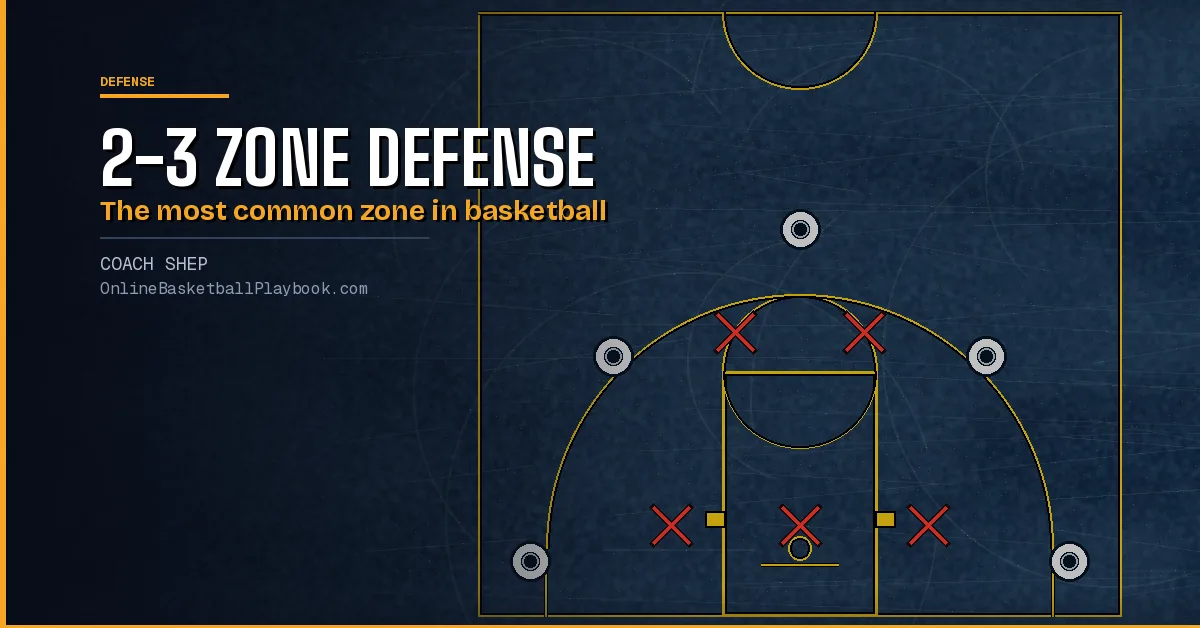
2-3 Zone Defense: Rotations, Weak Spots and Drills
How to play the 2-3 zone defense: the starting positions, how it shifts to the ball, where it leaks, when to trap, and the drills that install it.
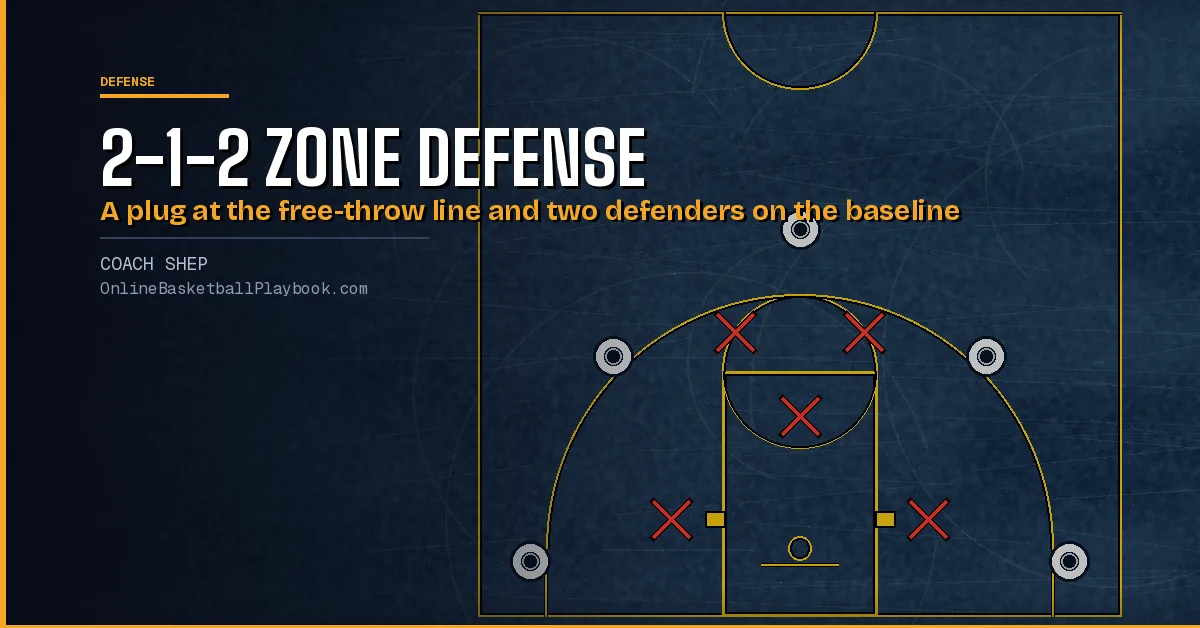
2-1-2 Zone Defense: Rotations, Weak Spots and Personnel
2-1-2 zone defense guide with the alignment, rotations by ball location, how it differs from the 2-3, who plays the middle and its weak spots.
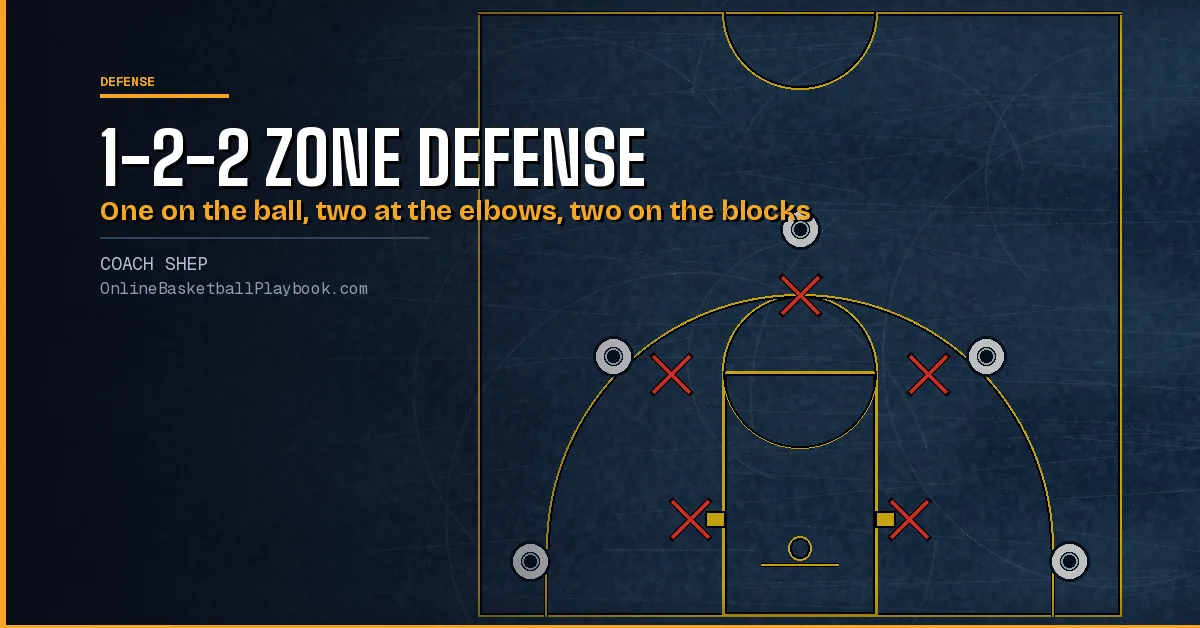
1-2-2 Zone Defense: Rotations, Weak Spots and Drills
How to run the 1-2-2 zone defense: the five roles, rotations for every ball spot, the corner trap, the high post problem, the variations coaches run and the drills.