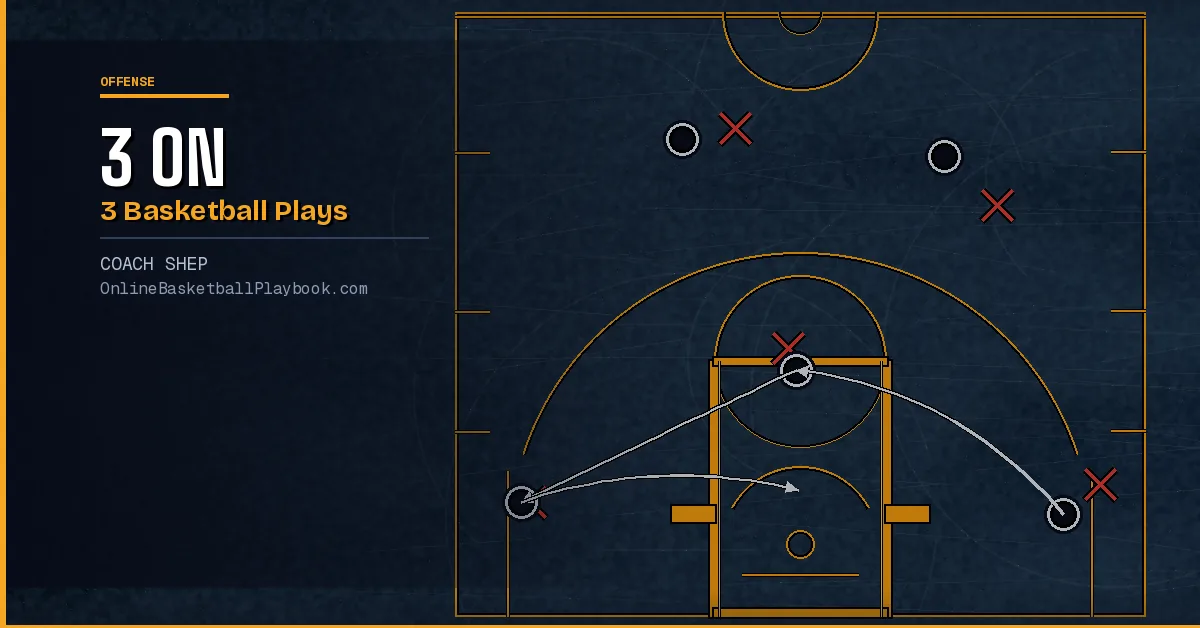
Three-on-three basketball strips the game to its bones: spacing, reads, and individual skill. These plays give you proven structures to run in pickup, league competition, or practice drills.
Why 3-on-3 Matters for Player Development
Three-on-three is not a watered-down version of the real game. At every level from recreational leagues to the Olympics, 3-on-3 demands the same reads, the same footwork, and the same decision-making that full-court basketball requires, compressed into a tighter space with far fewer hiding spots. Every player touches the ball more. Every player must guard. Every player must make decisions in real time without the option of deferring to a set play that someone else will execute.
For coaches, that compression is the point. When you run a 5-on-5 practice, a struggling player can obscure his weaknesses behind teammates who cover for him. In 3-on-3, there is nowhere to hide. The player who cannot dribble under pressure gets exposed. The player who refuses to move without the ball kills the spacing immediately. The player who cannot guard his man in a straight-line drive gives up a bucket on every possession.
That accountability is why so many elite programs use small-sided games as the foundation of their development work. The plays in this guide are designed with that context in mind. They are not gimmicks for a pickup game. They are structured actions built on sound offensive principles that will translate directly to 5-on-5 basketball.
Core Spacing Principles for 3-on-3
Before running any specific play, every player on the floor needs to understand the two non-negotiable rules of 3-on-3 spacing: stay wide and stay spaced.
Stay Wide
With only three offensive players, the floor must be stretched horizontally at all times. The moment two offensive players collapse toward the same area, the defense gets a free defender, and free defenders in 3-on-3 do not have much ground to cover before they are affecting the ball. The standard setup is one player at the top of the key and one player in each corner, or one player at the top of the key and one player on each wing at roughly 45 degrees. Neither corner nor wing player should drift toward the paint without a specific reason tied to the play.
Stay Spaced
Spacing in 3-on-3 is not just horizontal. It is also vertical. A corner player who drifts up to the elbow is no longer a kick-out threat. A wing player who cuts through the lane and does not relocate leaves the ball-handler with one fewer option. After every cut or action, the off-ball players have a responsibility to reset to a position that stresses the defense in two directions simultaneously. The defense cannot guard two threats in different time zones. That is the foundation of every play below.
Ball Movement vs. Dribble Drive
In 3-on-3, both approaches work, but they require different spacing reads. Ball-movement offenses (skip passes, reversal, pass-and-cut) thrive when defensive rotations are late. Dribble-drive attacks thrive when the defense overplays the pass. The plays below cover both. Know which one your personnel executes best and build your game plan around it.
The Horns Set: Pick-and-Roll Entry
The Horns set is one of the most adaptable actions in basketball at any level, and in 3-on-3, it is especially lethal because there is only one off-ball defender to account for after the screen.
Setup
Player 1 (the ball-handler) starts at the top of the key with the ball. Players 2 and 3 set up at each elbow, forming the two horns. This is a legitimate 3-on-3 setup that does not require any pre-play movement.
Action
Player 1 dribbles toward either horn (let's say Player 2 on the right elbow). Player 2 immediately sets a ball screen on Player 1's defender. Player 3 on the left elbow reads the defense:
- If the defense hedges hard on the screen, Player 3 relocates to the weakside corner for a skip pass and open three-pointer.
- If the defense drops under the screen, Player 1 uses the screen to get downhill and attacks the rim, with Player 2 rolling hard to the short corner after the screen.
- If the defense switches, Player 1 immediately looks to Player 2 (the screener), who has a size advantage on a switched guard defending him near the block.
Why It Works in 3-on-3
With only one off-ball defender, there is no weakside help waiting to stop the roll. If the defense sends two players to stop the ball-handler off the screen, the roll man and the skip receiver are both open. The Horns set forces the defense to make a binary choice, and both answers hurt them.
The Side Pick-and-Roll with Corner Kick
This is the most common action in professional 3-on-3 play, and for good reason. It combines a high-percentage scoring action (the side ball screen) with a release valve that punishes defensive overreactions.
Setup
Player 1 starts on the right wing with the ball. Player 2 is in the left corner. Player 3 sets up at the left elbow, ready to screen.
Action
Player 3 sprints across the lane to set a side ball screen on Player 1's defender. Player 1 uses the screen to attack the paint off the dribble. Player 2 in the left corner is the primary kick-out option. As Player 1 drives, Player 2 should be ready to catch and shoot a three-pointer from the corner.
If the defensive help rotates toward Player 1's drive, the pass goes to Player 2 for the corner three. If the defense stays home on Player 2 and two defenders account for Player 1, then Player 3 (the screener) rolls hard to the basket and catches a dump-off pass for a layup or short floater.
Countering the Defense
Defenses that have seen this action will try to go under the screen to take away the drive. The counter is simple: Player 1 receives the screen and immediately pulls up for a mid-range or three-point shot off the screen. As soon as the defender starts cheating under the screen to take away the drive, the pull-up becomes available. Running the base action a few times before using the pull-up counter creates the exact defensive dilemma you want.
Run the base drive action two or three times before showing the pull-up counter. Defenders who have been beaten on the drive will overcorrect and start hedging. That is the moment to take the pull-up off the screen while they are out of position chasing the ball-handler's shoulders.
The Dribble-Drive Triangle
This play is ideal when your best player is your ball-handler, a point guard or wing who can create off the bounce and has the vision to find open teammates.
Setup
Player 1 starts at the top of the key with the ball. Player 2 is on the right wing. Player 3 is in the left corner. This triangle of three players creates maximum horizontal spacing while giving Player 1 two distinct kick-out options on opposite sides of the floor.
Action
Player 1 reads the defense and attacks the most vulnerable gap (typically the right or left side of the lane based on where the defensive pressure is lightest). The key to this play is Player 2 and Player 3 reading the drive and moving to the correct spots:
- Player 2 (right wing): If Player 1 drives right, Player 2 lifts to the right corner to keep the spacing. If Player 1 drives left, Player 2 stays put as the strong-side kick-out.
- Player 3 (left corner): If Player 1 drives left, Player 3 lifts to the weakside wing to become a skip-pass option. If Player 1 drives right, Player 3 is the early help-side escape valve.
Pass-and-Cut Variation
The Dribble-Drive Triangle has a natural pass-and-cut variation that punishes help-side defenders who cheat off their man. Player 1 makes a simple pass to Player 2 on the wing, then immediately cuts hard through the lane using a V-cut or banana cut toward the rim. If Player 1's defender ball-watches or relaxes off the cut, Player 2 delivers the pass for an easy layup. If the defense stops the cut, Player 2 now has Player 3 in the corner as a swing option, and the defense has rotated one step in the wrong direction.
How to Guard 3-on-3 Plays
Understanding these plays from the offensive side is only half the equation. To be a complete 3-on-3 player, you need to know how the defense should respond (both because it makes you a better defender and because it tells you exactly how to attack when the defense overreacts).
On-Ball Fundamentals Are Everything
In 3-on-3 there is nowhere for a weak on-ball defender to hide. The ball-handler's defender must be able to stay in front without fouling, contest the shot without leaving his feet on a fake, and communicate when a screen is coming. The baseline and sideline are active co-defenders. Force the ball to them and eliminate the straight-line drive to the rim.
Hedge vs. Drop vs. Switch
On every ball screen, the two defenders involved must make a coordinated call before the screen arrives. Hedging (where the screener's defender steps out to slow the ball-handler) works best against a guard who needs space to create. Dropping (where the screener's defender stays back to protect the rim) works best against a non-shooter who will pull up for a mid-range jumper rather than attacking all the way to the basket. Switching works as a clean solution when the two defenders are close enough in size and speed to trade assignments without creating a mismatch.
Communication Is Non-Negotiable
In 3-on-3, every screen must be called out loud before it arrives. "Screen right," "screen left," or "ball screen" gives the on-ball defender a half-second to react rather than being taken by surprise. That half-second is the difference between a clean defensive stop and an open layup. Make the call early and make it loud. It costs nothing and prevents the most common breakdowns.
- Call every screen before it arrives: "Screen right!" or "Ball screen!" gives your teammate a half-second to react, which is all they need to stay in front of the dribbler.
- Force baseline, not middle: In 3-on-3 there is no weak-side help to stop a straight-line drive, so taking away the middle is the single most important defensive discipline on every possession.
- Belly up the moment the dribble stops: The instant the ball-handler picks up his dribble, close the gap aggressively with two active hands. A dead ball-handler with no passing lane is a free stop.
- Communicate the switch call before the screen, not after: Switching post-screen is always a step behind. A pre-agreed switch means both defenders move simultaneously and the offense gets no advantage.
- Contest every shot with a hand in the shooter's face: A contested shot in 3-on-3 lowers the opponent's percentage by more than any single rotation, and it costs you nothing when your closeout footwork is right.
Want more basketball coaching strategies and drills?
Join the Online Basketball Playbook newsletter →
Draw this play free in the play drawer →
Membership: the full library, playbook packs, and Pro drawing tools →
Keep Building
Related breakdowns
Basketball Quick Hitters: 25 Sets by Action and Formation
Basketball quick hitters sorted by the action you want, catch-and-shoot to post feed, with each set's formation, diagrams, the read and the counter.
Princeton Offense Drills: Breakdowns, Shooting and Live Reps
Princeton offense drills that teach the reads: spacing, backdoor and hand-off breakdowns, 3-0 Chin and wave drills, Point shooting, a drive drill and an install.
Four Corners Offense Basketball: Roles, Rules and Versions
Four corners offense basketball: the set, the chaser, the corner and post rules, three versions, when to run it, the shots it hunts and shot clock limits by level.