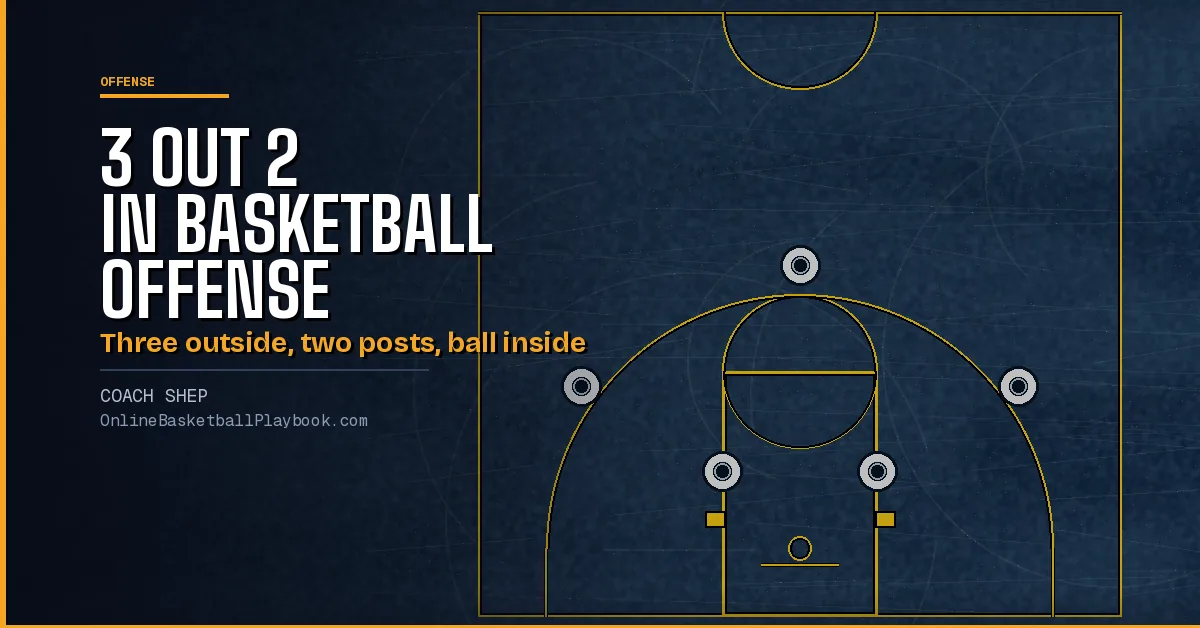
The 3 out 2 in basketball offense is a motion offense with three perimeter players and two post players who share the area around the lane. It is also called 3-2 offense or the two-post motion. The posts are not parked. They move up and down their side of the lane, screen for each other and flash to the ball, and the guards pass, cut and screen around them.
The aim is to get the ball close to the rim, then score there or pass out to a perimeter player who has found open space. This guide covers the alignment, the actions after every pass, how the posts react when a teammate drives, the high-low counter to a fronted post, add-on plays and the kind of team that should run it.
3 Out 2 In Basketball Offense at a Glance
| Piece | What it looks like |
|---|---|
| Perimeter | A player at the top of the key and a player on each wing, a little below the free-throw line extended |
| Posts | One on each side of the lane, a little above the block, free to move up and down their side |
| Spacing | About 12 to 15 feet between players |
| Goal | The ball inside first, then a shot for whoever the defense leaves open |
| Strengths | Post touches, size mismatches, offensive rebounding, decision-making practice for every player |
| Weak spots | Fewer driving lanes, long passes with only three players outside, and a need for posts who can score or pass |
Alignment and Rules
The perimeter spots are the top of the key and the two wings. The posts begin slightly above the blocks on opposite sides of the lane and may slide up and down it as long as they stay on their own side. A post who catches too low loses space to score, so the target is a catch above the block.
All five spots are interchangeable, which means a mismatch can start on the low block and a guard can post up.

The offense runs on a short list of rules.
- Keep about 12 to 15 feet of space between players.
- Never pass and stand. After a pass a perimeter player cuts, screens away or uses a screen, and a post is ready to cut to open space.
- Never stand more than three seconds.
- On a drive, move to open space.
- Back cut when you are denied on the perimeter.
- If the strong-side post is fronted, the weak-side post flashes high for the high-low.
Treat these rules as looks and not set plays. Players read, pass and then cut or screen.
- Every pass makes a cut or a screen. After a wing's pass to the top of the key he cuts and replaces himself.
- Do not become a machine. Do not let a team pass and screen away every time.
- Mix the actions. Players should mix screens away with basket cuts and mix the cuts they take off a screen.
The general principles are on the motion offense page, and the simplest version is pass-and-cut motion offense. Read the pass, then move with a purpose.
Actions After Each Pass
Top of the key to wing
The passer has two options, and either way the strong-side post posts above the block to create an angle for the pass while the weak-side post slides up to the elbow so the two posts stay opposite.
- Cut through the key. The passer fills the weak wing, which sends the weak-side wing to the top of the key.
- Screen away. The passer screens for the weak-side wing and takes that player's spot as the wing comes to the top of the key.

Wing to top of the key
When the ball goes from a wing back to the top of the key, the next pass is either back out to a wing or into the high post.
- Quick pass to the other wing. The high post waits a moment to see whether the ball handler attacks before he drops to the low block.
- Pass into the high post. The ball-side wing backdoor cuts for a layup, and if he does not get the ball he clears out to the weak wing while the other perimeter players fill.
- Go one on one. This is also a good moment for a high post with a favorable matchup to go one on one.
Wing to wing skip
A skip pass is hard to make with two posts in the way, but it comes up. The player at the top of the key always down-screens for the passer and they swap spots. Then the receiver chooses.
- Shoot or drive baseline. On the catch the receiver shoots or drives baseline, and the ball-side post steps to the middle so there are two targets for a pass inside.
- Pass to the high post and cut. The receiver cuts along the baseline while the others fill around.
- Swap the posts. If neither is there, the high post slides low as the other post slides high, and the ball goes inside or swings again.
Wing to low post
After a pass into the low post the passer has two choices, and in both the weak-side post cuts to the weak-side high post.
- Screen for the top of the key. The passer sprints to the top of the key and screens for the player there, who cuts to the strong-side wing for a shot, then fills the top of the key himself. That occupies the defense and gives the post room to work.
- Cut the baseline. The passer cuts along the baseline for a layup, which is one more reason the post must catch above the block, and fills the weak wing if the pass is not there.
The weak post's cut gives the low post room to back down, and if the weak post's defender tries to double the ball, the weak post has a clear cut to the rim.

Wing to high post
Every pass from a wing into the high post is followed by a baseline cut from the passer to the opposite wing. The pass back to the cutter is occasionally open for a layup. The player cutting from the top of the key to the strong wing cuts wide so the high post keeps his space. From there the high post can pass back out and reset or attack his defender.
The High-Low Counter
The only time the posts leave opposite sides of the lane is when the ball-side low post is fronted. He lets the defender sit in front and holds him there. That sends the weak-side post across to the high post on the ball side to catch the pass and lob it over the front to the low post. It depends on timing and passers who can make it, and it is the answer to a defense that fronts the post.
See high-low offense for the full action and the ways to run it.

Rules can be added to the high-low.
- Play behind. In Duke's version, if the post defender plays behind, the weak-side post goes up the lane to the weak elbow.
- Play three-quarters. In Duke's version, if the defender plays three-quarters, the ball-side post screens for the weak-side post.
- Post-to-post screen. The screener does the opposite of the cutter, so a cutter who goes low sends the screener high, and a cutter who goes high sends the screener low.
Time the high-low until the passer and both posts see it the same way.
Drive Rules for the Posts
Two posts around the lane make driving hard, so the posts have to open the lane the moment a teammate attacks. Three rules follow from where the drive starts.
| Drive from | Strong-side post | Weak-side post | Perimeter players |
|---|---|---|---|
| The top of the key, with both posts above the blocks | Clears to the short corner | Dives to the rim or steps into the paint for a drop-off pass | Wings go anywhere from the wing to the corner for a passing angle |
| A wing toward the middle | Slides to the dunker spot on the baseline | Stays high but can dive if his defender helps | The weak wing reads and moves up to the corner. The player at the top of the key makes an angle and is first back |
| A wing toward the baseline | Slides up to the high post for a bounce pass and an elbow jumper | Steps into the middle for a drop-off | The weak wing slides to the corner for a catch-and-shoot |
A guard should not drive toward a high post who is standing in the lane, and everyone should remember that the top of the key is empty on a drive, so everyone has to get back quickly.
There is a related rule when the drive starts from a wing toward the top of the key. The ball-side post circles out behind the dribbler as a pitch-back outlet. The lane can also open by clearing one side of the floor, with both posts moving to the right, to give a point guard the whole left lane. Open the lane the moment the ball moves.
Get the next coaching guide in your inbox
One email when a new guide or diagram set goes up. Free.
Add-On Plays and Quick Hitters
A motion offense should come first. Once players know the rules, a few called plays can sit on top. Install the base offense before any set play. Each one reuses an action the players already know.
| Play type | What happens |
|---|---|
| Reverse look | The posts start on the wings and the guards on the blocks. The posts down-screen, the guards cut to the wings for the pass from the point and the posts pivot and seal for a post catch. It helps a team with a good low-post scorer and a point guard who struggles with the pass to the wing, and a switch on the screen puts a big on a guard |
| Wing ball screen | The point guard passes to a wing and clears, the ball-side post drags his defender to the corner and the weak-side post sprints to set the on-ball screen |
| Weave into a stagger | A dribble hand-off weave ends with a staggered double screen that flares the shooter for a skip-pass three, and the screener slips to the rim if the defense switches |
| Double stagger | Off the point guard's dribble entry, a double staggered screen frees the best shooter |
| Post curl | One post curls off a screen from a perimeter player for a post catch, with an elbow entry as a backup and a kick-out to the corner |
| Two-read finish | The same start with one read changed, such as a curl for an inside catch or a flare to the corner for a three. A call can leave the choice to the cutter |

For the one-post cousin of this offense see 4 out 1 in offense, and for the all-perimeter version see 5 out motion offense. Screens used in the add-on plays are on the basketball screens page.
Who Should Run It
The roster decides this one.
- Two comfortable, smart posts. They do not have to be great scorers, but they must be active, cut without the ball and make good passes.
- Posts who are not great perimeter shooters. The offense is built so they never catch outside their scoring range.
- Not a dribble-penetration team. Two posts crowd the area around the lane, and players who cannot read the game will keep getting in each other's way.
- Climb the ladder. Run 3 out 2 in first, then 4 out 1 in, then 5 out as perimeter skill grows.
Mike Krzyzewski used a version of this offense at Duke.
Against a zone, match an even front such as a 2-3 with a one-guard look that splits the two outside defenders. The 3 out 2 in set is one of those looks. Against man defense, post mismatches on the low block are the main target. Pick the offense that fits the players you have.
How to Teach It
- Start with 5 on 0 and the point passing to a wing, followed by a basket cut every time.
- Add a choice of cutting or screening away, then a point screen.
- Add post entries to the high post, the low post and the short corner.
- Finish with breakdown drills for recognition.
Limit the options.
- Two or three movements. Teach only two or three ways to move after a wing-to-guard pass, such as a V-cut, an L-cut or a back screen.
- Never stand still. The post cannot stand in the same spot after the ball is reversed.
- A rough ratio. For the point guard after the first pass, about 45 percent basket cuts, 45 percent screens away and 10 percent point screens.
Treat the numbers as a starting dial for 5 on 0 work, not a law. For the full set of practice drills see drills to teach motion offense, and for the version without a guard-heavy perimeter see five-man open post offense.
Want the printable playbook packs?
OBP Pro members get the premium playbook packs: the zone attack, out of bounds and practice plan PDFs, plus each new pack as it is finished. The membership page lists what is in each one. Or draw your own version free in PlayDraw.
See what OBP Pro includesQuestions Coaches Ask
What is the 3 out 2 in offense in basketball?
A motion offense with three perimeter players and two posts on opposite sides of the lane. Players pass, cut, screen and read the defense, and the goal is to get the ball inside.
How do you set up a 3-2 offense in basketball?
Put a player at the top of the key and a player on each wing, a little below the free-throw line extended, and the two posts on opposite sides of the lane slightly above the blocks, with about 12 to 15 feet between players.
What are the weaknesses of the 3 out 2 in offense?
There are fewer driving lanes, the passes around the arc are long with only three players outside, and the offense needs two posts who can cut, pass and score.
When do the two posts switch sides?
They stay opposite each other except for the high-low. When the ball-side low post is fronted, the weak-side post flashes to the ball-side high post.
Is 3 out 2 in good for youth basketball?
It can be. It is a popular choice with youth coaches, but the long perimeter passes can cause turnovers and players need basketball IQ to avoid colliding in the lane.
What is the difference between 3 out 2 in and 4 out 1 in?
3 out 2 in keeps two posts around the lane, which gives more inside touches and rebounding and fewer driving lanes. 4 out 1 in keeps one post and puts a fourth player on the perimeter, which opens more space to drive.
More Guides From This Batch
- Sideline Out of Bounds Plays: SLOB Sets, Reads and Practice
- Hook Shot Basketball: How to Do It and How to Teach It
- Fun Basketball Games for Practice: Scored Games for Any Team
- Elevator Screen Basketball: How It Works, Plays and Counters
Back to Offense and every Offense page.
Keep Building
Related breakdowns
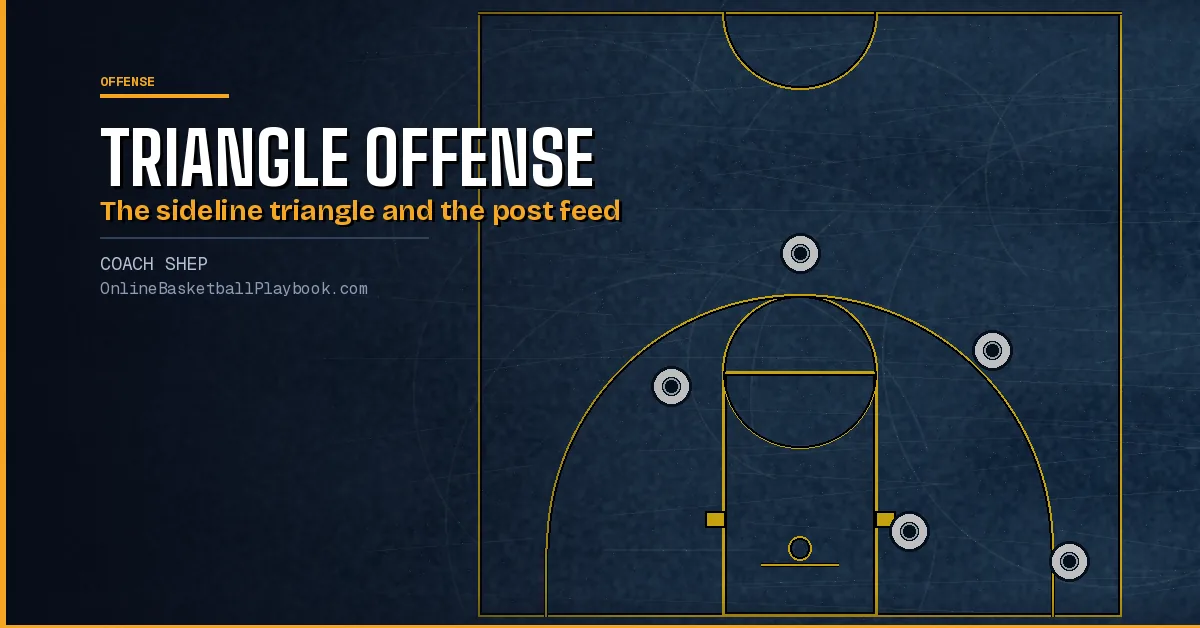
Triangle Offense Basketball: Reads, Spacing and Entries
How to run the triangle offense in basketball: the sideline triangle, spacing, entries, the four wing reads, post splits, counters and how to teach it in pieces.
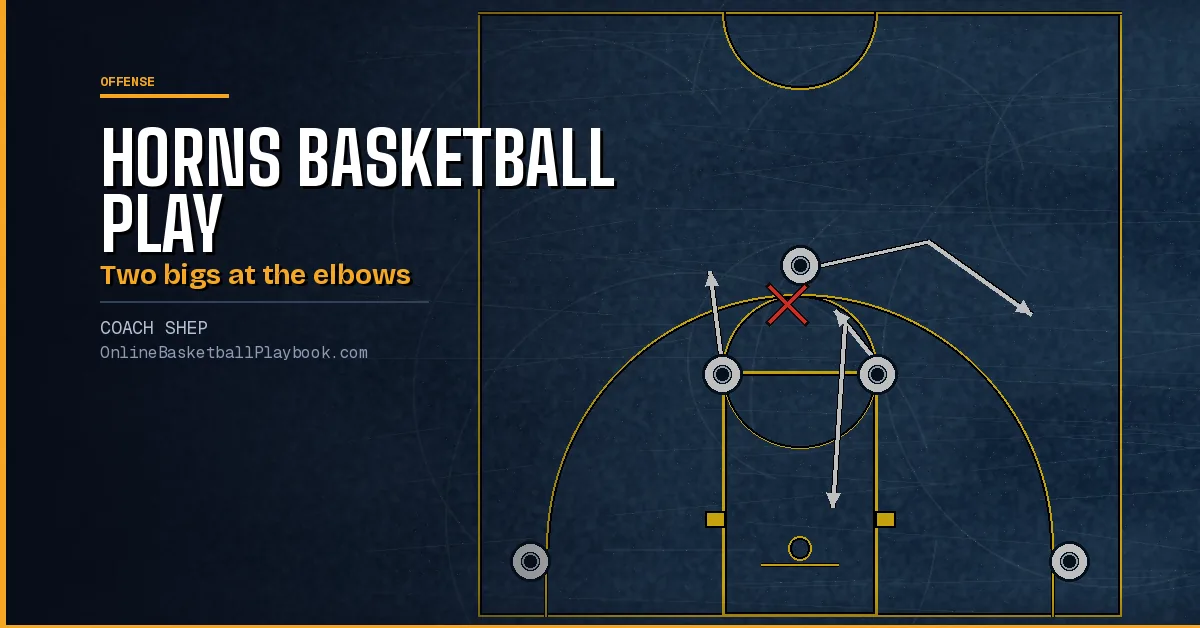
Horns Basketball Play: The Horns Set, Actions and Reads
The horns basketball play explained: the horns set, the elbow pick and roll, roll and pop rules, hi-lo, flex and shooter actions, the reads and the install.
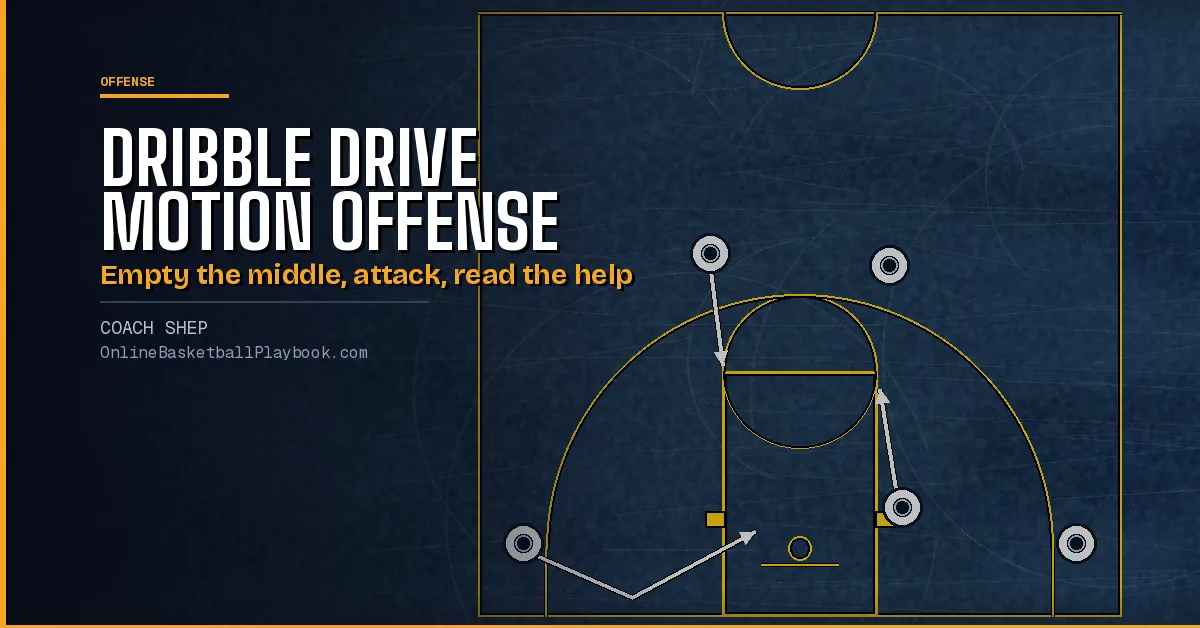
Dribble Drive Motion Offense: Spacing, Reads and Install
The dribble drive motion offense explained: 4-out 1-in spacing, the Drop, Drag and Rack zones, the read off a drive, shot diet, weak spots and the install.