
Motion offense is basketball's most adaptable attack. Players read the defense, move off every pass, and generate open looks without a play call. This guide covers every principle you need to install it and run it.
What Motion Offense Actually Is
A lot of coaches hear "motion offense" and picture chaos — five guys freelancing with no structure. That is not what motion offense is. Motion offense is a rule-based system where players respond to what the defense gives them. Instead of running scripted sequences, players make decisions based on real-time defensive reads. The plays "just happen" because the defense dictates them.
The defining feature of motion offense is that options emerge from the defense, not the bench. If a defender sags, the cutter attacks the gap. If a defender overplays, the backdoor is live. If the help is late, the skip pass finds the open shooter. No play call is needed because the answer is already built into the rules the players have learned.
This is why motion is often described as unscoutable. A scouting report on a set play can neutralize that play. A scouting report on "they read and react to whatever you show them" offers no tactical prescription to the opponent. The defense has to guard every possible outcome on every possession, every time down the floor.
The phrase that captures it best comes from the Five-Out system: options are not play calls — they just happen. Players learn to play, not to run plays. That distinction is the entire philosophy in two sentences.
The Core Principles Every Player Must Know
Motion offense runs on a small set of non-negotiable habits. If any of these break down, the offense breaks down. Every player on the floor must own these before the team runs a single 5-on-5 possession.
Read, Don't Call
Players must learn to diagnose the defense on the catch. Where is my defender? Where is the help? What is the next logical cut or screen? The answer to each question is a rule, not a coach's signal from the sideline. Players who wait for a play call to be signaled in are breaking the system. Train the reads until they are reflexive.
Pass and Move — Every Single Time
Every pass must be followed by a meaningful action: a cut, a screen, or the receipt of a screen. Jogging to a spot counts as standing. Standing is a team violation, not a personal choice. When one player holds their spot after a pass, the defender assigned to them can turn and help on the ball, which collapses the spacing and stalls the entire offense.
Jovan Obradović, one of Europe's most decorated coaches, ran no-dribble passing-game 5-on-5 every practice specifically to build the habit of moving without the ball. He identified off-ball movement as the habit motion lives or dies on. If you are not drilling it daily, you are hoping for it — and motion offense cannot be sustained on hope.
Fake First, Then Move
Obradović's principle applies to every catch and every cut: a fake always precedes the move. Not only the shot fake — fake a direction, fake a cut, fake a stay. The off-ball player cuts only when the on-ball defender turns his head. Never before. This one habit converts average cuts into scoring opportunities by creating the half-step the cutter needs to get across the defender's face.
Motion teaches kids how to play, not just how to run plays. It is simple to teach, develops players, is fun, hard to scout, works against any defense, and is positionless — unlike five memorized plays it does not collapse the moment one substitute enters the game.
— Rumjahn, Basketball Vault
Ball Movement Over Player Movement
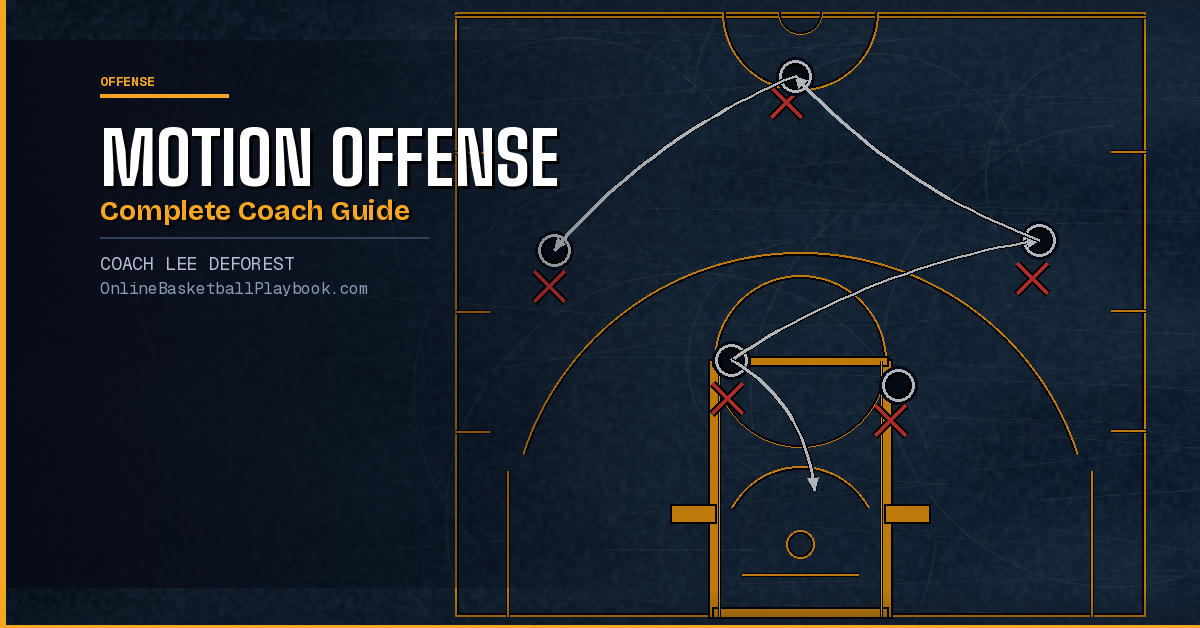
One of the most counterintuitive principles in motion offense comes from Ettore Messina's foundational teaching: five players standing still but passing quickly beats five players moving with one always holding the ball. Defenders must adapt to the ball, not to bodies. A quick pass finds a late defender faster than complex player movement with a stationary ball.
This is not a case for standing still — it is a case for understanding what actually puts pressure on the defense. When the ball moves quickly, defenders are forced to rotate, communicate, and recover simultaneously. Each rotation creates a new opening somewhere else on the floor. The player who holds the ball for an extra two seconds surrenders all of that pressure and hands the initiative back to the defense.
Holding the ball above your head and looking — what coaches call "going into a statue" — is the single most damaging habit in motion offense. It stops the ball, stops the cuts, and allows every off-ball defender to find their man and establish position. Train your players to make a decision within two seconds of catching. Pass and move, or drive with purpose.
Spacing: The Engine of Motion
Spacing is not a byproduct of motion offense — it is the offense. "Spacing is offense, offense is spacing." The 15-to-18-foot gaps between perimeter players are not a starting formation that the offense drifts away from. They are a constant that players are responsible for maintaining throughout the entire possession.
Why does spacing matter so much? Because every cut, every drive, and every pass depends on it. When players bunch, they allow defenders to guard multiple threats with one body position. When spacing collapses, the help defense arrives early, drives close out before they open, and passing lanes disappear. A single player who drifts inside the arc and stands there can make the entire offense unplayable.
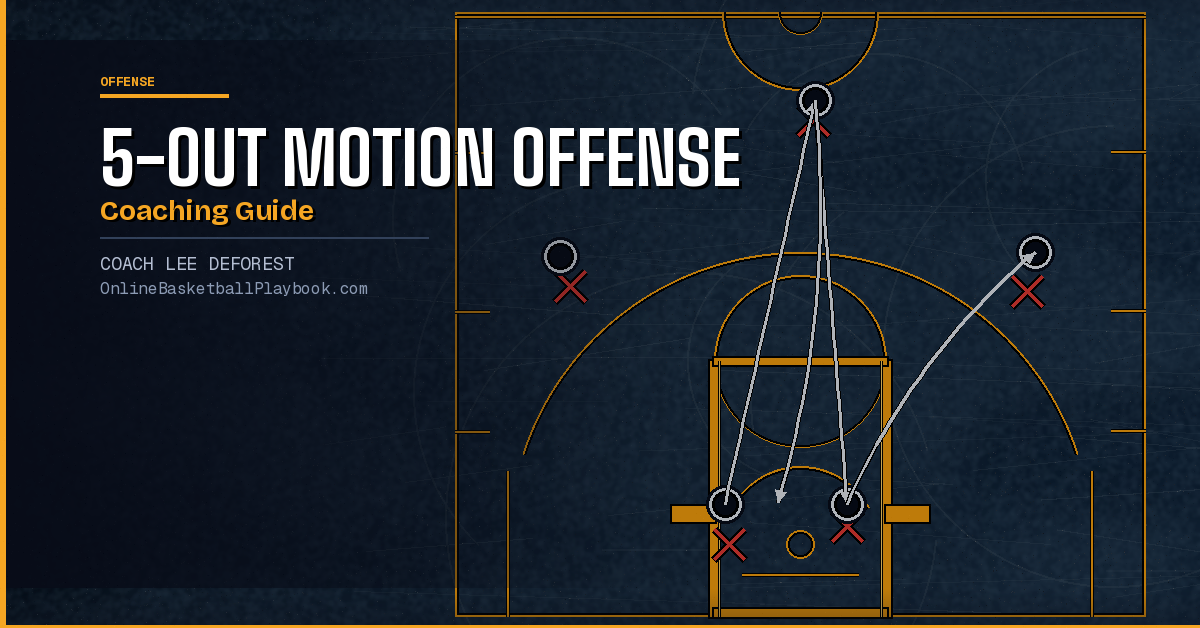
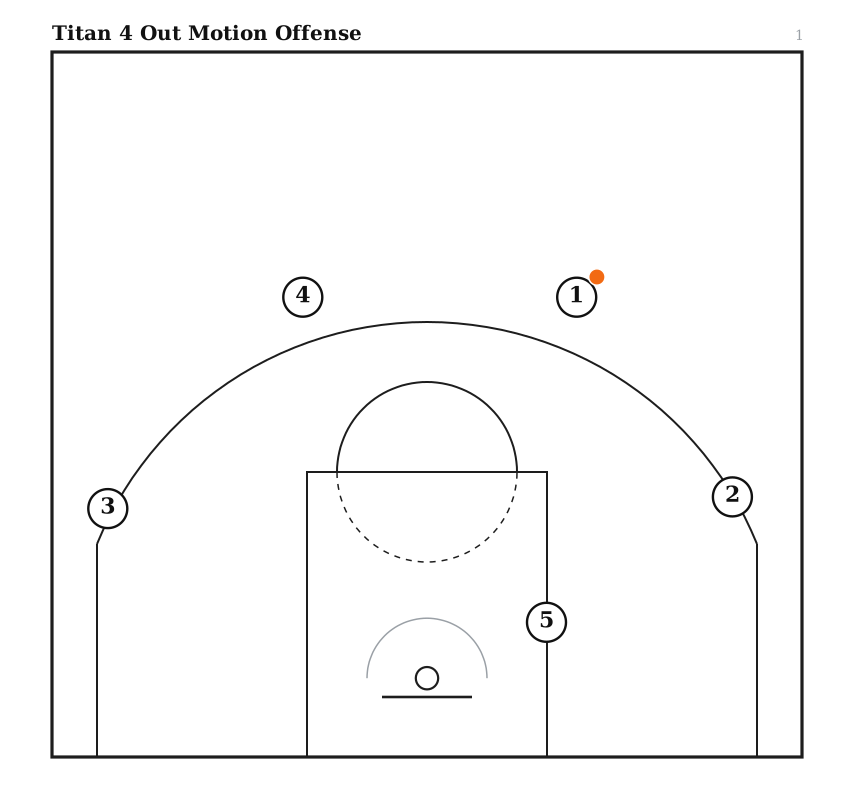
In the 5-out system — the purest expression of read-and-react motion — all five players begin on the perimeter and must fill all five perimeter spots at all times unless actively cutting or screening. Fill the spots. If you cut through and do not get the ball, exit to the weak-side corner and hold your spot. If you receive a screen and reject it, relocate immediately to maintain the spacing. This is not optional; it is the structural requirement that makes every other rule functional.
The most open a player ever is comes the instant he catches it — balanced, eyes on the rim, ready to shoot, drive, or pass. That moment exists only if the spacing was right before the pass was thrown. Spacing before the catch creates the opportunity at the catch.
Cutting and Screening Off Reads
Motion offense is more about cutting than screening. That principle — attributed directly to Lee DeForest's coaching notebook — tells you where to focus your energy in teaching the system. Screens set up cuts. Cuts create shots. But the cut must be credible to work.
Cut Credibility
A credible cut means the cutter looks for the ball as they come open and clears quickly after the cut. A defender who watches the cutter's eyes and sees no read of the ball knows the cutter is not actually looking for a pass. That defender can sit in help position and provide support elsewhere. A cutter whose eyes are on the ball throughout the cut forces the defender to make a hard choice: stay and get beaten behind, or help and give up the pass.
The Backdoor Is Always Live
In every motion system that respects defensive pressure, the backdoor is not a special play — it is a permanent read. Any overplay, anywhere on the floor, is a backdoor trigger. The currency of motion offense is patience: waiting for the defender to turn their head or commit before cutting. Players who rush the backdoor because they are frustrated with the defensive pressure are not running motion offense — they are freelancing. The backdoor works when it is earned through the read, not forced through impatience.
The After-Cut Rule
What a player does after a pass is as important as the pass itself. The options are: basket cut, set a screen, or receive a screen. "Never pass and stand" is not a reminder — it is a rule. After every pass, every player must choose one of those three actions. Standing is a team violation. Coaches who treat standing as a personal habit problem will keep fighting it forever. Name it as a rule violation from day one of installation, and enforce it consistently in every drill and every scrimmage.
Track standing as a measurable error in your film sessions. Every time a player passes and stands for more than one count, mark it. Show the film. Players who see the pattern in their own tendencies fix it faster than players who only hear a verbal correction. Motion offense is a film-correctable system precisely because the errors are visible and specific.
How to Install Motion Offense
Motion offense is installed by progression, not by explanation. You cannot walk a team through the rules on a whiteboard and then run 5-on-5. The reads must be built into muscle memory before competition pressure is applied. Here is the progression that works at every level.
Step 1: The Base Rhythm — Pass and Cut, 5-on-0
Start with 5-on-0 passing game. No defense, no pressure, no dribble. Players pass and move, fill spots, cut on reads, and catch in balance. The goal is not scoring — the goal is rhythm. Every player learns what it feels like to move on every pass, to fill the open spot, and to enter the floor with eyes on the rim. Run 5-on-0 until the rhythm is automatic.
Step 2: One Option Before Choices
This is the critical install discipline for any read-heavy system: choose one option and get players to execute that option completely before giving them a choice. If the first read in your system is a basket cut off the pass, every player runs the basket cut until it is automatic — regardless of what the defense does. Only after the first option is mastered do you layer in the second read. Coaches who introduce all the options at once watch their players freeze at the decision point because they have not automated any single option.
Step 3: Add Screens, Then Reads Off Screens
Once pass-and-cut is automatic, introduce the screening game. Down screens, ball screens, back screens — one type at a time. For each screen, teach the two or three reads the cutter must make based on how the defender plays it. Curl if the defender trails; flare if the defender cheats over; slip if the defender is not looking. Named actions — the vocabulary Rumjahn describes as essential — allow players to communicate reads faster than any coach signal from the sideline.
Step 4: No-Dribble Live
Before going full 5-on-5 with dribble, run the passing game with defense and no dribble. This is Obradović's practice drill. It forces players to move without the ball because the ball cannot bail them out. Players who rely on the dribble to escape defensive pressure discover quickly that the offense needs their movement, not their dribble. This drill also exposes spacing problems immediately — there is nowhere to hide when you cannot put the ball on the floor.
Continuity Triggers and the Dead Corner
One of the advanced concepts that separates well-coached motion teams from disorganized ones is the continuity trigger: the built-in answer after the first action is covered. If the offense resets every time the primary read is taken away, the defense learns to take it away and wait for the reset. Continuity triggers keep the possession breathing without stopping to call something new.
The Outlet Rule
Bill McKillop's Davidson system names this the "Outlet" rule: keep a one-pass-away relief valve alive opposite the featured action at all times. The ball handler is never stranded on a dead hold. If the primary read is covered and the ball handler cannot pass ahead, the outlet is the immediate next action — a reversal that triggers a new read sequence on the other side of the floor.
The Dead Corner
Every ball reversal creates a dead corner — the weak-side wing position that the defense has abandoned to provide help on the main action. In McKillop's system, every reversal is simultaneously a look to the dead corner man. He receives a stagger screen on every reversal. This is not improvised; it is wired into the offense as an automatic trigger. Teaching players to see the dead corner on every reversal converts a routine swing pass into a live scoring read. The defense cannot help and cover the dead corner simultaneously — they must choose, and either choice creates an advantage for the offense.
Change the Alignment for the Same Read
McKillop's anti-scouting principle is the most under-taught motion concept at the high school level: run the same read sequence out of different formations. A basket cut off a wing entry looks identical to the player running it whether the initial alignment is a 1-4 high, a box set, or a 5-out spread. The defense cannot key off the formation because the formation changes. The read does not. This is how motion becomes genuinely unscoutable — the reads are constant, the starting pictures are not.
Motion Offense Coach Cheatsheet
- Pass and move on every possession: after every pass, choose basket cut, set a screen, or receive a screen — no exceptions, no standing, no drifting. Enforce it as a rule from day one.
- Fake before every cut: the cutter does not go until the on-ball defender turns their head or overplays. A credible cut has eyes on the ball throughout the entire path to the basket.
- Maintain 15–18 foot spacing: fill all five perimeter spots unless actively cutting or screening. One player inside the arc without purpose collapses the spacing for everyone else.
- Install by progression — 5-on-0 first: build the base rhythm without defense before adding reads, then add screens one type at a time, then go live with no-dribble 5-on-5 before full scrimmage.
- Name the recurring actions: give players a vocabulary — Post Screen Away, Flare, Slip, Curl, Outlet — so communication is fast and reads are coachable. Named actions are not a script; they are a teaching shortcut.
- Shoot when the defense sags: any time a penetration kick or reversal finds a player whose defender is sagging, that player must shoot. Do not re-penetrate when the shot is open — the defense already surrendered it. Treat the pass-and-re-dribble as a coaching error, not a player choice.
- The backdoor is always live: build the backdoor read into every player's instincts from day one. Any overplay on the ball or on the wing is a trigger. Patience earns the backdoor — rushing it wastes it.
- Track standing in film: mark every pass-and-stand as a counted error in your film sessions. Players correct visible patterns faster than they correct verbal reminders. Show the film, name the violation, enforce the standard.
The Princeton System: Motion With Named Sets
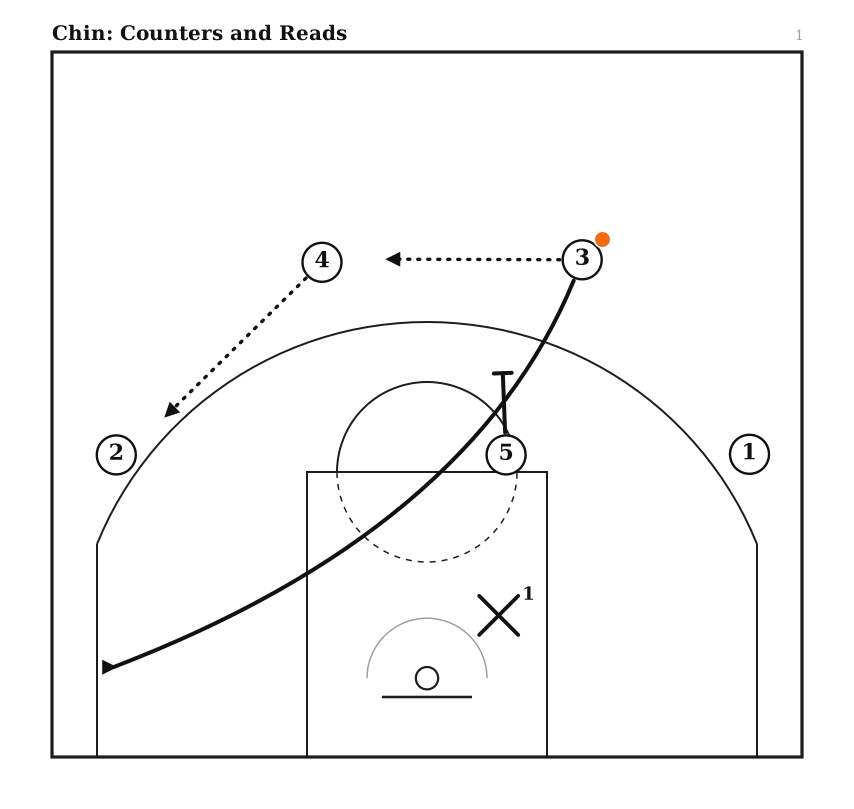
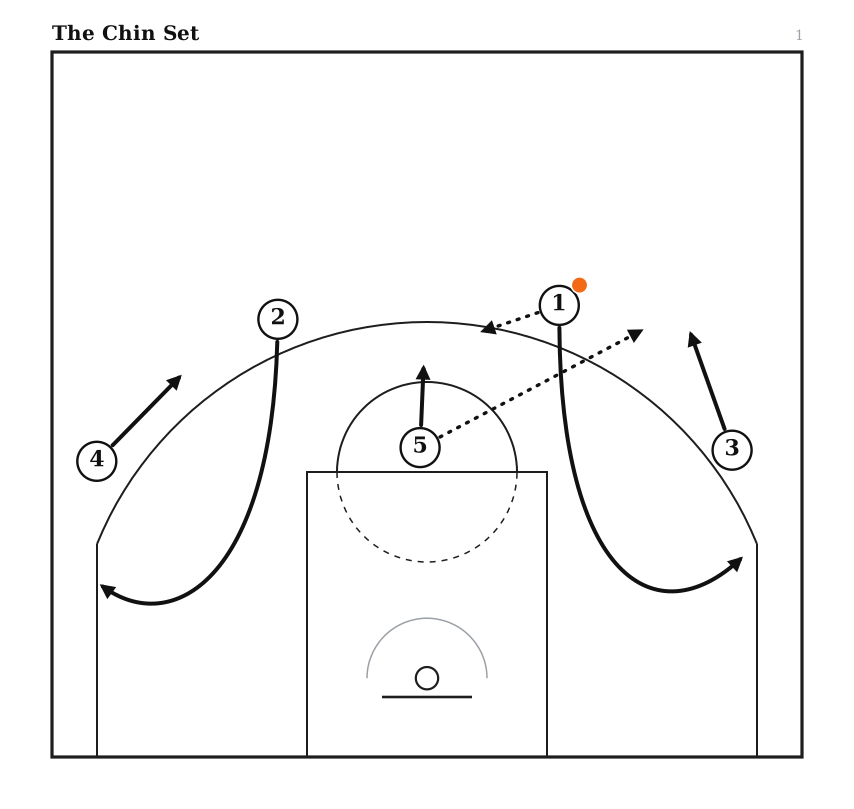
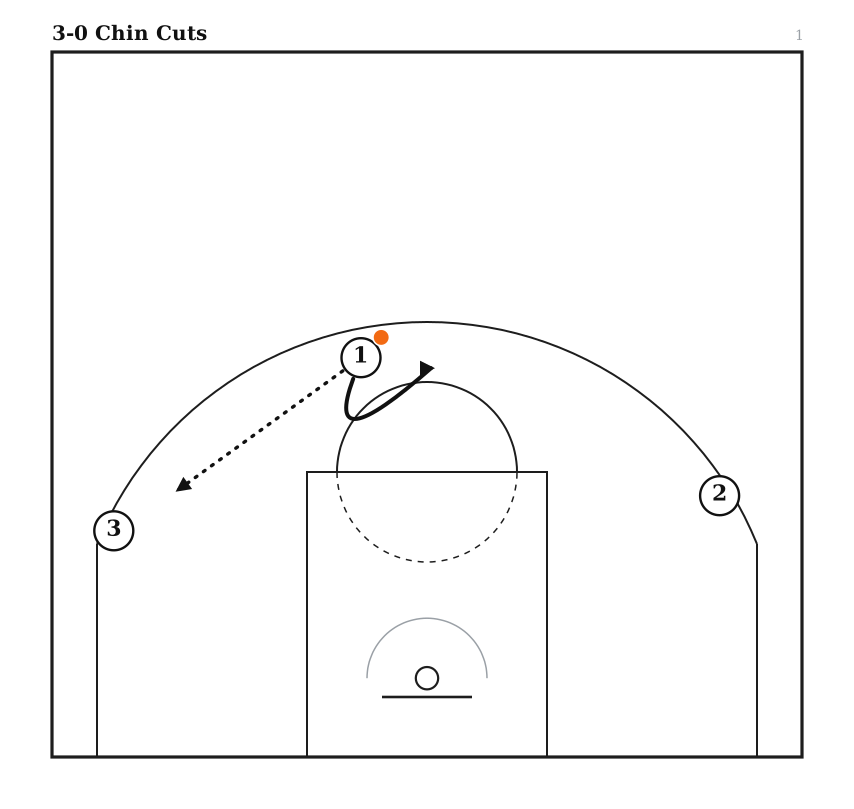
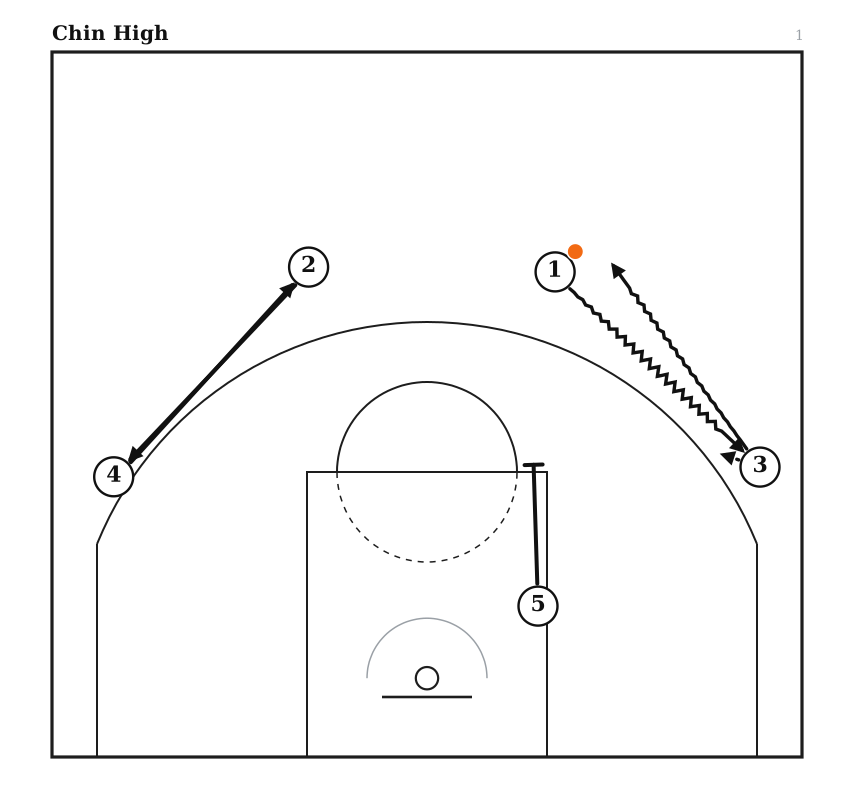
One of the cleanest examples of motion offense with a named-set vocabulary is the Princeton system developed by Lee DeForest — the system FCP runs. It uses six named entry sets: Chin, 5-Out, Low, Point, Twirl, and X. Each is an entry point into the same read logic, not a separate play to memorize. The offense is designed to be unscoutable because the options that emerge are determined by what the defense shows, not by what the bench signals.
The universal reset in the Princeton system is the dribble-up to CHIN. On any breakdown — contested entry, stalled possession, any confusion — every player knows that a dribble-up to the guard spot returns the offense to CHIN. Players are never stranded without a next action. The system's continuity survives because every player can execute the reset without a verbal call from the sideline.
The three wing options form the universal decision tree that every Princeton player must own: if the post is open, go to LOW; if the pass can go to the top, go to POINT; if neither is available, dribble up and return to CHIN. When every player on the floor can run this decision tree automatically, the offense handles defensive pressure without a timeout. The system survives substitutions, trapping defenses, and pressure man because the rules are simple enough to execute under stress.
Ball reversal in the Princeton system is not a reset — it is an offensive weapon. Reversal in the Point series combines with high-low duck-in reads and exposes weak-side defenders switching late. When coaches teach reversal as a passive action to move the defense, they are wasting one of the offense's most productive triggers. Reversal forces the defense to change sides, disrupts their help structure, and creates the dead corner opportunity on every swing.
The patience principle ties everything together: backdoor is always live, the defense will always give something, and the offense's job is to wait for the read and take what is offered. "There is a counter for everything the defense does — do the opposite." That principle, distilled from DeForest's own coaching notebook, is the practitioner's summary of the entire motion offense philosophy.
Want more basketball coaching strategies, drills, and tools?
See it drawn up
Related diagrams
Keep Building
Related breakdowns