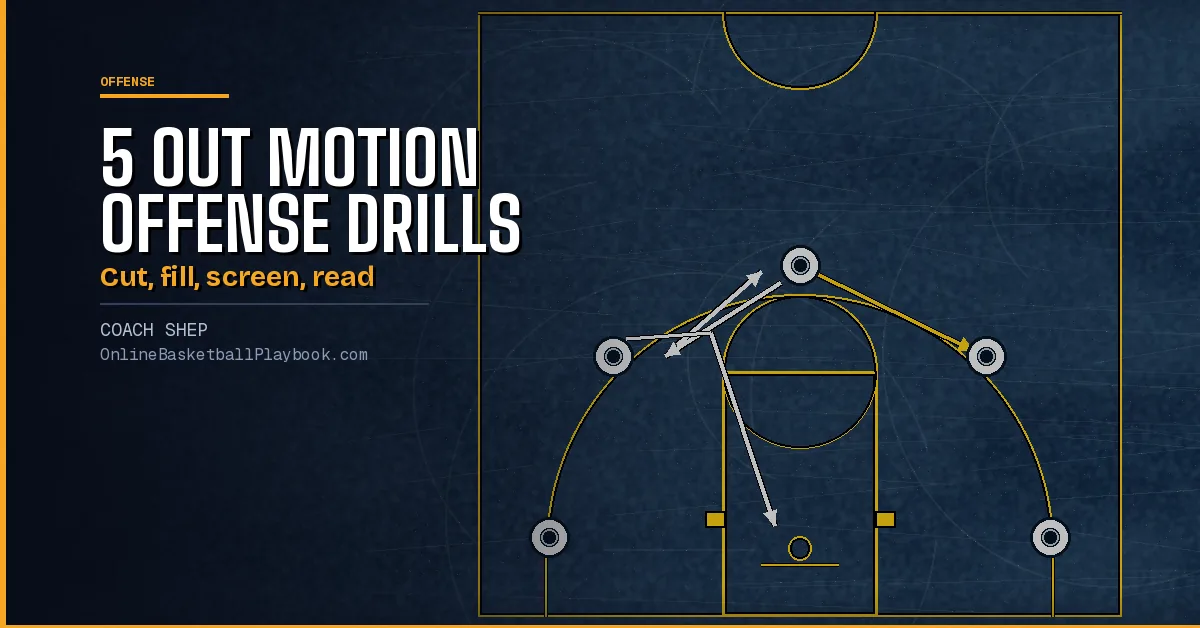
5 out motion offense drills turn the rules of the 5-out into habits: five players outside the arc, a cut or a screen after every pass, and a read off the defender. The drills on this page run from 5 on 0 cutting with nobody guarding, through back cuts, screens away, dribble-at hand-offs, ball screens and quick post-ups, to live games with no dribble. The install orders are compared below. Each drill has a diagram of the setup.
The offense itself, its spots and its rules are on 5 out offense, and motion in general is on motion offense basketball.
What the Drills Have to Teach
Every drill below trains one piece of the offense. Taught from simplest to hardest, the rules are nine:
- Spread the five spots: one at the top of the key in line with the rim, two wings, two corners. Put cones on the spots for young teams.
- Catch ready to attack: balanced, eyes on the rim, ready to shoot, drive or pass.
- Pass and basket-cut.
- Always fill the five spots unless cutting or screening.
- If denied, back-cut.
- Pass and screen away.
- Pass and screen on the ball.
- If dribbled at, take a dribble hand-off.
- Post-ups must be quick.
Spacing and the catch can be set two ways.
- Normal arc. Spots sit on the arc, and every catch is ready to attack.
- NBA line. Space the five spots about two feet behind the normal arc, and add two habits for every catch: square up, and if you can beat your man to the rim, go on the catch.
Whichever line you use, the five spots stay filled and every catch is a threat.
Install Order: Nine Rules, Four Steps or One Action
Coaches agree on teaching in layers. They disagree on what the layers are.
| Plan | Order | Method |
|---|---|---|
| Nine rules | The nine rules above, in that order, with the screen away added only once the cutting rhythm is owned | Whole-part-whole: teach the full concept, break it down in small-sided drills, then put it back together |
| Four progressions | Cutting, then screen away, then on-ball screens, then dribble at | One layer at a time, with cones on the spots while teaching |
| One action | Every pass is a screen away, then the slip, then three rules for denial, dribbling and the dribble-at | The whole offense lives in one action with counters layered on |
Player-count ladders give a different way to build up. A motion ladder runs 2 on 0, 2 on 1, 2 on 2, 3 on 0, 3 on 3 on the ball side, 4 on 0, 4 on 4 live, 5 on 0 cutting the lane, 4 on 4 plus 1, 1 on 1 in the post plus 4, then 5 on 5 with limits. More ladders like it are on offensive breakdown drills.
Pick one order and stay with it until the first layer is automatic.
Drill 1: 5 on 0 Pass and Cut
Five players start on the five spots with no defense. After every pass the passer basket-cuts, and the others fill the spot that opens. Write the fill rule for each pass:
- Top of the key to wing: the passer basket-cuts to the opposite corner and the two players behind him fill up one spot.
- Wing to corner: the same.
- Corner to wing: the passer cuts and replaces himself.
- Wing to top of the key: the passer cuts and fills the same-side corner.

Coaching points for the cut:
- Step away, then explode. On the front cut, step away and then explode to the ball side.
- Watch the ball. Watch the ball on every cut in case of a rebound.
- Cut hard. Cut hard so the help has to come.
- Cut through. A cutter who gets no pass cuts through to the weak-side corner.
- L cut to fill. A player filling the top of the key makes an L cut through the nail, the middle of the free-throw line, before he pops out.
Cut with a purpose every time and the spacing takes care of itself. More cutting work is on pass-and-cut motion offense and cutting in basketball.
Drill 2: The Back Cut When Denied
Put a defender on one wing and tell him to deny. The wing back-cuts to the rim, the passer looks for him, and the next player fills the empty spot. Coaches set the trigger and finish three ways:
- Back-cut on the feet. Back-cut when the defender has one or both feet above the three-point line or is making contact, finish with a reverse layup, and if the pass is not there get in and get out to the weak side. The threat alone pulls the defender back down.
- Back-cut at once. Cut when you are denied one pass away and the passer looks at you.
- Two exits only. Only two exits when denied, a back cut and fill from behind or a down screen and fill. No V cuts and no jukes.

Drill 3: Screen Away
Once the cutting rhythm is set, the passer may screen away instead of cutting. Under both the nine rules and the four progressions, the screen away is allowed after any pass except corner to wing. Two options fit different teams:
- For youth. The player screened for always curls to the rim, and the screener pops back to his spot, where he is open if his defender helps.
- For experienced teams. The cutter chooses to curl or pop, and the screener goes the opposite way.

Screen cues for the simple screen: the screener's backside faces between the ball and the basket, and he puts a fist up and calls the teammate's name.
In the one-action offense the screener keeps his butt to the ball, the cutter comes off hip to hip, one player goes to the rim while the other pops back to the ball, and the receiver reads the action before the ball arrives. The read menus differ:
| Plan | Cutter's reads | Screener's job or other branches |
|---|---|---|
| One-action continuity | Straight cut, tight curl or back cut. Against a switch with no slip, back-cut after the screen | Slip whenever his defender gets above the screen |
| Named reads | Curl when the defender trails, fade when he goes over, reject when he goes under | Named branches for denial (an automatic backdoor) and for a sag (attack off the catch) |
| Nine rules | Basket cut or fill | Older teams do the reverse of the teammate: he fills, you basket-cut, he cuts, you fill |
Sell the screen with the body and the read follows. Screen technique and more two-man screen drills are on drills to teach off-ball screens.
Drill 4: Dribble At
When the ball is pressured and passes are denied, the ball handler dribbles at a teammate. That teammate has two answers, and coaches choose between them differently:
- Hand-off first. Take the dribble hand-off, and back-cut if the defense jumps it.
- Back cut first. Back-cut, which makes the rule for youth, or take the hand-off with the ball held top and bottom so the receiver grabs the sides.
- Read the overplay. Take the hand-off if open and back-cut if overplayed. The filler comes from behind, straight up the sideline, and the passer then brush-cuts underneath to open a driving gap.

Drill 5: Ball Screen on Call
Coaches set different limits on ball screens in a 5-out, and the drill should match the rule your team uses:
- Receiver calls it. The passer follows his pass for a ball screen, but only when the receiver calls for it, because an uncalled screen kills spacing and causes turnovers. The handler looks for paint penetration, and the screener rolls or pops.
- Any pass. An on-ball screen is allowed after any pass. Make "pass to the corner, ball screen" automatic if you like. Do not screen for a player who cannot dribble.
- Audible only. No free ball screens, only screens from an audible or a specific look.

Whatever limit you pick, rep it until it is automatic. Full ball-screen progressions are on pick and roll basketball drills.
Drill 6: Quick Post-Up
With the lane empty, any cutter can post up for a moment. Two timings are taught:
- Two counts. The poster gets two counts to establish position, and if no entry comes he cuts through to the weak side. The purpose of posting in a 5-out is to score with both feet in the paint, not to pass out of the post.
- One or two seconds. Quick post-ups of one or two seconds are allowed after any cut through, for any mismatch, not only for bigs.
Post quickly, score or leave.

Get the next coaching guide in your inbox
One email when a new guide or diagram set goes up. Free.
5 Out Motion Offense Drills for Live Play
Once the layers are in, live games with limits test them against a defense.
The 60-Point Game
A 15-drill motion progression ends with the 60-Point Game: 5 on 5, no dribble, screens allowed. Its scoring is 1 point per pass, 5 for a layup, 4 for a foul, 3 for a steal and 1 for a turnover.
Earlier steps in the progression:
- Chute shooting. It starts with a V cut.
- Motion shooting off chairs. The chairs stand in for screens.
- 2 on 2 live. A point and a wing work downs, backs and flares (always re-screen the flare off a down screen).
- 3 on 3. No screen and no dribble.
- 4 on 4 live.

Constraint games
Four limits carry over to any motion offense:
- No-dribble games.
- Pass and move. Standing after a pass counts as a turnover.
- Required reversals. The ball must be reversed before a shot.
- Advantage finishing. The defense starts in rotation and the offense attacks it.
A dribbling rule works in any live drill: dribble only to attack the rim on a straight-line drive, to improve a passing angle, or to break a five-second count. When the drill is the defense's turn, the matching page is how to defend 5-out motion offense, and other motion drills are on drills to teach motion offense.
Where Coaches Teach It Differently
| Question | Cut first | Screen away | Mix |
|---|---|---|---|
| Cut first or screen first? | Cut first, add screens once the cut rhythm is owned | Every pass is a screen away | A mix after each pass: in a 3-out 2-in offense, basket cut 45%, screen away 45%, call for a point screen 10% |
| The V cut on a fill | Not on every fill, use it as a weapon | No V cuts at all, move in an arc to fill | No V cuts when denied, back-cut or down-screen only |
| The catch | Catch ready to attack, eyes on the rim | Square up, go on the catch if you can beat your man | Shoot, drive or pass within one second, and no triple threat |
Rebounding from a 5-out is also a choice:
- Safety and four crash. The point guard is the safety with four crashing.
- Two back and three crash. Two guards get back with three crashing.
- Everyone below the line. Everyone below the free-throw line crashes.
Decide it before the game, not after the first long rebound. Spacing drills for any alignment are on basketball spacing drills, and the whole offense section lists the rest.
Want the printable playbook packs?
OBP Pro members get the premium playbook packs: the zone attack, out of bounds and practice plan PDFs, plus each new pack as it is finished. The membership page lists what is in each one. Or draw your own version free in PlayDraw.
See what OBP Pro includesQuestions Coaches Ask
What drills teach the 5 out motion offense?
5 on 0 pass and cut on the five spots, a back-cut drill against a denying defender, screen away, dribble at, ball screen and quick post-up drills, then live games such as a no-dribble 5 on 5.
How do you teach 5 out motion to youth players?
Put cones on the five spots for young teams. Youth options are to always curl off a screen away with the screener popping back, and to back-cut when dribbled at.
How long does it take to install the 5 out motion offense?
The first layer can be running in a couple of weeks and the full offense takes a season or more.
Should you teach cutting or screening first in a 5 out?
Coaches split. Most teach the basket cut first and add screens later, and screen-away offenses make every pass a screen away from the start.
What is the 60-Point Game?
A 5 on 5 motion game with no dribble and screens allowed, scored with points for passes, layups, fouls, steals and turnovers.
When should a player back cut in the 5 out?
When denied. Trigger it when the defender has a foot above the three-point line or makes contact, or when the player is denied one pass away and the passer looks at him.
More Guides From This Batch
- Swing Offense Basketball: Rules, Cuts and Counters
- Continuity Offense Basketball: Types, Rules and How They Work
- Basketball Rules and Regulations by Level: NFHS, NCAA, NBA, FIBA
Back to Motion Offense and every Offense page.
Keep Building
Related breakdowns
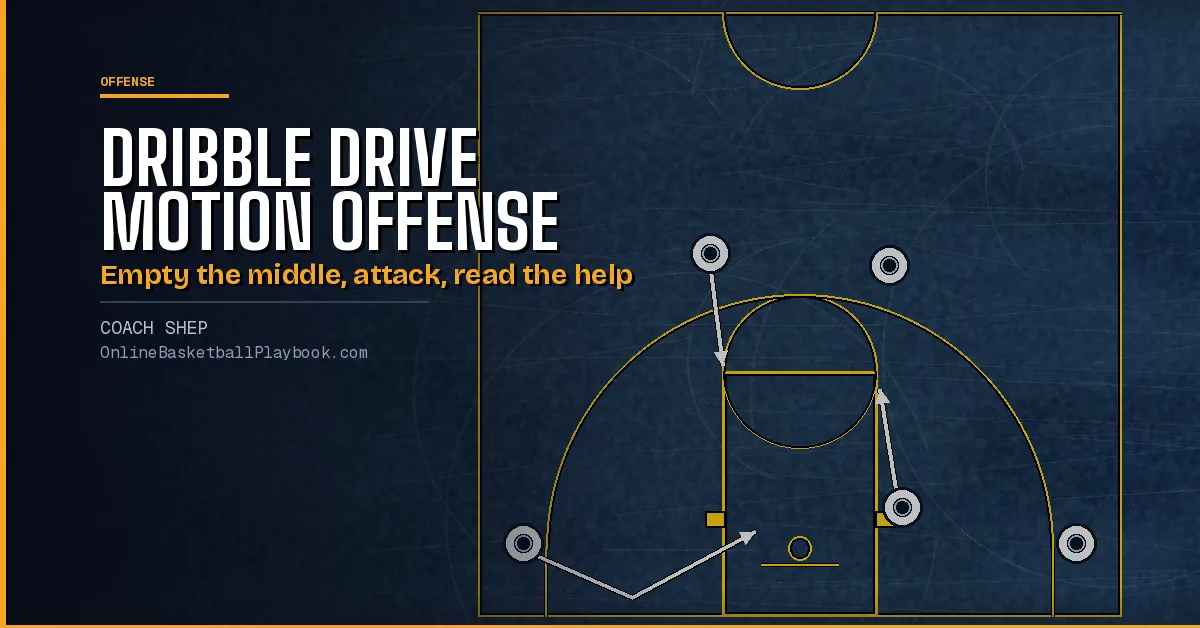
Dribble Drive Motion Offense: Spacing, Reads and Install
The dribble drive motion offense explained: 4-out 1-in spacing, the Drop, Drag and Rack zones, the read off a drive, shot diet, weak spots and the install.
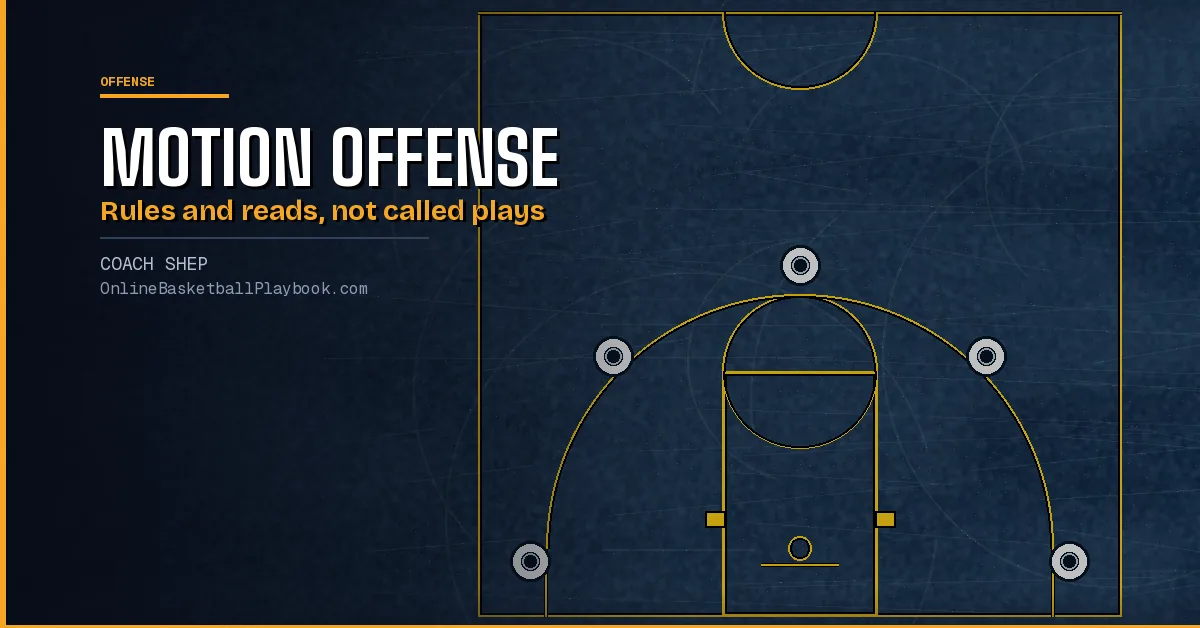
Motion Offense: Spacing, Rules, Actions and How to Install It
Motion offense runs on rules, not called plays. See the spacing, four core actions, 5-out versus 4-out 1-in, the install order, drills and where it struggles.
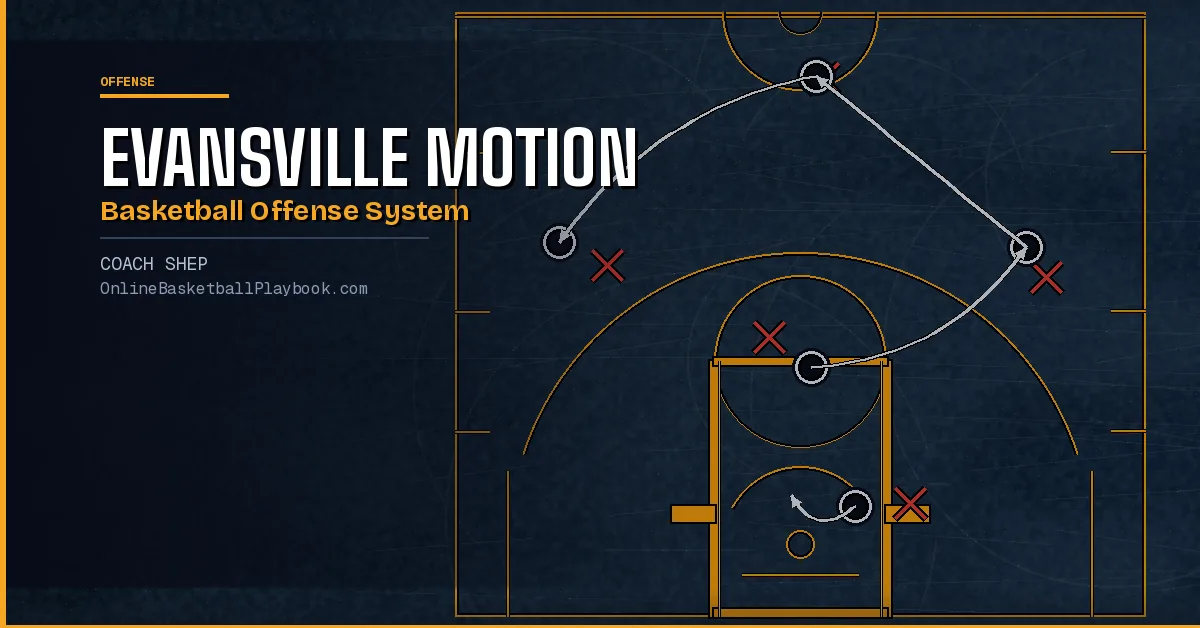
Pass-and-Cut Motion Offense: Reads, Backdoor and Install
This motion offense is a read-based system built on spacing, ball movement, and purposeful cutting. Every pass triggers a decision.