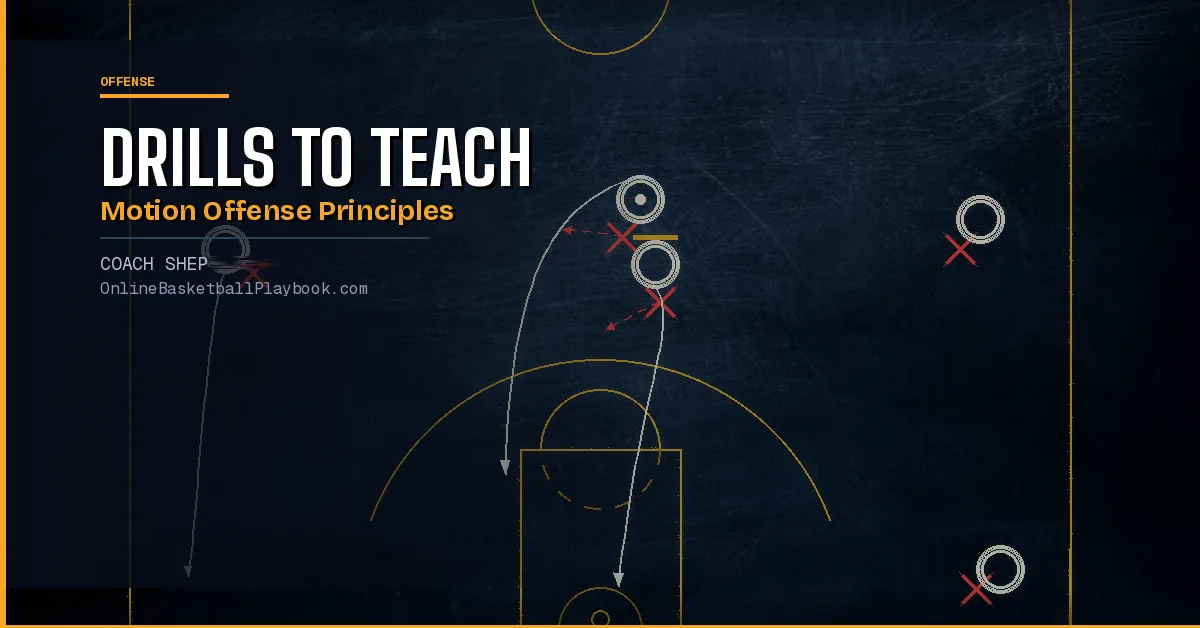
Motion offense lives or dies on habits players build before any defense shows up. These drills install those habits (pass-and-cut, spacing, reading defenders, and moving without the ball) from 5-on-0 foundations up to live competitive reps.
Why You Have to Drill Motion Principles Separately
Most coaches introduce motion offense by running 5-on-5 and hoping the principles emerge. They rarely do. Players default to their worst habits (catching and standing, dribbling to kill time, cutting randomly) because no one has yet made the right movement automatic.
Motion offense is a rule system, not a play. The rules are simple: pass and move, read the defense, space the floor, move without the ball. But simple rules are not the same as automatic behavior. Automatic behavior comes from repetition in controlled conditions, and that is exactly what drill work provides.
The drills in this guide are organized by principle. Each one isolates a specific motion habit, gives players clear feedback on whether they executed it correctly, and can be scaled from no-defense 5-on-0 reps all the way to live competitive situations. The sequencing matters: you add defensive pressure only after the action is clean without it.
One critical point before you start: choose one option and get your players to execute that option before giving them a choice. This is the install discipline that separates programs that run motion successfully from programs that run organized chaos. Layer options only when the first option is automatic. Every drill in this guide respects that principle.
The 5-on-0 Foundation: Installing the Rhythm Before the Defense
5-on-0 passing-game work is not a warmup drill. Coaches who treat it that way waste the most important teaching time they have. 5-on-0 is where the motion rhythm gets wired in, where every player learns that a pass is always followed by a move, and that standing is a team violation, not a personal choice.
5-on-0 Pass-and-Cut Drill
Set five players in your base spacing, whether that is a 5-out alignment, a 4-out-1-in set, or your program's primary formation. The only rule is this: after every pass, the passer must make a meaningful move. That means a basket cut, a screen, or relocating to maintain spacing. No player may stand in the same spot for more than one count after a pass leaves their hands.
Run this for three to five minutes at the start of every practice. Coaches should narrate: call out passes, call out cuts, and call out any player who stands. The standing player is not making a personal mistake. They are committing a team violation, and the group should understand it that way. When no defense is present, there is no excuse for standing.
No-Dribble Passing Game
Remove the dribble entirely. Five offensive players, no defense, no dribbles allowed. Every player must catch and pass within three seconds. This drill (used by Željko Obradović every practice) forces off-ball movement to create open passing targets. When you cannot dribble your way out of trouble, you are forced to move your feet.
Players who struggle with this drill reveal exactly what your motion offense is missing: they cannot find open teammates because their teammates are standing still. The no-dribble constraint makes the off-ball movement problem visible and urgent in a way that 5-on-5 never does.
5-on-0 With a Mandatory Finish
Add a finishing constraint to your 5-on-0 work: the possession does not end until someone scores at the rim or takes a catch-and-shoot three. No pull-up jumpers, no middle floaters. This teaches shot selection as a motion principle. The offense is designed to create layups and open threes, and drills should reinforce that hierarchy from the first week of installation.
Pass-and-Cut Drills: Ending the Catch-and-Stand Habit
The single most common motion offense breakdown at the high school level is the catch-and-stand. A player receives a pass, reads nothing, and stands with the ball while their defender recovers and the whole defense resets. The next pass goes into a defense that has already relocated. The spacing collapses. The rhythm dies.
Pass-and-cut drills exist to make the act of catching a pass inseparable from the act of immediately threatening the basket or creating a passing outlet. The catcher and the passer both have obligations.
Two-Man Pass-and-Cut Drill
Start with two players on the perimeter. Player A passes to Player B, then makes a hard basket cut. Player B catches with eyes on the rim, reads the lane, and either: (a) hits the cutter for the layup, or (b) passes to the outlet spot and receives a screen from the cutter who clears. No dribble. No hesitation on the catch.
The coaching point here is on the catcher, not just the cutter. The catcher must catch in an athletic stance, eyes up, ready to make a decision. The moment they catch and look at the floor or take a gather dribble, the cut opportunity is already gone. Coaches should stop the drill and reset whenever this happens. It is the core motion habit you are building.
3-Man Weave Into Pass-and-Cut
Use the traditional three-man weave as a warm-up, but require that every player who passes must make a basket cut before relocating to the corner. This modification converts a conditioning drill into a motion drill. Players practice the pass-then-move habit at game speed without a defense.
After players are comfortable with the weave modification, add a defender on the cutter. The cutter now reads whether the cut is open. If the defender jumps to the ball, the cutter goes backdoor. If the defender sags, the cutter goes hard to the basket. This is the first live read in your motion offense installation, and it flows directly from a drill most programs already run.
Wing Pass-and-Cut to 5-Out
Place all five players in your 5-out formation. Designate a ball handler at the top of the key. The ball handler passes to either wing and immediately makes a basket cut. The wing catches with eyes up, decides whether to hit the cutter, and if the cutter is covered, makes a skip pass to the opposite corner while the cutter exits and fills the weak-side corner. The next player in line fills the vacated spot at the top of the key. The possession continues with the same rule: every pass triggers a move.
This drill is your bridge from 2-man and 3-man work to full 5-out motion. Run it 5-on-0 for two weeks before adding passive defenders. Add full defense only when the movement pattern is automatic.
Spacing Drills: Teaching Players to See and Fill the Floor
Spacing is not a positioning concept. It is an active, constant job. Players who understand spacing are always reading the floor and moving to maintain the 15 to 18 foot gaps that keep defenders honest. Players who do not understand spacing drift, bunch, or orbit in the wrong areas, killing driving lanes and collapsing the offense from the inside out.
Fill-the-Spots Drill
Mark your five perimeter spots with cones or dots on the floor. Run 5-on-0 motion with a single rule: all five spots must be filled at all times. When a player cuts, the nearest player relocates to fill the vacated spot. When a player drives, the two nearest perimeter players adjust their spacing so the driving lane stays open.
Stop the drill whenever fewer than five spots are filled. The coaching conversation is always the same: who was responsible for filling that spot, and did they see it? Spacing awareness is a visual habit, and the fill-the-spots drill makes the visual error concrete and correctable in real time.
Drive-and-Kick Spacing Drill
Start with a ball handler at the top of the key and four perimeter players at the four corners. The ball handler drives hard toward the paint, forcing the defense to help. The four perimeter players adjust spacing based on where the help came from. The player nearest the drive kicks out to expand the gap, the player furthest from the drive fills the empty corner. The ball handler reads and kicks to the open player.
The teaching point: spacing is not a starting position. It is a continuous response to where the ball is and where the defense is helping. Players who stand in their starting spots while a drive happens are not playing motion offense. They are standing in a motion formation, which is not the same thing.
Reading Defenders: Drills That Build the Decision-Making Habit
Motion offense is only as good as the reads players make within it. The physical movements (cuts, screens, fills) are the vehicle. The reads are the engine. A player who makes the right move at the wrong time, or who cuts without reading the defender first, is running motion in name only.
Overplay-and-Cut Drill
Set up a passer on the wing and a cutter on the opposite wing. A defender guards the cutter. On the catch signal, the defender either plays honest or overplays toward the passing lane. The cutter reads: if the defender is honest, make a V-cut and come open for the pass. If the defender overplays, go backdoor immediately.
Run this at half speed first. The cutter must call out what they see ("overplay" or "honest") before making the cut. Verbal confirmation builds the habit of reading before moving. Coaches who skip the verbalization step get players who move on instinct rather than on information, which is exactly the wrong motion habit.
Defender-Turns-Head Drill
From the Princeton system: the off-ball player cuts only when the on-ball defender turns their head, never before. This is the cut credibility principle. You look for the ball as you come open, and you cut at the moment the defense loses track of you.
Drill it directly: one on-ball defender, one off-ball cutter, no additional players. The cutter waits at the wing. The on-ball defender guards the ball handler. The moment the on-ball defender's head turns toward the ball, the cutter cuts hard. If the head does not turn, the cutter does not cut. This drill teaches patience, which is the most undercoached element of motion offense at the high school level.
Shoot-If-Sagging Constraint Drill
In any live drill or scrimmage, add this rule: if a player catches a pass and their defender is sagging or has not fully recovered, they must shoot. No re-dribbling, no re-penetrating, no passing back out to reset. The defense gave up the shot. Take it.
This rule comes from Aito García Reneses and directly addresses one of the most common motion breakdowns: a player catches an open shot, hesitates, dribbles once, and the defender recovers. The defense did not take that shot away. The offensive player gave it back. The shoot-if-sagging constraint eliminates that breakdown by making the read non-negotiable during drill work, so it becomes automatic in games.
When you first install the shoot-if-sagging rule, your players will fight it. They will feel like they are forcing shots. That discomfort is the habit breaking. Track open-shot percentages over two weeks of applying this constraint and you will almost always see that the "forced" shots were statistically better than the re-penetrations that replaced them. Let the data do the convincing.
Moving Without the Ball: The Hardest Motion Habit to Build
Off-ball movement is where motion offense wins or loses. Most players, left to their instincts, will find a comfortable spot on the perimeter, settle into it, and watch the ball. This is the default behavior, and it is lethal to motion offense. A player standing on the perimeter is not a threat. They are not creating reads, not opening lanes, not making the defense work. They are furniture.
Obradović identified this decades ago: "In all of Europe nobody moves without the ball." His solution was the no-dribble passing game run every practice, because a stationary offense with no dribble option collapses immediately. The constraint forces off-ball movement, which is the habit motion lives or dies on.
Shadow Cutting Drill
Five players on offense, no defense, no ball. The coach calls out a ball location: "top," "right wing," "left corner." All five players immediately move to simulate what their off-ball movement should look like given that ball position. Players who are near the ball maintain proper spacing. Players on the weak side make relocation cuts or set phantom screens. The coach evaluates positioning and corrects mistakes.
This drill seems too simple to be valuable. Coaches who skip it discover six weeks later that their players have no idea where to be without the ball. Shadow cutting makes the off-ball assignment concrete and visual before any real pressure is applied.
Ball-Movement Constraint Scrimmage
Run a live scrimmage with one rule: the ball must be passed within four seconds of being caught. No exceptions. Players who hold the ball past four seconds turn it over, no contest. This constraint does two things simultaneously: it punishes the catch-and-hold habit that kills motion offense, and it rewards off-ball movement, because the only way to not turn the ball over is to have an open teammate, which requires someone to be moving.
After one week of this constraint, players begin anticipating where they need to be before the pass arrives. That anticipatory off-ball movement is the highest-level motion offense habit, and the ball-movement constraint scrimmage builds it faster than any other drill format.
Screener's Return Drill
One of the most neglected off-ball habits in motion offense: the screener moving after they set a screen. Most players set a screen and stand, watching the ball handler make a decision. In good motion offense, the screener is the second option on every action. They must roll, fade, pop, or relocate immediately after contact.
Drill it in pairs: one ball handler, one screener. The ball handler drives off the screen. The screener has three options: roll to the basket, pop to the perimeter for a shot, or seal and pin if the defender tries to fight over. The ball handler reads the screener and makes the pass. Run this until all three screener options are clean and the ball handler reads them without hesitation.
- 5-on-0 every practice, narrated: call out every pass, every cut, every player who stands. Make the team standard visible and consistent from day one of installation.
- No-dribble passing game 3x per week: five offensive players, no defense, no dribbles allowed, which forces off-ball movement to create passing targets and exposes spacing breakdowns immediately.
- Overplay-and-cut drill with verbal confirmation: cutter says "overplay" or "honest" before cutting, which builds the read-before-move habit that separates motion players from motion-formation players.
- Shoot-if-sagging rule in all live drills: if the defender sags on the catch, the shot is mandatory, which eliminates the hesitation and re-dribble that gives back open looks.
- Four-second ball-movement constraint in scrimmage: turnover on any hold past four seconds. This rewards anticipatory off-ball movement and punishes the catch-and-hold breakdown faster than any coaching cue alone.
- Screener's return drill in pairs before 5-on-5: practice all three post-screen options (roll, pop, seal) until the ball handler reads the screener automatically. The screener is the second option on every action.
A 4-Week Drill Progression for Installing Motion Offense
Motion offense is installed by progression, not by introduction. You teach the base rhythm before layering screens. You run 5-on-0 before adding passive defenders. You add full defense only when the movement pattern is automatic. Coaches who skip these stages end up with players who know the names of the actions but cannot execute them under pressure.
Here is a realistic four-week progression for a team installing motion principles from scratch:
Week 1: Rhythm Only
Every practice begins with ten minutes of 5-on-0 pass-and-cut work. No dribble, no screens, no defense. Every pass is followed by a basket cut or a relocation fill. The only standard enforced is this one: nobody stands after a pass. Run the shadow cutting drill to build off-ball awareness. Finish practice with the no-dribble passing game. Nothing else.
Week 2: Reads Without Pressure
Add the overplay-and-cut drill in pairs. Add the defender-turns-head drill. Continue 5-on-0 work but now name the actions as they happen: "basket cut," "fill," "relocate." Players should be able to identify what motion action they are making before they make it. Add the shoot-if-sagging constraint to all 3-on-3 work. No 5-on-5 this week.
Week 3: Live Reads with Passive Defense
Add passive defenders (defenders who guard their matchups but do not go full speed). The offense runs with the same rules but now has to read real bodies. Defenders are instructed to overplay occasionally so cutters get live backdoor reads. Run the drive-and-kick spacing drill with a live ball handler against a passive helper. Add the screener's return drill in pairs before every scrimmage segment.
Week 4: Full Competitive Motion
Run the four-second ball-movement constraint scrimmage for full 5-on-5 reps. Add the shoot-if-sagging rule. Keep the 5-on-0 warm-up as a permanent practice fixture. It never stops being useful. Introduce the named actions from your specific offensive system (post screen away, flare, rip, fist pick-and-roll family) only after the base motion habits are clearly automatic. Name the actions as they appear in live play, not before.
By the end of week four, your players should pass and move without being reminded. They should catch with eyes up and immediately threaten the basket. They should cut when the defender turns their head and stop when the defender has them locked up. They should shoot open shots without re-dribbling. These are not advanced skills. They are the fundamental habits of motion offense, and they are all buildable through the right drill progression.
Ball movement beats player movement when the ball moves faster than the defense can adjust. That principle, distilled from Ettore Messina's foundational motion teaching, captures what all of these drills are building toward: a team where the ball finds the advantage before the defense can recover, and every player knows their job the moment the ball leaves their hands.
Want more basketball coaching strategies, drills, and tools?
Join the Online Basketball Playbook newsletter →
Draw this play free in the play drawer →
Membership: the full library, playbook packs, and Pro drawing tools →
Keep Building
Related breakdowns
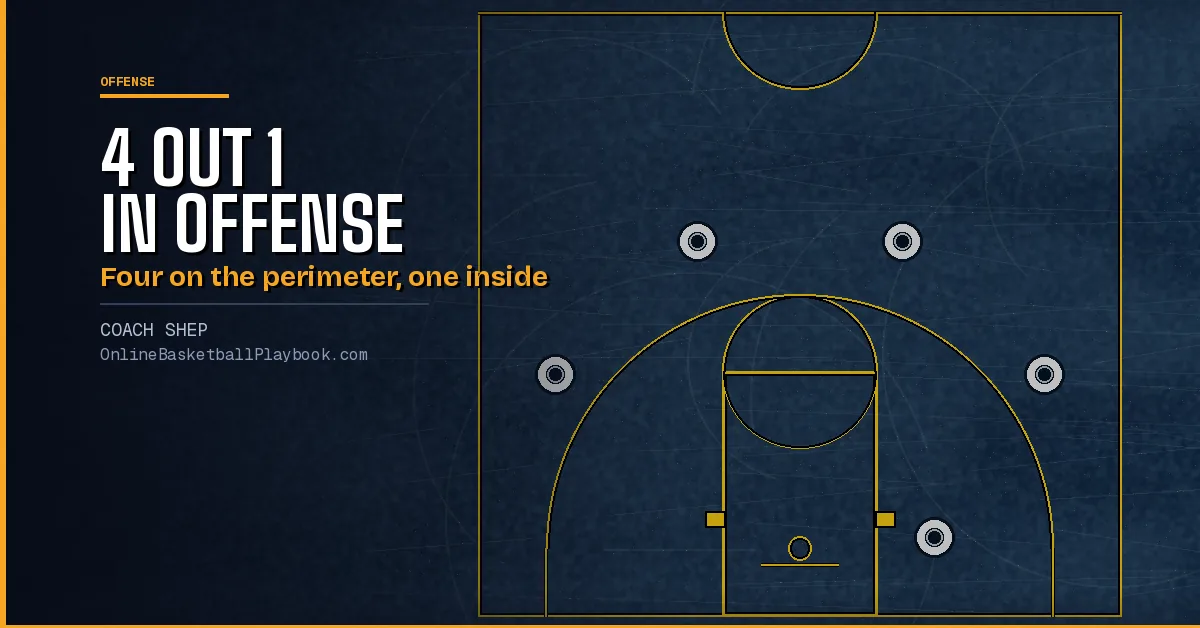
4 Out 1 In Motion Offense: Rules, Spacing and Sets
How to run the 4 out 1 in motion offense: spacing, the six rules, what the post does, pass-cut-fill, screens, quick hitters, zone adjustments and how to install it.
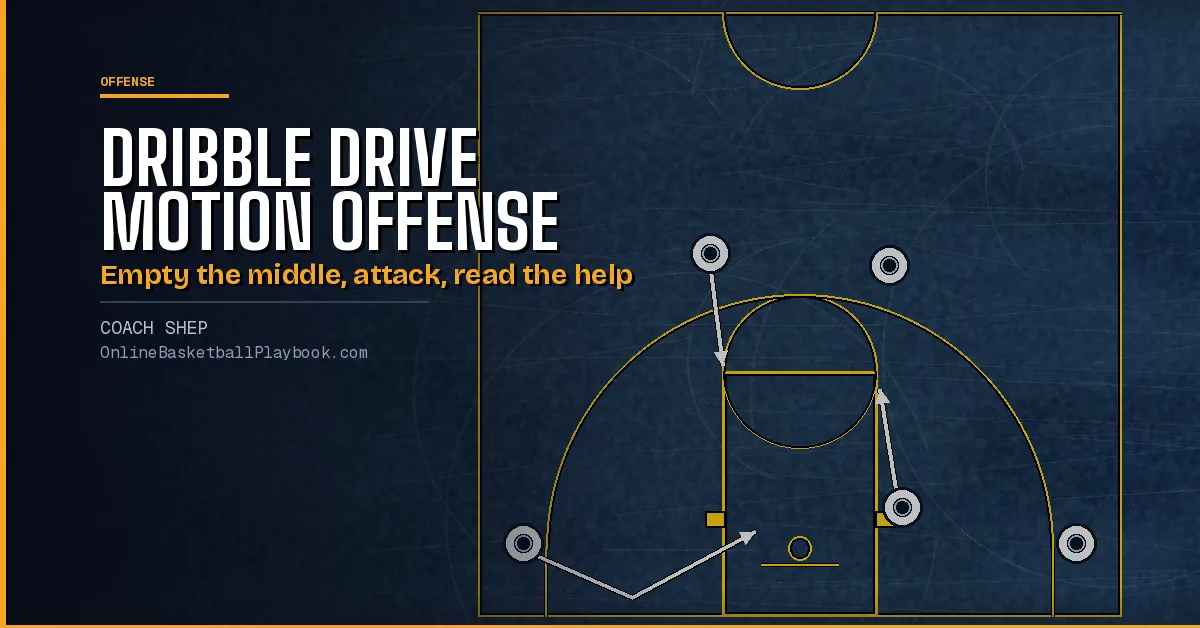
Dribble Drive Motion Offense: Spacing, Reads and Install
The dribble drive motion offense explained: 4-out 1-in spacing, the Drop, Drag and Rack zones, the read off a drive, shot diet, weak spots and the install.
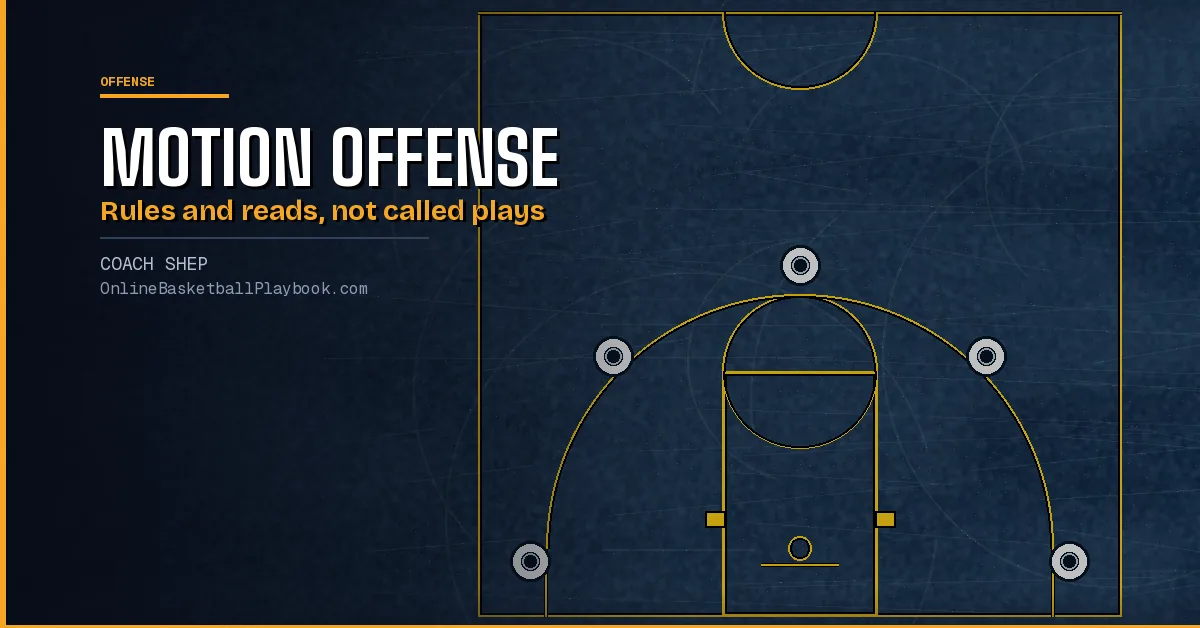
Motion Offense: Spacing, Rules, Actions and How to Install It
Motion offense runs on rules, not called plays. See the spacing, four core actions, 5-out versus 4-out 1-in, the install order, drills and where it struggles.