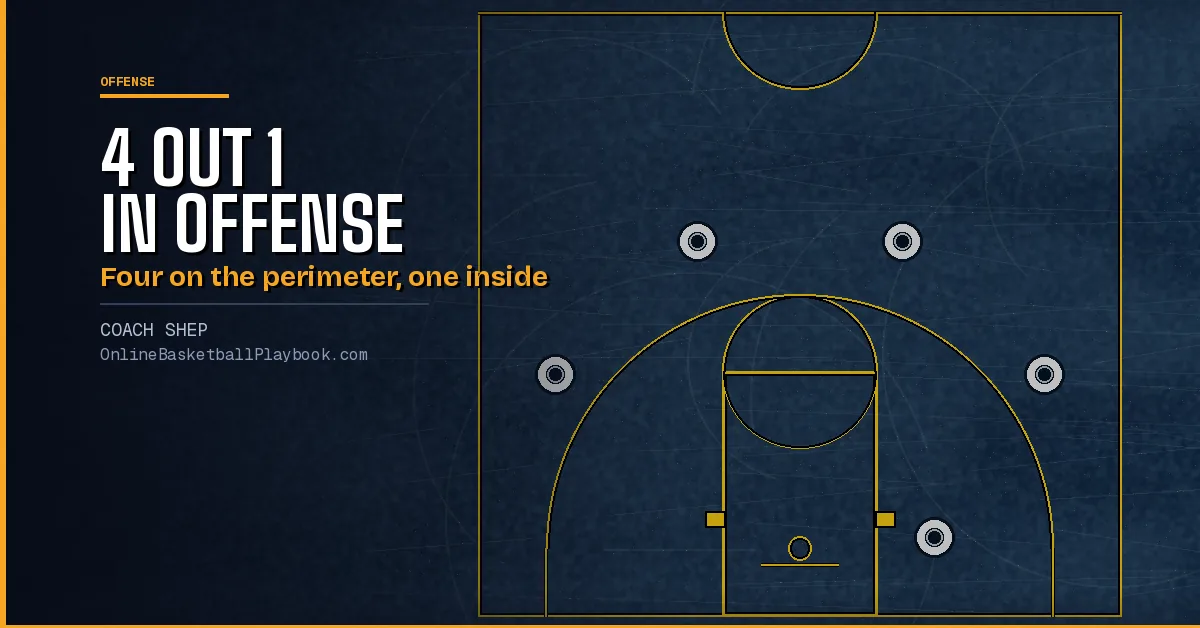
The 4 out 1 in motion offense, also written 4-out 1-in, puts four players on the perimeter and one post player inside. The four share six spots, two slots, two wings and two corners, and they cut, screen and fill by rules instead of waiting for a play call. The spacing makes the post hard to trap and gives the guards room to drive. It is a flexible base for a team with one real post and good perimeter players. This guide covers the spacing, the rules, the post's choices, the core actions, quick hitters, zone adjustments and the install order.
The 4 Out 1 In Offense at a Glance
| Piece | Detail |
|---|---|
| Perimeter | Two slots and two wings a step outside the arc, about 18 feet apart. Corners are secondary spots |
| Post | One player on the blocks or elbows. He moves, so the spot is a choice |
| Best for | Teams with one strong post and perimeter players who can shoot and pass |
| Cost | Less inside presence than 3-out 2-in, and a post who does not understand spacing clogs the lane |
4 Out 1 In Spacing and the Six Rules

The four perimeter players stand about 18 feet apart. That distance makes it hard for one defender to help and recover. Villanova's version uses three guards and two bigs, with the bigs in opposite spots, one high and one low, to keep the same 4-out spacing. The full Villanova system is on Jay Wright's Villanova system.
- Hold the spacing. Keep the 18 feet.
- Cut with purpose. Target the hands and call for the ball.
- Never pass and stand. Cut, screen or move.
- Watch the cutters. Know where your teammates are going.
- Catch looking to shoot. The catch makes the defense decide.
- Limit the dribble. Penetrate, use a ball screen or improve an angle. Do not dribble without a reason.
Off the ball, a player pops out against an underplay, back cuts against an overplay, back cuts when someone dribbles at him, fills a vacated spot and relocates on dribble penetration. A perimeter player filling to the ball cuts one of two ways. If his defender is within a step of the line to the ball, he V-cuts. If the defender is two or more steps away, he blast cuts to the ball.
What the Post Does
The post decides the offense. Four choices are common, and the choice belongs to the player, not the team. A starter may flash while the backup stays weak side.
| Option | How it works | Fits |
|---|---|---|
| Weak side, flash to the ball | Stays opposite the ball, flashes a set number of times, holds two or three seconds, then gets out | The recommended start, one flash per possession |
| Always weak side | Never leaves the weak side | A post who cannot create |
| One side | Stays on a single side | Predictable, so use it rarely |
| In front of the ball | Always above the ball | A rare dominant post |

Two setups give the post different homes. In 4-high the post starts at the free-throw line. That opens backdoor cuts and dribble penetration underneath and sets up UCLA screens, pinch-post hand-offs and high ball screens.

In 4-low the post stays on the block or short corner. That opens the top of the key for one-on-one penetration and runs the post-up series. It helps a post who cannot beat a shot blocker on the block but can hit the short-corner shot and pull the shot blocker away from the rim.
The Core Actions

Pass, cut and fill. Every pass triggers a basket cut through the charge circle and everyone fills toward the ball. On a slot to wing pass, the passer cuts and replaces the weak-side wing. On a wing to slot pass, the passer cuts and returns to his own wing. On a slot to slot pass, the passer cuts through and out to the weak-side wing and the post crosses the lane to stay weak side. If the post flashes to the block on a slot to wing pass, the cutter goes behind him. Any cutter who has a mismatch can post for two seconds. Do not rush this stage. It can take weeks or months.
Back cuts. A hand in the passing lane while the passer is looking at you means back cut, with no hesitation. Teach it against a dummy defense that alternates deny and sag.

Dribble penetration. If a player can beat his man, he goes. He drives in a straight line just outside the defender's hip. The post reads the helper and opens a lane from the baseline to the elbow. On a wing baseline drive, the post goes to the front of the rim and the weak-side slot drops to the corner for the kick-out. Everyone else moves to an open spot. Practice the floater.

Post entry. The ball-side wing cuts to the weak side on every post feed so nobody can double from his spot. The post catches with his low foot above the block, so the baseline cut and the bounce pass are still there. If the post is on or below the block, run a Laker cut, to the elbow and then the corner. If a defender doubles from the wing, the post skip passes to the opposite wing where the help came from, follows his pass and re-posts for a quick return feed. A feed from a slot avoids the double, because help-side is not yet set.
Get the next coaching guide in your inbox
One email when a new guide or diagram set goes up. Free.
Screens and Dribble At
Away screens come in one form first, the curl. The screener sets on the defender's back hip and pops back. The receiver holds the ball a beat, so the screener is seen. A back cut is the answer when the defender cheats over the screen. Later, give the receiver a choice. If the defender trails, he curls. If the defender goes under, he cuts straight. A screener who goes the opposite way keeps the floor balanced. Straight cuts everywhere turn the offense into a delay game.
On-ball screens come after any pass. Name the screen and signal with a fist. The other two perimeter players slide to the corners, the post stays low for the dump-down, and the screener plays safety.
On a dribble at a teammate, young teams use the back cut and high school teams and older add the hand-off. On a hand-off everyone holds. On a back cut everyone fills.
4-Out 1-In Quick Hitters and Set Plays
Quick hitters live inside the base motion. A few fire off a specific pass.
- Slot to slot. A flare for the passer. Or a flex screen then a pin down, the screen the screener action.
- Slot to wing. A stagger for the weak wing, then a screen for the second screener. Or a UCLA screen into a ball screen.
- Wing to slot. A weak-side down screen, or a weak-side flare.
Many set plays are base reads in a new frame, so do not teach the whole catalog. If the post is fully fronted at the high post, he seals and cuts to the rim for a lob. If half-fronted, move the ball to the corner so the sealed post can roll to the rim. For late clock, run a ball screen. In the straight version, the post sprints to a ball screen for the best playmaker. In the UCLA-first version, the post first sets a UCLA screen for the ball-side slot, then the ball screen, which makes every defender rotate one more spot. Out of a transition entry, wings sprint wide to the corners, the first big down the floor fills the paint and the trailing big fills the opposite slot.
Rebounding rules protect the transition game. On an inside shot, players inside the arc crash and the others get back. The post goes to the front of the rim. On a wing shot, the weak wing crashes and three get back. On a shot from a slot, both wings crash and the two slots get back.
Against a Zone
The base needs few changes against a 2-3 zone. The post seals the middle defender as the ball swings. Cutters hook and look in the open area between the back line and the foul line for one or two seconds. When the bottom defender is pulled out to a high wing, the post goes to the short corner. A slot player cuts to the ball-side corner to overload. For more, see How to Attack a Zone Defense.
4-Out 1-In Compared With 3-Out and 5-Out
One common view treats 3-out 2-in, 4-out 1-in and 5-out as a ladder. Move up as the perimeter skills grow. The 3-out 2-in version keeps a post presence for teams without shooters at all five spots, and it works only with two posts who are smart and comfortable inside. The 5-out version removes the last post and maximizes spacing at the cost of inside scoring and rebounds. Coaches disagree on where to start in high school. The 5-out-first case says 5-out suits most young teams. The 4-out-first case argues for 4-out because it isolates a single post with no second big to help the defense, and because four good perimeter players are easier to find than two real posts.
The same alignment also hosts the dribble drive. That system uses almost no screening and clears the middle for guards who can beat their man. See Dribble Drive Motion Offense for that approach, 5 Out Offense and 3-Out 2-In Motion Offense for the neighbors, and Motion Offense for the rules that apply to all of them. A three-rule version of 4-out runs on a slot-to-slot pass that brings a post back screen, a slot-to-wing pass where the passer cuts through, and a back screen with a switch when the 4 steps up.
How to Install the 4-Out 1-In Offense
Install it in layers and do not skip ahead. Spend weeks on the first two.
- Pass, cut and fill. Learn the spots and rotate on every pass.
- Back cuts. Add a deny and sag dummy defender.
- Dribble penetration. Teach spacing reactions and the floater.
- Away screens. Curl only at first.
- On-ball screens after a pass. Name them.
- Straight cut option. The receiver chooses curl or straight.
- Dribble at. Back cut for youth, hand-off for older teams.
Pair the layers with the work on Drills to Teach Motion Offense and Basketball Spacing Drills.
Questions Coaches Ask About the 4 Out 1 In Offense
What is the 4 out 1 in offense?
A motion offense with four perimeter players and one post. Players share six perimeter spots and move by rules.
What does the post player do in 4 out 1 in?
He picks a plan. Common choices are staying weak side and flashing a set number of times, staying weak side always, or setting up high or low. The best choice depends on the player.
Is 4 out 1 in good for youth basketball?
Yes, with a simple rule set. Teach pass, cut and fill, back cuts and the dribble-at back cut first, and leave screens until later.
What is the difference between 4 out 1 in and 5 out?
4-out keeps one post inside. 5-out puts all five outside the arc, which opens the lane further and gives up inside scoring and offensive rebounds.
Did Jay Wright run 4 out 1 in?
Villanova under Jay Wright is a well-known college user. The version uses three guards and two bigs in opposite spots. More is on Jay Wright's Villanova system.
What is a 3 out offense?
Usually 3-out 2-in, with three perimeter players and two posts. It suits teams with two skilled posts. See the 3-out 2-in guide.
Other systems to compare are the Princeton offense, the flex offense and continuity offense. For the post's side of this offense see Post Play in Basketball, and for the concept behind the 18 feet see What Is Spacing in Basketball. Every system sits under Offense.
Want the printable playbook packs?
OBP Pro members get the premium playbook packs: the zone attack, out of bounds and practice plan PDFs, plus each new pack as it is finished. The membership page lists what is in each one. Or draw your own version free in PlayDraw.
See what OBP Pro includesMore Offense and Press Guides
- Princeton Offense: Cuts, Reads and Sets
- Triangle Offense Basketball: Reads, Spacing and Entries
- 1-2-1-1 Diamond Press Basketball: Roles, Traps and Install
Back to Motion Offense and every Offense page.
Keep Building
Related breakdowns
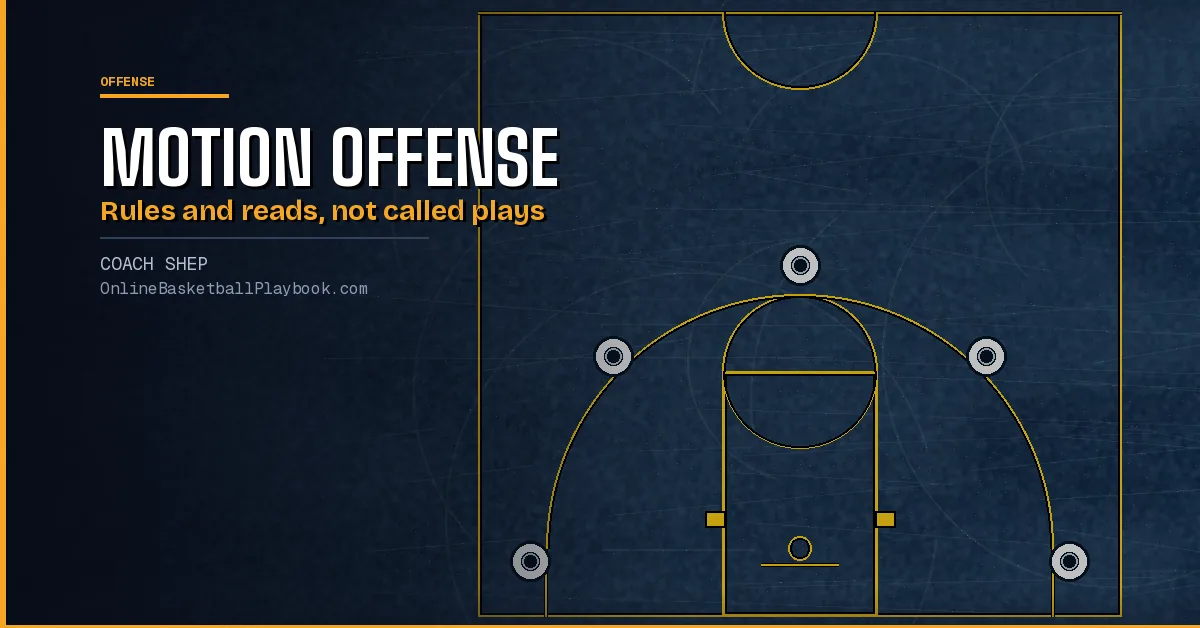
Motion Offense: Spacing, Rules, Actions and How to Install It
Motion offense runs on rules, not called plays. See the spacing, four core actions, 5-out versus 4-out 1-in, the install order, drills and where it struggles.
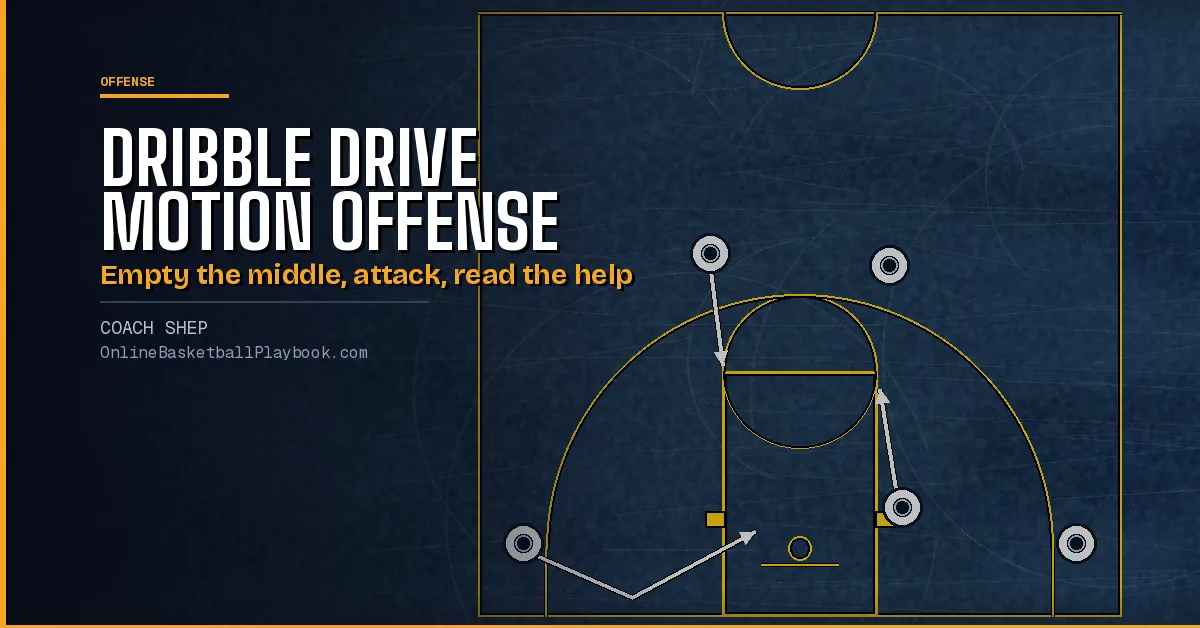
Dribble Drive Motion Offense: Spacing, Reads and Install
The dribble drive motion offense explained: 4-out 1-in spacing, the Drop, Drag and Rack zones, the read off a drive, shot diet, weak spots and the install.
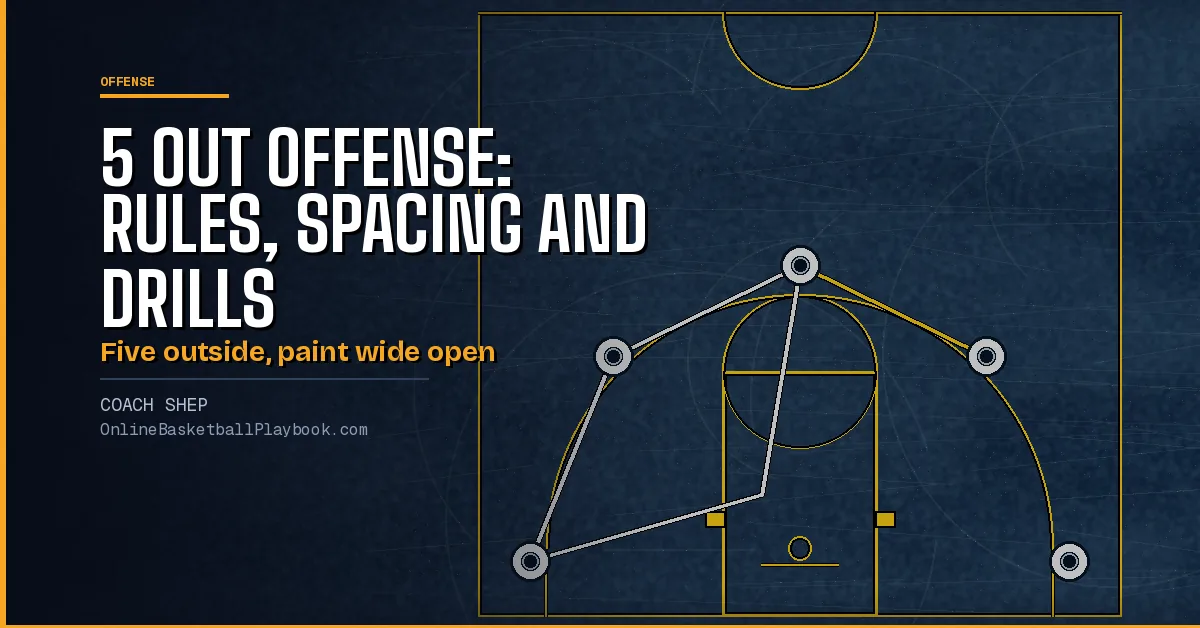
5 Out Offense: Rules, Spacing and Drills
How the 5 out offense works: the five spots, the rules, pass and cut, back cuts, screen away, circle motion, youth teaching order, and what to do against a zone.