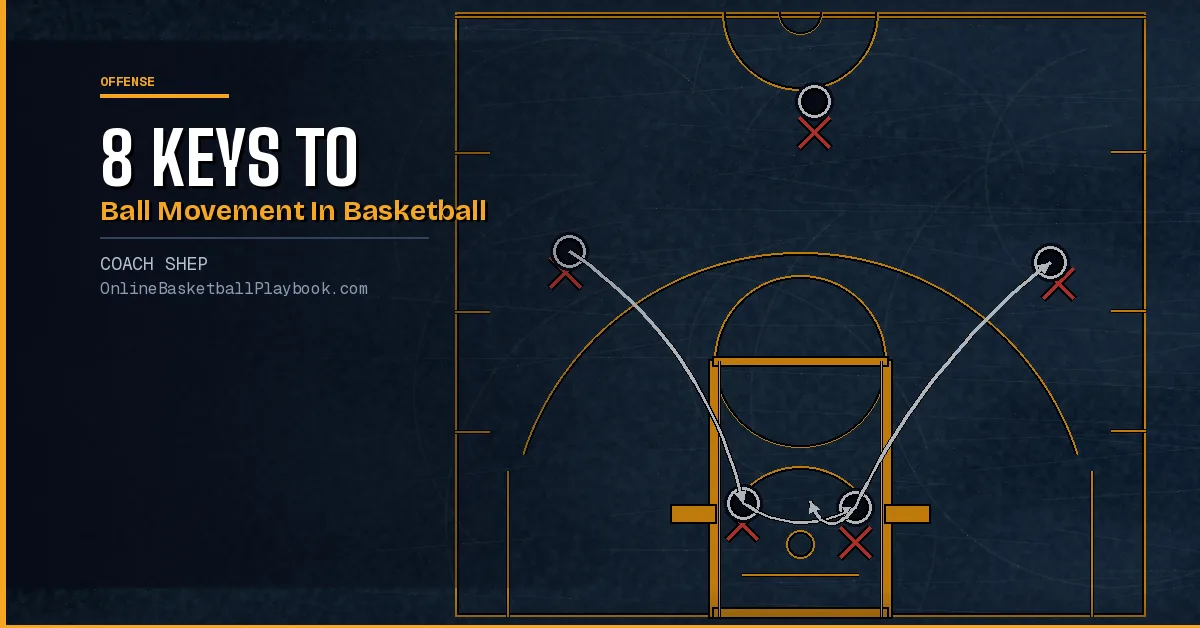
Ball movement wins basketball games. Teams that pass with purpose, space the floor correctly, and attack defenses on the move consistently outscore teams that rely on isolation and individual creation. Here are the eight principles that make it work.
Why Ball Movement Beats Isolation
Every defense has a weakness somewhere on the floor. The challenge is finding it, and you cannot find it by holding the ball. When the ball stops moving, the defense stops moving too. Help defenders can settle into position, close lanes, and take away every option the ball-handler has. The math tilts toward the defense the moment the ball goes dead.
When the ball moves, defenders have to make decisions. Every pass forces a rotation, every skip forces a closeout, and every closeout creates a drive opportunity. Defenses are designed to handle the ball in one spot. They are not designed to handle four or five reads in a row at pace. Great ball movement does not require great individual skill. It requires five players who understand their role in the chain and commit to finding the next right pass before they catch the current one.
The teams that move the ball best are not necessarily the most talented teams. They are the most disciplined ones. A roster of average athletes who trust each other and execute can make a defense look broken. A roster of talented players who each want to create for themselves will spend possessions walking the ball up and settling for contested jumpers. The choice is a coaching decision as much as a personnel one.
Spacing: The Foundation of Every Pass
Ball movement only works when there is somewhere to move the ball. If four players stack on the same side of the court because they are watching the ball-handler work, the pass has no value. The defense has nothing to guard. Help defenders sit in the paint and make every drive dangerous. Spacing is what makes the pass threatening, and a threatening pass is what creates open shots.
The basic spacing principle is simple: give the ball-handler room to operate, and put shooters or cutters at positions that force defenders to make a choice. If a wing defender has to decide between staying with his man on the perimeter or helping on a drive, the offense wins. If he can cheat toward the paint without consequence because his man is standing in the corner watching, the defense wins. Spacing creates the dilemma. The pass resolves it.
Practical spacing guidelines for most systems:
- Players without the ball should maintain roughly 15 feet of separation from each other.
- No two players should be on the same side of the imaginary vertical line through the lane unless there is a specific action (staggered screen, weakside cut) happening there.
- The corner is not a penalty box. A player stationed in the corner is threatening a three-point attempt and occupying a defender who cannot help without giving up an open look. Stay there with intent.
Bad spacing is the single most common reason good ball movement concepts break down at the youth and high school levels. Players cluster, the lane fills, and no one can receive a clean pass anywhere dangerous. Fix the spacing first, and most other ball movement problems become significantly easier to solve.
Pass with a Purpose, Not Just to Relocate
There is a version of ball movement that looks good statistically and accomplishes nothing. Players swing the ball around the perimeter, each pass landing at a position where the receiver has no immediate advantage. The defense rotates calmly, no one drives, no one cuts, and after 20 seconds of pretty passing, someone takes a contested pull-up because the shot clock is dying.
Every pass should accomplish one of three things: it should attack a specific defender who is out of position, it should create an angle the passer could not exploit himself, or it should advance the ball toward the basket. If a pass does none of those things, it is relocation passing. It moves the ball without moving the defense, and it is essentially wasted time.
Teaching players to pass with purpose requires teaching them to read the defense before they pass. The cue is simple: before you give up the ball, know where the defense is weak. Is a help defender leaning toward the ball? Skip it to the opposite corner. Did the pass you just made put a slower defender on a quicker player? Immediately set a screen or cut to exploit it. Did the ball go into the post? The passer should not stand and watch. The passer should cut away, relocate to a different spot, or set an action that makes the defense choose between the post and the perimeter.
Cutting Creates the Advantage. Passing Delivers It
A pass to a stationary player gives the defense time to adjust. A pass to a player in motion (particularly one who just cut off a screen or read a defender cheating toward the ball) delivers the ball to someone who already has a step of advantage. The cut creates the problem. The pass is the solution. Teams that understand this distinction play at a different level than teams that think of cutting and passing as separate skills.
The backdoor cut is the clearest example. If a wing defender is overplaying the passing lane, working hard to deny the entry pass, the cutter has a gift. One hard step toward the ball, then a sharp cut to the basket. If the ball-handler sees it and delivers the pass on time, it is a layup. If the ball-handler is not paying attention, the cutter's work is wasted and the defender recovers. The cut without the pass is just running. The pass without the cut is just throwing. Together, they are a layup.
For this to work at the team level, every player has to be a potential passer when they receive the ball, not just a potential scorer. The point guard needs to trust that the wing who cuts will get the ball on time. The wing needs to trust that cutting hard will be rewarded. When those two players have history together (when they have run that action dozens of times in practice), the timing becomes almost automatic. Trust between passer and cutter is earned through repetition, not assumed at the start of a season.
Read the Defense Before You Catch
The best ball-movers in basketball are reading the floor before the pass arrives. They know where the help defenders are, where the open space is, and what their first move will be, all before they touch the ball. By the time they catch, the decision is already made. This eliminates hesitation, which is what defenses are hunting for.
Hesitation is the enemy of ball movement. A player who catches, looks around to gather information, and then decides where to pass has already given the defense a half-second to recover. That half-second is often the difference between an open shot and a contested one. Teaching players to read while they are off the ball (rather than waiting until they have the ball in their hands) is one of the highest-leverage coaching habits you can develop.
Specific cues to teach:
- Watch your defender's feet and weight. If his weight is forward, he has committed to helping on a drive. That means there is a passing lane behind him. Find it and use it.
- Track the weakside help. The player two passes away from the ball is often open because that defender is shading toward the ball. A skip pass to the weakside before the defense can recover is one of the most reliable actions in basketball.
- Know the shot clock situation before you catch. If there are four seconds left, you are catching to shoot. If there are 14 seconds left, you are catching to make the next right pass.
Timing: The Invisible Skill
Timing separates good ball movement from great ball movement. The right pass a half-second late is a defended pass. The right pass delivered when the defender is still recovering from a cut is a layup. Most players understand what pass to make. Far fewer understand exactly when to make it, and the difference between those two things is the gap between a pretty offense and a productive one.
Timing is developed through repetition. You cannot coach it in a meeting room. Players have to run actions together until the rhythm becomes instinctive. Until the passer knows the cut is coming and begins the delivery motion before the cutter has fully committed. Watch how two-man combinations operate in well-coached offenses. The ball and the cutter arrive at the same spot at the same moment because both players have internalized the timing through thousands of repetitions. That is not talent. That is practice time deliberately spent on timing, not just on the shape of the action.
A drill approach that builds timing faster than most: run two-man actions at game speed with no defense. The goal is not to score. The goal is to make the pass at the exact moment the cutter is two steps from the catch point. If the passer waits until the cutter is at the catch point, the timing is already late. The pass needs to meet the cutter, not wait for him. Once two players have it locked, add a token defender and let the timing be stress-tested. The adjustment will happen naturally.
Ball Movement Under Pressure
Any team can move the ball against a passive, sagging defense. The real test is ball movement against an aggressive, denying defense (one that is trying to cut off passing lanes, speed up your offense's decision-making, and force turnovers). Most teams that look fluid in a moderate-tempo game suddenly hold the ball, over-dribble, and make low-value passes the moment defensive intensity goes up.
On-ball pressure is specifically designed to make the offense handle the ball more than it wants to. As our coaching research library notes on individual on-ball defense, the goal is not to force an immediate turnover. It is to make the ball travel farther from the basket, make each dribbler make one more decision than they want to. The offensive counter is not to fight the pressure by dribbling harder. The counter is to pass before the pressure can settle.
Two rules for maintaining ball movement against pressure:
One: meet the ball. A passer under pressure needs a receiver who steps toward the ball rather than waiting in place. Waiting lets the defender sit in the passing lane. Moving toward the pass (even two or three steps) shrinks the distance the ball must travel and reduces the window a defending hand can intercept it.
Two: use the dribble as a pressure valve, not a first option. When a player catches with a defender in their face, one hard dribble away from pressure (not toward traffic) creates the space for the next pass. The dribble is a tool. Use it once, purposefully, then move the ball. Teams that dribble to think rather than dribble to attack invite the defense to reset and smother the next catch too.
Against a trapping or denying defense, the most effective relief valve is the player two passes away from the ball. That player's defender almost always shades toward the trap to provide help, leaving a wide open skip-pass opportunity if your players are trained to look for it immediately. Drill the skip-pass read weekly so it is automatic under game pressure.
Building the Culture of Ball Movement
The eight keys in this article are skills. But skills only show up when the culture of the program rewards using them. If players believe that scoring earns more playing time than making the right pass to an open teammate, they will hold the ball. If the coach celebrates the pass that led to the basket as enthusiastically as the basket itself (if the assist matters to the program, not just the scorer), players will make the extra pass consistently.
Culture change starts in practice. Reward the correct read, not only the made shot. When a player catches in the post with a clear advantage and kicks it to a wide-open corner shooter, acknowledge it on the floor immediately. When a player catches on the wing with an open cutter beneath them and shoots anyway, address it (not harshly, but directly). Players take their cues from what the coach notices and what the coach lets pass without comment.
Statistical accountability helps too. Track hockey assists and second assists at the team level. Show players after every game how many of their made shots came off two or more passes. Over time, those numbers tell the story more convincingly than any pregame speech. Players who see the correlation between ball movement and efficient scoring (who see that their best offensive nights come when the ball circulates freely) become advocates for the system rather than resistors to it.
Finally, play your ball-movers. If the player who makes the right read and the right pass consistently does not get floor time over the player who holds the ball and creates independently, the team learns the wrong lesson. The roster takes its values from the rotation. Make sure the rotation reflects what the program actually believes about how the game should be played.
- Fix spacing first: before installing any action or scheme, ensure every player knows where to stand when they do not have the ball. Proper spacing is the prerequisite for everything else.
- Teach the read, not just the cut: every off-ball player should know what defensive cue triggers their cut, screen, or relocation before they move. Purposeful movement beats scripted movement.
- Reward the extra pass in practice: verbally acknowledge the pass that creates a layup as emphatically as the layup itself. Players optimize for what coaches celebrate.
- Drill timing in two-man isolation: run two-man actions at game speed with no defense. The only goal is for the ball and the cutter to arrive at the same spot at the same moment. Then add a token defender.
- Install the skip-pass read against pressure: the player two passes away is almost always open when defenses trap or deny. Make reading and hitting that player an automatic weekly drill, not an afterthought.
Want more basketball coaching strategies and drills?
Join the Online Basketball Playbook newsletter →
Draw this play free in the play drawer →
Membership: the full library, playbook packs, and Pro drawing tools →
Keep Building
Related breakdowns
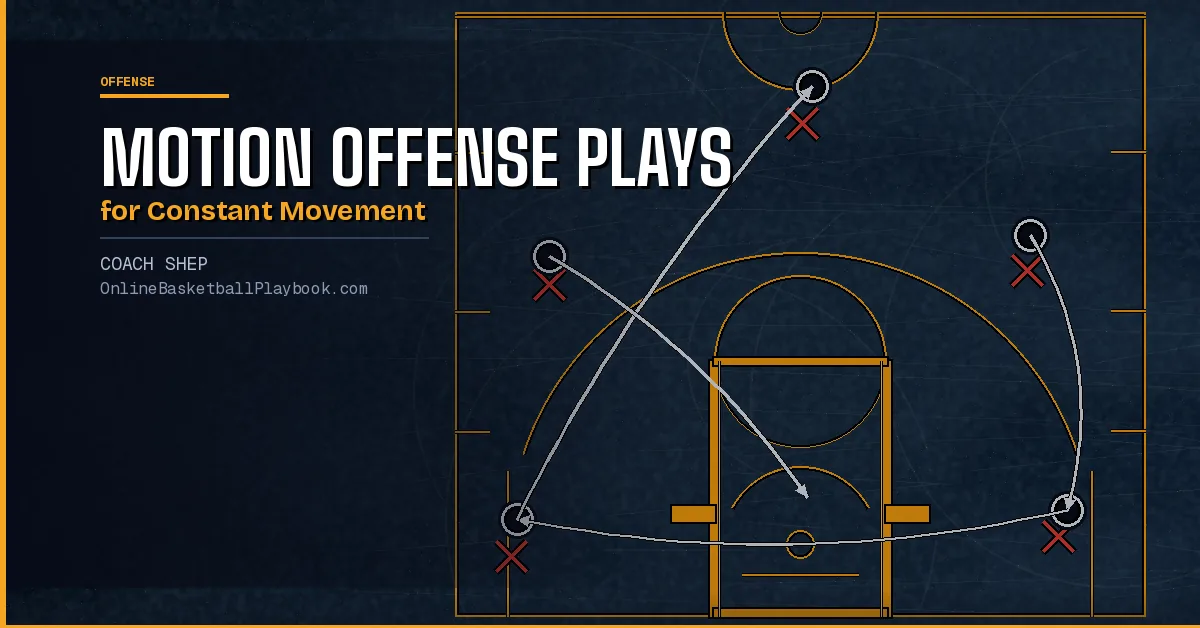
Motion Offense Basketball Plays for Constant Movement
Motion Offense Basketball Plays for Constant Movement
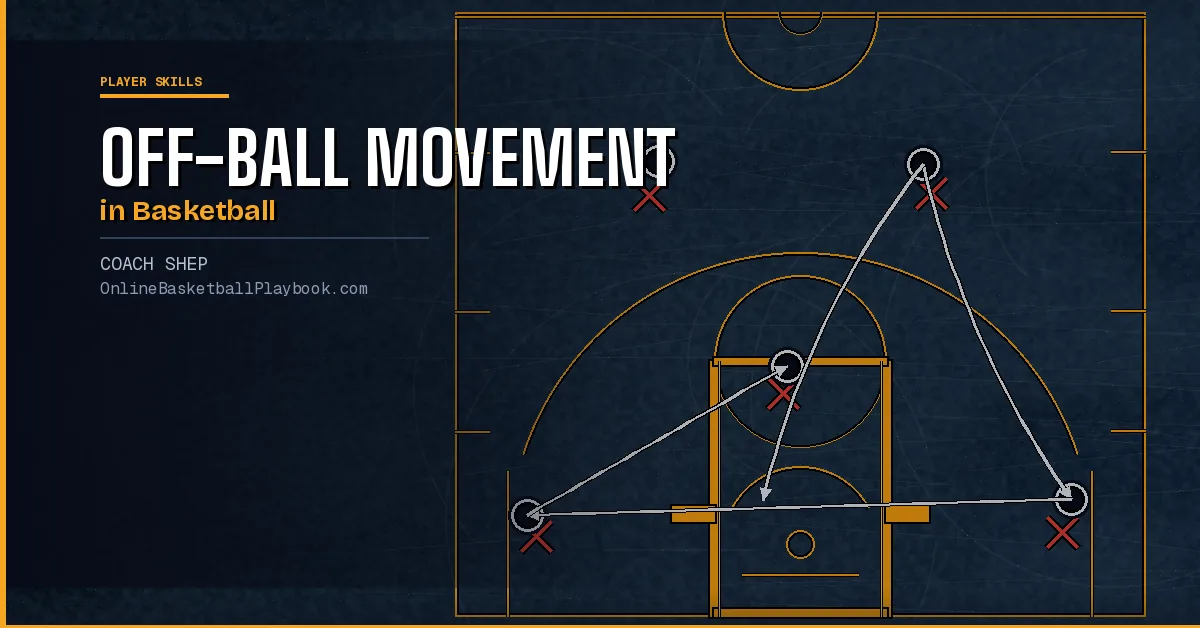
Off-Ball Movement in Basketball: Complete Guide
Off-Ball Movement in Basketball: Complete Guide