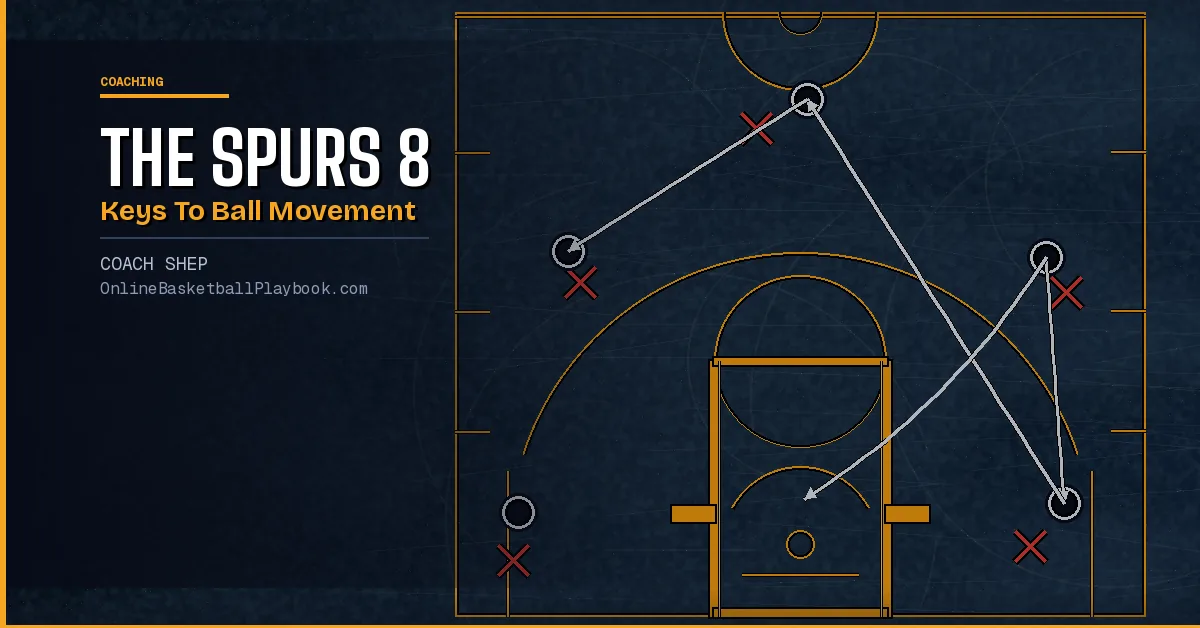
The San Antonio Spurs turned ball movement into a weapon that overwhelmed elite defenses for two decades. These eight principles (the DNA of their system) are teachable at any level.
Why Ball Movement Beats Isolation
Gregg Popovich built five championships in San Antonio on a single organizing idea: a defense can only be in one place at a time, so move the ball until the defense is in the wrong place, then attack. It sounds simple. It is also extraordinarily hard to execute at game speed because it demands that every player on the floor read the same picture simultaneously.
The counterintuitive truth that Popovich and his staff taught year after year is that ball movement is not about being unselfish. It is about being efficient. The Spurs did not share the ball because they were good people. They shared the ball because passing creates advantages that individual skill cannot. When Tim Duncan caught the ball at the elbow and immediately reversed it to Manu Ginobili cutting baseline, they were not being generous. They were executing the highest-percentage play available on that possession.
Modern analytics have confirmed what Popovich understood by feel. Shots generated through ball movement, measured by "secondary assists" (the pass that leads to an assist), yield a measurably higher effective field goal percentage than shots off isolation or one-pass sets. The Spurs led the league in secondary assists for years running during their dynasty. That is not a coincidence. That is a system.
The eight keys below are the principles that made the system work. They are not exclusive to elite players. Coaches at the youth, high school, and college levels have applied each of them to teams with ordinary talent and seen the same effect: more open shots, more player movement, less defensive recovery time, and (most important) a more connected team on the floor.
Key 1–2: Read the Defense Before You Catch
Key 1: Eyes on the Defense, Not on the Ball
The first and most foundational principle is this: every player on the floor is reading the defense on every possession, not admiring the ball. In a static offense, players watch the ball. In the Spurs system, players watch the defense because the defense is the information source. Where is the help? Who is sagging? Who is overplaying? The answer to those questions tells you where to go before the ball ever arrives.
Popovich drilled this by requiring players to call out their read before they made their cut or set their screen. This verbalization forced the cognitive step. It made the read conscious before it became automatic. Young players who never practiced this skip straight to physical execution, moving without processing, and they are almost always in the wrong place or one count too late.
The practice drill that builds this habit is called "freeze tag" or "read the defender": the offense runs motion actions but the coach or manager holds up colored cards rather than having the defense play live. Each color signals a different help position. The offense must adjust their cut, their fade, or their fill based on the color shown. It slows the drill down, builds the habit of seeing the picture first, and transfers directly to live ball movement.
Key 2: Catch Ready to Shoot, Pass, or Drive
The second key is the catch. In the Spurs system, every catch is a triple-threat read, not a dribble launch. The receiver catches the ball in a position to shoot, pass, or drive, and the decision is made in the fraction of a second after the catch based on what the defense shows. This is fundamentally different from catching and then looking. Looking after the catch is a beaten play. The defense already closed.
Tony Parker was the master of this. His catch-and-go footwork (the way he received the ball already moving into his first step) compressed the defender's reaction window to near zero. He was not cheating the catch; he was making his read before the pass arrived and organizing his body accordingly. That is an acquired skill built through thousands of repetitions of catch-footwork drills, not a natural gift.
For a coach installing this principle, the teaching point is simple: if the receiver's first action after the catch is to look, the drill is wrong. The read happens before and during the catch. Fix the footwork and fix the timing of the read, and the decision-speed problem largely solves itself.
Key 3–4: Fill and Space Without the Ball
Key 3: Move to Create, Not to Get
The third key is off-ball movement, and the specific principle that distinguishes the Spurs' version from generic "motion offense" is the purpose of that movement. Players in the Spurs system move off the ball to create space for a teammate, not primarily to get open themselves. This is a subtle but critical distinction in player mindset.
When a player moves to create, the geometry of the floor opens up. A skip cut that pulls a help defender away from the ball-handler generates an advantage for the ball-handler even if the cutter never touches the ball. That is productive movement. A player who drifts to a corner to get himself a catch (without any relationship to what the ball-handler needs) is simply relocating. The movement looks the same on film, but one changes the defense and one does not.
The teaching cue Popovich's staff used repeatedly was "what does the ball need right now?" If the ball needs spacing, give spacing. If the ball needs a cutter to occupy the nail defender, become that cutter. The player with the ball does not always know what he needs, so the off-ball players have to see it for him and provide it without waiting to be asked.
Key 4: Space the Floor in Straight Lines
The fourth key is geometric: space the floor in straight lines from basket to three-point line. The Spurs consistently positioned three or four players at or beyond the arc because straight-line spacing creates the longest possible closeout distance for the defense. When a defender has to close twenty-two feet to contest a shot, there is a window (however brief) for the catch-and-drive or the catch-and-shoot.
Collapsed spacing, where two offensive players drift toward the same area, kills ball movement. The pass may arrive, but the advantage has already been surrendered because help defenders do not have to travel to recover. The drill to build spacing awareness is simple: freeze the offense mid-possession and check whether any two players are within eight feet of each other on the same side. If they are, the spacing is wrong. Fix it in freeze-frame before fixing it at game speed.
Key 5–6: Pass Angles and the Third Man
Key 5: Pass to the Advantage, Not to the Open Man
The fifth key reframes the passing decision entirely. Most players are taught to pass to the open man. The Spurs' system teaches players to pass to the advantage (to the place where the defense is most compromised, which is not always the same as the most open player). An open player on the weak side with no driving angle is a lower-value pass than a slightly contested player at the elbow who is two dribbles from the basket.
This distinction requires players to understand what "advantage" means geometrically: proximity to the basket, driving lane availability, and the number of decisions the defense must make to recover. The best pass in the Spurs system was routinely the most difficult pass to see (the cross-court skip to the corner that forced two defenders to close simultaneously, splitting the coverage and leaving one of them a step late).
Key 6: The Third Man Makes the Play
The sixth key is what Popovich called "the third man concept" (the idea that the best play on a possession is usually the one completed by the third person to touch the ball). Player A passes to Player B; Player B passes or dribbles to create a read; Player C is the beneficiary. The defense is reacting to A and B. C gets the shot.
This requires all five players to stay connected to the possession even when they do not have the ball: tracking every pass, anticipating the next read, and being in position for the third-man role before Player B has even made his decision. It is a team cognition skill, and it is the most sophisticated thing the Spurs did. Tim Duncan was masterful in the third-man role (he caught dump-offs and skip passes at the finish point of so many two-man actions that the defense could never fully commit to stopping the primary action without giving him an open eight-footer at the elbow).
Key 7–8: Decision Speed and the Empty Corner
Key 7: One Second or Fewer on Every Read
The seventh key is tempo (specifically, the pace of decision-making). The Spurs' ball movement was fast not because they were in a hurry, but because each individual decision was made quickly. One second or fewer on each read. If the advantage is there, attack it in one second. If it is not there, release the ball in one second and reset.
Long reads (three seconds, four seconds of holding the ball while deliberating) allow the defense to recover and rotate. They also flatten the rhythm of the offense and make the next read harder because the defense has settled. The Spurs' offense kept the defense in continuous reaction mode by making decisions before the defense could set up. Fast decisions on each read; the overall pace of the possession could still be deliberate and controlled.
Teaching decision speed requires time pressure in practice. Many coaches slow down their motion drills to correct technique, which is useful for early learning. But the next stage (the stage that transfers to games) is running the motion with a decision clock: catch, read, act in two counts. Then one count. Then real-time. Players who only ever practice at slow speed cannot compress their decision-making when the defense is live and pressuring.
Key 8: Use the Empty Corner to Reset and Re-Attack
The eighth key is what happens when the advantage disappears. The Spurs did not force stalled possessions into bad shots. They reset, using an empty corner or a wide pin-down action to reconfigure the spacing and start the movement sequence again from a new angle. The empty corner in their system was a safety valve: a spot on the floor that could absorb a player and re-open driving lanes without requiring the defense to make any new decision. It was not passive. It was a deliberate structural reset that set up the next attack.
Coaches can install this principle by teaching a simple "reset signal" (a verbal or visual cue that tells all five players to revert to their base spacing). When the ball swings back to the top of the key, every player recalibrates. This prevents the common failure mode of tired motion offense: players drifting off the system and bunching because they are uncertain what to do after the primary action breaks down.
Teach the reset as a positive action, not a sign of failure. When players learn to reset with purpose (recognizing that resetting from proper spacing is the setup for the next advantage), they stop forcing bad reads and start trusting the system to generate open shots across multiple actions within a single possession.
Installing the Spurs Principles at Your Level
The common mistake coaches make when trying to teach Spurs-style ball movement is introducing all eight principles at once. That produces confusion, not movement. The Spurs built their system in layers over years with the same core players. A high school or youth coach has weeks, not years, and a roster that turns over every season.
The practical approach is to sequence the eight keys by prerequisite. Keys 1 and 2 (reading before the catch and catching ready) are prerequisites for everything else. Without them, the other six principles have nothing to build on. Spend the first two weeks of the season doing nothing but catch-footwork and read drills. It feels slow. It pays off in October when the players can execute the full sequence at game speed.
Keys 3 and 4 (off-ball movement and floor spacing) are the second layer. Add them after the catch reads are reliable. Run motion actions and freeze-check spacing. Correct it before you run it live.
Keys 5 and 6 (pass to the advantage and the third-man concept) are the most cognitively demanding and come last. They require a team that already understands the first four keys well enough to execute them without thinking, freeing up mental bandwidth for the higher-order read of where the advantage is.
Keys 7 and 8 (decision speed and the reset) are installed as refinements. By the time you add a decision clock and a reset signal, your players should already understand the why behind the system. The clock enforces the tempo. The reset signal gives them a recovery protocol when possessions break down.
This sequence works at every level from middle school to junior college. The vocabulary changes; the principles do not.
Common Ball-Movement Mistakes and How to Fix Them
Most teams that try to run ball-movement offense make the same handful of errors. Identifying them early saves months of practice time.
Standing still off the ball. Players catch and watch. Fix: institute a "two-second rule." No player may stand in the same spot for more than two seconds without the ball. Movement is the default state, not the exception.
Passing to relieve pressure, not to create advantage. The ball-handler is in trouble and dumps it to the first open teammate regardless of where that teammate is or what advantage that pass creates. Fix: run possession-review film sessions where you ask "what did that pass create?" If the answer is "nothing," the pass was wrong even if it was safe.
Not reading the third-man opportunity. Two players execute a pick-and-roll perfectly, the defense collapses, and the third man is standing flat-footed in the corner because he stopped tracking the possession. Fix: make third-man reads an explicit part of every film session. Show it, name it, celebrate it when a player executes it without being told.
Forcing the extra pass when the advantage is already there. The inverse of the previous error. A player passes when he should attack because he has been over-taught to share. Fix: clarify that the goal is attacking advantages, and when you have a clear advantage on your catch, taking it IS the Spurs principle, not a violation of it.
Resetting without spacing. Players reset the ball to the top of the key but everyone is still bunched from the previous action. Fix: the reset is not complete until spacing is verified. Make re-spacing to the arc a required part of the reset action, not an optional add-on.
Ball movement at its best is not a play. It is a set of habits that every player on the floor has internalized to the point that the right read is also the automatic read. The Spurs did not diagram their way to five championships. They built habits through thousands of repetitions until the system was invisible, and what the opponent saw was not a playbook, but a living, connected offense that seemed to always know where the advantage was before the defense could stop it.
- Read before the catch: players call their read out loud during early-season drills so the cognitive habit becomes conscious before it becomes automatic.
- Freeze-check spacing: Stop every motion drill mid-action to verify no two players are within eight feet on the same side. Fix the geometry before running it live.
- Third-man tracking: Every player must be able to identify the third-man target on every possession in film review. Make it a call-out exercise before it transfers to live reps.
- One-second decision clock: Once reads are reliable, add a count: catch, read, act in one second. Long deliberation lets the defense recover and the advantage evaporates.
- Named reset signal: give the team a verbal reset cue so every player recalibrates spacing simultaneously when the primary action breaks down, setting up the next advantage.
Want more basketball coaching strategies and drills?
Join the Online Basketball Playbook newsletter →
Draw this play free in the play drawer →
Membership: the full library, playbook packs, and Pro drawing tools →
Keep Building
Related breakdowns
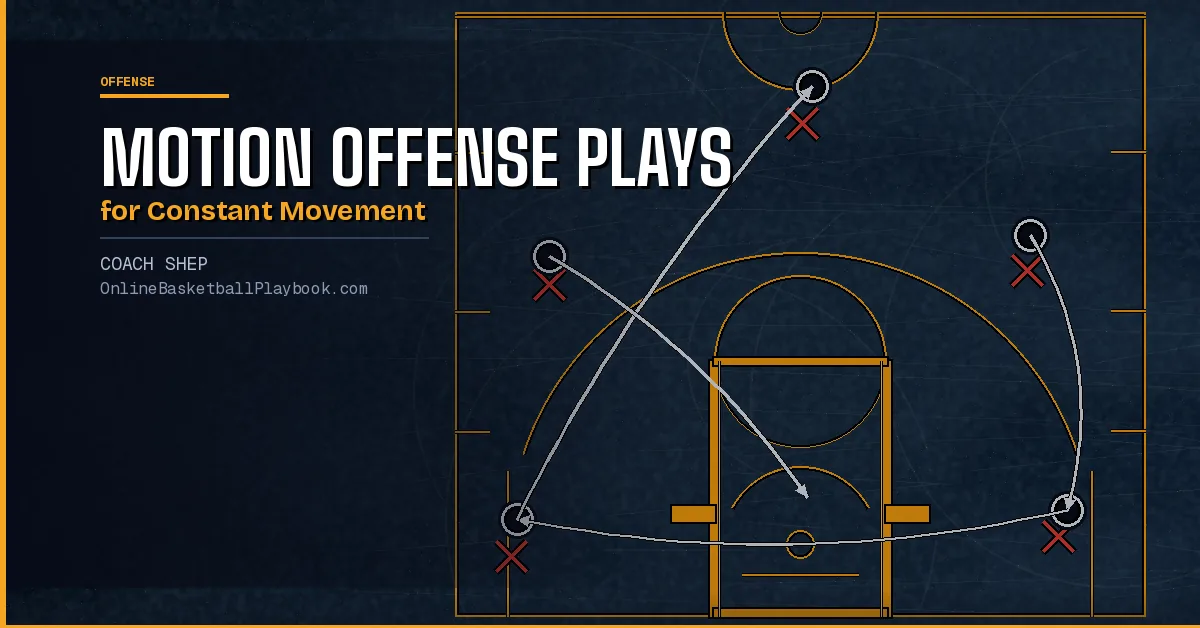
Motion Offense Basketball Plays for Constant Movement
Motion Offense Basketball Plays for Constant Movement
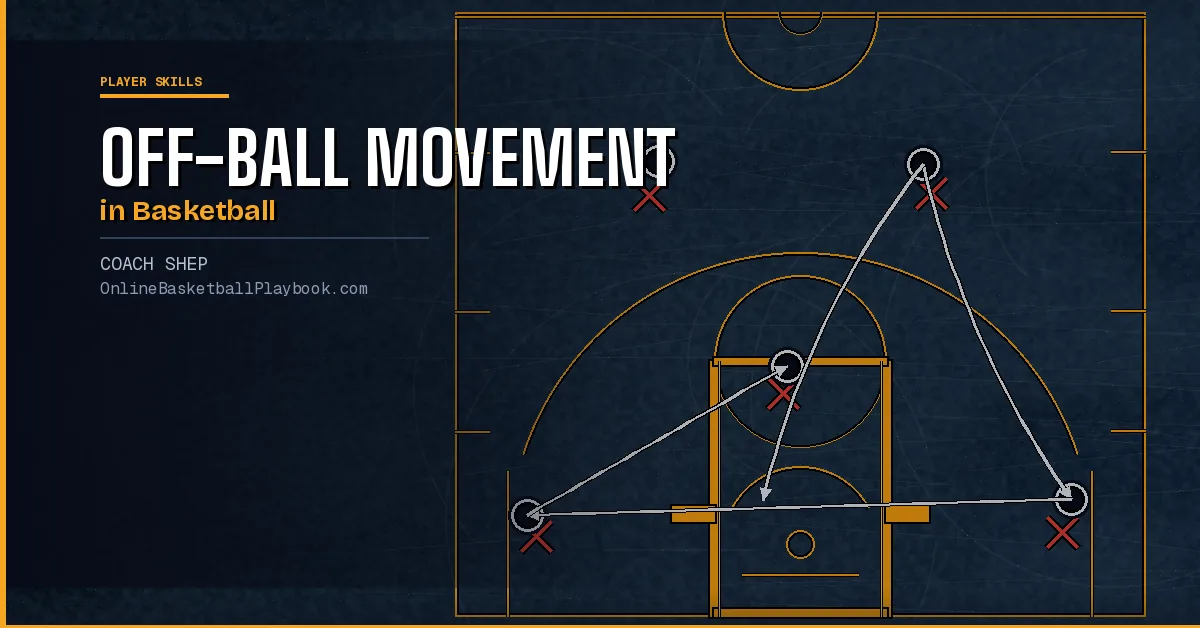
Off-Ball Movement in Basketball: Complete Guide
Off-Ball Movement in Basketball: Complete Guide