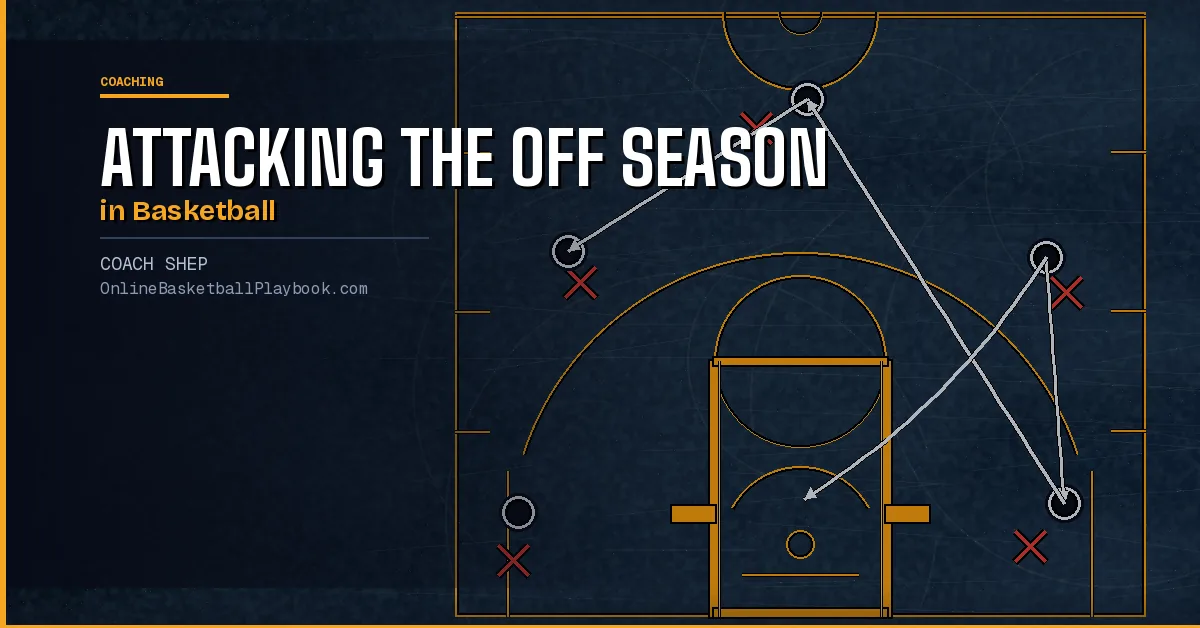
The teams that separate themselves do it before the season starts. Here is how to build a purposeful off-season plan that turns weakness into weapons and gives your roster a real edge come tip-off.
Why the Off Season Wins Championships
Every coach says the off season matters. Few actually attack it with a plan. The difference between a team that improves ten percent and one that improves forty percent over the summer is almost never talent. It is structure. Players left to their own devices will work on what they are already good at. They will shoot the shots they are comfortable with, play one-on-one in familiar spots, and skip the footwork and the film that actually close the gap to the next level.
Your job as a coach is to make the uncomfortable work unavoidable. That means deciding, before the first summer workout, exactly what the team's weaknesses cost you last season and then designing every rep around fixing those weaknesses. If you got destroyed by zone defenses, zone attack is the priority. If your guards could not read ball screens, that is the work. If your bigs had no short-corner awareness, you drill short-corner footwork until it is automatic.
The off season is also the safest time to fail. There are no rankings on the line, no playoff seedings, and no parents in the stands tallying turnovers. A player can try a new move, fail at it fifty times in a row, and build real confidence in it before it ever gets tested in a real game. That psychological safety is a gift. Use it deliberately. Tell your players that this is the time to experiment, to look stupid, and to get better at things they cannot yet do, because the season is not the place to learn. It is the place to execute.
Championship programs treat the off season as a second season with its own schedule, goals, and accountability structure. Set a start date, an end date, and measurable outcomes. Did each player add one reliable move from the short corner? Can every guard make the skip pass under pressure? Does the team have a named zone-attack package they can run cold, without a timeout? If you cannot answer those questions in October, you did not attack the off season. You wandered through it.
Setting Skill Priorities for Each Position
Not every player needs the same work. One of the most common off-season mistakes is running the whole team through the same drills when the gaps are wildly different by position and by individual. A guard with a reliable pull-up jumper does not need more pull-up jumper reps. He needs to learn how to use a ball screen, how to attack a zone gap, and how to deliver a skip pass on time and on target. A big who is already a finisher needs to develop a face-up game from the elbow so he can function in a four-out read offense.
Start the off season by auditing last season's film and charting each player's shot chart, turnover spots, and defensive breakdowns. The chart tells you the truth without opinion getting in the way. Then build each player an individual development menu, three to five things they are going to get undeniably better at before the season starts. Post it. Make it visible. Let players hold each other accountable to the list.
Guards
Guards should prioritize: reading the ball screen at game speed, making the skip pass to the weak-side corner without telegraphing it, attacking the zone gap with one purposeful dribble and immediately kicking to the open man, and mid-range pull-up consistency off the high ball screen. The skip pass is particularly critical for any program that wants to attack zone defenses. A guard who can fire a quick, flat skip forces the defense to scramble in a way that no set play can manufacture on its own.
Wings
Wings need to become reliable catch-and-shoot threats from both corners, develop a move off the wing catch against a closing defender, and learn to flash to the high post with timing and purpose. In a zone attack, the wing who flashes to the elbow while the ball is on the opposite side is one of the most dangerous players on the floor. That skill requires repetition. Not just understanding the concept, but moving on the flight of the ball until the timing is instinctive.
Bigs
Bigs should build their short-corner game, high-post face-up reads, and footwork for sealing and diving after screening a zone defender. The short corner is the most reliable soft spot against a 2-3 zone, and most bigs do not spend a single off-season minute there. Add a lob-target finish for bigs who will play in zone overload sets, and make sure every big can pass out of the double team before it arrives, not after.
Building Your Zone Attack Foundation
Zone defense disrupts more programs than any other defensive scheme, not because it is impossible to beat, but because teams have not done the work in the off season to build a reliable answer. When a zone goes up mid-game and the players look confused, that is an off-season failure showing up in a real game. Fix it before the season starts.
The framework that holds up across every coaching source and every level of play comes down to four universal principles that every player on the roster should be able to recite and execute without a timeout:
First: the ball must touch the paint. Do not rush the first perimeter opening. Find the short corner, the high post, or the baseline cutter before pulling the trigger on a three. The zone is most vulnerable when the ball gets inside the perimeter. Every zone breaks down from the inside out, not the outside in.
Second: skip passes beat zone rotations. The ball travels faster than any zone can shift. A flat, on-time skip to the weak-side corner is the highest-value pass in any zone offense. Drill it daily. Make it automatic at game speed, with a defender closing hard, so players are not discovering the timing for the first time in a district playoff game.
Third: dribble penetration collapses and kicks. Bob Knight put it simply. Dribble against a zone every time you catch on the perimeter. One hard dribble into a gap forces the zone to rotate. The instant the rotation happens, the ball goes to the open man. Do not hold the dribble looking for a better pass. Attack the gap and read immediately.
Fourth: never rest the offense in the zone's comfort area. Sitting on the perimeter away from the seams lets the zone recover and reset. Players who stand let the defense breathe. Movement (not scripted movement, but purposeful movement through gaps and across the paint) keeps the zone from ever settling into its shape.
Beyond the universal principles, every program needs a named package: one continuity, one quick-hitter, and one zone BLOB. The continuity gives players a repeatable structure when the free-flow attack stalls. The quick-hitter creates a specific look off a timeout or a press break. The zone BLOB protects baseline out-of-bounds situations. Install all three in the off season, rep them enough that they run on muscle memory, and you walk into the season with a complete zone answer.
Individual Development Over Group Drills
Group drills are efficient. Individual development is where players actually get better. The off season should be weighted toward individual sessions (a player, a coach, a focused skill) more than any other time of the year. During the season, individual development takes a back seat to game prep. The off season is the only window where a player can spend forty-five uninterrupted minutes on a single move until it becomes reliable.
The most effective individual sessions follow a simple structure: introduce the skill or concept, break it into its physical components, rep each component separately, then put it together at game speed against a live or simulated defender. For a guard working on skip passes, that means footwork first, then the mechanics of the pass itself with no defense, then catching and skipping against a hard close-out, then executing the same read in a 3-on-3 zone drill. The progression matters. Skipping the early stages produces players who understand a skill but cannot execute it when pressure arrives.
Kermit Davis at Ole Miss built his zone attack around one discipline that coaches often overlook: footwork is practiced every day, not occasionally. Zone cuts and flashes are footwork problems as much as read problems. A player who understands the high-post flash timing but takes two extra steps getting there arrives late and finds the window closed. Five minutes of zone-entry footwork at the start of every off-season workout compounds into genuine skill by the time the season starts. Make it a non-negotiable.
Track each player's individual development with a simple weekly log. One sentence per skill, marking whether the rep count was hit and whether the player could execute the skill under pressure by the end of the week. Players who see their own progress in writing are far more likely to stay engaged through the grind of off-season work, and you will have real data when it is time to build your season-opening lineup and rotation decisions around who actually put in the work.
Structuring Off-Season Scrimmages and Film
Scrimmages without structure are just pickup basketball with whistles. Off-season scrimmages are most valuable when they are designed to create specific game situations that the team struggled with last year. If zone defense was the problem, play every scrimmage half against a zone. If late-clock execution was the problem, end every scrimmage with a two-minute drill where the score is close and the clock is short. Make the scrimmage answer the specific question you identified in the film audit.
Film should be part of the off season, not as punishment and not as a lecture, but as a teaching tool that players learn to use themselves. Teach players to watch film by asking them to find one moment per game where a read was available that they missed. When players can identify their own missed reads on film, they are far more likely to make the right read when it shows up in a live game. The skill of seeing the game clearly on film transfers directly to seeing it clearly in real time.
One structure that works well at the high school and prep level: brief each scrimmage with a single focus point, run the scrimmage, then watch a five-minute film clip immediately after (while the reps are still fresh) that shows the focus point happening correctly and incorrectly. Short, specific, and immediate. Players retain more from five minutes of sharp film review right after a rep than from thirty minutes of general film the next morning.
Track scrimmage data at a simple level. Chart each player's shot selection, specifically whether shots came from within the offense's designed reads or from off-script freelancing. Chart turnover type: was it a decision error, a skill error, or a communication breakdown? That sorting tells you exactly what the next individual session should address. Data does not have to be complex to be useful. Simple charting done consistently is more valuable than sophisticated analytics done once.
Culture and Habits That Carry Into the Season
The off season is when culture is actually built, not in the pre-season speech, not in the locker room at halftime of the first game, but in the daily habits that players form during the months when no one is watching. The discipline of showing up early, filming your own shots, getting your footwork right when no one is grading you. Those habits are the culture. Everything else is decoration.
Create off-season accountability without making it punitive. Voluntary workouts are genuinely voluntary. Players who choose to come are investing. Players who are dragged there are going through the motions. The goal is to make the workouts so clearly valuable, so obviously connected to what happens in games, that players want to be there. When a guard who worked on the skip pass all summer drains the open corner three in the first game of the season because the skip arrived on time and on target, every player in the gym remembers why the summer work mattered.
Set one team goal for the off season that is visible and measurable. Not "get better". Something specific: every guard can execute the zone skip pass under closeout pressure by August 1st. Every big can score from the short corner in two-on-two situations by the first day of practice. Specific goals create specific accountability, and specific accountability creates the buy-in that vague exhortations never can.
End the off season with a structured evaluation, not tryouts, but a genuine look at who improved and in what ways. Communicate the findings clearly to each player: here is what you worked on, here is what improved, here is what the season asks of you next. Players who know what their coach sees are better equipped to keep developing. Players who guess tend to drift. The off season's last gift to the season is clarity: about the roster, about the system, and about what every player's role is going to be when it counts.
- Audit last season's film before the first off-season workout. Chart each player's shot selection, turnover type, and zone-attack failure spots so every session has a target.
- Build each player an individual development menu of three to five specific skills and post it where the player and teammates can see and track it all summer.
- Run five minutes of zone-entry footwork at the start of every workout. Flash timing and short-corner footwork are skill problems, not concept problems, and they require daily reps to become automatic.
- Install one zone continuity, one zone quick-hitter, and one zone BLOB before the first day of practice so the team has a complete zone answer they can run cold without a timeout.
- Design each off-season scrimmage around a specific game situation the team struggled with last year (zone defense, late-clock execution, or press break) so every competitive rep is solving a real problem.
- Drill the overload-to-skip sequence daily: load one side of the zone, force the rotation, then fire the skip pass to the weak-side corner shooter before the zone can recover.
- End the off season with a clear individual evaluation delivered directly to each player: what improved, what the season needs from them, and what the next gap to close is heading into year two of development.
Want more basketball coaching strategies, drills, and tools?
Join the Online Basketball Playbook newsletter →
Draw this play free in the play drawer →
Membership: the full library, playbook packs, and Pro drawing tools →
Keep Building
Related breakdowns
Basketball Season Planning: The Four Phases of the Year
Basketball season planning: plan backward from March, the four phases of the year, the post-season review, summer plans, preseason install and the in-season week.
Maintaining and Building Team Chemistry Mid Season
Maintaining and Building Team Chemistry Mid Season