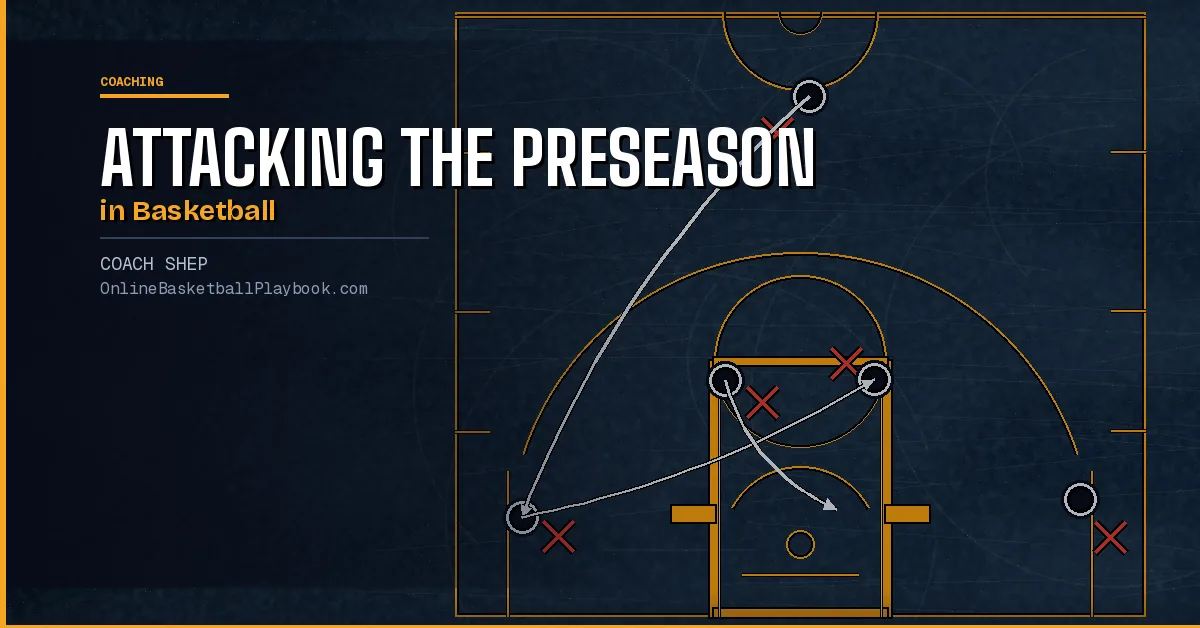
Preseason is the only window where you control the clock. Use it to build a zone offense your team can actually execute, not just run through, before game one arrives.
Why Preseason Is Your Zone-Offense Window
Every team you play this season will throw a zone at you at least once. Some opponents use it as their primary defense. Others use it as a surprise weapon, dropped in after a run to disrupt your rhythm, when you have no timeout to use and no play already dialed up. Both situations punish a team that has not built real zone-attack habits in preseason.
The problem most coaches run into is sequencing. They install their man-to-man offense first, spend the bulk of preseason reps on it, and then try to bolt a zone package on in the final week before games. Players never get comfortable. The principles are not automatic. The first zone they see in a real game produces hesitation, poor spacing, and stalled possessions.
Preseason fixes this if you use it correctly. You have the repetitions, the practice time without game pressure, and the ability to stop play and teach reads in real time. That window closes fast. A deliberate preseason zone plan (starting with principles, layering in sets, finishing with recognition drills) gives your team something durable rather than something memorized and forgotten.
The goal is not to install every zone set in your playbook. The goal is to build three things: a shared vocabulary for reading the zone, one reliable continuity, and one or two quick-hitters that your players can trigger on their own when they recognize what the defense is showing. That is a complete zone offense for most programs, and preseason is where you build it.
Four Universal Principles Before Installing Any Set
Before you diagram a single zone play, teach the four principles that every zone offense in the literature returns to. John Thompson III at Georgetown distilled them cleanly: challenge the zone first with a dribble, screen-roll a zone defender, skip the ball across the floor, and look into the post after every reversal. Those four actions in sequence create the same advantage that complicated sets try to manufacture, and they are teachable in a single preseason practice.
Principle 1: Challenge the Zone With a Dribble First
Bob Knight put it plainly: "Dribble against a zone every time you catch the ball on the perimeter. The dribble disrupts zone more than any pass." When a player catches on the wing and attacks a gap, the zone must react. That reaction creates the read. The skip pass, the elbow catch, the short-corner flash. All of them are easier to execute after one dribble of penetration forces the zone to move. Teach your players to be attackers when they catch against a zone, not stationers waiting for a play call.
Principle 2: The Ball Must Touch the Paint
Perimeter passing does not beat a zone. The zone is resting when the ball moves around the arc without pressure. The ball has to touch the paint (the short corner, the high post, the elbow, a baseline cutter splitting the bottom two defenders) before the zone breaks down enough to give up a quality shot. Hubie Brown's instruction on attacking the 2-3 is the clearest version of this idea: get the ball touched in the post area first, either the short corner or the high post, before launching a perimeter skip. Rep this in preseason until it is a reflex.
Principle 3: Skip Passes Beat Zone Rotations
The basketball travels faster than any zone can shift. The skip pass (from one wing to the opposite corner, or from the high post to a weakside shooter) is the highest-value action in any zone offense because the rotation cannot arrive in time to contest. Every zone continuity and quick-hitter in the library builds toward a skip. Teaching players to keep their feet set, read the help rotation, and fire the skip on time is a preseason fundamental, not a game-week install.
Principle 4: Never Hold the Ball in the Zone's Comfort Area
A zone resets and recovers when the ball sits on the perimeter away from the seams. Kermit Davis's movement discipline from his Ole Miss program states it as a team rule: every player cuts somewhere when the ball moves. No one stands. A stationary offense is a comfortable zone defense. Motion (even simple gap cuts and short-corner flashes) keeps the zone working and prevents the defense from resetting into its coverage spots.
Attacking the 2-3 Zone in Preseason
The 2-3 is the zone your team will face most often, especially at the high school level. It is also the most exploitable zone when you know where the soft spots are and how to put pressure on them simultaneously. Preseason is where you build that literacy.
The Elbow Is the Single Most Disruptive Catch Spot
When a player catches at the elbow against a 2-3, the entire defense collapses toward him. That collapse opens three reads at once: the short-corner lob, the high-low feed to a diving post, and the kick to the weakside corner for a skip three. The elbow catch forces the zone into an impossible decision, and the player who catches there must be trained to read which of the three options the defense is giving up, not to look for a predetermined action.
This is your base play against the 2-3. Ten minutes of deliberate elbow-entry work in preseason (catch, read, execute) pays dividends through an entire season. Players who have done the rep recognize the elbow opportunity during a game and take it without hesitation.
Short Corner Plus High Post: The 2-3's Impossible Problem
The two spots that break a 2-3 open are the short corner and the high post. When both are occupied at the same time, the zone has no clean answer. The bottom two defenders cannot guard both the short corner and a cutter to the rim. The middle defender cannot help on the high post and recover to the corner. The defense is outnumbered in an area, which is the definition of what zone offense is supposed to accomplish.
Installing a simple short-corner continuity in preseason, where your post player reads the high-post occupant and times his short-corner flash, gives you a repeatable overload action that your players understand and can execute against any 2-3 they see. The baseline flash, run between the bottom two zone defenders when the ball reaches the wing, is the entry point into this combination.
High-Post Entry Plus Skip: The Safest 2-3 Attack
Enter the ball to the high post and the two top defenders collapse toward it. The moment they collapse, the weakside corner is uncovered. The high-post player turns and skips to the corner shooter. This action (enter high, collapse the top, skip weak) is the most reliable and lowest-turnover 2-3 attack in the library. It asks one player to read one thing: are the top two collapsing? If yes, skip. If no, attack the gap with a dribble or feed the short corner. Install it in preseason with a simple three-player half-court drill and you have built a base answer for the most common zone your team will see.
Attacking the 1-3-1 and the Matchup Zone
The 1-3-1 and the matchup zone require different reads than the 2-3, and preseason is the right time to teach your players to recognize which zone they are facing and switch their read accordingly. Surprise zone recognition (calling out the defense and adjusting without a timeout) is a skill that has to be built through repetition, not explained once and assumed to be learned.
The Corner Skip Kills the 1-3-1
The 1-3-1's fatal structural flaw is weakside corner coverage. The zone's design makes it nearly impossible to get a defender to the opposite corner before the ball arrives on a skip. The attack is straightforward: overload one side to pull the zone in that direction, then skip to the opposite corner. The corner man catches with no help defender within recovery distance. One-on-none from the corner is as good as basketball offense gets.
Coach the entry into this read as a single trigger: when the wing catches and the 1-3-1 shifts toward the ball, the opposite corner shooter moves into position and prepares to catch the skip. The passer reads the shift and fires. No play call needed. This is teachable as a two-part read (identify the 1-3-1 front, find the opposite corner) and once players have the rep, they can execute it cold when the opponent drops the defense in the middle of a game.
Attacking the Matchup Zone: Drive-and-Kick Above All Else
The matchup zone is the hardest zone to attack because it follows men inside areas, which eliminates most overload principles. An overloaded side against a matchup zone gets matched up on rather than outnumbered. The most reliable counter is drive-and-kick: force a gap, create the scramble that breaks down the matchup assignments, and kick immediately before the defense re-matches. Post players who can seal in the gap between two matchup defenders are the other reliable weapon. The matchup has no clean rule for a ball in the gap.
The one absolute rule against a matchup zone is constant motion. A regular zone can guard a stationary offense by staying in its coverage spots indefinitely. A matchup zone will do the same. Movement (not scripted, just continuous) is the only method that stresses the matchup into breakdowns. Preseason is where you ingrain that movement habit so your team does not freeze when they see a defense that looks like a zone but plays like man.
Preseason Practice Structure for Zone Offense
The sequencing of your preseason zone-offense installation matters as much as the content. Most programs install too many sets and too few reads. The result is a team that can walk through a zone play in practice but cannot execute it in a game when the defense does something unexpected.
Week One: Principles Only
The first week of preseason zone work should contain zero sets. Teach the four universal principles (dribble to challenge, ball touches paint, skip the ball, never hold in the comfort zone) through small-group drills and shell work. Run a three-on-three or four-on-four zone shell where the only rule is that the offense has to make the ball touch the paint before shooting. Add the skip-pass read on day three. By the end of week one, your players should be able to articulate why they are doing what they are doing against a zone, not just follow a pattern.
Week Two: One Continuity, Drilled to Automaticity
In the second week, install one zone continuity (the overload-skip or an elbow-entry continuity works well as a base) and drill it until players do not have to think about the sequence. Kermit Davis's practice rule applies here: coaches never make passes in drills. Every pass is a player rep in live game-motion. Run the continuity against a live defensive shell that adjusts and forces reads. The continuity becomes automatic through repetition against real resistance, not walk-through reps with a passive defense.
Week Three: Add the Quick-Hitter and Recognition
The third preseason week adds one zone quick-hitter (the corner skip vs. 1-3-1 or the high-post entry vs. 2-3) and introduces zone recognition work. Show players clips or live looks of three different zone fronts and ask them to name the defense and call the right action. Recognition is the part of zone offense that coaches most often skip. A player who can read the zone front before the ball is inbounded is worth more than a player who has memorized twelve zone sets but cannot tell a 2-3 from a matchup.
Zone Footwork as a Daily Habit
Adopt Kermit Davis's footwork-every-day discipline. Zone cuts and flashes are footwork problems as much as read problems. Five minutes of zone-entry footwork daily (the elbow-flash footwork, the short-corner footwork, the baseline cut split) compounds significantly by season's end. It also creates the physical habit of moving on the flight of the ball, which is the same cue the zone defense uses. One phrase, both ends of the floor, reinforced every day.
Build your preseason zone package around what your roster can actually execute, not what looks sophisticated on a whiteboard. If you have a dominant post player and three credible perimeter shooters, the Box Isolation action (three cutters occupy a defender each while the post gets a one-on-one) is worth installing. If you have a stretch big who can flash to the elbow, the high-post entry plus skip is your highest-percentage zone attack. Match the system to the personnel in preseason, when you still have time to adjust, rather than discovering the mismatch in week two of the regular season.
Zone Reads Your Team Can Run Without a Timeout
The most undervalued part of zone-offense preparation is building the two or three reads that your team can execute cold (no timeout, no play call, no huddle) when an opponent drops into a surprise zone in the middle of a game. A team without these reads stalls. A team with them attacks immediately, which sends a clear message that the zone is not a disruption but an opportunity.
The elbow entry against a 2-3 and the corner skip against a 1-3-1 are the right reads for this purpose. Both require nothing more than zone recognition and one shared trigger. The elbow-entry trigger is: see a 2-3, find the elbow gap, enter, read the three options. The skip trigger is: see a 1-3-1, overload one side, skip to the opposite corner. These two reads can be installed in a single forty-minute preseason practice and maintained with five minutes of daily review through the season.
The culture piece matters too. When players recognize a zone going up, their first instinct should be attack mode, not hesitation, not waiting for a play call, not looking to the bench. Preseason is where you build that mindset. Tell your team directly: a zone is an opportunity, not a problem. A prepared offense attacks a zone more aggressively than a man defense, because the zone's structure creates predictable soft spots that a man defense does not have. Your job in preseason is to find those soft spots together, build the reads that exploit them, and arrive at game one knowing that any zone an opponent throws at you will be met with a prepared, confident attack.
- Elbow Entry vs. 2-3: Wing catches at the elbow, zone collapses, read the short-corner lob first, then the high-low feed, then the weakside skip. Three reads from one catch spot. Install this in ten minutes and rep it every week.
- Corner Skip vs. 1-3-1: Overload one side to pull the 1-3-1 toward the ball, then skip to the opposite corner before the tail man recovers. Teach the trigger phrase "load and skip" so players execute it without a play call.
- High-Post Entry vs. 2-3: Enter to the high post, top two defenders collapse, skip immediately to the weakside corner shooter. The simplest, lowest-turnover zone attack in the library. One passer, one catcher, one read.
- Short-Corner Flash Timing: Rep the short-corner flash so that your post player reaches the short corner on the flight of the wing pass, not after the catch. Late arrivals let the bottom zone recover. On-time arrivals create the two-on-one the play needs.
- Drive-and-Kick vs. Matchup: Against any matchup zone, dribble into a gap on every perimeter catch. Kick to the open man immediately when the defense scrambles. Never try to overload a matchup. Attack it with penetration and quick decision-making.
- Zone Recognition Drill: Three times per week in preseason, show your team a live zone look and require them to name the defense and call the appropriate action before the ball is entered. This is the habit that makes everything else work under game pressure.
Want more basketball coaching strategies, drills, and tools?
Join the Online Basketball Playbook newsletter →
Draw this play free in the play drawer →
Membership: the full library, playbook packs, and Pro drawing tools →
Keep Building
Related breakdowns
How to Become a Basketball Coach: Paths, First Jobs and Steps
How to become a basketball coach: where coaches start, youth, school, club and college paths, entry jobs, coaching education, networks and mentors.