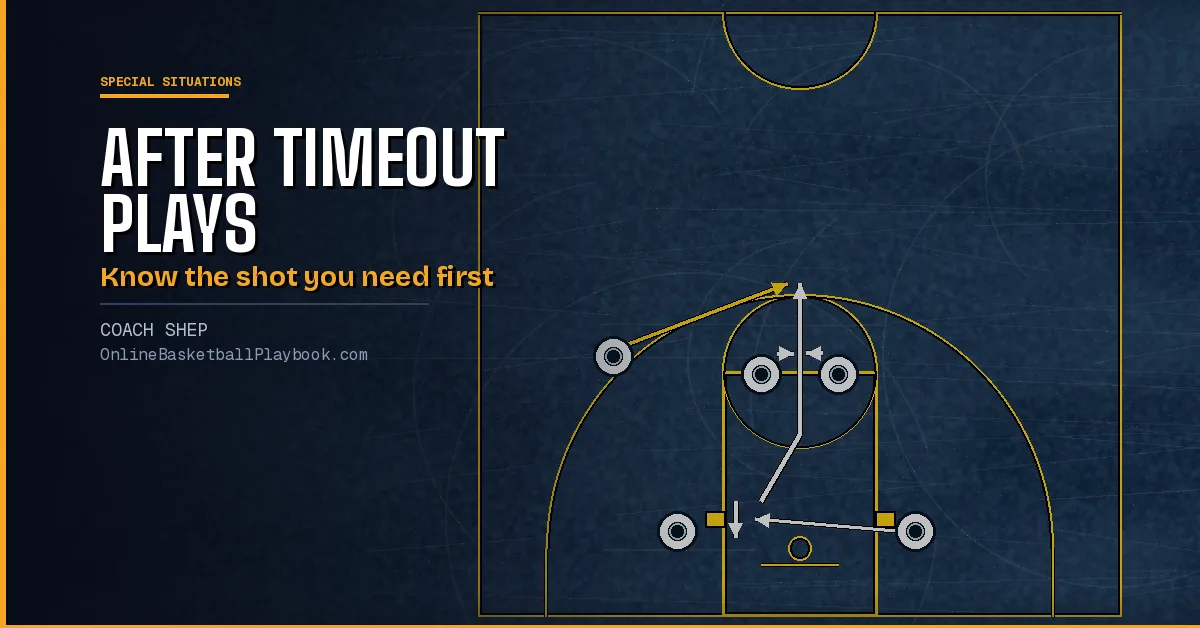
After timeout plays, called ATOs, are the sets a team runs on the first possession out of a timeout. The defense has had the same timeout to get set, so an ATO has to beat a defense that expects a play. This page sorts after timeout plays by situation: the shot you need, the time left, where the ball starts and whether the defense is man or zone. The plays for the very last seconds are on last second basketball plays, and the full libraries of sideline and baseline sets are on sideline out of bounds plays and baseline out of bounds plays.
After Timeout Plays Start With the Situation
End-of-game play libraries are filed by situation before they are filed by play. The biggest split their specials by court location and by the shot needed, with separate three-point and two-point chapters, or index NBA and college sets by the exact seconds and score. The questions a staff answers in the first seconds of the timeout:
- Two or three? The deficit decides the play family before anything else.
- How much time? The time-band version keeps a play for each of three time bands, 0 to 3, 4 to 8 and 9 or more seconds, at each inbound spot, each with a two-point and a three-point option.
- Where is the ball? Sideline, baseline or backcourt, and at some levels whether a late timeout moves it.
- Man or zone? Teams change defenses after a dead ball, so an ATO needs an answer for both.
Know the shot you need before anyone draws a line on the whiteboard.
ATOs All Game, Not Only at the End
An ATO is not only a last-shot tool. Counting media and team timeouts, a college game can hold roughly 18 ATO possessions. A team down 10-0 can call timeout to get a designated basket and stop the run, not just to draw up the finish. Another way to get the same possession without a timeout: dribble the ball below the free-throw line and set up a rehearsed baseline play. Don Meyer's rule is not to bank timeouts, because you cannot eat them.
How many timeouts each level gets, and when a coach may call one, is on basketball timeout rules, and when to spend them is on basketball timeout strategy. Jump ball and free throw specials have their own pages: jump ball plays and free throw alignments.
Treat the first ATO of the night like the last one.
Need a Three
In a 74-play collection of game-winning specials, the three-point specials lean on staggered screens, flares and screens for a catch-and-shoot, while the two-point specials lean on ball screens, slips and post feeds. The end-of-game libraries show the same split. Three shapes repeat when the defense knows a three is coming:
- Triple screen. Several bodies screen for one shooter cutting to the top of the key or the corner, so the defense cannot hedge or switch every screen.
- Elevator doors after a freeze. A cross screen first freezes a defender, then the shooter runs through two screeners who close the doors behind him.
- Screen the screener. A down screen, then the screener sets a second screen for the shooter.

The elevator action itself is on elevator screen. From the sideline, a screen-the-screener set clears the corner first:

The same set is in the sideline table on buzzer beater plays. More catch-and-shoot sets are on three-point shooting plays.
For a three, the screens serve the catch, and the catch is the shot.
Need a Two
The two-point specials in the same collection get a drive or a dump pass, not a catch-and-shoot:
- Ball screen and roll or slip. A high or wing ball screen, with the screener slipping or rolling to the rim.
- Back screen for a lob. The ball handler dribbles toward one post, the other post dives to the ball-side block, and a wing back screens the post who stepped up, for a lob.
- Post feed. A double screen sends a post to the short corner while the guard attacks one way, then comes back to feed him.
Under a minute, the NBA sets for a trailing team lean on isolations and simple two-man pick and roll, and Stan Van Gundy's rule when tied is to get the last shot to your best player. When the defense takes your best player away, the decoy sets are on late game plays when they deny your best player. Isolation sets for a star are on isolation plays for star players.
For a two, get the ball moving toward the rim, not away from it.
One Trusted Special
The one-special version runs the same core action every year, at every club: a middle ball screen that goes straight into a pin-down for a player in the corner, with the big waiting near the rim. It matters that the team feels comfortable with one play, and a tied game was won on it with the last possession. The pin-down cutter reads his defender:
- Defender trails. Curl, but not too deep, because the big is there.
- Defender cuts under the screen. Step back for the catch and attack the defender who is off balance.
- Defender plays over the top. Back door, or set the screen higher first.
- Good screen, open look. Catch and shoot.
After the cutter reads, the big flashes or posts with four shooters spaced, and the ball handler reads the ball screen itself. Do not copy it whole. Think about which options fit your own players. At the 2024 Olympics the USA ran three half-court sets and Serbia ran five. Coaches split on how many to carry:
- A small core. A few plays drilled until they hold up.
- A big catalog. A large catalog, with counters for every play, makes a team very hard to prepare for.
One play your team can run cold beats five it half knows.
Fake First, Then the Real Action
The most repeated shape in the NBA and college end-of-game libraries is a false read before the scoring screen:
- A fake dribble handoff into a drive, with a flare screen for a shooter on the far side.
- A fake pick and roll that turns into a screen away.
- A fake ball screen into a double stagger.
- A cross screen that freezes a defender before the elevator doors.

The 2024 NCAA Tournament sets show the same idea with handoffs: in several, the shot comes from a back cut or a slip away from the exchange, not from the handoff. The back door version is built on one mechanic: make the defender overplay with a fake, then cut when he turns his head. The cutter takes one or two hard steps toward the ball, reads the defender's head, and goes. Bob McKillop's note for inbounders is "be an actor."

The cutting reads behind it are on backdoor triggers.
Sell the first action as if it were the play.
Draw the Counter In
In the 2024 NCAA sets the screener's slip is drawn into the first diagram, not added later. Design each play with two or three high-percentage options, then go straight into the team's offense. The counters coaches build in:
- The slip against the switch. Against a switching defense, the screener screens, then slips and releases over the top. The counter keeps the play's name plus "again," so the other bench hears the same call, and it is run with one second on the shot clock because teams switch all screens late.
- The counter written into the play. The elbow lob from the baseline has its counter built in: if the screener's defender helps on the lob, the inbounder fakes it and passes to the screener. The full play is on buzzer beater plays.
- The flow chart. Hubie Brown's sideline play for 10 seconds or less runs a pin-down for one player and a double screen for another, then the 5 pops to catch, then a back door, then a back screen for a fade to the corner.
- The safety valve. If the back door is not there, do not throw it. Run the offense.
Some defenses switch everything in the last 10 seconds, which is the reason the slip has to be drilled with the screen. More set plays with their counters are on how to run quick hitters.
If the counter is not drawn, the play is not finished.
ATOs Against a Zone
After a dead ball, teams switch defenses, so the staff answers both before the game. Željko Obradović builds his sideline play to work against man, an even-front zone and an odd-front zone. Zone answers in the libraries:
- Back screen for the lob. An end-of-half set against a 2-3 sends a cutter to the free-throw line to occupy the middle defender, then back screens the low defender for a lob.
- Two cutters on two defenders. A family of 28 zone baseline plays shares one idea: occupy two zone defenders with two cutters and leave the middle defender helpless on one action.
- Screen the middle man. Ettore Messina's CSKA screens the middle zone defender while the shooter seals behind him.
Against a box and one, keep the answer simple and close to a set you already run. The full zone plan is on zone offense against the 2-3 and zone offense quick hitters.
Walk out of every timeout with a man call and a zone call.
Late Timeouts: Where the Ball Goes
At some levels a late timeout moves the throw-in, and at others it does not:
- NCAA women. After a timeout charged to the offense in the last 59.9 seconds of the fourth quarter or overtime, with the ball out of bounds in the backcourt, the team may throw in from its frontcourt, 28 feet from the end line. The head coach tells the officials before the timeout is reported.
- NBA. In the last two minutes of the fourth period or overtime, the same kind of timeout gives the option of a throw-in at the 28-foot mark in the frontcourt.
- FIBA. With 2:00 or less in the fourth quarter or overtime, after a timeout by the team entitled to the ball from its backcourt, the head coach chooses the frontcourt throw-in line or the backcourt.
- NFHS and NCAA men. No such rule. The ball stays where it was. Check your state association for anything else at high school.
The game clock starts on a throw-in when a player on the court touches the ball, not when it is thrown, at the NCAA, NBA and FIBA levels. For high school, check your state association rulebook. The clock decisions around the timeout are on basketball clock management.
Know your level's rule before you decide where to run the play from.
In the Huddle
- Nothing new. Players remember little from a timeout. Keep it to one to three points and never expect a play that was not drilled. Jay Wright opens the same way: under pressure, run what the players know.
- Know the counts. Every player leaves the huddle knowing the timeouts left and the team foul situation, and an assistant checks fouls and timeouts with the scorer at every timeout.
- Set before the ball. The inbounder waits until teammates are aligned and the play has been called and echoed. Jay Wright's late-game inbounder takes his time, even ties a shoe, before he takes the ball from the official, so everyone is in place.
The calls and signals themselves are on play calling and signals.
Say the play, say the counter, and say it once.
They Have Scouted Your ATOs
Dead-ball sets repeat all season, and good staffs chart every opponent's baseline and sideline possession, not just the late ones, to learn who the actions are for. Ways coaches disguise the call without changing the play:
- One alignment, a new card. Every baseline play runs from a 1-4 low that turns into a box if denied, with the calls on a card sewn into the players' shorts and a new card each game.
- Same play, different alignments. Bob McKillop and Tom Izzo run the same play from different alignments.
- Same play, different players. Put different players in the spots and use plays that set up other plays.
More on reading the other team is on basketball scouting report.
Change the call, keep the play.
Practicing ATOs
Jay Wright practices out-of-bounds plays by time window, 0 to 3, 4 to 7 and 8 or more seconds, and ends practice with a game-winning drill. Other formats:
- Daily situations. Review two or three situations every day.
- The card box. Draw one score-and-time card from a box at the end of every practice, with coaches calling the timeouts and subs.
Drill formats are on drills to teach late game situations.
Run the timeout in practice, huddle and all, and the real one will feel familiar.
Get the next coaching guide in your inbox
One email when a new guide or diagram set goes up. Free.
Questions Coaches Ask
What does ATO mean in basketball?
ATO stands for after timeout. It is the set a team runs on the possession right after a timeout, usually from a sideline or baseline throw-in.
What is the best after timeout play?
No single play wins the vote. Coaches agree more on the rules than the play: decide two or three first, put a fake before the real action, draw the counter in, and run something the team has drilled.
Should you run a different ATO every time?
Coaches split. One side runs one trusted action every year and dresses it up with different calls or alignments. The other carries a large catalog with counters so the opponent cannot prepare for all of it.
Can you advance the ball after a timeout in high school?
The NCAA's rules-differences chart lists no such rule for NFHS or NCAA men. NCAA women, the NBA and FIBA allow a frontcourt throw-in after a late timeout under set conditions. Check your state association rulebook.
Want the printable playbook packs?
OBP Pro members get the premium playbook packs: the zone attack, out of bounds and practice plan PDFs, plus each new pack as it is finished. The membership page lists what is in each one. Or draw your own version free in PlayDraw.
See what OBP Pro includesMore Coaching Guides From This Batch
- Basketball Press Terminology: Trappers, Interceptors and Safeties
- Full Court Last Second Plays: Long Passes, Screens and Splits
- Buzzer Beater Plays From Half Court: Sideline and Baseline
- Late Game Plays When They Deny Your Best Player
Back to Special Situations and every Special Situations page.
Keep Building
Related breakdowns
Fouling When Trailing: When, Who and How by Time and Score
Fouling when trailing late: when to start by possessions and seconds, the bonus and clock rules by level, how to foul, who to foul, down 3 and the rebound.
Basketball Late Game Situations: Decisions, Fouls and Clock
Basketball late game situations settled before tip-off: the score math, timeouts, fouling up three and behind, the last shot, protecting a lead and daily practice.
Basketball Clock Management: Foul Up 3, Two for One, Last Shot
Basketball clock management explained: the clock rules by level, counting possessions, foul or defend up 3, fouling when behind, the two for one and the last shot.