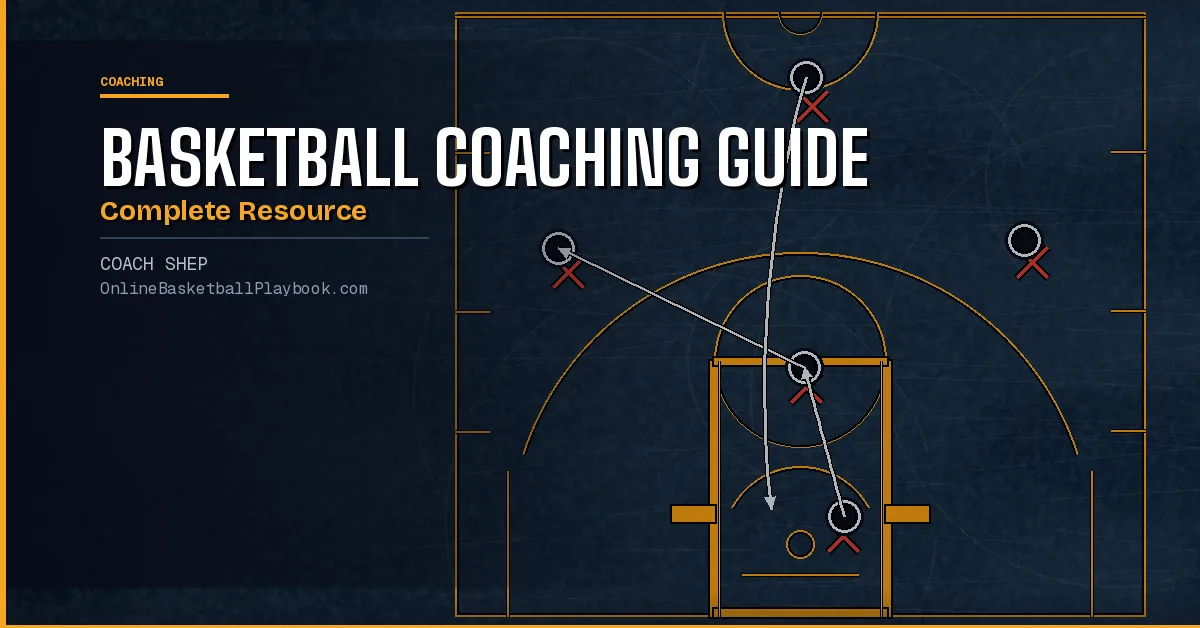
Great coaches are built, not born. This guide gives you the framework (from practice structure to player development to parent management) that turns good intentions into real results on and off the court.
The Core Philosophy Every Coach Needs
Most coaches start their careers thinking their job is to win games. The best coaches eventually realize their job is to build players. Those two goals aren't always in conflict, but when they are, the coach who defaults to player development wins in the long run, both in retention and in the quality of talent they develop over a full season or program cycle.
The foundational question to ask before every practice, every drill, every decision: does this make my players better, or does it just make me feel like I'm coaching? There's a real difference. A coach who runs complex systems to impress parents versus a coach who runs simple, high-repetition fundamentals until they become automatic. One of those coaches is coaching for the scoreboard, and the other is coaching for the player.
At every age level, the same three non-negotiables apply. First, guarantee some form of success for every player, not just the best ones. A player who couldn't dribble with their left hand in October and can in December has succeeded, regardless of the team's record. Second, make sure your players enjoy the process. Enjoyment is the driver of intrinsic motivation. If a player stops enjoying practice, they stop pushing in practice. Third, teach in a way that matches where your players actually are developmentally, not where you wish they were.
These principles don't get easier to hold as stakes get higher. They get harder. The best coaches are the ones who hold them anyway.
Player Development That Actually Works
Player development is not the same as running drills. Drills are a delivery vehicle. Development is what happens when the right drill is used at the right time, with the right cue, at the right volume. Coaches who conflate the two end up running busy practices that don't translate to games.
The Long-Term Athlete Development (LTAD) model (used by Canada Basketball, Basketball Australia, and USA Basketball) is the clearest framework available. It breaks player development into distinct stages and prescribes different training emphases for each. At the youngest ages (roughly 6–8, often called the FUNdamental stage), the job is to develop fundamental movement patterns first (push/pull, squat/lunge, jump, throw, catch) and layer basketball skills on top of that athletic base. Trying to teach advanced basketball concepts before those movement patterns are owned is like building a house without a foundation.
As players mature into the "Learn to Train" stage (roughly ages 9–12), the emphasis shifts toward structured skill acquisition. This is when the trainable window for motor skills is widest. The Canada Basketball benchmark for this age group is a 4:1 practice-to-game ratio (four practices for every game). Most youth programs invert that ratio and wonder why their players' skills plateau. Games don't develop skills; they test them. Skills are developed in practice, through deliberate repetition.
One principle that transfers across every age group: repetition with variation beats novelty. Teaching the same skill through five different drill formats (changing the constraint, the defender, the scoring system) produces better retention than introducing five completely different skills. The brain consolidates what it encounters repeatedly. Build your practice blocks around a single skill developed from multiple angles, and you'll see more carry-over to games.
How to Build a Practice That Moves
The number-one indicator of a well-run practice is tempo. Practices that drag (long explanations, players standing in lines, awkward transitions between drills) are the enemy of development. Attention decays fast, especially at younger ages. The moment players mentally check out, the repetition you're running stops producing growth.
A proven template for youth and developmental practices: 10 minutes of warm-up and movement training, 30–40 minutes of technical work delivered through games and competitive drills, 10–15 minutes of small-sided scrimmage, and a brief cool-down. The new skill of the day goes first, not last. When attention is highest, give it your hardest teaching. Water breaks should be built in, not earned.
Planning is the single biggest lever. Coaches who plan every drill in sequence, with time allocations and transitions mapped out, run noticeably better practices than coaches who improvise. The improvising coach inevitably defaults to drills they're comfortable with, skips the hard teaching, and lets the best players dominate rep volume while the developing players wait in line.
The Loading Principle
Instead of switching drills every three minutes, load a single drill by adding complexity in place. Start with a basic form (say, a two-ball dribbling pattern), then add a defensive presence, then add a decision trigger (shoot or drive), then add a time constraint. Players stay in flow. The coach can read readiness before advancing. One well-loaded drill beats five short drills every time, because the cognitive demand increases without the setup cost of a transition.
Keep each drill segment short (three to five minutes for younger players, five to eight for older) and use competitive scoring within the drill. Tracking makes/jump-stops/accurate passes for points raises the intensity of any drill without changing the fundamental skill being trained. Players who are competing don't coast.
Communication: Players, Parents, and Staff
Most coaching problems aren't technical problems. They're communication problems. A coach who can plan a perfect practice but can't communicate clearly with players, manage parent expectations, or align assistant coaches on a philosophy will still have a chaotic season.
With Players
The single most transferable communication rule for youth coaches: shout praise, whisper criticism. Most coaches default to the reverse, correcting loudly in front of teammates and praising quietly, or not at all. That inversion crushes a young player's willingness to take risks in practice, which is exactly when you need them to try the skill they haven't mastered yet.
When you do correct, be precise and fast. Name what was wrong, give one short replacement cue, keep the tone encouraging, and move on. Long corrections in the middle of a drill break tempo, embarrass the player, and rarely produce better results than a short, direct cue delivered with confidence. "Pivot foot moved, reset and go again" is more useful than a two-minute explanation of the pivot rule.
For older players (11+), involve them in problem-solving. Ask them what they see. Use self-assessment: "What's one thing you improved today? What are you still working on?" Players who have language for their own development take ownership of it. Players who only receive coaching remain dependent on the coach to identify and fix every problem, which is not a development outcome. It's a coaching crutch.
With Parents
A parent meeting before the first practice prevents the majority of season-long friction. Cover your philosophy (what you're building toward, what success looks like), playing time expectations, game-day behavior expectations, and the communication chain. Invite parents to be part of the culture, not just observers. When parents feel like partners in the process, they behave like partners.
The 24-hour rule (no playing-time discussions within 24 hours of a game) protects the coach's composure and the team's focus. Implement it program-wide so it's a consistent policy, not a per-coach preference. For issues that escalate, involve the player directly, especially at ages 11 and up. Part of development is learning to advocate for yourself and ask questions directly.
Building a Culture That Keeps Players Coming Back
Culture is not a speech. It is what you repeat. Coaches who give a culture talk at the start of the season and then behave inconsistently all year don't have a culture. They have a wish. Coaches who install small, repeatable rituals and hold them without exception do.
Proactive culture-building is a discipline, not a personality trait. You don't need to be a natural motivator. You need to be consistent. A few concrete habits that compound over a season:
Begin every practice with a focus word (one concept you want players to carry through that session). End every practice with a shout-out circle where players recognize each other by name and by specific action ("Marcus helped me up twice after I fell. That's who I want next to me in a game"). Rotate practice captains who lead warm-ups and own one drill. These habits don't require charisma. They require showing up the same way every day.
Create a short team code (three words or a short phrase) and repeat it constantly. The content matters less than the repetition. "Hard work, together, grow" repeated fifty times becomes part of how the team talks about itself, which shapes how the team behaves. Culture is language that becomes behavior.
End-of-season individual player conversations are the most underused tool in coaching. A three-minute one-on-one (what they improved, what you genuinely appreciated about them specifically, and one challenge for next year) lands differently than any team speech. Players carry those conversations for years. Schedule them before the last practice of the season and don't skip them, even when the season feels done.
The Four Non-Negotiable Fundamentals
Across every credible player development framework (USA Basketball, Canada Basketball, Basketball Australia, FIBA), four fundamental skill areas appear consistently. Not because they're traditional, but because they're the skills that transfer into every other aspect of the game. Get these four right, and everything else becomes easier to teach. Skip one, and the gaps show up in games in ways that are hard to diagnose because they look like decision-making problems but are actually skill problems.
The four fundamentals are ball-handling, passing, shooting, and footwork. They are the same at every age. What changes is the drill vehicle. The specific exercise used to develop each skill should match the developmental stage and the current skill level of your players.
Ball-Handling
Ball-handling is the foundation of every offensive action. A player who can't control the ball under mild pressure can't run any offense, can't exploit defensive breakdowns, and can't make the decisions you're asking them to make. For younger players, the emphasis is two-hand control, eyes up, and stationary or slow-moving patterns. For older players, add pressure: a hand in the face, a foot in the path, a time constraint. Two-ball patterns and cone slaloms are the tools; the principle is progressive overload applied to the ball-handling base.
Passing
Most players at every level undervalue passing and coaches under-train it. Passing is the fastest way to move the ball, the most direct way to create advantages, and the skill most directly tied to team offensive efficiency. Teach the chest pass and bounce pass with "step to your target" as the core cue. Progress to partner challenge drills, monkey-in-the-middle, and eventually drive-and-kick and three-person weave patterns. Track passing accuracy in drills the same way you track shooting makes.
Shooting
Close-range form shooting (done correctly, consistently) builds the muscle memory that holds under pressure. The "pizza waiter" cue (hand under the ball, elbow in, wrist bent back like carrying a pizza) and "cookie jar" cue (shooting hand reaching up into the cookie jar on the follow-through) are the most effective simple cues available for young shooters. For older players, add movement: catch-and-shoot off a pass, one-dribble pull-ups, shots off screens. Hold the follow-through until the ball hits the rim or the net. It trains the full motion, not just the release.
Footwork
Footwork is the skill that separates players who look good in isolation drills from players who look good in games. The jump-stop and the pivot (mastered first at a stationary level, then integrated into movement) are the on-ramp to every other footwork concept. Triple-threat position, spacing, cutting with purpose: all of these are footwork concepts before they're basketball concepts. Coaches who skip footwork training because it's less exciting to watch than shooting or dribbling are building players with gaps that show up in the most pressure-sensitive moments of games.
Redefining and Measuring Success
Win-loss record is a lagging indicator. It measures the output of development, not development itself. For youth and developmental programs especially, it is a misleading metric, one that causes coaches to over-rotate toward tactics that win games now at the expense of skills that matter later.
A more useful success framework: track three to five specific skills for each player at the start of the season, re-check them every two to three weeks with a simple 1–5 rating, and use end-of-season self-assessments where players identify one thing they improved and one thing they're still working on. These habits create accountability without the distortion of the scoreboard.
For program-level success, the most honest question is: what percentage of your players come back next season? Retention is the truest measure of a youth or developmental program's health. A team that goes 8–2 and loses six players to other sports or other coaches has failed at something more fundamental than any tactical system could fix. A team that goes 4–6 and returns every player hungry for next year has built something real.
Track skill progression the same way you'd track conditioning, with numbers, not feelings. Layup percentage from both hands. Passing accuracy in a drill. Free throw percentage. Defensive stance consistency rated on a simple scale. Objective data prevents the bias that coaches naturally bring to evaluating players they like versus players they don't, and it gives players something concrete to work toward that isn't dependent on the scoreboard or their role on the team.
The end-of-season individual conversation (what each player improved, what you genuinely appreciated about their specific contribution, one challenge you're giving them for next year) may be the single highest-leverage thing a coach does all season. A three-minute conversation, done individually and specifically, lands in a way that no team speech can replicate. Players remember those conversations. Make them specific: not "you got better" but "your left-hand dribble in traffic went from a liability to a weapon. That's a real skill you built." Specific praise tells the player what to own. Generic praise tells them nothing.
- Plan every practice before you walk in the gym. Map out each drill, the time allocation, and the transition between segments. Coaches who improvise waste developmental time and default to comfortable drills instead of necessary ones.
- Put the new skill first, not last. Attention is highest at the start of practice. Teach the hardest thing when players are most ready to absorb it, not as a reward for getting through the easy stuff.
- Use the loading principle. Start one drill simple, then add complexity (a defender, a decision trigger, a time constraint) rather than switching to a new drill. Players stay in flow and coaches can read readiness before advancing the challenge.
- Shout praise, whisper correction. Most coaches do the opposite by instinct. Inverting this one habit changes the emotional tone of practice and raises players' willingness to try difficult skills they haven't mastered yet.
- Hold the parent meeting before the first practice. Cover your philosophy, playing time expectations, communication chain, and game-day behavior in one session. It prevents the majority of season-long friction before it starts.
- Track skill progression, not just the scoreboard. Rate each player on three to five specific skills at the start of the season and revisit every few weeks. Objective data keeps development honest and gives players concrete targets beyond their game statistics.
Want more basketball coaching strategies, drills, and tools?
Join the Online Basketball Playbook newsletter →
Draw this play free in the play drawer →
Membership: the full library, playbook packs, and Pro drawing tools →
Keep Building
Related breakdowns
How to Become a Basketball Coach: Paths, First Jobs and Steps
How to become a basketball coach: where coaches start, youth, school, club and college paths, entry jobs, coaching education, networks and mentors.
Basketball Scouting Report Template and How to Fill It Out
A printable basketball scouting report template with team, offense, defense, player and game plan sections, the questions to ask and how to brief players.
Basketball Tryouts: Sessions, Drills, Scoring and Cuts
A coach's guide to basketball tryouts, with session plans, drills and scrimmages, evaluation forms, what to look for, and how to tell players the decision.