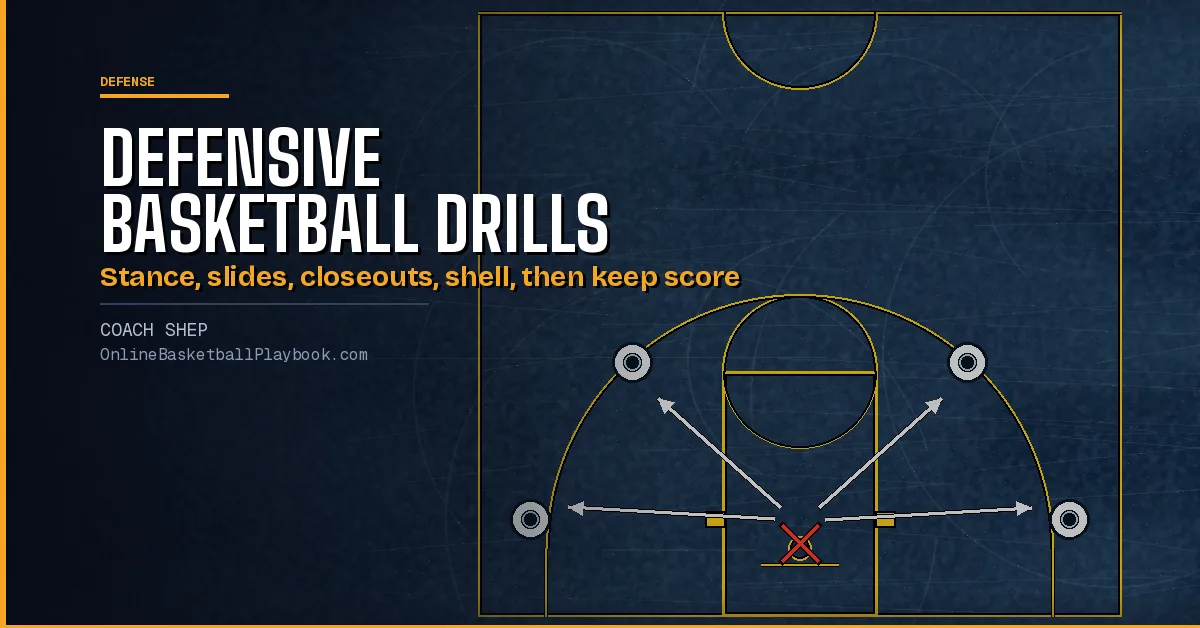
Defensive basketball drills work best in a teaching order. A team learns the stance, then slides, then closeouts and denial, then the shell and help rotations, and finishes in scored games that make a stop worth something. This guide lays out the drills in that order, including the defensive slide drills coaches use. Coaches disagree on several points, such as how to close out and whether to run closeouts as a separate drill, so the versions sit side by side.
Defensive Basketball Drills at a Glance
| Stage | What it trains | Example drills |
|---|---|---|
| Stance and slides | Balance, lateral movement, turning when beaten | Stationary stance, 1-vs-0 slides, zig-zag, Mass Sliding, lane drill |
| Closeouts | The move from help to the ball | 4-Point Closeouts, 1-on-1 Continuous, closeout to zig-zag |
| Denial and help | Positioning off the ball | Pass Denial, Deny-Open-Deny, 2-on-2 closeouts |
| Shell and team | Rotations and communication | 4-on-4 shell, Baseline Advantage, touch-the-baseline drills |
| Box out and toughness | Finishing the stop | 3-on-3 Blockout, WAR, Hamburger |
| Scored games | Stops under pressure | Cut Throat, 24-Second Drill, stop-points game |
Stance and Defensive Slide Drills
The checkpoint version breaks the stance into six checkpoints. The feet are a little more than shoulder width apart and point straight ahead, the weight rides the balls of the feet while the heels stay down, and the hips sink as the knees bend. The back stays straight, the hands are up and out at shoulder height and the eyes watch the offensive player's waist, because fakes are hard to disguise with the torso. Its ladder starts with a stationary stance, moves to 1-vs-0 lateral slides in a straight line or a zig-zag and then to a 1-vs-1 zig-zag in which the offense starts at about half speed and builds to full speed.

Defensive slide drills vary in rules more than in shape.
- Slide rules. The habits version says to stay on the balls of the feet and slide with quick, short steps, with no crossing of the feet and no hopping. A defender who is beaten does not reach and swipe. He turns and sprints after the ball handler and returns to his stance once he gets in front.
- Z-drill. A version credited to Stringer is slides, then slides plus sprints as if beaten, then a live dribbler.
- Mass Sliding. Everyone spreads out in stance while the coach cues lateral slides, drop-step slides, closeouts, a charge with a fall and a get-up, a rebound with three maximum jumps, a backpedal and a sprint. It runs two to three minutes, and the coach has to bring the energy.
- Four-cone course. A four-cone course of sprint and closeout, backpedal around a cone, slide across the floor, slide around a cone, closeout and slide back. It runs three to five minutes.
- Mirror slides. In Duke's circuit one partner slides and the other stays in front for 12 to 15 second reps.
- Lane drill. The hands-behind-the-head version has players slide the lane for 30 seconds with their hands interlocked behind the head, so the legs do the work.
Coaches split on how to teach footwork. The glide-run-glide version teaches a push and reach shuffle, then a run step and a glide-run-glide in which the defender runs to get ahead of the ball handler and closes back into the stance. Dave Leitao and Billy Donovan both say their 1-on-1 is not a zig-zag drill, while Bob Knight runs a zig-zag every day as a toughness test. The checkpoint version notes that cones do not react, so it uses mirror and cone-reaction drills in a 10 to 15 minute block and trains reads live. See Defensive Stance in Basketball and Basketball Defensive Footwork.
Closeout Drills
The checkpoint version's 4-Point Closeouts has defenders under the rim sprint out to close out on four players around the arc. They pressure the shooter for two or three seconds, backpedal to the charge circle and move to the next player. The coaching points are short choppy steps, one hand up, balance to absorb the drive and one hand tracing the ball with the other low. It is run at game pace as conditioning.

- 1-on-1 Continuous. A line at the top of the key with balls, one offensive player on each wing and one defender. They play 1-on-1 from the wing, then the offensive player closes out on the opposite wing and defends the next one. Variations are a dribble limit, v-cut starts and loser stays on defense.
- Habits version's closeout drills. Four baseline lines about 12 to 15 feet apart, with closeouts on a partner at the free-throw line extended. The defender sprints about halfway and then slides with active feet and hands up. Closeout to Zig Zag adds slides side to side to half court, and the 2-on-2 version plays live.
- Staged closeout. Mike Fratello's first rep is a closeout only, the second allows two dribbles and the third is live.
- Pat Riley Drill. This version needs four successful closeouts with no baseline layup and no leaping at blocks.
| Question | One view | Another view |
|---|---|---|
| Hands on a closeout | Both hands high. The palms-up version throws the hands straight up with palms to the ceiling | The one-high-one-low version keeps one hand high and one low, because two hands overhead raise the center of mass and slow the first lateral step against a shot fake |
| Closing on a shooter | The fly-by version goes hard at a shooter and flies by if needed | Kevin O'Neill says do not close out short on a good shooter. The habits version warns that a defender flying at the shooter gets beaten by a shot fake |
| A separate closeout drill | Chris Mack runs closeouts every day | The sell-out version runs no closeout drills and no block-out drills, and uses sell-out contests instead |
For technique, read Basketball Closeout Technique and Closeout and Recover in Basketball.
Pass Denial and Help Drills
Pass Denial puts a passer in the slot, an offensive player on the wing and a defender denying. The offense walks the defender in and explodes out, v-cuts and changes speed, but never leaves the lane between the wing and the hoop. After three catches the players swap. The defender keeps his chest to the offensive player with the arm out and the eyes over the shoulder, so a backdoor cut does not force a 180-degree turn. A top-to-wing pass opens many offenses, so winning that lane takes a team out of its sets.

An eight-drill footwork series runs about 15 minutes a day, three to four days a week. It covers the lane drill, Deny-Open-Deny from block to wing, wing denial with a contest and a box-out, On Top, closeouts, a full-court zig-zag, Cut the Cutter and a closeout detail in Monkey in the Middle. Every rep ends in a contest and a box-out, so players do not treat the stop as the end of the possession. A walk-through version has the defender see man and ball and move a step toward the ball for each pass that moves away from his man. Drills to Teach Help and Rotation Defense and Drills to Teach Individual On-Ball Defense carry more of these.
Shell and Team Drills
The shell is the standard team drill, taught in stages from a walk-through to live play. Shell Drill Basketball has the setups, stages and scored live versions. These team drills carry the same ideas full court.

- Baseline Advantage. This 5-on-5 drill starts with the offense spread along the baseline and the defense at the free-throw line. The coach passes to any offensive player to start a live transition rep. The defender guarding that player must touch the baseline before sprinting back while the other four sprint, communicate and hold the fort.
- Touch the baseline first. The 5-on-3 and 5-on-4 versions have the defenders touch the baseline first. The first three force the ball to one side and never allow a dribble to the baseline, and the offense gets 12 seconds to score.
- Four Man Touch. In a live 4-on-4 the defender who passes must sprint to touch the boundary and recover, which makes a 4-on-3 scramble with no extra setup.
- The 2-on-1 build-up. In a Skip Prosser practice the drill starts at 2-on-1 and adds a player each stage through 3-on-2, then 4-on-3, then 5-on-4, ending at 5-on-5.
Box Out and Toughness Drills
- 3-on-3 Blockout. Bob Knight has the defense hold the block for a four-count before going after the ball when the coach calls "Get it." A timed version uses a three-second hold.
- Hamburger. In Knight's 2-on-1 rebounding drill, three players compete for the ball with no more than one dribble.
- WAR. This daily drill starts with five defenders inside the lane. The coach misses a shot on purpose and the defense must cut out and find the ball.
- Charges. The habits version teaches both feet set before the driver arrives, a low body with the hands up and a fall backward in the direction of the drive, because a sideways fall reads as a block. The mat version has each defender take five or six in a row on a mat.
The disagreement is whether rebounding deserves its own drill. The habits version says to stop doing isolated rebounding drills and require three crashers and a box-out in every drill. Knight and Prosser keep stand-alone banks. See Box Out Drills for Basketball and Rebounding Drills for Basketball Practice.
Get the next coaching guide in your inbox
One email when a new guide or diagram set goes up. Free.
Scored Defensive Games
| Game | Rule | Version |
|---|---|---|
| Cut Throat | Three teams in 3-on-3 or 4-on-4. A team wins only on defense with three stops in a row, or only on offense by scoring three to five times | Bruce Weber |
| Perfection Cut Throat | The coach names one fundamental, such as jump to the ball. A defender who misses it puts the defense out | Weber |
| 24-Second Drill | 5-on-5 half court. The defense must hold the offense scoreless for a full shot clock | Weber |
| Stop-points game | 4-on-4-on-4. A defensive rebound pays 1, a turnover 2 and a charge 3, and a score is the price of admission to defense | Price-of-admission version |
| Protect the Paint | 3-on-3. The offense gets five passes to get into the box and only the defense scores | Defense-only scoring |
| Defensive validation | A score only counts if the team gets a stop on the next possession, played to 5 or 7 | Ettore Messina |
| Five or six stops | The defense goes to offense only after five or six stops, which are turnovers plus defensive rebounds | Stops-to-switch version |
A six-part test for a good drill covers time, a score, an advantage or disadvantage, unpredictability, communication and a rebound. Hubie Brown caps a drill at 5 minutes, the checkpoint version runs 8 to 12 and Billy Donovan's press breakdown runs 8 to 15, so there is no agreed length.
Building a Defensive Practice
| Version | Order |
|---|---|
| Ettore Messina | 2-man zig-zag, sprint-recover into zig-zag, defending the crossover drive, live closeout, drag-screen 2-on-2, transition side pick and roll 2-on-2, 3-on-2 curl and baseline help, defending the duck-in, 3-on-3 shell, 4-on-4 shrink-and-spread, 5-on-5 stop-score-stop and a 5-on-5 validation game |
| On-ball-first version | Week one of camp is stance, footwork and on-ball work only. The sequence then teaches jump to the ball and help positions in 2-on-2 and 3-on-3 before 5-on-5 |
| Tarkanian | The first three weeks of preseason go to defense without a ball, including the ape drill, an upright shuffle with the hands behind the back, mock guarding and a chaser drill |
| 14-stage install | A 14-stage install from buy-in, on-ball, closeout, box-out, one and two pass positioning and shell through transition, post defense, screens, ball screens, cross screens and inbounds |
A coach also chooses whether the first weeks use a ball at all. Tarkanian's preseason starts without one, and the on-ball-first version's first week is stance, footwork and on-ball work only. For layouts, see Basketball Practice Plan, Man-to-Man Defense Practice Drills and How to Coach Defensive Rotations Effectively.
Defensive Drills for Young Players
The stance checkpoints, slides and a shell with players pointing at the ball and their man suit young teams. A youth recovery drill asks a beaten defender to sprint ahead, turn and slide instead of reaching. See Basketball Drills for Beginners. None of these versions gives separate times for young players, so shorten the drill and watch the stance.
Questions Coaches Ask About Defensive Drills
What are the best defensive basketball drills?
Coaches build a set in order: stance and slides, closeouts, denial and help, a shell and then scored games. Examples are Mass Sliding, 4-Point Closeouts, Pass Denial, the 4-on-4 shell and Weber's Cut Throat.
What are good defensive slide drills in basketball?
Stationary stance, 1-vs-0 slides in a line or zig-zag, the 1-vs-1 zig-zag, Mass Sliding, the Z-drill and Duke's mirror slides. Each stresses quick short steps with no crossed feet.
What drills teach defensive footwork?
An eight-drill series, the push and reach shuffle with glide-run-glide, and the four-cone course all train footwork, usually before any live offense.
How do you teach a closeout?
Sprint while the pass is in the air, then take short choppy steps. The habits version sprints about halfway before sliding, while three other versions sprint the first two-thirds. All finish with short choppy steps and hands up.
How long should a defensive drill last?
Coaches differ. Hubie Brown caps drills at 5 minutes, the checkpoint version uses 8 to 12 and Donovan's segments run 8 to 15.
Drills are one part of man-to-man defense, and the Defense hub lists every defense page.
Want the printable playbook packs?
OBP Pro members get the premium playbook packs: the zone attack, out of bounds and practice plan PDFs, plus each new pack as it is finished. The membership page lists what is in each one. Or draw your own version free in PlayDraw.
See what OBP Pro includesMore Guides From This Batch
- Press Break Basketball: Alignments, Reads and Drills
- Basketball Conditioning Drills for Teams: Runs, Games and Tests
- Basketball Tryouts: Sessions, Drills, Scoring and Cuts
- Shell Drill Basketball: Stages, Rules and Live Versions
Back to Man-to-Man Defense and every Defense page.
Keep Building
Related breakdowns
Pack Line Defense Drills: Closeouts, Shell, Post and Scored Games
Pack line defense drills for every habit: on-ball containment, 2-on-2 gap work, Vegas closeouts, Blackhawk, shell, post wall-ups, scored games and transition.
Zone Defense Drills: Slides, Closeouts, Traps and Rebounding
Zone defense drills for any zone: deflection and closeout work, the on-off bump, rotation drills with no shot, build-up ladders, trap drills and zone rebounding.
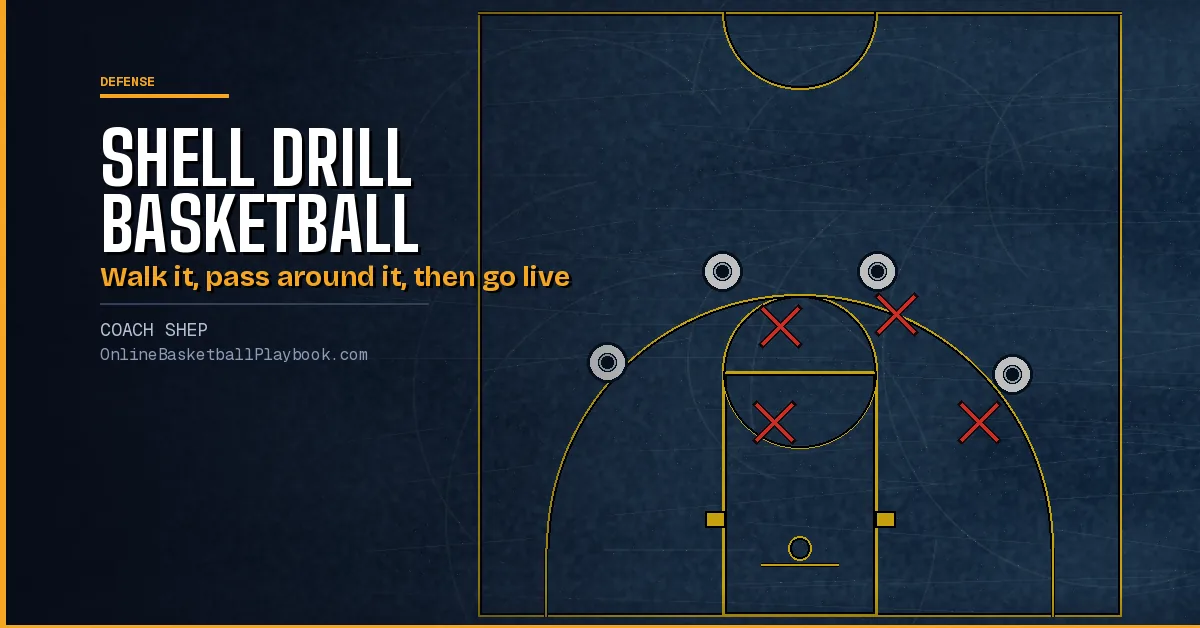
Shell Drill Basketball: Stages, Rules and Live Versions
Shell drill basketball guide with 4-on-4 setups, the stages from walk-through to live, rules on the offense, scored live versions and where coaches differ.