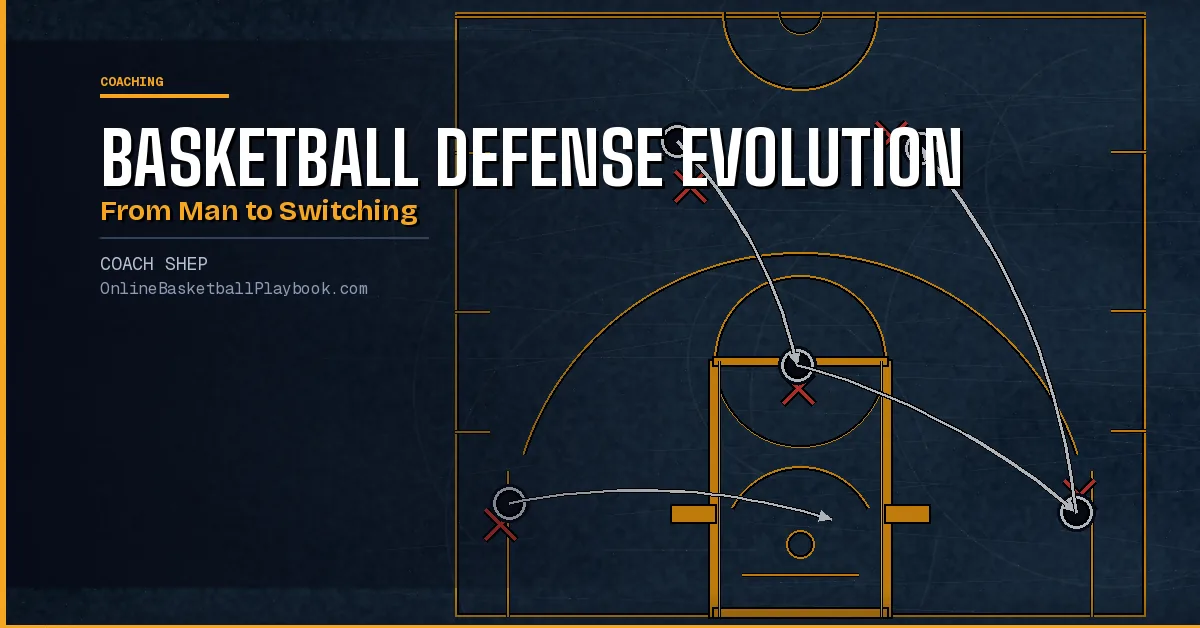
Basketball defense has never stood still. From rigid man-to-man roots in the mid-20th century to today's positionless switching systems, the way teams guard the ball has been shaped by rule changes, personnel innovation, and tactical necessity.
The Man-to-Man Foundation
Every defensive system in basketball (no matter how sophisticated) traces its roots back to the same place: man-to-man defense. The concept is deceptively simple. Each defender takes responsibility for a specific offensive player. But the way that responsibility is executed is anything but simple, and the details coaches worked out over decades became the bedrock of everything that followed.
The core of man-to-man defense was never just "guard your man." The structure was always organized around the ball. The ball-you-man line (the invisible line connecting the ball, the defender, and the player being guarded) is the organizing principle. Every positioning decision a defender makes off the ball is built around that line. The farther your man is from the ball, the farther you can drift toward the paint. The closer your man is to the ball, the tighter you play.
Morgan Wootten, who coached DeMatha Catholic High School for 46 years with pressure man-to-man as his primary defense, codified this structure into a five-layer system known as 22-Tough. His first layer was non-negotiable: stance and footwork before any team concept. Three footwork tools (the retreat step, the advance step, and the swing step) were drilled in isolation before players ever learned how to help a teammate. This sequencing was deliberate. Individual defensive skill was the prerequisite. The team structure came second.
What made these early man-to-man systems so durable was their shared vocabulary. Guard Your Yard. Belly up. No middle. Jump to the ball on air time. These phrases encoded specific technical behaviors, not slogans, but instructions. A defender who heard "guard your yard" knew to stay between his man and the basket. A defender told to "belly up" knew to crowd the ball-handler the instant the dribble was picked up. The language was the system.
The Two Poles: Pressure vs. Pack
As man-to-man defense matured, coaches began to identify a fundamental fork in the road. Every man defense ultimately had to answer the same question: how much do you commit to disrupting the pass versus protecting the lane? The answer split the defensive world into two philosophies that remain in tension today.
The deny-and-pressure approach, exemplified by Wootten's 22-Tough, commits defenders to denying the first pass. Players on the ball-side are positioned with a body part in the passing lane on every one-pass-away situation. The theory: if you're already denying, you're already in help position. The cost is real. Systematic denial creates a back-door vulnerability, and help-side must be pre-positioned to intercept the lob pass. Teams that run this system have to drill the back-door read relentlessly or they get carved up by smart point guards.
The pack-line approach, developed by Dick Bennett and later refined by his son Tony Bennett at Virginia, took the opposite bet. Non-ball defenders sit behind the arc. No denial at all. Both feet inside the 16 to 17 foot arc, already in rotation before the offense even catches. The theory is that eliminating denial means eliminating negative movement. Gap defenders are already where they need to be before the ball arrives. The tradeoff is giving up the open catch at the wing, which means the system absolutely requires elite on-ball pressure to function. As Tony Bennett has said directly: the Pack Line does not work without great on-ball defense.
Both systems share the same core commitment: pressure the ball aggressively and protect the middle at all costs. What separates them is the off-ball bet. Pressure coaches bet that disrupting the pass is worth the back-door risk. Pack coaches bet that being in position before the catch is worth giving up the catch.
How Zone Defense Forced the Adaptation
Zone defense did not replace man-to-man. But it forced man-to-man coaches to sharpen their thinking. When teams started deploying 2-3 zones and 1-3-1 trapping sets regularly, offenses adapted, and those offensive adaptations put new pressure on man defenders who had to guard shooters in space, handle skip passes, and close out at full speed.
The help-side rotation became more important. Zone defense, by positioning all five players in relation to the ball rather than to specific opponents, demonstrated how much court geography mattered. Man coaches absorbed that lesson. The concept of the Helpside I (two off-ball defenders stacking on the midline with inside feet on the lane line) came directly from observing how zone teams controlled skip-pass angles. You could achieve the same angle coverage in man defense by positioning your weak-side defenders like zone players.
Junk defenses emerged at the boundary between the two systems. The Box-and-1 assigned one chaser to shadow a star offensive player while four defenders held a zone box. The Triangle-and-2 was the mirror image. These hybrid schemes forced offenses to confront a problem zone and man defense created together: you couldn't solve one without opening vulnerabilities the other could exploit.
Full-court pressure also evolved during this period. When teams extended their man defense beyond half-court, they had to codify rules for situations that didn't exist in the half-court set. If the opponent secured an offensive rebound off a five-man crash, who guarded whom? The answer that emerged (guard whoever was defending you before the rebound, then re-sort to natural matchups once in the half-court) resolved the hesitation that had plagued full-court man before that rule existed. It also reinforced the same principle that governed half-court man: ball pressure is the first priority, not specific matchup assignment.
The Modern Switching Era
The switching revolution in basketball defense was not a sudden invention. It was an accelerating trend driven by two parallel forces: the rise of the three-point shot as a primary offensive weapon, and the emergence of players who could operate effectively in multiple positions on both ends of the floor.
Traditional man-to-man defense handled ball screens with rigid rules. The on-ball defender fought over the screen. The screener's defender hedged or dropped depending on the scouting report. This worked when offensive players were slotted into defined roles and stayed in them. A center who set screens but never caught the ball at the perimeter could be guarded in a conventional drop scheme without consequence. A center who could shoot from 25 feet changed the math completely.
The switching response was practical before it was philosophical. If a center could shoot like a wing, you needed a wing defender on him. If that meant switching the ball screen and putting a guard on the roll man, you accepted that tradeoff. Gradually, teams built rosters around the ability to switch, long, versatile players who could guard multiple positions credibly enough that switching any screen combination didn't create a catastrophic mismatch.
Kevin O'Neill distilled the modern man-to-man standard into three rules that any player can memorize and repeat: no lay-ups, no threes, contested twos. These three rules encode the same insight that switching defenses operate on. The most dangerous shots are at the rim and behind the arc, and everything in between is a negotiated loss. A contested midrange jumper is an acceptable outcome. A clean corner three or a straight-line drive to the basket is a failure regardless of which defender was supposed to be there.
Switching demands a particular kind of defensive IQ. Defenders have to recognize the screen, communicate the switch in real time, find their new assignment without losing sight of the ball, and immediately apply the same on-ball pressure that the switched defender would have applied. The technique requirements are identical. The decision-making requirements are higher. A player who can execute switching seamlessly has internalized the principles so deeply that applying them to a new assignment mid-possession feels natural rather than disorienting.
Before installing any switching system, players need to master individual on-ball fundamentals first. A switch only works if the new on-ball defender can immediately contain the dribbler without fouling, force the ball away from the middle, and communicate the change to all four teammates within the first step of taking the assignment. Drill the switch read in 3-on-3 sets before running it in a full five-man shell, and build in a clear verbal cue (one word your team uses every single time) so the communication becomes automatic under pressure.
Core Principles That Never Change
Across every era and every system, certain defensive principles have proven consistent enough that no tactical evolution has displaced them. These are the principles that transfer from man-to-man to zone to switching and back again. They are worth naming directly, because coaches who teach them as absolutes give their players a stable foundation regardless of which scheme they're running.
Jump to the ball on air time. This single habit eliminates most basket-cut problems in any defensive system. The defender repositions while the pass is in the air, not after the catch. Done correctly, the defender is already in the new position before the offensive player can take a single step with the ball. Drilled consistently (most effectively with the Shell drill), it becomes involuntary. Coaches who track this habit in practice will find that most defensive breakdowns trace back to players who moved on the catch instead of on the release.
No lay-ups, no threes, no fouls, no second shots. These four transition-defense commandments show up in virtually every defensive system at every level. They define what a successful defensive possession looks like in terms of outcomes rather than execution. The first step when the other team secures a rebound is not to find your man. It is to stop the ball, get into the paint, and eliminate the easy basket. Specific matchup re-sorting happens only after the immediate threat is neutralized.
Move on air time, not on the catch. Position closes out with short choppy steps and a high head. The objective is not to steal the ball. The objective is to force the offense to make one more pass than they planned, farther from the basket than they wanted. "Force the extra pass" is the mental picture that prevents reaching, and reaching is the fastest way to send an opponent to the free throw line.
Protect the middle. From the earliest man-to-man systems through modern switching schemes, no principle has held more consistently. The baseline and the sideline are your co-defenders. The middle of the floor is where defenses collapse and point totals climb. Every defensive system routes ball-handlers toward the edges. The specific technique varies by system. The destination is always the same.
Choosing Your Defensive Identity
The biggest mistake coaches make when studying defensive evolution is treating every system as equally available to them. They are not. The right defensive system for a team depends on the personnel available, the level of competition, the practice time committed to defense, and the technical sophistication of the players on the floor.
The deny-and-pressure approach works best with athletic, long-armed defenders who can move laterally without fouling. It requires significant practice time. Thad Matta at Ohio State began every practice with 75 percent of the time devoted to defense. For a coach who has limited practice time or younger players who are still developing footwork fundamentals, a full denial system will produce more fouls than turnovers. The players have to be ready before the system can function.
The pack-line approach requires great on-ball defenders but is more forgiving of off-ball athletes who are learning their positions. The positioning rules are explicit, one foot in the lane two passes away when the ball is above the foul line, both feet in the lane three passes away. The clarity of those rules makes it teachable to players who don't yet have the defensive IQ to read and react dynamically. But the on-ball defender has to hold. If the ball-handler gets into the paint, the entire structure collapses.
Switching systems require the highest level of individual defensive competency and communication. Every player must be able to guard every other player credibly, call the switch in real time, and apply immediate on-ball pressure to a new assignment. These are not beginner skills. For youth coaches, the switching framework is better used as a teaching concept (helping players understand how all five defenders move as one unit) than as a primary defensive system.
Kevin Stallings at Vanderbilt offered a useful framing for the choice. His master gap principle was to position defenders far enough into the gap that the dribbler did not want to attack there. The defender should only have to move to recover, never to help. That framing applies at every level: the best defensive systems put players in positions where they are already a threat before the offense can exploit them, not in positions where they are reacting after the damage has been done.
Pick one pole and teach it with conviction. The teams that struggle defensively are almost never the ones who chose the wrong system. They are the ones who could not commit to any system long enough to drill it into muscle memory. A team that runs the same Shell drill every practice for four months will outperform a team that switches defensive schemes every week, regardless of which scheme is technically superior. Consistency of execution beats novelty of system at every level of basketball.
- Establish one defensive language across your program: shared cues like "Guard Your Yard," "No Middle," and "Jump to the ball" must mean the same thing to every player on every team. Consistent vocabulary eliminates hesitation in live game situations.
- Teach footwork before team concepts: retreat step, advance step, and swing step must be drilled in isolation before players learn rotations. An on-ball defender who cannot stay in front of a dribbler cannot be covered for by any help scheme.
- Run Shell drill daily and track air-time movement: Players who move on the catch instead of the release account for the majority of defensive breakdowns. This one habit is worth more practice time than almost any other.
- Pick one pole (deny-and-pressure or pack-and-gap) and commit: mixing philosophies without a clear framework leaves defenders uncertain exactly when the pressure is on. Clarity of system is more valuable than complexity of system.
- Prioritize transition defense before half-court defense: The four commandments (no lay-ups, no threes, no fouls, no second shots) must be internalized first. A team that eliminates easy transition baskets improves its defensive numbers before running a single half-court scheme.
- For switching systems, build the skill base first: run 3-on-3 switching reads before installing switching in the full five-man shell. Players must be able to identify the screen, communicate, and apply immediate on-ball pressure to a new assignment before the system can function in a game.
Want more basketball coaching strategies, drills, and tools?
Join the Online Basketball Playbook newsletter →
Draw this play free in the play drawer →
Membership: the full library, playbook packs, and Pro drawing tools →
Keep Building
Related breakdowns
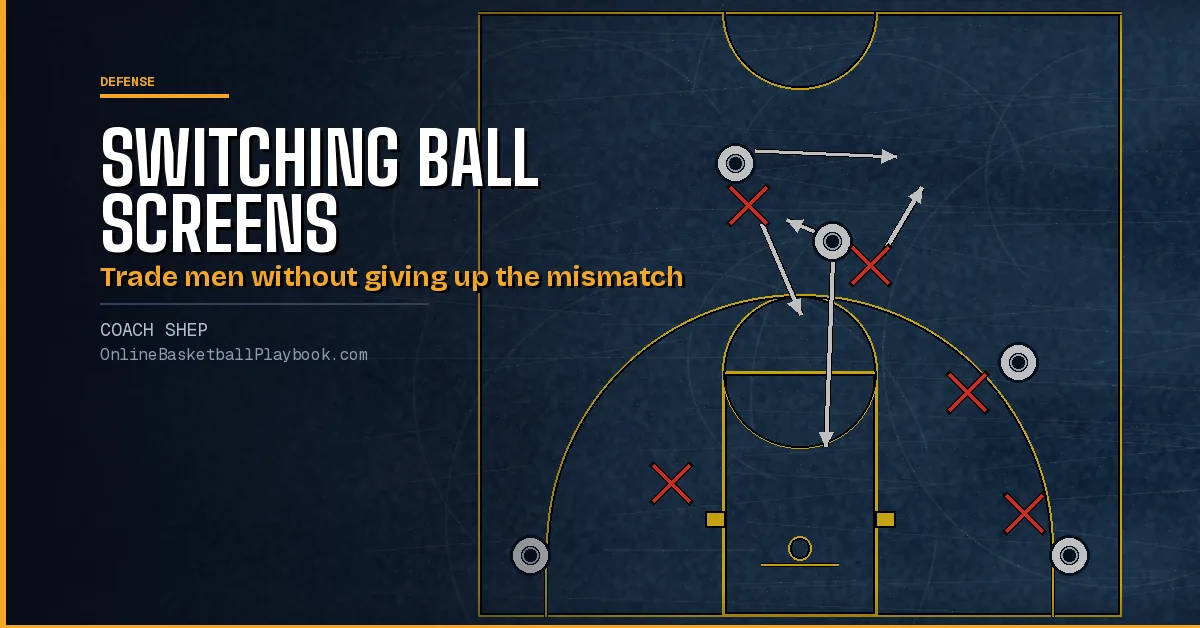
Switching Defense Basketball: How to Switch Ball Screens
Switching defense in basketball: when to switch ball screens, who calls it, the jump switch, the late switch, the scram after a mismatch and drills to install it.
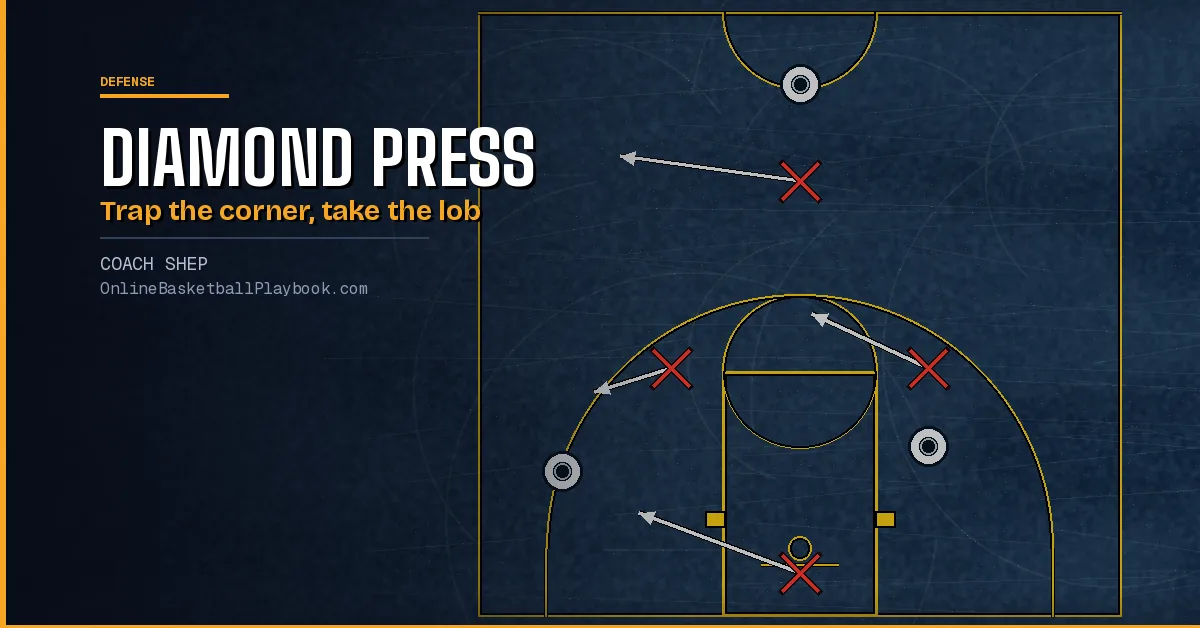
1-2-1-1 Diamond Press Basketball: Roles, Traps and Install
How to run the diamond press in basketball: who plays each role, how to trap the corner, what to do on the reversal and the lob, and how to install it step by step.
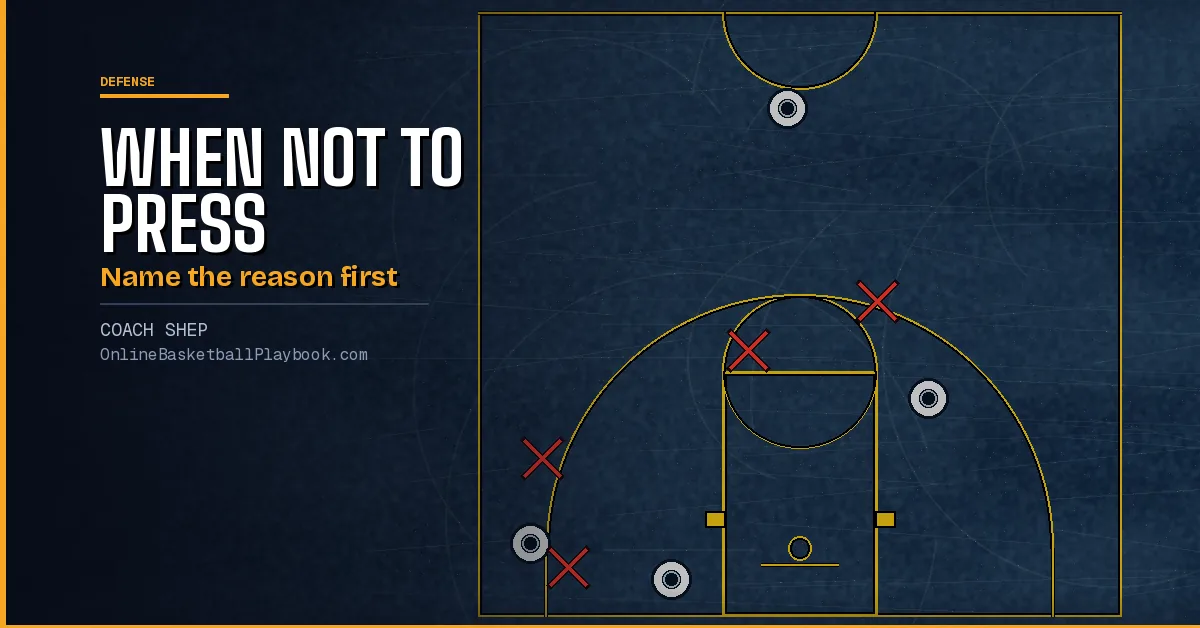
When Not to Press: Bad Reasons, Thin Benches, Poised Guards
When not to press in basketball: the bad reasons, the roster you need first, the opponents who beat it, the moments to drop it and the youth limits.